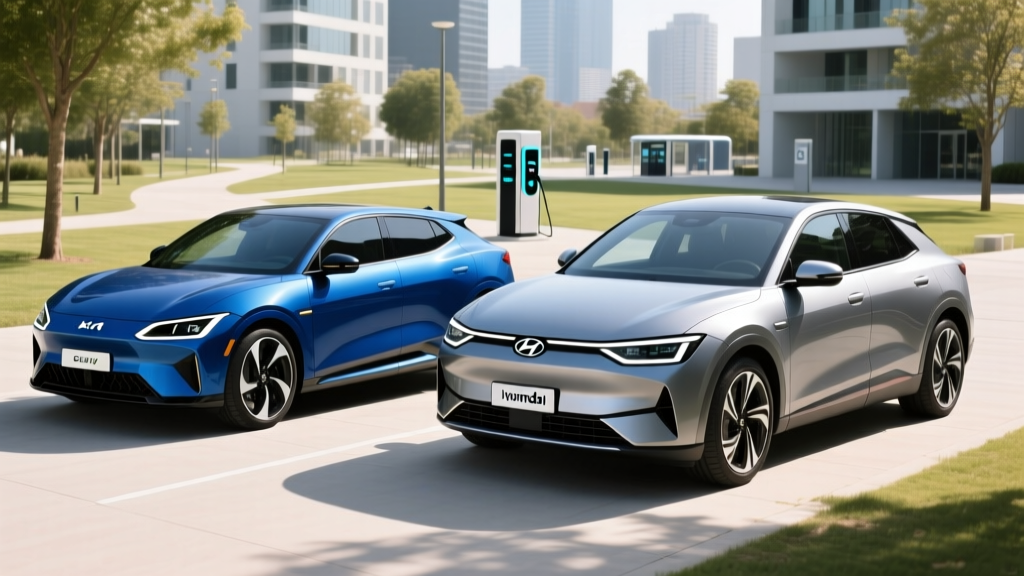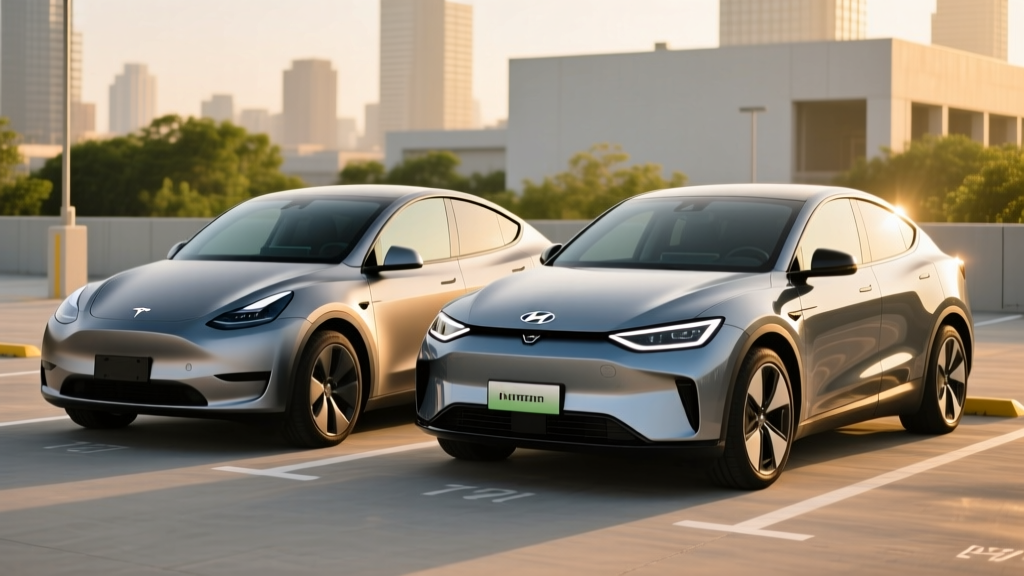
The midsize electric crossover segment remains the most competitive space in the EV market, and two nameplates continue to dominate buyer shortlists: the Tesla Model Y and the Hyundai Ioniq 5. Both offer compelling range, fast DC charging, and spacious interiors — but they take fundamentally different approaches to efficiency, charging infrastructure, and software. This head-to-head EV compare breaks down every spec that matters in 2026, from real-world range to federal tax credit eligibility, so you can match the right vehicle to your driving pattern and budget.
Side-by-Side Specs: Model Y vs Ioniq 5 at a Glance
Before the subjective analysis, here are the hard numbers. All figures reflect 2026 model-year Long Range AWD trims unless otherwise noted. Data sourced from fueleconomy.gov and manufacturer specifications.
| Specification | 2026 Tesla Model Y Long Range AWD | 2026 Hyundai Ioniq 5 Long Range AWD |
|---|---|---|
| EPA Range | 320 miles | 290 miles |
| Battery (usable) | 78.1 kWh (NMC) | 84.0 kWh (NMC) |
| Efficiency (MPGe combined) | 117 MPGe | 103 MPGe |
| Peak DC Fast Charge | 250 kW | 238 kW |
| 10–80% DC Charge Time | ~22 min | ~18 min |
| Level 2 Charge Rate | 11.5 kW (44 mi/hr) | 10.9 kW (38 mi/hr) |
| 0–60 mph | 4.8 seconds | 5.1 seconds |
| Horsepower | 384 hp | 320 hp |
| Cargo Volume (rear seats up) | 30.2 cu ft (+ 4.1 cu ft frunk) | 27.2 cu ft (+ 0.85 cu ft frunk) |
| Base MSRP | $48,990 | $49,850 |
| Battery Warranty | 8 yr / 120,000 mi | 10 yr / 100,000 mi |
| ADAS Suite | Autopilot (Level 2) | Highway Driving Assist 2 (Level 2) |
Range and Efficiency: Real-World Expectations
The Model Y holds a 30-mile EPA advantage on paper, and that gap is rooted in its class-leading aerodynamic efficiency and lighter curb weight. Tesla's 117 MPGe combined translates to roughly 29 kWh per 100 miles, while the Ioniq 5 consumes about 33 kWh per 100 miles under the same conditions.
Real-World Range Reality Check:
- Tesla Model Y LR AWD: EPA 320 mi → Expect ~270–290 mi at sustained 75 mph highway speeds; ~240–260 mi in sub-freezing winter conditions.
- Hyundai Ioniq 5 LR AWD: EPA 290 mi → Expect ~245–265 mi highway; ~215–235 mi in cold weather.
Both vehicles use NMC chemistry with active liquid thermal management, which helps mitigate cold-weather losses — but expect a 15–20% reduction in any EV when temperatures drop below 32°F.
For commuters with round trips under 80 miles who charge nightly at home, either vehicle's range is more than adequate. Road-trippers covering 300+ miles per day will notice the Model Y's extra buffer, particularly in winter when pre-conditioning and cabin heating eat into capacity.
Charging Speed and Network Access
This is where the comparison gets nuanced. The Ioniq 5's 800-volt architecture allows it to sustain higher charge rates deeper into the session, achieving a 10–80% fill in approximately 18 minutes — four minutes quicker than the Model Y despite a slightly lower peak kW rating.
However, peak kW tells only part of the story. The charge curve — how fast charging tapers as the battery fills — favors the Ioniq 5. Tesla's curve drops sharply above 50% state of charge, while Hyundai's 800V system maintains stronger throughput through 70%. On a 250-mile road trip requiring a 10–80% top-up, the Ioniq 5 gets you back on the road faster.
Network advantage: Tesla. The Model Y accesses the Tesla Supercharger network natively — over 6,000 stations and 60,000+ stalls in North America, consistently the most reliable and widely available DC fast-charging infrastructure. The Ioniq 5 now supports the NACS connector (as of the 2025 model year) and can access Superchargers via Tesla's open network, but third-party networks like Electrify America and EVgo remain the primary non-Tesla option, and their uptime and plug availability remain more variable.
Performance and Driving Dynamics
Both crossovers deliver brisk acceleration that outpaces most gas-powered competitors in this price range. The Model Y's 4.8-second 0–60 time edges the Ioniq 5's 5.1 seconds, and Tesla's instantaneous torque delivery and lower center of gravity give it a slightly more planted feel in corners.
The Ioniq 5 counters with a more compliant ride quality over rough pavement — its suspension tuning prioritizes comfort over sportiness, which most daily commuters will prefer. Hyundai's regenerative braking paddle shifters offer four levels of regen (including full one-pedal driving), giving drivers granular control without navigating touchscreen menus.
Tesla's Autopilot remains one of the most capable Level 2 driver-assistance systems for highway lane centering and adaptive cruise. Hyundai's Highway Driving Assist 2 (HDA2) is equally competent on divided highways and adds lane-change assist. Both are SAE Level 2 — the driver must remain engaged and hands-on (or eyes-on, in Tesla's camera-monitoring implementation) at all times.
⚠️ SAE Level 2 Reminder: Neither Autopilot nor HDA2 is "self-driving." Both require continuous driver supervision. Hands-free systems like GM's Super Cruise or Ford's BlueCruise operate on pre-mapped highways under specific conditions — but still require driver attention. Full self-driving (SAE Level 4) remains limited to geofenced robotaxi services like Waymo.
Pricing, Tax Credits, and Total Cost of Ownership
Sticker prices are close, but the real cost picture depends heavily on federal tax credit eligibility under IRS §30D rules. As of 2026, the credit structure involves critical-mineral sourcing and battery-component manufacturing requirements that can reduce or eliminate eligibility.
| Cost Factor | Tesla Model Y LR AWD | Hyundai Ioniq 5 LR AWD |
|---|---|---|
| Base MSRP | $48,990 | $49,850 |
| Max §30D Federal Credit | Up to $7,500 (eligibility varies by battery sourcing) | Up to $7,500 (eligibility varies by battery sourcing) |
| Effective Price After Max Credit | ~$41,490 | ~$42,350 |
| Estimated 5-Year Electricity Cost (15k mi/yr) | ~$3,975 | ~$4,500 |
| Estimated 5-Year Insurance | ~$10,500 (higher avg. for Tesla) | ~$8,750 |
| Estimated 5-Year Maintenance | ~$1,200 | ~$1,500 |
| 5-Year Total Cost of Ownership (est.) | ~$57,165 | ~$57,100 |
Assumes $0.13/kWh home charging, 70% home / 30% DC fast-charge mix. Insurance estimates based on national averages — your rate will vary by state, age, and driving record. Tax credit eligibility depends on income caps ($150K single / $300K joint), MSRP caps ($55K for SUVs), and battery sourcing requirements. Confirm via irs.gov or a tax professional. Point-of-sale transfer is available at participating dealers.
The Model Y's superior efficiency saves roughly $525 in electricity over five years, but Tesla's higher insurance premiums (averaging 15–20% above the Ioniq 5 per industry data) nearly erase that advantage. Five-year TCO lands within $100 between the two — making this essentially a wash on pure economics.
Tech, Interior, and Practicality
The interiors reflect each brand's philosophy. Tesla's cabin is minimalist to the point of austerity — a single 15.4-inch touchscreen controls virtually everything, including climate and mirror adjustment. Storage is generous with 30.2 cu ft behind the second row plus a usable 4.1 cu ft frunk. Build quality has improved substantially since the Fremont-built early models, with the Shanghai and Austin-produced 2026 units showing consistent panel gaps and material quality.
Hyundai takes a more conventional approach with a dual-screen layout (12.3-inch cluster + 12.3-inch infotainment), physical climate controls, and a column-mounted shifter that frees up a flat-floor center console. The Ioniq 5's flat floor and longer wheelbase (118.1 in vs the Model Y's 113.8 in) create noticeably more rear-seat legroom. Cargo space trails slightly at 27.2 cu ft, though the frunk is small at 0.85 cu ft — enough for charging cables, not a carry-on.
On software, Tesla's over-the-air updates remain the industry benchmark for feature additions and performance improvements post-purchase. Hyundai's OTA capability is more limited, focusing on infotainment and ADAS calibration rather than powertrain or chassis changes.
Decision Framework: Which EV Should You Choose?
Choose the Tesla Model Y if:
- You road-trip frequently and want the most reliable, extensive DC fast-charging network
- Maximum range per charge is a priority (especially in cold climates)
- You value OTA software updates that meaningfully improve the car over time
- You prefer a minimalist interface and don't mind touchscreen-only controls
- Frunk space matters for charging gear or groceries
Choose the Hyundai Ioniq 5 if:
- You prioritize the fastest possible DC charging sessions (800V architecture advantage)
- Rear-seat passenger comfort and legroom are important (family hauling)
- You prefer physical buttons and a more traditional dashboard layout
- Vehicle-to-Load (V2L) capability appeals to you for camping, tailgating, or backup power
- You want a longer battery warranty (10 yr / 100,000 mi vs Tesla's 8 yr / 120,000 mi)
Pros and Cons Summary
Tesla Model Y — Pros
- Class-leading EPA range and efficiency
- Supercharger network reliability
- Spacious cargo area with large frunk
- Industry-best OTA update cadence
- Strong resale value retention
Tesla Model Y — Cons
- Higher insurance premiums on average
- Minimalist interior isn't for everyone
- 400V architecture means slower 10–80% charge vs 800V rivals
- Service center wait times can be long in some markets
Hyundai Ioniq 5 — Pros
- 800V architecture delivers fastest 10–80% charging in class
- Excellent rear-seat room and flat floor
- V2L capability (120V outlet, up to 3.6 kW)
- Physical controls and conventional ergonomics
- 10-year battery warranty
Hyundai Ioniq 5 — Cons
- Shorter EPA range than Model Y
- Lower efficiency (higher electricity cost per mile)
- Smaller frunk
- Non-Tesla charging network reliability can be inconsistent
- OTA updates less transformative than Tesla's
Frequently Asked Questions
Which EV has better real-world range?
The Tesla Model Y. Its 320-mile EPA rating translates to roughly 270–290 miles at highway speeds, compared to the Ioniq 5's 245–265 miles. In winter, expect the Model Y to retain a ~25–30 mile advantage due to its more efficient heat pump and lighter weight.
Does the Hyundai Ioniq 5 charge faster than the Tesla Model Y?
Yes. The Ioniq 5's 800-volt architecture sustains higher charge rates through the session, completing a 10–80% charge in approximately 18 minutes versus the Model Y's 22 minutes. However, the Model Y's access to the Supercharger network means more reliable, available chargers on road trips.
Do both vehicles qualify for the $7,500 federal tax credit in 2026?
Eligibility depends on battery critical-mineral sourcing and component manufacturing requirements under IRS §30D, which change periodically. Both vehicles fall under the $55,000 MSRP cap for SUVs. Buyer income caps also apply ($150K single / $300K joint modified AGI). Check current eligibility on the IRS website or consult a tax professional before purchasing. Point-of-sale transfer is available at participating dealerships.
Is Autopilot or Highway Driving Assist 2 better?
Both are competent SAE Level 2 systems. Tesla's Autopilot offers slightly more confident lane centering and a broader operational design domain, while Hyundai's HDA2 excels in stop-and-go traffic with smoother deceleration. Neither is self-driving — continuous driver supervision is mandatory.
Which is cheaper to insure?
The Hyundai Ioniq 5, typically by 15–20%. Tesla vehicles carry higher average insurance premiums due to elevated repair costs (specialized body structure, sensor calibration). Shop quotes from multiple insurers — Tesla also offers its own insurance product in many states that can be competitive.
Can I use Tesla Superchargers with the Ioniq 5?
Yes. Starting with the 2025 model year, the Ioniq 5 ships with a native NACS charge port and can access Tesla's open Supercharger network. You'll use the Tesla app or your Hyundai BlueLink app to initiate sessions at compatible stalls.
Final Recommendation
There is no universal winner in this comparison — the right choice depends on your priorities. If maximum range, Supercharger reliability, and software innovation top your list, the Model Y remains the benchmark. If fastest charging sessions, passenger comfort, and V2L versatility matter more, the Ioniq 5 is the more well-rounded daily driver. Both are excellent vehicles that will serve most EV buyers well for years to come. Test-drive both back-to-back, pull insurance quotes for your ZIP code, and verify your tax-credit eligibility before signing — the numbers, not the marketing, should make the decision for you.