Quick Verdict: Two Different EV Philosophies
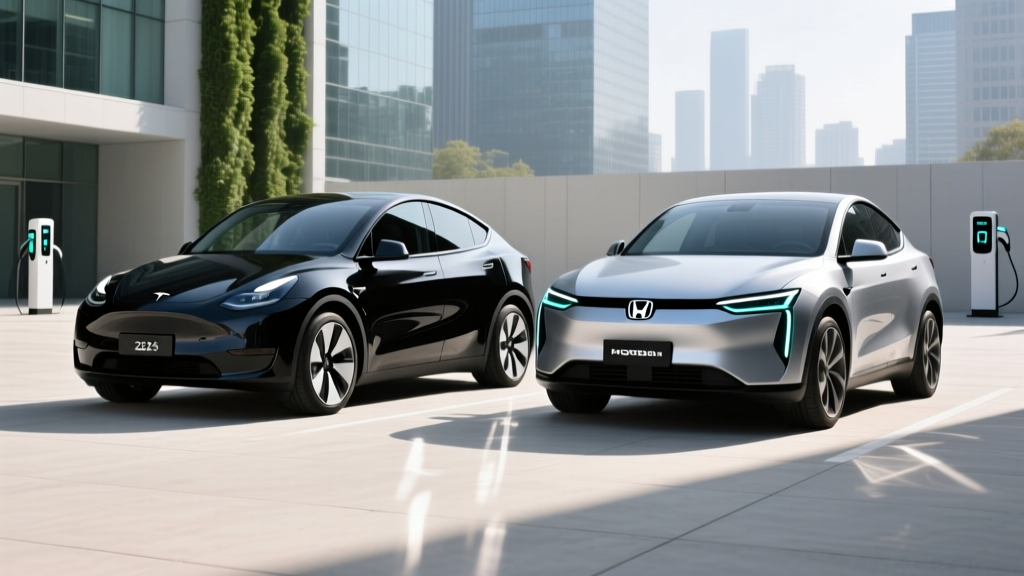
The Tesla Model Y and Honda Prologue represent fundamentally different approaches to the electric SUV. Tesla sells a tech-forward, vertically integrated ecosystem with access to the largest fast-charging network in North America. Honda delivers a conventional, comfort-oriented crossover built on GM's Ultium platform, targeting buyers who want a familiar driving experience with dealership support and straightforward controls. Neither is universally better — the right choice depends entirely on what you prioritize as a buyer.
Bottom Line Up Front
Choose the Tesla Model Y if you want maximum range, the fastest charging, access to 25,000+ Superchargers, and industry-leading driver-assist tech — and you're comfortable with a minimalist interior and Tesla's direct-sales model.
Choose the Honda Prologue if you prefer traditional dealership service, physical buttons, a quieter ride, Apple CarPlay/Android Auto, and you mostly drive under 250 miles between charges where home Level 2 charging covers your needs.
Side-by-Side Specifications
Numbers tell the first half of the story. Below, we compare the most popular trims: the Model Y Long Range AWD and the Prologue EX-L AWD (the volume sellers for each nameplate). All figures reflect 2026 model-year EPA and manufacturer data.
| Specification | 2026 Tesla Model Y LR AWD | 2026 Honda Prologue EX-L AWD |
|---|---|---|
| EPA Range | 320 miles | 281 miles |
| Battery (usable) | ~75 kWh (NMC) | ~85 kWh (NMC, Ultium) |
| Efficiency (MPGe combined) | 117 MPGe (29 kWh/100mi) | 99 MPGe (34 kWh/100mi) |
| Peak DC Fast Charge | 250 kW | 150 kW |
| 10–80% DC Charge Time | ~22 minutes | ~34 minutes |
| Level 2 Charge Rate | 11.5 kW (44 mi/hr) | 11.5 kW (35 mi/hr) |
| 0–60 mph | 4.8 seconds | 5.8 seconds |
| Horsepower | 384 hp | 288 hp |
| Cargo (rear seats up) | 30.2 cu ft | 25.2 cu ft |
| Cargo (rear seats folded) | 72.1 cu ft | 57.7 cu ft |
| Towing Capacity | 3,500 lbs | 1,500 lbs |
| Base MSRP | $48,990 | $47,900 |
| Battery/Powertrain Warranty | 8 yr / 120,000 mi | 8 yr / 100,000 mi |
Sources: fueleconomy.gov, Tesla specifications, Honda Prologue specifications.
Category Winners: Where Each SUV Excels
🏆 Range & Efficiency: Tesla Model Y
The Model Y Long Range achieves 320 miles EPA on a smaller ~75 kWh battery, demonstrating Tesla's efficiency advantage — 29 kWh/100mi vs the Prologue's 34 kWh/100mi. In real-world highway driving at 70–75 mph, expect roughly 270–285 miles from the Model Y and 235–250 miles from the Prologue. In cold weather (below 32°F), both vehicles lose 20–30% of range, but the Model Y's heat pump manages cabin heating more efficiently than the Prologue's resistance-based system, narrowing the gap further in winter.
🏆 Charging Speed & Network: Tesla Model Y
Tesla's 250 kW peak DC rate delivers a 10–80% charge in about 22 minutes. The Prologue tops out at 150 kW and takes roughly 34 minutes for the same session. More importantly, Tesla's Supercharger network now exceeds 6,000 stations and 25,000 stalls in North America, with near-universal reliability and plug-and-charge simplicity. The Prologue relies on third-party networks (Electrify America, EVgo, ChargePoint) via CCS — functional but less consistent, with occasional stall outages and payment-app friction. Note: As of 2025, non-Tesla EVs gained Supercharger access via NACS adapters, but the experience still requires an adapter and doesn't match native Tesla integration.
🏆 Price & Value After Incentives: Honda Prologue
The Prologue EX-L AWD starts at $47,900 — roughly $1,100 less than the Model Y LR AWD at $48,990. However, the value story shifts with the federal §30D tax credit. The Prologue, assembled in Mexico on GM's Ultium platform with qualifying battery sourcing, has maintained eligibility for the full $7,500 credit for buyers meeting income caps ($150K single / $300K joint). The Model Y, assembled in Fremont, CA, qualifies for $3,750 (partial) or the full $7,500 depending on current-year critical-mineral and battery-component sourcing rules — check the latest IRS guidance before purchasing. Both vehicles fall under the $80,000 SUV MSRP cap. With the full credit, the Prologue's effective price drops to ~$40,400 vs the Model Y's ~$41,490–$45,240.
🏆 Interior Comfort & Traditional UX: Honda Prologue
Honda's cabin uses soft-touch materials, physical climate knobs, a traditional gear selector, and an 11.3-inch touchscreen with wireless Apple CarPlay and Android Auto — features many buyers still prefer. The Model Y's stark interior (no instrument cluster, all controls on a 15-inch center screen, no CarPlay) polarizes. The Prologue's ride quality is notably quieter and more compliant over rough pavement, while the Model Y's sport-tuned suspension transmits more road imperfections.
🏆 Performance & Cargo: Tesla Model Y
The Model Y's 384 hp and 4.8-second 0–60 time handily outpace the Prologue's 288 hp and 5.8-second sprint. The Tesla also offers a front trunk (frunk) for additional storage, 3,500 lbs of towing capacity (vs 1,500 lbs for the Honda), and over 14 cu ft more cargo space with seats folded — a meaningful gap for families hauling strollers, bikes, or luggage.
🏆 Driver-Assist Technology: Tesla Model Y
Tesla's Autopilot (standard) and optional FSD (Supervised) provide the most capable Level 2 driver-assist system on the market, with smooth lane centering, automatic lane changes, and navigate-on-autopilot highway functionality. Important: This is SAE Level 2 — the driver must remain fully engaged and supervising at all times. Honda's Honda Sensing suite is competent for adaptive cruise and lane keeping but lacks automatic lane changes and feels more conservative in calibration. Neither system is "self-driving."
Real-World Range and Charging: What the Sticker Doesn't Tell You
Range Reality Check
Tesla Model Y LR AWD: EPA 320 mi → Expect 270–285 mi at sustained highway speeds (70–75 mph), 230–250 mi in sub-freezing weather with cabin heat.
Honda Prologue EX-L AWD: EPA 281 mi → Expect 235–250 mi highway, 195–215 mi in cold conditions.
Both vehicles precondition their batteries when navigating to a DC fast charger (Tesla natively, Honda via the infotainment nav route), which is essential for achieving peak charge rates in cool weather.
Charging curve reality: Neither vehicle sustains its peak charge rate for the entire session. The Model Y ramps quickly to ~250 kW between 10–30% SoC, then tapers progressively — by 60% SoC, it's pulling roughly 150 kW, and above 80% it drops below 50 kW. The Prologue's 150 kW peak is held for a narrower band (roughly 15–40% SoC) before tapering. This is why manufacturers quote 10–80% times rather than 0–100%: the final 20% can take as long as the first 70%.
Home charging: Both vehicles accept 11.5 kW on Level 2 (240V/48A), but because the Model Y is more efficient, it adds roughly 44 miles of range per hour of charging vs the Prologue's 35 miles per hour. For overnight charging, both easily replenish a full day's driving in 4–6 hours on a home Level 2 station. Installation of a 240V/50A circuit typically costs $800–$2,000 depending on panel proximity and local permit requirements — budget for a licensed electrician to assess your panel capacity.
Five-Year Ownership Cost Breakdown
Purchase price is only the beginning. Here's a realistic five-year/75,000-mile cost projection for each vehicle, assuming 80% home charging at $0.14/kWh and 20% DC fast charging at $0.35/kWh national averages.
| Cost Category | Tesla Model Y LR AWD | Honda Prologue EX-L AWD |
|---|---|---|
| MSRP | $48,990 | $47,900 |
| Est. Federal Tax Credit (§30D) | –$3,750 to –$7,500 | –$7,500 |
| Effective Purchase Price | $41,490–$45,240 | $40,400 |
| 5-Year Electricity Cost (75K mi) | ~$3,150 | ~$3,700 |
| 5-Year Insurance (avg) | ~$9,500 | ~$7,800 |
| 5-Year Maintenance | ~$600 | ~$900 |
| Est. 5-Year Depreciation | ~$18,000 | ~$19,500 |
| Est. 5-Year Total Cost | $55,240–$58,990 | $54,800 |
Key takeaways: The Prologue holds a slight edge in total cost primarily due to lower insurance premiums (Tesla insurance rates remain 15–25% above segment average, per industry data) and more predictable full tax-credit eligibility. The Model Y's superior efficiency saves roughly $550 in electricity over five years, but that's offset by higher insurance. Depreciation is close, though Tesla's price cuts in recent years have introduced more volatility in resale values, while Honda's dealer network provides more traditional trade-in pathways.
Insurance estimates based on national averages for drivers aged 35–50 with clean records. Actual premiums vary significantly by state, ZIP code, and driving history. Tax credit eligibility depends on buyer income, battery sourcing, and MSRP caps per IRS §30D rules — consult a tax professional before relying on credit amounts.
Charging Network and Road-Trip Practicality
For daily commuting and local driving, both vehicles work equally well with home Level 2 charging. The divergence appears on road trips exceeding 250 miles.
Tesla Model Y: The Supercharger network remains the gold standard for long-distance EV travel. Stations are plentiful along interstate corridors, stalls are individually reliable (rarely more than 1–2 out of 8–12 stalls down at a given location), and the in-car navigation automatically routes you through chargers, preconditions the battery on approach, and handles payment without an app. A 500-mile trip typically requires one 20–25 minute stop.
Honda Prologue: Honda provides access to Electrify America, EVgo, and ChargePoint networks. Electrify America's reliability has improved significantly but still trails Supercharger consistency — expect occasional stalls that are out of order or delivering reduced power. The Prologue's 150 kW peak means 10–12 extra minutes per stop compared to the Model Y. A 500-mile trip typically requires two stops of 30–35 minutes each, partly because the lower range means you're stopping sooner and more often. Honda includes a limited period of complimentary charging on partner networks for new Prologue buyers.
NACS adapter note: Non-Tesla EVs, including the Prologue (via adapter or future native NACS port), can now access Superchargers. However, the adapter adds cost (~$200–$250), requires carrying an extra piece of hardware, and the Supercharger cable is optimized for Tesla's charge-port location — reaching the Prologue's port may require awkward cable routing at some stalls.
Who Should Buy Which?
Choose the Tesla Model Y if:
- You regularly take road trips over 300 miles and need fast, reliable DC charging
- You want maximum cargo space and towing capacity for family gear
- You value cutting-edge driver-assist technology (Autopilot/FSD Supervised)
- You prefer over-the-air updates that add features post-purchase
- You're comfortable with a touchscreen-centric interface and no Apple CarPlay
- Performance matters — 384 hp and 4.8s 0–60 is meaningfully quicker
Choose the Honda Prologue if:
- You want a traditional dealership experience for sales, service, and trade-ins
- You prefer physical buttons, a conventional instrument cluster, and Apple CarPlay/Android Auto
- Your daily driving stays under 250 miles and you charge at home overnight
- Ride comfort and cabin quietness rank above performance
- You want the most predictable path to the full $7,500 federal tax credit
- Lower insurance premiums matter for your total cost of ownership
Pros and Cons at a Glance
Tesla Model Y LR AWD
Pros:
- Best-in-class range (320 mi EPA) and efficiency (117 MPGe)
- Fastest DC charging in segment (250 kW, ~22 min 10–80%)
- Supercharger network — unmatched reliability and coverage
- Class-leading cargo volume and 3,500-lb towing
- Strong performance (4.8s 0–60, 384 hp)
- Continuous OTA software improvements
Cons:
- Higher insurance costs (15–25% above segment average)
- Minimalist interior not for everyone; no Apple CarPlay
- Tax credit eligibility can be partial ($3,750) depending on sourcing year
- Firm ride quality on rough roads
- No physical buttons — all controls via touchscreen
- Direct-sales model means no local dealer for negotiation or quick service
Honda Prologue EX-L AWD
Pros:
- Familiar Honda dealership experience for service and support
- Comfortable, quiet ride with traditional controls and CarPlay/Android Auto
- Reliable full $7,500 federal tax credit eligibility (verify current-year rules)
- Lower insurance premiums than Tesla
- GM Ultium platform with proven 85 kWh battery architecture
- Competitive starting price ($47,900)
Cons:
- 39 fewer miles of EPA range than Model Y (281 vs 320)
- Slower DC charging (150 kW peak, ~34 min 10–80%)
- Less efficient (99 MPGe vs 117 MPGe) = higher electricity costs
- Smaller cargo area (25.2 cu ft vs 30.2 cu ft behind rear seats)
- Lower towing capacity (1,500 lbs vs 3,500 lbs)
- Dependent on third-party charging networks for road trips
Frequently Asked Questions
Does the Honda Prologue qualify for the $7,500 federal tax credit?
The Prologue has qualified for the full $7,500 §30D credit for buyers meeting income caps ($150K single, $300K joint filing) because it meets current battery-component and critical-mineral sourcing requirements. However, IRS rules update periodically as sourcing supply chains shift. Always verify eligibility on the IRS clean vehicle credit page or with a tax professional before finalizing your purchase. The credit can now be transferred to the dealer at point of sale, reducing your out-of-pocket cost immediately.
Can I charge the Honda Prologue at a Tesla Supercharger?
Yes, but with caveats. Tesla has opened select Supercharger locations to non-Tesla EVs via the built-in Magic Dock NACS connector or a third-party NACS-to-CCS adapter. Not all Supercharger stations support non-Tesla vehicles, and the cable may not reach the Prologue's charge port comfortably at every stall. Plan road trips using the Tesla app's non-Tesla charger filter or apps like PlugShare that show NACS-equipped Supercharger locations.
Which is better for cold-weather driving?
The Tesla Model Y has a distinct cold-weather advantage thanks to its standard heat pump, which heats the cabin using roughly one-third the energy of a resistive heater. The Prologue uses a resistive heating system that draws significantly more from the battery in sub-freezing temperatures. In real-world winter testing, expect the Model Y to retain 70–80% of its EPA range in cold conditions, while the Prologue may drop to 65–75%. Both vehicles offer battery preconditioning for DC fast charging, which is essential for achieving rated charge speeds in cold weather.
How do maintenance costs compare?
Both EVs eliminate oil changes, transmission fluid, spark plugs, and exhaust-system maintenance. The Model Y's maintenance is minimal — cabin air filter replacement every 2 years, brake fluid checks, tire rotation, and wiper fluid. Honda's dealer network may charge slightly more per visit but offers the convenience of local service bays and loaner vehicles. Over five years, expect roughly $600 in maintenance for the Model Y and $900 for the Prologue, primarily driven by Honda's recommended cabin-filter and brake-fluid service intervals.
Is the Tesla Model Y's Autopilot actually self-driving?
No. Tesla Autopilot and FSD (Supervised) are SAE Level 2 driver-assistance systems. You must keep your hands on the wheel (or demonstrate attention via the cabin camera), monitor traffic, and be prepared to take over instantly. FSD (Supervised) can handle highway navigation, lane changes, and some city-street scenarios, but it makes errors and requires constant supervision. The Honda Prologue's Honda Sensing system is also Level 2, offering adaptive cruise control and lane-keeping assist with similar driver-engagement requirements.
Which has more cargo and passenger space?
The Model Y offers 30.2 cu ft behind the rear seats (72.1 cu ft folded) plus a 4.1 cu ft frunk, totaling 76.2 cu ft maximum. The Prologue provides 25.2 cu ft behind the rear seats (57.7 cu ft folded) with no frunk. Rear legroom is comparable (40.5 inches in the Tesla, 39.8 inches in the Honda), but the Model Y's hatchback design makes loading bulky items easier. For families regularly hauling double strollers, multiple suitcases, or bicycles, the Model Y's cargo advantage is substantial.
Final Recommendation
There is no single winner between the Tesla Model Y and Honda Prologue — only the right answer for your priorities. If you drive long distances regularly, value charging speed and network reliability, want maximum cargo space, and embrace touchscreen-first interfaces, the Model Y is the more capable vehicle. If you prioritize dealer-supported ownership, a traditional and comfortable cabin, predictable tax-credit eligibility, and your driving stays within 250 miles most days, the Prologue is the more practical and financially predictable choice.
Before purchasing either, confirm your home electrical panel can support a Level 2 charger installation (a licensed electrician can assess this for $100–$200), verify your federal and state tax-credit eligibility, and test-drive both vehicles back to back on the same roads. The spec sheet narrows the field; the steering wheel makes the final decision.