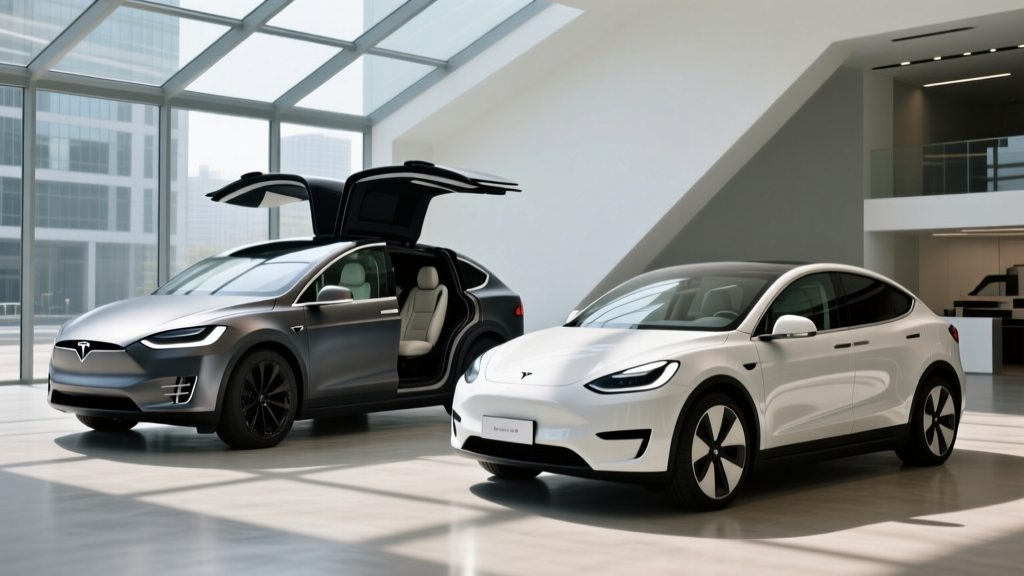
If you're cross-shopping Tesla's lineup, the difference between Tesla Model X and Y comes down to much more than size. One is a premium three-row family hauler with falcon-wing doors and air suspension; the other is a compact crossover that dominates the US EV sales charts for good reason. Both ride on Tesla's proprietary architecture and tap into the Supercharger network, but their battery packs, efficiency figures, pricing, and federal tax-credit eligibility diverge sharply.
This head-to-head uses current 2026 model-year specs from fueleconomy.gov and Tesla's official configurator to give you exact numbers — not marketing gloss. We'll cover range, charging curves, real-world efficiency, total cost of ownership, and which buyer each SUV actually serves best.
Side-by-Side Spec Comparison: Model X vs Model Y (2026)
| Spec | 2026 Tesla Model X Long Range | 2026 Tesla Model X Plaid | 2026 Tesla Model Y Long Range | 2026 Tesla Model Y Performance |
|---|---|---|---|---|
| EPA Range | 335 mi | 311 mi | 320 mi | 293 mi |
| Battery (usable) | ~100 kWh (NMC) | ~100 kWh (NMC) | ~75 kWh (NMC) | ~75 kWh (NMC) |
| Peak DC Fast Charge | 250 kW | 250 kW | 250 kW | 250 kW |
| 10–80% DCFC Time | ~32 min | ~32 min | ~27 min | ~27 min |
| Level 2 Charge Rate | 11.5 kW (44 mi/hr) | 11.5 kW (44 mi/hr) | 11.5 kW (44 mi/hr) | 11.5 kW (44 mi/hr) |
| 0–60 mph | 3.8 sec | 2.5 sec | 4.8 sec | 3.5 sec |
| Horsepower | 670 hp | 1,020 hp | 384 hp | 456 hp |
| Efficiency (MPGe) | 103 MPGe | 98 MPGe | 122 MPGe combined | 111 MPGe combined |
| Cargo (max, cu ft) | 88.1 | 88.1 | 72.1 | 72.1 |
| Seating | 5, 6, or 7 | 5 or 6 | 5 (optional 7 compact) | 5 |
| Base MSRP | $79,990 | $94,990 | $44,990 | $51,490 |
| Federal §30D Credit | Not eligible (MSRP cap) | Not eligible (MSRP cap) | Up to $7,500 | Up to $7,500 |
| Warranty (battery) | 8 yr / 150,000 mi | 8 yr / 150,000 mi | 8 yr / 120,000 mi | 8 yr / 120,000 mi |
Range & Efficiency Winner: Model Y Edges Ahead
On paper, the Model X Long Range posts a higher EPA number (335 vs. 320 miles). But efficiency tells the real story. The Model Y Long Range achieves 122 MPGe combined, translating to roughly 28 kWh per 100 miles. The Model X, heavier by about 900 pounds and pushing a larger frontal area through the air, consumes around 33 kWh per 100 miles at 103 MPGe.
What this means in practice: for every dollar you spend on electricity, the Model Y takes you further. Over 15,000 miles of annual driving at $0.16/kWh (the US residential average), the Model Y costs roughly $672 per year to "fuel" while the Model X runs closer to $792. That $120 annual gap compounds over ownership, and it's before you factor in the Model Y's lighter tire wear and lower insurance premiums.
Higher MPGe, lower cost per mile, and nearly identical real-world highway range despite a smaller battery. The Model X wins only if you need absolute maximum miles between charges regardless of efficiency.
Charging Speed & Network: A Shared Advantage
Both vehicles peak at 250 kW on V3 Superchargers and use Tesla's NACS connector natively — no adapter needed. However, the charging experience differs due to battery size and charge-curve physics.
The Model Y's ~75 kWh pack reaches 80% in roughly 27 minutes because there's less total energy to push. The Model X's ~100 kWh pack needs about 32 minutes for the same 10–80% session. Both taper significantly above 80% SoC — a common trait of NMC chemistry where the battery management system slows current to protect cell longevity. If you regularly charge to 100% on road trips, budget an extra 15–20 minutes for that final 20%.
At home on a Level 2 wall connector (11.5 kW / 48A circuit), the Model Y refills from 10–80% in about 5 hours, while the Model X needs roughly 6.5 hours. For most owners charging overnight, this difference is academic — both are fully topped up by morning.
The Supercharger network remains Tesla's strongest moat. As of early 2026, there are over 6,500 V3/V4 stalls across the US. Both vehicles also benefit from Tesla's built-in route preconditioning, which warms the battery before you arrive at a charger — critical for achieving peak 250 kW rates in cold weather. Non-Tesla EVs now access many Superchargers via NACS adapters, but Tesla owners still get priority routing and seamless plug-and-charge billing.
Same peak rate and network access, but the Model Y's smaller battery means shorter sessions. Neither is a slouch.
Pricing, Tax Credits & True Cost to Buy
This is where the comparison flips decisively. The 2026 Model Y Long Range starts at $44,990. The 2026 Model X Long Range starts at $79,990 — a $35,000 gap before incentives.
Under current IRS §30D rules, the Model Y qualifies for up to $7,500 in federal clean-vehicle credits, provided you meet income thresholds ($150,000 single / $300,000 joint AGI), the vehicle's MSRP stays under the $80,000 SUV cap, and the battery satisfies critical-mineral and component-sourcing requirements. Tesla publishes sourcing compliance on their site, and the credit can now be transferred at point of sale, reducing your purchase price directly.
The Model X, at $79,990, sits under the $80,000 SUV MSRP cap for the Long Range trim — but add any options (six-seat interior, FSD Supervised, premium paint) and you'll breach the cap, eliminating eligibility. The Plaid at $94,990 is categorically ineligible. Even the base Long Range Model X requires careful option selection to preserve credit eligibility, and battery-sourcing rules may limit the credit to $3,750 depending on the production batch.
| Cost Factor | Model Y Long Range | Model X Long Range |
|---|---|---|
| Base MSRP | $44,990 | $79,990 |
| Typical Options (paint, wheels, FSD) | +$4,500 | +$6,000 |
| Destination Fee | $1,390 | $1,390 |
| Configured Price | ~$50,880 | ~$87,380 |
| Est. Federal §30D Credit | $7,500 (if eligible) | $0–$7,500 (MSRP cap risk) |
| Effective Price After Credit | ~$43,380 | ~$79,880–$87,380 |
Important caveat: §30D eligibility depends on your individual tax situation, the specific vehicle's battery sourcing at time of manufacture, and current IRS guidance. Always verify with a tax professional and check fueleconomy.gov's credit lookup for the specific VIN before purchasing.
Nearly half the price, reliably eligible for the full federal credit, and lower ongoing costs. The Model X is a luxury product and priced accordingly.
Performance, Cargo & Practicality
The Model X Plaid's 1,020 hp and 2.5-second 0–60 time make it one of the quickest SUVs ever built. But unless you're drag-racing at stoplights, the more relevant comparison is the Long Range variants. The Model X Long Range hits 60 mph in 3.8 seconds with 670 hp — still seriously quick and more than adequate for highway merging and mountain passes.
The Model Y Long Range manages 4.8 seconds to 60 with 384 hp. The Performance trim closes the gap at 3.5 seconds. For daily driving, both feel immediate thanks to instant electric torque. The difference you'll actually notice is ride quality: the Model X uses adaptive air suspension that soaks up rough pavement and allows adjustable ride height for snow or rough driveways. The Model Y uses conventional coil springs — competent but firmer, and it transmits more road imperfections into the cabin.
Cargo capacity is a Model X stronghold. With seats folded, the Model X offers 88.1 cubic feet — enough for full-sheet plywood or serious camping gear. The Model Y maxes out at 72.1 cubic feet. The Model X also offers genuine third-row seating (up to 7 passengers), though the third row is best suited for children. The Model Y's optional third row is even tighter and was discontinued for the 2026 refresh in most markets.
One unique Model X feature: falcon-wing rear doors. They articulate upward with ultrasonic obstacle sensing, making car-seat loading dramatically easier in tight parking spaces. They're also a maintenance complexity — owners report occasional sensor and hinge issues that are expensive out of warranty.
🏆 Practicality Winner: Model X (cargo + seating)
🏆 Everyday Drive Winner: Model Y (lighter, easier to park, simpler)
Technology & Driver Assistance
Both vehicles share Tesla's current infotainment stack: a 15-inch center touchscreen (Model X adds a rear-seat entertainment screen), over-the-air updates, and the full Tesla app ecosystem. Both offer Autopilot standard with adaptive cruise and lane-centering, and both offer Full Self-Driving (Supervised) as a $8,000 add-on or $99/month subscription.
The Model X includes a few tech features the Model Y omits: a powered frunk (the Model Y's frunk is manual), ventilated front seats standard, and a more premium audio system with 22 speakers vs. the Model Y's 14. The Model X also features a larger 17-inch tilted center display in the 2026 refresh.
More premium interior hardware, rear-screen, and standard luxury features. But the core software and ADAS experience is identical.
5-Year Ownership Cost Breakdown
| Cost Category | Model Y LR (5 yr) | Model X LR (5 yr) | Notes |
|---|---|---|---|
| Purchase (after credit) | $43,380 | $82,380 | Assumes Y gets full $7,500; X gets partial |
| Electricity (15k mi/yr) | $3,360 | $3,960 | At $0.16/kWh avg |
| Insurance (avg) | $9,600 | $13,200 | Model X premiums ~35% higher |
| Maintenance | $1,800 | $2,400 | X has air suspension, falcon-wing service |
| Depreciation (est.) | $18,500 | $32,000 | Higher-priced vehicles lose more in $ terms |
| 5-Year Total | ~$76,640 | ~$133,940 | ~$57,300 difference |
Insurance is a significant hidden cost. Tesla vehicles already carry higher-than-average premiums due to repair complexity and parts pricing. The Model X, with its falcon-wing doors, air suspension, and larger glass windshield, costs insurers more to cover. Expect quotes 30–40% higher than the Model Y from the same carrier.
By a massive margin. Lower purchase price, better efficiency, cheaper insurance, and less maintenance complexity.
Decision Framework: Which Tesla SUV Is Right for You?
Choose the Tesla Model X if:
- You regularly carry 5+ passengers and need a usable third row
- You need maximum cargo volume (88+ cu ft) for gear, dogs, or work equipment
- Falcon-wing doors genuinely help your car-seat loading workflow
- Air suspension and adaptive ride height matter for your roads or driveways
- You want a luxury-badge experience and the budget supports $80K+
- Plaid-level performance (2.5 sec 0–60) is a priority
Choose the Tesla Model Y if:
- You want the best value in Tesla's lineup — period
- You're a 1–4 person household without regular third-row needs
- Federal tax credit eligibility is important to your purchase math
- Lower insurance premiums and maintenance costs matter over 5 years
- You want a daily driver that's easy to park and efficient on road trips
- Total cost of ownership is a top decision factor
Frequently Asked Questions
Is the Tesla Model X worth $35,000 more than the Model Y?
Only if you need what the extra money buys: three-row seating, 16 more cubic feet of cargo, air suspension, falcon-wing doors, and a luxury-tier interior. For a family of four or fewer who prioritizes efficiency and value, the Model Y delivers 90% of the Tesla experience at roughly half the cost. The $35,000 gap could cover a decade of charging and insurance differences.
Does the Model Y qualify for the $7,500 federal tax credit in 2026?
The Model Y Long Range at $44,990 falls well under the $80,000 SUV MSRP cap. Eligibility for the full $7,500 depends on your income (under $150K single / $300K joint), the battery's critical-mineral and component sourcing at time of manufacture, and whether you haven't exceeded the §30D lifetime limit. Check IRS.gov and confirm with your tax advisor. The credit can be applied at point of sale through a registered dealer.
Which Tesla SUV is better for road trips?
Both use the same Supercharger network with identical peak charge rates (250 kW). The Model X Long Range has a 15-mile EPA advantage and a larger battery buffer, which helps on remote stretches. The Model Y charges 10–80% about 5 minutes faster due to its smaller pack. For long-distance comfort, the Model X's air suspension and quieter cabin give it an edge. For cost-per-mile on road trips, the Model Y wins.
How do real-world ranges compare in cold weather?
Both vehicles use NMC chemistry, which loses 20–30% range at freezing temperatures. The Model X Long Range, starting from 335 EPA miles, might deliver 235–270 miles at 20°F. The Model Y Long Range, from 320 EPA miles, might deliver 225–260 miles. Both benefit from Tesla's heat pump (standard on all current trims) and battery preconditioning, which mitigates some cold-weather charging slowdown and range loss.
Will the Model X be discontinued?
Tesla has not announced a discontinuation of the Model X as of early 2026. However, sales volumes are a fraction of the Model Y's, and Tesla periodically adjusts production allocations. If you're considering the Model X, ordering sooner rather than later is prudent — Tesla has discontinued low-volume variants before without long lead times.