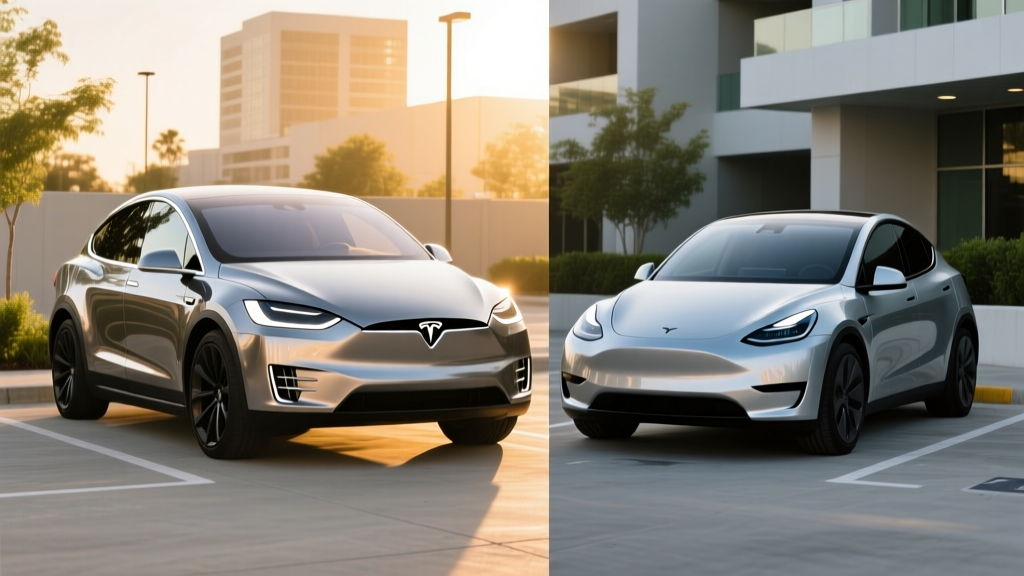
If you're cross-shopping Tesla's lineup, the Model X vs Model Y decision comes down to more than just size. One is a premium three-row family hauler with falcon-wing doors and 300+ miles of range; the other is a compact crossover that undercuts it by tens of thousands while delivering nearly identical tech. Below, we break down every spec that matters—from real-world range and DC fast-charging curves to total ownership cost and federal tax credit eligibility—so you can match the right Tesla to your actual needs.
Tesla Model X vs Model Y: Side-by-Side Specs
Before we get into subjective territory, here's the hard data. All figures reflect 2026 model-year Long Range AWD trims unless noted. The Performance variants are addressed in the performance section.
| Specification | 2026 Tesla Model X (Long Range AWD) | 2026 Tesla Model Y (Long Range AWD) |
|---|---|---|
| EPA Range | 335 miles | 320 miles |
| Battery (usable) | ~100 kWh (NMC) | ~78 kWh (NMC) |
| Efficiency (MPGe combined) | 102 MPGe | 117 MPGe |
| Peak DC Fast Charge | 250 kW | 250 kW |
| 10–80% DC Charge Time | ~32 min | ~25 min |
| Level 2 Charge Rate | 11.5 kW (44 mi/hr) | 11.5 kW (44 mi/hr) |
| 0–60 mph | 3.8 sec | 4.8 sec |
| Horsepower | 670 hp | 384 hp |
| Cargo (behind 2nd row) | 42.5 cu ft | 30.2 cu ft |
| Cargo (max, seats folded) | 85.1 cu ft | 72.1 cu ft |
| Seating | 5, 6, or 7 | 5 (7-seat option available) |
| Base MSRP | $79,990 | $44,990 |
| Federal §30D Credit Eligible | No (MSRP cap exceeded) | Yes (up to $7,500, income/sourcing rules apply) |
| Battery & Drive Unit Warranty | 8 yr / 150,000 mi | 8 yr / 120,000 mi |
Sources: EPA / fueleconomy.gov, Tesla.com Model X, Tesla.com Model Y.
Range, Efficiency, and Real-World Expectations
On paper, the Model X Long Range edges ahead with 335 EPA-estimated miles versus the Model Y's 320 miles. But EPA stickers tell only part of the story, and efficiency is where the Model Y quietly wins.
Model X: EPA 335 mi. Expect ~270–290 mi on sustained highway driving at 70–80 mph. In freezing temperatures (below 32°F), plan for 220–250 mi due to cabin heating demand and battery resistance.
Model Y: EPA 320 mi. Expect ~265–285 mi highway. Cold weather drops this to roughly 225–250 mi. The Model Y's lighter curb weight (~4,400 lbs vs ~5,100 lbs) gives it a slight highway efficiency edge per mile driven.
The Model Y's 117 MPGe combined versus the Model X's 102 MPGe means you'll spend less on electricity per mile in the Model Y—roughly $0.041/mile versus $0.047/mile at the national average residential rate of $0.17/kWh. Over 15,000 miles annually, that's about $90/year in savings. Modest, but it compounds.
Both vehicles use Tesla's heat pump system, which significantly reduces cold-weather range loss compared to resistive heating. If you live in northern climates, preconditioning while plugged in is essential for both models—it warms the battery and cabin using grid power, preserving range and enabling faster DC charging upon departure.
Charging Speed and Network Access
Both the Model X and Model Y peak at 250 kW on V3 Superchargers, but peak rate isn't sustained rate—and that's where battery size creates a divergence.
The Model X's ~100 kWh battery takes longer to fill from 10–80% (roughly 32 minutes) because there's simply more energy to push through. The Model Y's smaller ~78 kWh pack reaches 80% in approximately 25 minutes. On a road trip with two or three DC stops, the Model Y shaves 15–20 minutes off total charging time.
Both models benefit from the same advantage: full, native access to the Tesla Supercharger network, which remains the most reliable and widespread DC fast-charging network in North America. With the 2025–2026 opening of Superchargers to NACS-equipped non-Tesla EVs, the network is expanding, but Tesla owners still enjoy the most seamless plug-and-charge experience—no adapters, no third-party apps, automatic billing.
At home, both vehicles accept 11.5 kW on Level 2 (48-amp circuit, 60-amp breaker). That translates to roughly 44 miles of range per hour of charging, or a full overnight replenishment for either vehicle on a standard Tesla Wall Connector installation.
Performance and Driving Dynamics
If straight-line speed matters, the Model X Long Range hits 0–60 mph in 3.8 seconds with 670 horsepower from its dual motors. The Model Y Long Range does the same in 4.8 seconds with 384 hp. Both are genuinely quick by any standard, but the Model X's advantage is substantial—nearly a full second and 286 additional horsepower.
Step up to the Performance variants and the gap narrows: the Model X Plaid reaches 0–60 in 2.5 seconds (1,020 hp), while the Model Y Performance does it in 3.5 seconds (456 hp). The Plaid is a supercar-baiting anomaly in a three-row SUV; the Model Y Performance is the more rational sporty choice.
In daily driving, the Model Y feels more agile. It's roughly 700 pounds lighter, shorter in wheelbase, and easier to park in urban environments. The Model X rides more comfortably on its adaptive air suspension, which can raise for driveways or lower for highway efficiency. The Model Y uses a conventional coil-spring setup—firm but well-damped, with a slightly busier ride over broken pavement.
Pricing, Tax Credits, and True Cost to Buy
This is where the comparison tilts dramatically. The Model X starts at $79,990. The Model Y starts at $44,990—a $35,000 gap before incentives.
| Cost Factor | 2026 Model X Long Range | 2026 Model Y Long Range |
|---|---|---|
| Base MSRP | $79,990 | $44,990 |
| Destination Fee | $1,990 | $1,990 |
| Federal §30D Tax Credit | $0 (SUV MSRP cap: $80,000 — Model X at $81,980 out-the-door exceeds it) | Up to $7,500 (if buyer meets income & battery sourcing requirements) |
| Effective Price (best case) | ~$81,980 | ~$39,480 |
The §30D federal EV tax credit has strict eligibility requirements under current IRS rules. For the Model Y to qualify for the full $7,500, the buyer must meet income thresholds (modified AGI ≤ $300,000 for joint filers, ≤ $150,000 for single filers), the vehicle must meet critical mineral and battery component sourcing requirements, and the credit can now be transferred to the dealer at point of sale as an instant discount. The Model X's MSRP pushes it over the $80,000 SUV cap, making it ineligible regardless of buyer income. Always verify current-year rules at IRS.gov and consult a tax professional.
When you factor in the credit, the effective price gap widens to over $42,000. That's a second vehicle, a decade of charging costs, or a substantial investment portfolio.
Ownership Costs: Insurance, Efficiency, and Maintenance
Beyond the purchase price, the two Teslas diverge in ongoing costs:
- Insurance: The Model X typically costs 20–35% more to insure than the Model Y, driven by its higher replacement value, aluminum body repair complexity, and falcon-wing door mechanism. National average estimates put Model X insurance at ~$2,800–$3,400/year versus ~$1,900–$2,400/year for the Model Y (varies heavily by state, age, and driving record).
- Energy: As noted, the Model Y's superior efficiency saves roughly $90/year at 15,000 miles. Over five years: ~$450.
- Tires: The Model X runs larger, heavier-rated tires (255/45R20 or 265/45R22) that cost $250–$400 per corner. Model Y tires (255/45R19 or 255/40R20) run $180–$300 per corner. Expect replacement every 25,000–35,000 miles on either due to EV weight and instant torque.
- Maintenance: Both Teslas have minimal scheduled maintenance—cabin air filter, brake fluid check, tire rotation. The Model X adds air suspension service risk out of warranty ($1,500–$2,500 per corner if a strut fails) and the complexity of falcon-wing door hinges and sensors. The Model Y's simpler mechanical layout means fewer expensive failure points long-term.
Category Verdicts: Where Each Tesla Wins
335 vs 320 EPA miles. A 15-mile edge, though real-world gaps narrow.
117 MPGe vs 102 MPGe. Lower cost per mile, lighter weight.
10–80% in ~25 min vs ~32 min. Smaller battery fills faster.
670 hp, 3.8-sec 0–60. Dominant straight-line acceleration.
85.1 cu ft max, available 6/7-seat configs, true large-SUV utility.
$35,000 less before incentives; $42,000+ less after §30D credit.
Standard air suspension, falcon-wing doors, larger 17" touchscreen, available yoke.
Compact footprint, easy parking, excellent visibility, lighter steering.
Decision Framework: Which Tesla Fits Your Life?
- You need genuine three-row seating for 6 or 7 passengers regularly
- You want maximum cargo volume for family gear, sports equipment, or road trips
- You value air suspension ride quality and highway comfort
- You want the prestige and presence of a full-size luxury EV SUV
- Budget is not your primary constraint ($80K+ after incentives)
- You tow (5,000-lb capacity vs Model Y's 3,500-lb capacity)
Choose the Tesla Model Y if:
- You want the best value in the Tesla lineup with the lowest effective price
- You're a family of 4–5 and don't need a third row daily
- Efficiency and lower per-mile energy cost matter to you
- You want faster DC charging stops on road trips
- You live in an urban or suburban area where compact dimensions help
- You qualify for the §30D tax credit and want to maximize incentive savings
- Lower insurance and long-term maintenance costs are priorities
Final Recommendation
The Model Y is the rational choice for most buyers. It delivers 95% of the Tesla experience—same Supercharger network, same software, same Autopilot hardware (with SAE Level 2 driver-assist, not self-driving), same over-the-air updates—at less than 60% of the Model X's effective cost. Unless you regularly need three rows of seating, tow frequently, or specifically want the luxury-sUV presence and air suspension, the Model Y's value proposition is overwhelming.
The Model X isn't a bad vehicle—it's an excellent one with genuine advantages in space, comfort, and performance. But at nearly double the effective price, it's a premium product for buyers who need its specific capabilities. For everyone else, the Model Y Long Range AWD at ~$39,480 after the federal credit is one of the best deals in the EV market.
Frequently Asked Questions
Does the Tesla Model Y qualify for the $7,500 federal tax credit in 2026?
The Model Y can qualify for up to $7,500 under IRS §30D, but eligibility depends on your modified adjusted gross income (≤$300,000 joint / ≤$150,000 single), the vehicle's battery component and critical mineral sourcing compliance, and purchasing new from a dealer. The credit can be applied at point of sale as an instant price reduction. The Model X exceeds the $80,000 SUV MSRP cap and is not eligible. Verify current-year rules at IRS.gov.
Can the Model Y seat seven passengers like the Model X?
Tesla has offered an optional third-row seat for the Model Y, bringing capacity to seven. However, the third row is very tight—best suited for small children on short trips. The Model X offers a genuinely usable third row with more headroom and legroom, plus available six-seat captain's chair configurations that the Model Y cannot match.
Which is better for road trips—Model X or Model Y?
The Model X offers more range (335 vs 320 EPA miles) and more cargo space, which matters for long family trips. However, the Model Y charges faster (25 vs 32 minutes, 10–80%) and costs less to fuel per mile. For couples or small families, the Model Y's quicker charging and lower cost make it the more practical road-tripper. For large families hauling gear, the Model X's space advantage wins.
Is Autopilot or FSD different between the Model X and Model Y?
No. Both vehicles ship with the same Tesla Autopilot hardware suite and support FSD (Supervised). Both are SAE Level 2 driver-assistance systems, meaning the driver must remain fully engaged, hands on or near the wheel, and eyes on the road at all times. Neither system is self-driving. Feature parity is maintained across the Tesla fleet via over-the-air software updates.
How does cold weather affect range on each model?
Both vehicles lose 20–30% of rated range in sustained freezing temperatures, primarily due to cabin heating demand and increased battery internal resistance. The Model X's larger battery provides a bigger absolute buffer (roughly 220–250 real-world miles in cold vs 225–250 for the Model Y), but the percentage loss is similar. Both feature heat pumps that mitigate this loss compared to older resistive-heater EVs. Preconditioning while plugged in is critical for preserving range and enabling peak DC charge rates in cold weather.