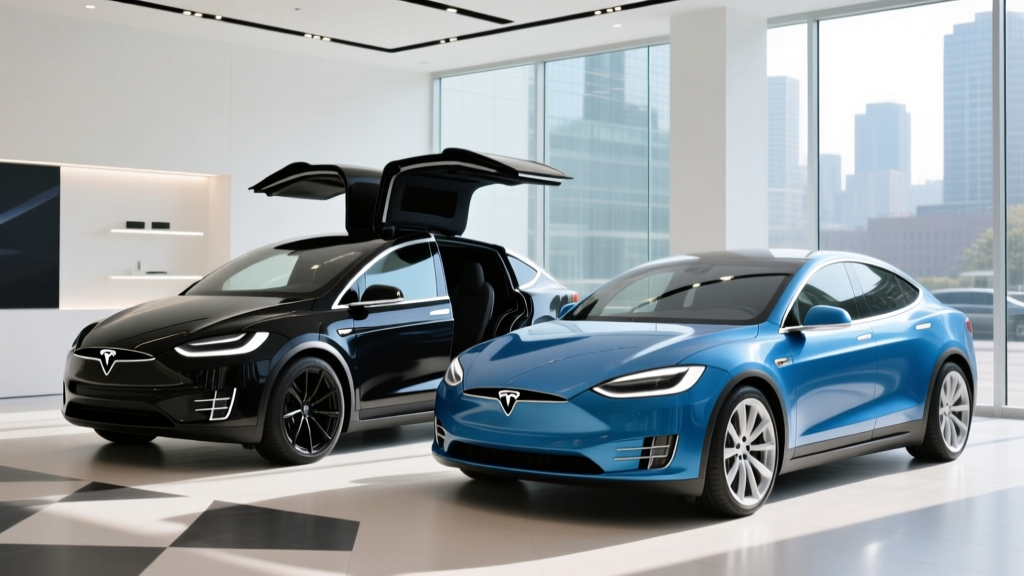
Tesla's two flagship vehicles share the same tri-motor powertrain architecture, similar battery packs, and identical software stacks — yet they serve fundamentally different buyer profiles. The 2026 Model S is a performance sedan optimized for efficiency and speed. The 2026 Model X is a three-row SUV built around family utility and cargo flexibility. This comparison breaks down every spec that matters: real-world range, charging curves, ownership costs, and which one actually delivers better value after federal incentives.
Side-by-Side Spec Table: Model X vs Model S (2026)
| Specification | 2026 Tesla Model S (Long Range AWD) | 2026 Tesla Model X (Long Range AWD) |
|---|---|---|
| EPA Range | 402 mi | 335 mi |
| Real-World Highway Range (est.) | ~330–350 mi | ~270–290 mi |
| Battery (usable) | ~100 kWh (NMC) | ~100 kWh (NMC) |
| Efficiency (MPGe combined) | 120 MPGe (28 kWh/100mi) | 102 MPGe (33 kWh/100mi) |
| Peak DC Fast Charge | 250 kW | 250 kW |
| 10–80% DC Fast Charge | ~27 min | ~30 min |
| Level 2 Charge Rate | 11.5 kW (48A) | 11.5 kW (48A) |
| 0–60 mph | 3.1 sec | 3.8 sec |
| Horsepower | 670 hp | 670 hp |
| Seating | 5 passengers | 5, 6, or 7 passengers |
| Cargo Volume (max) | 28 cu ft (rear seats up) / 79 cu ft (folded) | 88 cu ft (rear seats folded) |
| Towing Capacity | Not rated | 5,000 lbs |
| Base MSRP | $79,990 | $84,990 |
| Battery & Drive Unit Warranty | 8 yr / 150,000 mi (70% retention) | 8 yr / 150,000 mi (70% retention) |
Source: fueleconomy.gov and Tesla Model S / Model X configurator, 2026 model year. Real-world highway estimates assume 70–75 mph in 65–75°F conditions; subtract 15–25% for sub-freezing temperatures.
Range and Efficiency: The Sedan Advantage
The Model S Long Range achieves an EPA-estimated 402 miles — one of the highest of any production EV sold in the US. The Model X Long Range trails at 335 miles. Both vehicles carry essentially the same ~100 kWh usable NMC battery pack, so the 67-mile gap comes down entirely to aerodynamics and weight.
EPA estimates assume a mix of city and highway driving at moderate speeds. On a sustained 75 mph highway run in fair weather, expect the Model S to deliver roughly 330–350 miles and the Model X around 270–290 miles. In sub-freezing conditions without preconditioning, both vehicles will lose 15–25% of range. The Model X's larger frontal area makes it slightly more sensitive to crosswinds and cold-air density drag.
The Model S's 0.208 drag coefficient is among the lowest of any production car. The Model X, despite Tesla's efforts with its flush door handles and flat underbody, sits at roughly 0.25 — a meaningful difference at highway speeds where aerodynamic drag dominates energy consumption. Efficiency figures from the EPA bear this out: the Model S consumes 28 kWh per 100 miles (combined), while the Model X uses 33 kWh/100mi. Over 15,000 annual miles, that's roughly 750 kWh more electricity consumed in the Model X — approximately $110–$150 in additional charging costs per year at national average residential rates.
67 more EPA miles, 5 kWh/100mi better efficiency. The sedan's aero advantage is physics you can't software-update away.
Charging Speed and Network Access
Both vehicles peak at 250 kW on V3 Tesla Superchargers and share the same NACS connector natively — no adapter needed at any Supercharger station. Neither supports 800V-class charging (like the Hyundai Ioniq 5 or Porsche Taycan), so neither will see 350 kW rates at Electrify America or similar CCS stations without an adapter, and even then, the vehicle-side charge curve caps at 250 kW.
The practical difference shows up in charge-session duration. The Model S reaches 10–80% in approximately 27 minutes; the Model X takes about 30 minutes. That 3-minute gap is small per session but compounds on road trips with multiple stops. The Model S's superior efficiency means it also needs fewer total kWh to cover the same distance, translating to shorter cumulative time plugged in.
On Level 2 home charging (11.5 kW via a Wall Connector on a 60A circuit), both vehicles add roughly 35–40 miles of range per hour and can fully recharge overnight from near-empty in about 9–10 hours. Neither vehicle gains a home-charging advantage.
~3 min faster 10–80%, fewer total stops on road trips thanks to better efficiency. Identical home charging.
Performance: Shared Powertrain, Different Feel
Both Long Range models use Tesla's tri-motor setup (one front, two rear) producing 670 horsepower. The Model S hits 0–60 mph in 3.1 seconds; the Model X does it in 3.8 seconds. The 0.7-second gap comes from the Model X's extra ~500 pounds of curb weight and taller gearing optimized for towing rather than launch grip.
In daily driving, both feel explosively quick. The Model X's higher seating position gives a commanding view but also more body roll through corners. The Model S sits lower, corners flatter, and delivers a sport-sedan experience closer to a Porsche Taycan than a luxury crossover. If you're upgrading from a BMW 5 Series or Mercedes E-Class, the Model S will feel more familiar. If you're coming from a BMW X5 or Range Rover, the Model X matches that posture.
Neither vehicle currently offers the Plaid tri-motor (1,020 hp) in the 2026 model year for the standard Long Range trim — that remains a separate, significantly more expensive configuration.
0.7 sec quicker to 60, lower center of gravity, sharper handling. The X is fast for an SUV; the S is fast by any measure.
Interior Space, Cargo, and Daily Utility
This is where the Model X justifies its $5,000 premium and lower range. The Model X offers three seating configurations: 5-seat (standard), 6-seat (with second-row captain's chairs), and 7-seat (with a third-row bench). The Model S seats five, period.
Cargo volume tells the story: the Model X provides up to 88 cubic feet with rear seats folded, compared to 79 cu ft in the Model S with its rear seats down. But the Model X's advantage is more about shape than raw volume — its taller roofline and wider opening (via the powered liftgate) make loading bulky items like strollers, dog crates, or furniture dramatically easier. The Model S's trunk, while deep, has a narrower sedan-style opening.
The Model X also offers a 5,000-pound towing rating (with the optional tow package), making it viable for light boat or utility trailers. The Model S is not rated for towing.
Both vehicles share the same 17-inch center touchscreen, the same yoke-or-round steering wheel option, ventilated front seats, and a HEPA air filtration system ("Bioweapon Defense Mode"). The Model X adds falcon-wing rear doors, which open vertically — useful in tight parking spaces for loading children into car seats, though they add mechanical complexity and have been a source of reliability complaints in earlier model years.
Three-row seating, 5,000-lb tow rating, falcon-wing doors, and a more usable cargo area. This is the family hauler.
Pricing, Tax Credits, and Value After Incentives
Under the federal §30D EV tax credit rules for 2026, both vehicles face the same challenge: the MSRP cap for sedans is $55,000 and for SUVs/pickups/vans is $80,000. The Model S Long Range starts at $79,990 — which, as a sedan, exceeds the $55,000 cap, making it ineligible for the $7,500 federal credit. The Model X Long Range starts at $84,990 — which also exceeds the $80,000 SUV cap, making it ineligible as well.
Neither the 2026 Model S nor Model X qualifies for the $7,500 federal §30D new EV tax credit at their Long Range MSRPs. Buyers should also verify income caps ($300K MFJ / $150K single), battery critical-mineral sourcing requirements, and North American final assembly rules via the IRS clean vehicle credit page. A point-of-sale transfer is available for qualifying vehicles, but neither qualifies here. Consult a tax professional for your specific situation. Some state-level incentives (e.g., California, Colorado, New York) may still apply — check your state's energy office.
| Cost Factor | Model S Long Range | Model X Long Range |
|---|---|---|
| Base MSRP | $79,990 | $84,990 |
| Destination Fee | $1,390 | $1,390 |
| Federal §30D Credit | $0 (exceeds sedan MSRP cap) | $0 (exceeds SUV MSRP cap) |
| Effective Starting Price | $81,380 | $86,380 |
The Model S saves $5,000 at purchase. Without the federal credit available on either, the gap is purely MSRP-based. If Tesla introduces a lower-priced trim or if future legislation adjusts MSRP caps, the calculus could shift — but as of 2026, both vehicles are full-price purchases.
$5,000 less to start, better efficiency (lower charging costs), and similar equipment. Neither gets the federal credit.
Ownership Costs: Insurance, Maintenance, and Depreciation
Insurance: Both vehicles carry premium insurance costs typical of high-performance EVs over $80K. Industry data suggests the Model X costs roughly 8–12% more to insure than the Model S, driven by higher repair costs for the falcon-wing doors, larger glass area, and greater collision-repair complexity. Expect annual premiums in the $2,800–$4,200 range depending on state, driving record, and coverage level.
Maintenance: Tesla's maintenance requirements are minimal for both — no oil changes, no spark plugs, cabin air filter replacement every 2–3 years, brake fluid checks, and tire rotations. The Model X has additional mechanical complexity from the falcon-wing door actuators and the power-folding second/third-row seats, which may increase out-of-warranty repair risk after year 5. The Model S is mechanically simpler.
Charging cost: At the national average residential electricity rate of ~$0.16/kWh (EIA), the Model S costs approximately $644 per year to drive 15,000 miles. The Model X costs roughly $792 for the same distance — a $148/year difference. On public DC fast chargers (averaging $0.35–$0.48/kWh), the gap widens proportionally.
Depreciation: Both vehicles have historically depreciated faster than mainstream EVs like the Model Y or Model 3, partly due to their higher starting prices and Tesla's frequent price adjustments on new vehicles. Expect roughly 45–55% value retention at 5 years / 60,000 miles for both, though the Model X's larger buyer pool (family SUV segment) may provide marginally better resale stability.
Lower insurance, less mechanical complexity, and ~$150/year less in charging. The gap is modest but consistent.
Tech, Autopilot, and Software
Both vehicles come with Tesla's Basic Autopilot (adaptive cruise + lane centering). Full Self-Driving (Supervised) is an optional $8,000 add-on (or $99/month subscription). Despite the name, FSD is an SAE Level 2 driver-assistance system — the driver must remain fully engaged, hands on the wheel (or providing torque input), and eyes on the road at all times. This is not autonomous driving.
Both vehicles share identical infotainment hardware (AMD Ryzen processor, 17-inch touchscreen, rear-seat entertainment screen), the same software feature set, and the same over-the-air update pipeline. There is no tech advantage to either vehicle — the experience behind the screen is the same.
Both include Tesla's suite of active safety features: automatic emergency braking, blind-spot monitoring, lane departure warning, and 360-degree cameras. NHTSA has awarded both vehicles 5-star overall safety ratings in prior model years.
Identical hardware, software, Autopilot, and FSD capability. No differentiation.
Decision Framework: Which Should You Buy?
Choose the Model S if:
- Maximum range is your top priority (402 mi EPA, ~340 mi real-world highway)
- You primarily drive solo or with one passenger and rarely need more than 5 seats
- You value sport-sedan handling and a lower, more engaging driving position
- You want the lowest possible cost per mile (charging + insurance + maintenance)
- You don't need towing capability
- You're upgrading from a luxury sedan (5 Series, E-Class, A6)
Choose the Model X if:
- You regularly carry more than 5 passengers (kids, carpool, extended family)
- You need a third row and easy car-seat access via falcon-wing doors
- You require cargo space for bulky items (strollers, sports gear, furniture)
- You need to tow up to 5,000 lbs (boat, utility trailer, camper)
- You prefer a higher, commanding driving position
- You're upgrading from a luxury SUV (X5, GLE, Cayenne, Range Rover)
Final Recommendation
There is no universal winner between the Model S and Model X — they are purpose-built for different lives. The Model S is the objectively more efficient, longer-range, quicker, and cheaper-to-own vehicle. If your daily life doesn't demand three rows of seats or a tow hitch, the Model S is the smarter financial and practical choice.
The Model X earns its premium only if you actually use its utility. If you're regularly loading kids into car seats, hauling a family of six on road trips, or towing a trailer on weekends, no sedan — electric or otherwise — can replace what the Model X offers. The 67-mile range penalty and slightly higher operating costs are the price of that versatility.
Neither vehicle qualifies for the federal tax credit at current MSRPs, so the decision is purely about which body style fits your household. Test-drive both, but let your cargo and passenger needs — not the spec sheet — make the call.
Frequently Asked Questions
Does the Tesla Model X have more range than the Model S?
No. The 2026 Model S Long Range achieves 402 miles EPA, while the Model X Long Range achieves 335 miles EPA. Despite sharing a similar ~100 kWh battery, the Model S's superior aerodynamics (0.208 Cd vs ~0.25 Cd) and lighter weight give it a 67-mile advantage.
Can either the Model S or Model X qualify for the $7,500 federal tax credit?
No. Under 2026 IRS §30D rules, the MSRP cap is $55,000 for sedans and $80,000 for SUVs. The Model S ($79,990) exceeds the sedan cap, and the Model X ($84,990) exceeds the SUV cap. Neither qualifies. Verify current rules at irs.gov.
Which charges faster: Model S or Model X?
Both peak at 250 kW on V3 Superchargers. The Model S reaches 10–80% in approximately 27 minutes; the Model X takes about 30 minutes. The difference is modest but favors the sedan on multi-stop road trips.
Is the Model X worth the extra $5,000 over the Model S?
Only if you need its specific capabilities: three-row seating (up to 7 passengers), 5,000-lb towing, or significantly more usable cargo volume. If you don't need these features, the Model S is the better value with more range and lower operating costs.
Do both vehicles have the same Autopilot and FSD capability?
Yes. Both include Basic Autopilot standard and offer Full Self-Driving (Supervised) as an $8,000 option or $99/month subscription. Both are SAE Level 2 systems requiring full driver engagement — neither is self-driving.
What is the real-world highway range of each vehicle?
Expect approximately 330–350 miles from the Model S and 270–290 miles from the Model X on sustained highway driving at 70–75 mph in moderate temperatures. Subtract 15–25% in sub-freezing conditions.