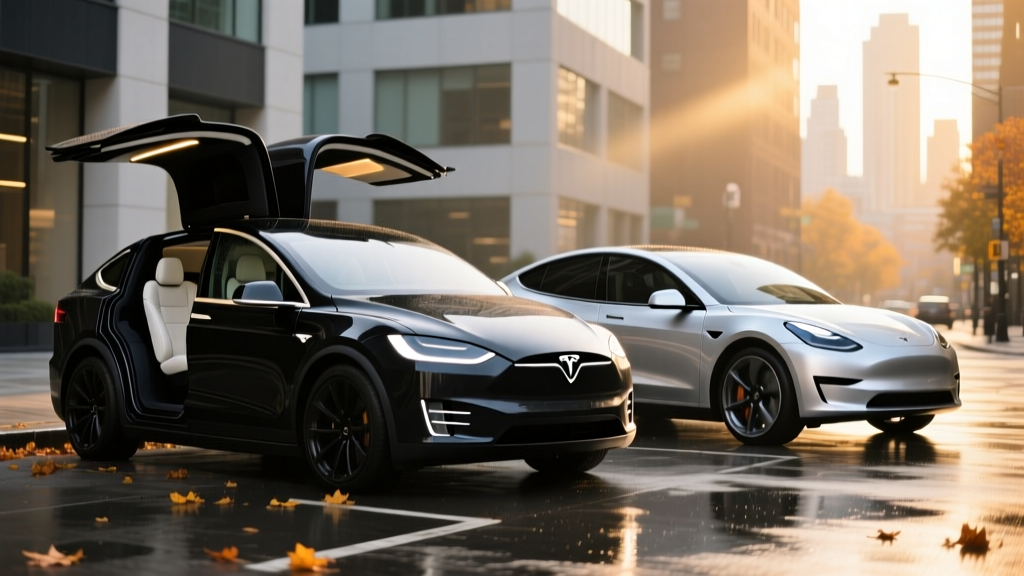
Comparing the Tesla Model X to the Model 3 is less about which is "better" and more about which solves your specific problem. One is a three-row, falcon-wing family hauler with supercar acceleration. The other is a compact luxury sedan that delivers 360+ miles of range at roughly half the price. In this Tesla Model X vs Model 3 breakdown, we run the exact numbers — EPA range, battery chemistry, charge curves, insurance, and §30D tax credit eligibility — so you can match the right Tesla to your driveway, budget, and daily drive.
Specs at a Glance: Model X Long Range vs Model 3 Long Range AWD
Before opinions, here are the hard figures for the most comparable 2026 trims. We use Long Range AWD on both sides because it's the volume trim for each. Plaid and Performance variants are noted where relevant.
| Spec | Model X Long Range AWD | Model 3 Long Range AWD |
|---|---|---|
| EPA Range | 335 mi | 363 mi |
| Real-World Highway (~70 mph) | ~260–280 mi | ~290–310 mi |
| Battery (usable) | ~95 kWh, NMC | ~79 kWh, NMC |
| Efficiency (MPGe) | 98 MPGe | 132 MPGe |
| kWh/100 mi | 34 kWh | 25 kWh |
| Peak DC Fast Charge | 250 kW (V3 Supercharger) | 250 kW (V3 Supercharger) |
| 10–80% DCFC Time | ~32 min | ~25 min |
| Level 2 Charge Rate | 11.5 kW (~30 mi/hr) | 11.5 kW (~44 mi/hr) |
| 0–60 mph | 3.8 sec | 4.2 sec |
| Horsepower | 670 hp | 346 hp |
| Cargo Volume (seats up) | 37.1 cu ft (+ frunk) | 22.9 cu ft (+ frunk) |
| Cargo (max, seats folded) | 85.1 cu ft | 22.9 cu ft (trunk only) |
| Seating | 5, 6, or 7 | 5 |
| Towing Capacity | 5,000 lb | Not rated |
| Base MSRP | $79,990 | $47,740 |
| Battery & Drive Unit Warranty | 8 yr / 150,000 mi | 8 yr / 120,000 mi |
Sources: fueleconomy.gov, Tesla spec sheets. Real-world highway range reflects sustained 70–75 mph driving in moderate temps; expect 15–25% loss in sub-freezing weather.
Range and Efficiency: Why the Smaller Battery Goes Farther
The Model 3 Long Range's 363-mile EPA rating beats the Model X's 335 miles despite carrying roughly 16 fewer kWh of usable energy. That gap comes down to physics: the Model X is a 5,185-lb box with falcon-wing doors and the aerodynamics of a bread loaf, while the Model 3 is a 4,034-lb sedan with a 0.219 drag coefficient. On the highway, the Model 3 sips 25 kWh/100 mi versus the Model X's 34 kWh/100 mi — a 26% efficiency advantage that compounds on road trips.
- Model X LR: EPA 335 mi. Expect ~260–280 mi highway, ~230–250 mi in winter with heat pump running.
- Model 3 LR: EPA 363 mi. Expect ~290–310 mi highway, ~260–280 mi in winter.
Efficiency matters more than battery size. A lighter, slipperier car with a smaller pack will usually outperform a heavier SUV with a bigger one on the open road.
Charging Speed: Same Peak kW, Very Different Curves
Both vehicles peak at 250 kW on Tesla V3 Superchargers, but peak is not sustained. The Model 3's smaller 79 kWh pack reaches 80% State of Charge (SoC) in roughly 25 minutes, while the Model X's 95 kWh pack needs about 32 minutes to hit the same threshold. That seven-minute gap adds up on multi-stop road trips — a 1,200-mile drive can mean one extra stop or longer cumulative dwell time in the Model X.
On Level 2 home charging at 11.5 kW (48A circuit), the Model 3 recovers about 44 miles of range per hour of charging, while the Model X recovers roughly 30 miles per hour. Overnight charging from 20% to 80% is painless in either car, but the Model 3's efficiency means you'll need fewer kWh — and therefore less electricity cost — for the same commute.
Performance: The X's Brute Force vs the 3's Agility
With 670 hp and a 3.8-second 0–60, the Model X Long Range is absurdly quick for a 5,000+ lb SUV. The Plaid variant (1,020 hp, 2.5 sec 0–60, ~$94,990) exists in a category of its own. But the Model 3 Long Range AWD's 4.2-second run is more than adequate for merging and passing, and its lower center of gravity and lighter weight make it noticeably more engaging on back roads. If you care about driving dynamics over brute force, the 3 is the driver's car here.
Interior, Tech, and Practicality
This is where the two vehicles diverge most sharply. The Model X offers:
- Falcon-wing rear doors (dramatic, but watch for sensor quirks in tight garages)
- Optional 6- or 7-seat configurations
- A 17-inch center touchscreen plus a rear-seat display
- 5,000-lb towing (useful for small boat or utility trailers)
- A massive 85.1 cu ft max cargo volume with seats folded
The Model 3 Highland refresh (carried into 2026) offers a quieter, more refined cabin than prior years, ventilated front seats, ambient lighting, and a rear touchscreen for passengers. But it seats five, has no tow rating, and cargo is limited to its 22.9 cu ft trunk plus a modest frunk. It's a premium commuter and weekend-trip car, not a family logistics platform.
Price and Federal Tax Credit: Where the Math Flips
The base MSRP gap is stark: the Model X starts at $79,990, while the Model 3 Long Range AWD starts at $47,740 — a $32,250 spread before incentives. But the IRS §30D clean vehicle credit treats them very differently.
| Model X LR AWD | Model 3 LR AWD | |
|---|---|---|
| Base MSRP | $79,990 | $47,740 |
| §30D MSRP Cap (SUVs: $80,000 / Sedans: $55,000) | ✅ Under $80K cap (barely) | ✅ Under $55K cap |
| Buyer Income Cap (MFJ $300K / Single $150K) | Must meet | Must meet |
| Critical Minerals + Battery Sourcing | Must verify current-year compliance | Must verify current-year compliance |
| Maximum Potential Credit | Up to $7,500 (if all rules met) | Up to $7,500 (if all rules met) |
| Point-of-Sale Transfer | ✅ Available | ✅ Available |
| Effective Price (best case, full credit) | ~$72,490 | ~$40,240 |
Key caveat: The Model X's MSRP sits very close to the $80,000 SUV cap. Adding certain packages or destination fees could push a configured Model X over the threshold, disqualifying it from the credit entirely. The Model 3 has far more headroom under its $55,000 sedan cap. Always check the latest IRS guidance and confirm sourcing compliance at the time of purchase — these rules have tightened annually. Consult a tax professional for your specific situation.
5-Year Ownership Cost: Insurance, Electricity, and Maintenance
| Category | Model X LR AWD | Model 3 LR AWD |
|---|---|---|
| Purchase (after $7,500 credit) | $72,490 | $40,240 |
| Insurance (avg, 5 yr) | ~$17,500 | ~$11,000 |
| Electricity (home L2, 12¢/kWh avg) | ~$2,550 | ~$1,875 |
| Maintenance (tires, cabin filter, wipers) | ~$2,800 | ~$2,200 |
| Depreciation (est. 5 yr) | ~$32,000 | ~$18,000 |
| Est. 5-Year Total | ~$127,340 | ~$73,315 |
Insurance is the hidden cost multiplier. The Model X's higher repair costs (aluminum body, falcon-wing door mechanisms, larger glass) push premiums roughly 50–60% higher than the Model 3. Electricity costs also favor the Model 3 thanks to its 26% efficiency advantage. Over five years, the Model 3 costs roughly $54,000 less to own — enough to buy a second vehicle outright.
Charging Network and Road-Trip Reality
Both vehicles access the Tesla Supercharger network, which remains the most reliable and extensive DC fast-charging network in North America, with over 20,000 V3/V4 stalls. With NACS now adopted industry-wide, the Supercharger network is opening to non-Tesla EVs, but Tesla owners still enjoy native plug-and-charge integration and the best route-planning via the in-car navigation.
On a 600-mile road trip, the Model 3's efficiency and faster 10–80% charge time typically means one fewer stop or 15–20 fewer total minutes of charging compared to the Model X. In cold weather, both benefit from Tesla's heat pump and battery preconditioning, but the Model X's larger cabin requires more energy to heat, compounding winter range loss.
Decision Framework: Which Tesla Is Yours?
Choose the Model X if:
- You need 3 rows of seating for 6 or 7 passengers regularly
- You tow a trailer, small boat, or camper (up to 5,000 lb)
- You need maximum cargo volume (85 cu ft with seats folded)
- Falcon-wing doors and SUV presence matter to you
- Your budget comfortably exceeds $75K after incentives
Choose the Model 3 if:
- You commute daily and want maximum range per kWh
- You want the lowest total cost of ownership in the Tesla lineup
- You prioritize §30D tax credit eligibility (more MSRP headroom)
- You don't need more than 5 seats or significant cargo space
- You want a more engaging, agile driving experience
- Road-trip charging speed matters (faster 10–80%, fewer stops)
Final Verdict
There is no universal winner in the Tesla Model X vs Model 3 comparison — only the right tool for your life. The Model 3 Long Range AWD is the objectively more efficient, more affordable, and easier-to-own vehicle. It wins on range, charging speed, insurance, electricity cost, and tax credit eligibility. For 80% of EV buyers, it's the rational pick.
The Model X earns its premium only if you need what it uniquely offers: three rows, massive cargo space, and tow capacity. If those are non-negotiable, no other Tesla (and few EVs at any price) fills that role. But if you're choosing between the two simply because both are Teslas, let the spec table — not the badge — make the call.
Is the Model X worth $32K more than the Model 3?
Only if you need 6–7 seats, 5,000-lb towing, or 85 cu ft of cargo space. For commuting and road trips, the Model 3 is faster to charge, cheaper to insure, and more efficient.
Do both qualify for the $7,500 federal tax credit?
Both can, but the Model X's MSRP sits near the $80,000 SUV cap — adding options could disqualify it. The Model 3 has ample headroom under the $55,000 sedan cap. Income limits, battery sourcing rules, and point-of-sale transfer eligibility all apply. Verify current-year rules on IRS.gov.
Which charges faster on road trips?
The Model 3. Both peak at 250 kW, but the Model 3's smaller pack reaches 80% SoC in ~25 minutes vs ~32 minutes for the Model X. Its 26% better efficiency also means fewer total stops.
Can I tow with the Model 3?
No. The Model 3 has no factory tow rating. The Model X is rated for 5,000 lb with the proper hitch.
Which is cheaper to insure?
The Model 3, by roughly $6,000–$7,000 over five years. The Model X's aluminum body, falcon-wing doors, and higher repair costs drive premiums significantly higher.
Is Autopilot or FSD different between the two?
No. Both run the same Tesla Autopilot hardware and software. Note that Autopilot and FSD (Supervised) are SAE Level 2 driver-assistance systems — you must remain engaged and supervise at all times. Neither is self-driving.