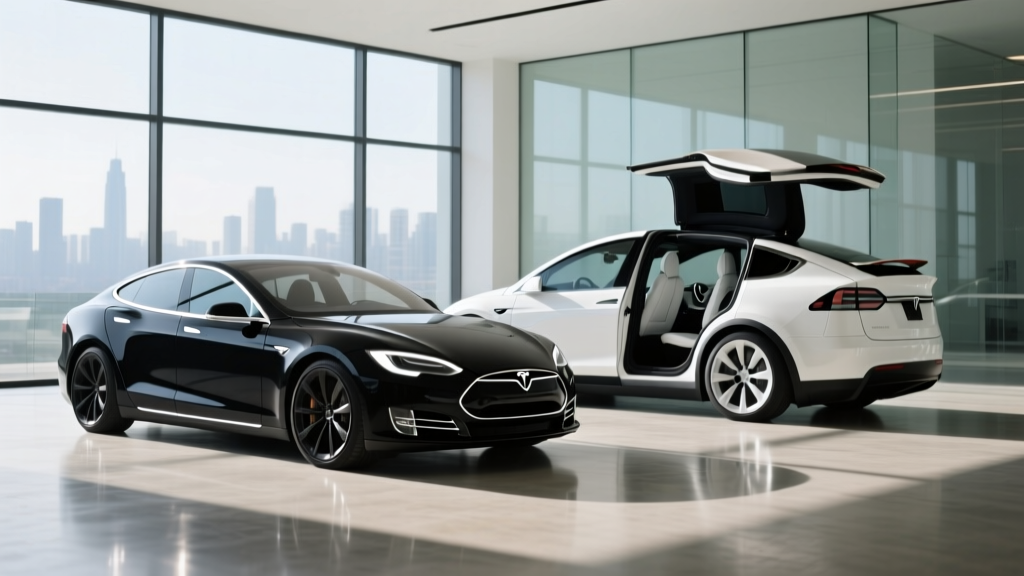
Tesla's flagship sedan and SUV share the same tri-motor Plaid powertrain architecture, similar battery packs, and nearly identical tech stacks — yet they serve fundamentally different buyers. The Model S prioritizes range and performance per dollar; the Model X trades some efficiency for three-row seating, falcon-wing doors, and SUV practicality. This comparison breaks down exactly where each vehicle wins, what you'll actually pay after incentives, and which one fits your daily driving profile.
Tesla Model S vs Model X: Side-by-Side Specs
Both vehicles sit on Tesla's updated platform with a ~100 kWh (usable) battery pack and access to the Supercharger network. Below are the key numbers for the current Long Range and Plaid trims, sourced from EPA / fueleconomy.gov and Tesla's official specification pages.
| Spec | Model S Long Range | Model S Plaid | Model X Long Range | Model X Plaid |
|---|---|---|---|---|
| EPA Range | 402 mi | 359 mi | 335 mi | 320 mi |
| Battery (usable) | ~100 kWh (NMC) | ~100 kWh (NMC) | ~100 kWh (NMC) | ~100 kWh (NMC) |
| Peak DC Fast Charge | 250 kW | 250 kW | 250 kW | 250 kW |
| 10–80% DC Charge Time | ~30 min | ~30 min | ~32 min | ~32 min |
| Level 2 Charge Rate | 11.5 kW (48A) | 11.5 kW (48A) | 11.5 kW (48A) | 11.5 kW (48A) |
| 0–60 mph | 3.1 sec | 1.99 sec | 3.8 sec | 2.5 sec |
| Horsepower | 670 hp | 1,020 hp | 670 hp | 1,020 hp |
| Efficiency (MPGe combined) | 120 MPGe | 116 MPGe | 102 MPGe | 98 MPGe |
| Cargo Volume (rear seats up) | 28 cu ft (+ frunk) | 28 cu ft (+ frunk) | 88 cu ft (behind 2nd row) | 88 cu ft (behind 2nd row) |
| Seating | 5 | 5 | 5, 6, or 7 | 5 or 6 |
| Towing Capacity | N/A | N/A | 5,000 lb | 5,000 lb |
| Base MSRP | $74,990 | $89,990 | $79,990 | $94,990 |
| Federal §30D Credit Eligible? | No (MSRP cap $55k sedan) | No | No (MSRP cap $80k SUV) | No |
| Battery/Drive Unit Warranty | 8 yr / 150,000 mi | 8 yr / 150,000 mi | 8 yr / 150,000 mi | 8 yr / 150,000 mi |
Range and Efficiency: Sedan Aerodynamics Win
The Model S has a decisive efficiency advantage rooted in physics. Its lower curb weight (~4,561 lb vs. ~5,185 lb for the Model X) and superior drag coefficient (~0.208 vs. ~0.24) mean it uses fewer kWh per mile at every speed. At highway velocities, where aerodynamic drag dominates energy consumption, the gap widens further.
On a 300-mile road trip at 75 mph in 65°F conditions, the Model S Long Range will arrive with roughly 15–20% state of charge remaining, while the Model X Long Range will need a charging stop — arriving at roughly 5–8% SoC without one. For frequent long-distance drivers, the Model S's 67-mile EPA range advantage (and larger real-world gap) translates to fewer Supercharger stops and lower per-mile electricity costs.
The efficiency gap also shows up in daily charging costs. At the national average electricity rate of ~$0.16/kWh, the Model S costs roughly $4.00 per 100 miles to charge at home, while the Model X costs approximately $4.70 per 100 miles. Over 15,000 annual miles, that's about $105/year in savings for the sedan.
402 mi EPA (LR), 120 MPGe combined, ~$4.00/100mi. The sedan's aero and weight advantage is insurmountable for efficiency-focused buyers.
Charging Speed and Network Access
Both vehicles peak at 250 kW on V3 Superchargers and use the NACS (North American Charging Standard) connector natively. Tesla's Supercharger network remains the most reliable and widespread DC fast-charging infrastructure in the U.S., with over 6,000 stations and 30,000+ stalls as of 2026.
The charging experience is nearly identical between the two. Both precondition the battery when a Supercharger is set as a navigation destination, enabling peak charge rates upon arrival. The Model S charges marginally faster in practice (10–80% in ~30 minutes vs. ~32 minutes for the Model X) because its smaller energy consumption per mile means each kWh added translates to more range recovered.
One important nuance: the 250 kW peak rate is only sustained up to approximately 40–50% SoC. Above 80%, the charge rate tapers significantly — often dropping below 50 kW. This means the last 20% can take as long as the first 70%. Both vehicles exhibit this same charge curve behavior, so neither has an advantage here.
For home Level 2 charging, both accept 11.5 kW via a 48-amp circuit, requiring a 60-amp breaker. This adds roughly 35–44 miles of range per hour of charging — sufficient for overnight replenishment for any daily commute. Installation costs for a home Level 2 setup typically range from $800 to $2,500 depending on panel proximity and local permitting, per U.S. Department of Energy guidance.
Same 250 kW peak, same NACS connector, same Supercharger access. The Model S gains slightly more range per minute of charging due to higher efficiency, but the hardware is identical.
Performance: Both Are Absurdly Fast
The Plaid variants of both vehicles share Tesla's tri-motor powertrain producing 1,020 hp. The Model S Plaid hits 0–60 mph in 1.99 seconds — one of the quickest production cars ever built. The Model X Plaid manages 2.5 seconds, which is staggering for a three-row SUV weighing over 5,000 pounds.
Even the Long Range trims, with 670 hp dual-motor setups, deliver 0–60 times (3.1 sec sedan, 3.8 sec SUV) that outpace most sports cars. For any buyer who prioritizes straight-line acceleration, neither vehicle disappoints. The performance difference between the two is measurable but, in practice, both deliver instantaneous torque and effortless highway merging.
Where they diverge is handling dynamics. The Model S's lower center of gravity and lighter weight give it noticeably sharper cornering and less body roll. The Model X, with its higher ride height and extra ~620 pounds, feels more planted in straight-line cruising but less agile on canyon roads. Neither is a track car, but the sedan rewards spirited driving more.
The Plaid sedan's 1.99-sec 0–60 and sharper handling edge out the SUV, but both are in a performance class of their own.
Interior, Cargo, and Practicality
This is where the Model X earns its premium. The SUV offers up to 88 cubic feet of cargo space behind the second row (seats folded), compared to the Model S's 28 cubic feet of trunk plus front trunk (frunk). For families hauling strollers, hockey gear, or Costco runs, the difference is transformative.
The Model X also offers optional third-row seating (five, six, or seven-passenger configurations), while the Model S seats exactly five. The falcon-wing rear doors — which open vertically with articulated hinges — make loading children into car seats significantly easier in tight parking spaces, though they add mechanical complexity and have been a source of maintenance complaints in earlier model years.
Both vehicles share the same 17-inch center touchscreen, yoke or round steering wheel options, glass roof, and minimalist interior. Build quality has improved substantially since the 2022 refresh, with better panel gaps and materials. However, neither vehicle offers the luxury-grade interior finishes found in competitors like the Lucid Air or BMW iX at similar price points.
The Model X also tows up to 5,000 pounds — a meaningful capability for boat or small trailer owners that the Model S simply cannot match.
Three-row seating, 88 cu ft cargo, 5,000-lb towing, and falcon-wing doors for car-seat access. For family duty, the SUV is the clear choice.
Pricing, Tax Credits, and Ownership Costs
Neither the Model S nor Model X qualifies for the federal §30D new EV tax credit in 2026. The reasons differ by body style:
- Model S: The §30D MSRP cap for sedans is $55,000. At $74,990+ base, the Model S exceeds this limit.
- Model X: The §30D MSRP cap for SUVs is $80,000. The Long Range at $79,990 sits just under the cap, but battery sourcing and critical mineral requirements under current IRS rules have disqualified most Tesla vehicles from the full credit in recent years. Verify current eligibility directly with Tesla and a tax professional before purchase.
State-level incentives may still apply — states like Colorado, California, and others offer rebates or tax credits that don't carry the same MSRP restrictions, though amounts and eligibility vary by jurisdiction and are subject to legislative changes.
5-Year Ownership Cost Estimate
| Category | Model S Long Range | Model X Long Range |
|---|---|---|
| Purchase Price (MSRP) | $74,990 | $79,990 |
| Estimated Electricity Cost | $3,000 | $3,525 |
| Insurance (avg. annual) | $3,200/yr ($16,000) | $3,500/yr ($17,500) |
| Maintenance (tires, cabin filter, fluid) | $2,500 | $3,000 |
| Estimated Depreciation (5-yr) | ~45% ($33,746) | ~48% ($38,395) |
| Total 5-Year Cost (est.) | ~$55,236 | ~$62,410 |
The Model S costs roughly $7,000 less to own over five years, driven by lower depreciation, better efficiency, and slightly cheaper insurance premiums. Tesla vehicles generally carry higher insurance costs than average due to repair complexity and parts pricing — obtain quotes from your insurer before committing to either vehicle.
Lower MSRP, better efficiency, lower insurance, and slower depreciation add up to ~$7,000 in savings over five years.
Technology and Driver Assistance
Both vehicles ship with Tesla's latest hardware (HW4) and identical software stacks. Autopilot (adaptive cruise + lane centering) is standard; Full Self-Driving (Supervised) is an optional add-on that enables automatic lane changes, navigation-on-autopilot, and traffic light/stop sign recognition.
Both Autopilot and FSD (Supervised) are SAE Level 2 driver-assistance systems. The driver must remain fully attentive, keep hands on the wheel (or demonstrate engagement via the cabin camera), and be prepared to take over instantly. These are not self-driving systems. Only Level 4 services like Waymo operate without a human driver in defined geofenced areas.
The Model X offers one unique tech advantage: its power-folding falcon-wing doors can be set to open automatically when you approach with the key fob or phone key — a genuinely useful feature when loading groceries or children in rain or snow. The Model S has a powered trunk but conventional doors.
Both vehicles receive over-the-air (OTA) updates that periodically add features, improve efficiency algorithms, and refine the user interface. Tesla's infotainment system remains one of the most responsive in the industry, though it lacks Apple CarPlay and Android Auto — a dealbreaker for some buyers.
Identical software, hardware, and ADAS. The Model X's auto-opening doors are a nice touch, but not enough to declare a winner.
Pros and Cons at a Glance
Model S — Pros
- Best-in-class 402-mi EPA range (LR)
- 1.99-sec 0–60 (Plaid)
- Lower cost of ownership
- Superior highway efficiency (120 MPGe)
- Sharper handling dynamics
Model S — Cons
- Only 5 seats, 28 cu ft cargo
- No towing capability
- Low seating position (harder entry/exit)
- No federal tax credit
- Aging exterior design (2012 silhouette)
Model X — Pros
- Up to 7 seats / 3-row option
- 88 cu ft cargo, 5,000-lb towing
- Falcon-wing doors for car-seat access
- Higher ride height / easier entry
- Still absurdly quick (2.5 sec Plaid)
Model X — Cons
- 67 fewer miles of EPA range (LR)
- Lower efficiency (102 MPGe)
- Higher insurance and depreciation
- Falcon-wing door complexity / repair cost
- $5,000 MSRP premium over Model S
The Decision Framework: Which Should You Choose?
Choose the Model S if:
- You prioritize maximum range and fewest charging stops on road trips
- You commute long distances solo or with one passenger
- You want the lowest total cost of ownership in Tesla's lineup
- Performance (especially Plaid's 1.99-sec 0–60) is a top priority
- You don't need more than 5 seats or significant cargo space
Choose the Model X if:
- You need three-row seating for children, carpooling, or passengers
- You regularly haul bulky cargo, bikes, or tow a trailer
- You prefer an SUV ride height for visibility and easier entry/exit
- Falcon-wing doors solve a real car-seat-loading problem for your family
- You're willing to trade ~67 miles of range and ~$7,000 in 5-year costs for the utility
Final Recommendation
There is no universal winner between the Model S and Model X — the right choice depends entirely on your household's passenger and cargo needs. If you're a two-adult household (or solo driver) who values range, efficiency, and driving dynamics, the Model S Long Range at $74,990 is the smarter buy. It costs less, goes farther, charges marginally faster per mile gained, and depreciates more slowly.
If you have children in car seats, regularly carry more than four passengers, or need to tow, the Model X Long Range at $79,990 justifies its premium with utility the sedan physically cannot provide. The falcon-wing doors alone make daily family logistics meaningfully easier, and 5,000-lb towing opens up weekend possibilities the Model S can't touch.
Neither vehicle qualifies for the federal §30D tax credit at current pricing and sourcing requirements, so don't factor a $7,500 credit into your budget for either. Check your state's incentive programs, get insurance quotes before ordering, and test-drive both body styles back-to-back if possible — the seating position and visibility difference is the factor most buyers underestimate until they experience it.
Frequently Asked Questions
Does the Tesla Model S or Model X qualify for the $7,500 federal tax credit?
As of 2026, neither vehicle qualifies for the full §30D new clean vehicle credit. The Model S exceeds the $55,000 sedan MSRP cap, and while the Model X Long Range sits just under the $80,000 SUV cap, battery sourcing and critical mineral requirements under current IRS rules have generally disqualified Tesla's flagships. Always verify current eligibility on IRS.gov and consult a tax professional before purchasing.
How much range do the Model S and Model X lose in cold weather?
Both vehicles typically lose 20–30% of their EPA-rated range in sustained below-freezing temperatures. The Model S Long Range might deliver 280–320 miles in winter, while the Model X Long Range drops to approximately 235–270 miles. Tesla's heat pump (standard on both) is more efficient than resistive heating, but cold battery chemistry and cabin heating demands still reduce range significantly. Preconditioning while plugged in helps recover some of this loss.
Can I charge a Model S or Model X at non-Tesla chargers?
Yes. Both vehicles use the NACS connector natively. With a CCS adapter (sold by Tesla), you can access Electrify America, EVgo, and other CCS-equipped networks. Tesla has also opened its Supercharger network to other brands, but as a Tesla owner you benefit from native plug-and-charge integration, automatic billing, and route-based battery preconditioning that third-party chargers don't support.
Is the Model X falcon-wing door mechanism reliable?
Tesla has significantly improved the falcon-wing door mechanism since the Model X's early production years, with redesigned sensors and actuators. However, the articulated hinges, multiple sensors, and powered operation add complexity compared to conventional doors. Out-of-warranty repairs can be costly. Factor this into long-term ownership planning if buying used or keeping the vehicle beyond the 4-year/50,000-mile basic warranty.
Which is cheaper to insure — Model S or Model X?
The Model S is typically cheaper to insure by roughly $200–$400 per year, depending on your insurer, location, and driving record. The Model X's higher MSRP, more complex door mechanism, and greater repair costs contribute to higher premiums. Always obtain personalized quotes before purchasing — Tesla also offers its own insurance product in many states that uses real-time driving behavior to set premiums.