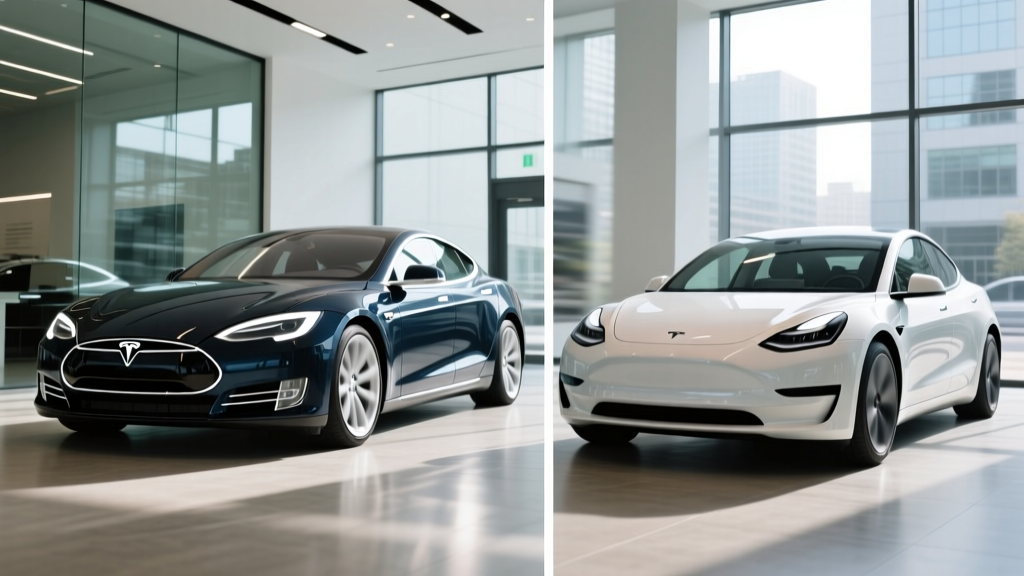
The Short Answer: Flagship Sedan vs. Mass-Market Benchmark
The Tesla Model S and Model 3 share a badge, a charging network, and a software ecosystem — but they serve fundamentally different buyers. The Model S is Tesla's flagship luxury sedan: larger, faster, longer-legged, and priced accordingly. The Model 3 is the company's volume car: compact, efficient, and — crucially — eligible for the full federal EV tax credit that the Model S cannot touch.
If you're researching the difference between Model S and Model 3, the decision almost always comes down to three factors: budget, space requirements, and whether you need the performance envelope the Model S provides. Let's break it down with hard numbers.
Side-by-Side Spec Comparison: 2025/2026 Model Year
The table below reflects current EPA data and Tesla's published specifications. Note that Tesla adjusts pricing and specs periodically — always verify on Tesla's configurator before purchasing.
| Specification | Tesla Model 3 Long Range AWD | Tesla Model S Long Range | Tesla Model S Plaid |
|---|---|---|---|
| EPA Range | 363 mi | 402 mi | 359 mi |
| Battery (usable, est.) | ~79 kWh (NMC) | ~95 kWh (NMC) | ~95 kWh (NMC) |
| Efficiency (MPGe) | 134 MPGe combined | 120 MPGe combined | 116 MPGe combined |
| Peak DC Fast Charge | 250 kW | 250 kW | 250 kW |
| 10–80% DC Charge Time | ~28 min | ~30 min | ~30 min |
| Level 2 Charge Rate | 11.5 kW (44 mi/hr) | 11.5 kW (34 mi/hr) | 11.5 kW (34 mi/hr) |
| 0–60 mph | 4.2 sec | 3.1 sec | 1.99 sec |
| Horsepower | 346 hp | 670 hp | 1,020 hp |
| Cargo Volume | 23 cu ft (trunk + frunk) | 28 cu ft (liftback + frunk) | 28 cu ft (liftback + frunk) |
| Seating | 5 | 5 | 5 |
| Base MSRP | $47,740 | $79,990 | $94,990 |
| Federal Tax Credit (§30D) | $7,500 eligible | Not eligible (MSRP cap) | Not eligible (MSRP cap) |
| Effective Price (w/ credit) | ~$40,240 | $79,990 | $94,990 |
| Warranty (battery/drive) | 8 yr / 120,000 mi | 8 yr / 150,000 mi | 8 yr / 150,000 mi |
Sources: EPA / fueleconomy.gov, Tesla Model S specs, Tesla Model 3 specs. Tax credit eligibility per IRS §30D rules — subject to buyer income caps and battery-sourcing requirements.
Range and Efficiency: The Real-World Gap
On paper, the Model S Long Range leads with 402 miles of EPA range versus the Model 3 Long Range's 363 miles. That 39-mile gap matters on road trips — it's roughly the difference between stopping in a small town versus pushing through to a major city.
Model 3 Long Range: EPA 363 mi. Expect ~300–320 mi at sustained 75 mph highway speeds in mild weather. In freezing temperatures with cabin heat, plan for ~250–280 mi.
Model S Long Range: EPA 402 mi. Expect ~330–350 mi highway in mild conditions. Cold-weather highway range drops to ~280–310 mi.
Model S Plaid: EPA 359 mi. Aggressive driving or sustained high speeds can cut this to ~270 mi. The Plaid's tri-motor setup trades efficiency for output.
The Model 3's smaller, lighter platform gives it a meaningful efficiency advantage: 134 MPGe combined versus 120 MPGe for the Model S Long Range. That translates to lower per-mile electricity costs over ownership. If you drive 15,000 miles annually at a national average of $0.16/kWh, the Model 3 costs roughly $460/year to charge at home versus $520 for the Model S Long Range. Over five years, that's a ~$300 gap — modest, but it compounds.
Charging Speed and Network Access
Both vehicles peak at 250 kW on Tesla's V3 Superchargers and use the NACS (North American Charging Standard) connector natively. Neither has a charging-speed advantage at current-generation Superchargers.
| Charging Level | Model 3 LR | Model S LR / Plaid |
|---|---|---|
| Level 1 (120V, ~1.4 kW) | ~5 mi/hr | ~4 mi/hr |
| Level 2 (240V, 11.5 kW) | ~44 mi/hr | ~34 mi/hr |
| DC Fast (250 kW peak) | 10–80% in ~28 min | 10–80% in ~30 min |
One nuance: the Model 3 charges faster on Level 2 relative to its battery size because it adds 44 miles of range per hour versus 34 for the Model S. That means a full overnight charge from 20% to 100% takes about 7 hours in the Model 3 versus roughly 9 hours in the Model S. For most owners charging nightly from 60–80%, this difference is negligible — but if you arrive home near-empty, the Model 3 recovers faster.
Both vehicles benefit equally from Tesla's Supercharger network, which remains the most reliable public DC fast-charging ecosystem in the U.S. With NACS now adopted by Ford, GM, Rivian, and others, Supercharger stalls are getting busier — but Tesla owners still enjoy native plug-and-charge integration without adapters.
Performance: Where the Model S Justifies Its Price
This is where the gap becomes a chasm. The Model S Long Range delivers 670 horsepower and a 3.1-second 0–60 time — figures that would have defined a supercar a decade ago. The Plaid variant, with its tri-motor setup producing 1,020 hp, hits 60 mph in 1.99 seconds, making it one of the quickest production cars ever built.
The Model 3 Long Range is no slouch at 4.2 seconds to 60 mph with 346 hp. For merging, passing, and daily driving, it feels genuinely quick. But if track capability, triple-digit acceleration, or the sheer theater of absurd speed matters to you, the Model S Plaid occupies a category of its own.
Worth noting: the Model S's adaptive air suspension provides adjustable ride height and damping — useful for speed bumps, steep driveways, and highway comfort. The Model 3 uses a conventional steel-spring setup. It's well-tuned, but it doesn't offer the same range of compliance.
Price, Tax Credits, and the True Cost Gap
This is the single biggest differentiator for most buyers, and it's where the math flips dramatically.
| Cost Factor | Model 3 Long Range AWD | Model S Long Range |
|---|---|---|
| Base MSRP | $47,740 | $79,990 |
| Federal §30D Credit | −$7,500 (if eligible) | $0 (exceeds $55K sedan cap) |
| Effective Purchase Price | ~$40,240 | $79,990 |
| Price Gap After Credit | ~$39,750 | |
The federal EV tax credit under IRS §30D caps sedan eligibility at $55,000 MSRP. The Model 3 Long Range qualifies; the Model S does not — it's nearly $25,000 over the cap. This means the effective price gap between the two cars is nearly $40,000, not the ~$32,000 sticker gap.
Eligibility caveats for the Model 3 credit: The buyer must meet income caps ($150K single / $300K joint MAGI), and the vehicle must satisfy battery-component and critical-mineral sourcing requirements. Tesla's U.S.-built Model 3 has consistently qualified for the full $7,500, and as of 2025, buyers can transfer the credit to the dealer at point of sale for an immediate price reduction. Always verify current eligibility on IRS.gov before purchasing.
Five-Year Ownership Cost Estimate
| Cost Category (5 yr) | Model 3 LR AWD | Model S LR |
|---|---|---|
| Depreciation (est.) | ~$15,000 | ~$28,000 |
| Home Charging (15K mi/yr) | ~$2,300 | ~$2,600 |
| Insurance (avg.) | ~$9,500 | ~$14,000 |
| Maintenance / Tires | ~$2,200 | ~$3,500 |
| 5-Year Total (excl. purchase) | ~$29,000 | ~$48,100 |
The Model S costs significantly more to insure (luxury classification, higher repair costs), depreciates from a higher base, and wears through tires and suspension components faster due to its weight (~4,700 lb vs. ~4,000 lb). Over five years, the total cost of ownership gap widens to roughly $19,000 beyond the purchase-price difference.
Interior, Tech, and Daily Livability
Both cars share Tesla's minimalist interior philosophy: a single 15.4-inch central touchscreen (landscape in the Model 3, portrait-oriented 17-inch in the Model S), no physical instrument cluster, and a yoke or round steering wheel. Software features — navigation, over-the-air updates, Sentry Mode, the Tesla app — are functionally identical.
Where they diverge:
- Rear-seat space: The Model S offers noticeably more rear legroom and a wider rear bench. Adults can sit comfortably on long trips. The Model 3's rear seat fits adults but is tighter — fine for kids or short rides, less ideal for six-foot passengers on road trips.
- Cargo: The Model S's liftback design and larger trunk (28 cu ft total with frunk) swallows luggage more easily than the Model 3's conventional trunk lid (23 cu ft). Both have usable front trunks.
- Ride quality: Air suspension and additional sound insulation give the Model S a quieter, more compliant highway ride. The Model 3 is firmer and transmits more road texture — sporty, but less isolating on rough pavement.
- Displays: The Model S adds a rear-seat entertainment screen and a driver-facing instrument display. The Model 3 routes all information through the center screen.
Both vehicles offer Tesla's Autopilot (standard) and Full Self-Driving Supervised (optional, ~$8,000 or $99/mo). Despite the name, FSD is an SAE Level 2 driver-assistance system — it requires continuous driver supervision and does not make either car self-driving. Only Level 4 services like Waymo operate without a human driver in the loop.
Category Verdicts
402 miles EPA is the longest range Tesla currently sells. For road-trip-heavy drivers in the Mountain West or rural corridors, those extra 39 miles reduce stop frequency.
134 MPGe combined means lower electricity costs and fewer kWh drawn per mile. Over 100,000 miles, the Model 3 uses roughly 3,500 fewer kWh than the Model S.
At ~$40,240 after the federal credit, the Model 3 delivers 363 miles of range, AWD, and 4.2-second acceleration for less than half the Model S price.
1,020 hp, 1.99-second 0–60, tri-motor torque vectoring. Nothing at any price is meaningfully quicker. The Model 3 Performance (3.1 sec) is fast — the Plaid is a different sport.
Liftback cargo, more rear-seat room, air suspension, and a longer battery warranty (150K mi vs. 120K mi) make the Model S the better family hauler and road-trip companion.
44 mi/hr on Level 2 versus 34 mi/hr. The Model 3's smaller battery recovers proportionally faster on home charging — a real advantage for daily top-ups.
Decision Framework: Which Should You Buy?
Choose the Tesla Model 3 if:
- Your budget is under $50,000 (or ~$40K after the tax credit)
- You commute daily and want the lowest per-mile operating cost
- You qualify for the §30D federal tax credit (income under $150K single / $300K joint)
- You don't regularly carry adults in the rear seat
- You value efficiency and agility over outright power
- This is your first EV and you want a lower-stakes entry point
Choose the Tesla Model S if:
- You need maximum range (402 mi) for long, sparse-corridor road trips
- You regularly carry adult passengers in the rear seat
- You want air suspension for ride comfort and adjustable ground clearance
- Performance is a priority and you're considering the Plaid's 1,020 hp
- You've outgrown compact sedans and need liftback cargo flexibility
- The ~$40,000 price premium over the Model 3 is immaterial to your budget
Frequently Asked Questions
Does the Model 3 qualify for the $7,500 federal tax credit but the Model S does not?
Yes. Under current IRS §30D rules, sedans must have an MSRP under $55,000 to qualify. The Model 3 Long Range at $47,740 qualifies; the Model S at $79,990+ does not. Buyer income caps and battery-sourcing requirements also apply — verify on IRS.gov.
Is the Model S significantly bigger than the Model 3?
Yes. The Model S is roughly 11 inches longer, 3 inches wider, and rides on a wheelbase that's 4.5 inches longer. That translates to noticeably more rear legroom, shoulder room, and cargo capacity. If you're cross-shopping with a BMW 5 Series or Mercedes E-Class, the Model S is the comparable size. The Model 3 aligns more with a BMW 3 Series.
Which has lower insurance costs?
The Model 3, typically by a wide margin. Insurers classify the Model S as a luxury/performance vehicle with higher repair costs. Expect Model S premiums to run 30–50% higher than Model 3 premiums for the same driver profile. Get quotes from your insurer before committing — the difference can exceed $900/year.
Can I get the Model 3 with a Performance variant for more speed?
Yes. The Model 3 Performance (2025 refresh) delivers 510 hp and a 2.9-second 0–60 time for approximately $54,990. It still may qualify for the federal credit depending on final MSRP configuration and eligibility rules — check the IRS clean vehicle credit list. It's a compelling middle ground between the Model 3 LR and the Model S Plaid.
Do both cars use the same charging connector?
Yes. Both use NACS natively, which means direct compatibility with Tesla's Supercharger network without adapters. As other automakers adopt NACS through 2025–2026, Supercharger stalls will see more non-Tesla traffic, but Tesla owners retain native plug-and-charge functionality.
Which battery will last longer?
Both use NMC (nickel manganese cobalt) chemistry with similar degradation profiles — expect roughly 85–90% capacity retention after 100,000 miles based on aggregated fleet data. The Model S carries a longer warranty: 8 years/150,000 miles versus 8 years/120,000 miles for the Model 3. Both warranties guarantee at least 70% capacity retention.