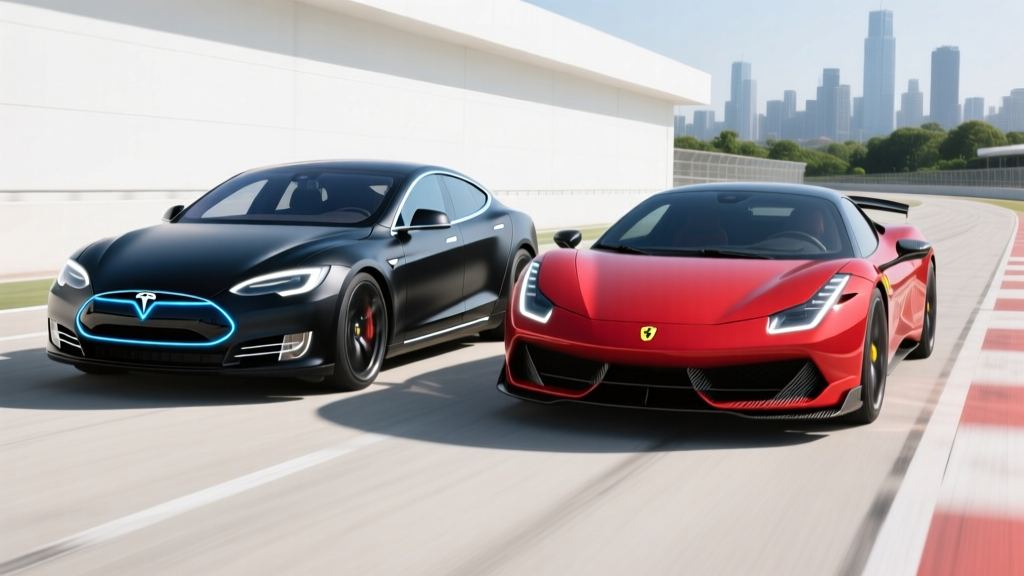
Comparing Tesla and Ferrari feels like pitting a quantum computer against a Swiss watch — both represent peak engineering, but they're solving entirely different problems. The Tesla Model S Plaid is a $90,000 four-door sedan that happens to demolish supercars at the drag strip. The Ferrari SF90 XX Stradale is a $850,000+ limited-run hybrid hypercar built for track glory and exclusivity. This isn't a contest of which is "better" in a vacuum. It's a breakdown of how two radically different philosophies of electrified performance stack up on paper, at the charger, and in your garage.
For this head-to-head, we're matching the 2026 Tesla Model S Plaid (the fastest Tesla sedan currently in production) against the 2026 Ferrari SF90 XX Stradale (Ferrari's most extreme road-legal plug-in hybrid). One is a pure battery-electric daily driver. The other is a twin-turbo V8 PHEV track weapon. Let's get into the numbers.
Side-by-Side Specifications: Tesla Model S Plaid vs Ferrari SF90 XX Stradale
| Spec | 2026 Tesla Model S Plaid | 2026 Ferrari SF90 XX Stradale |
|---|---|---|
| Powertrain | Tri-motor AWD (BEV) | 4.0L Twin-Turbo V8 + 3 electric motors (PHEV) |
| Horsepower | 1,020 hp | 1,016 hp (combined) |
| 0–60 mph | 1.99 sec | 2.3 sec |
| Top Speed | 200 mph | 199 mph |
| EPA Electric Range | 396 mi (BEV total) | ~16 mi (electric-only) |
| Total Range (fuel + electric) | 396 mi | ~435 mi (combined gas + electric) |
| Battery Capacity | ~100 kWh usable (NMC) | 7.9 kWh (lithium-ion) |
| DC Fast Charge (10–80%) | ~250 kW peak, ~27 min | N/A (AC charge only, ~7.4 kW) |
| Level 2 AC Charge Rate | 11.5 kW (~44 mi/hr) | 7.4 kW (~full in ~1 hr) |
| MPGe / Combined Efficiency | 116 MPGe | ~14 MPGe (hybrid mode, est.) |
| EPA Fuel Economy (gas) | N/A | ~16 mpg combined (V8) |
| Cargo Volume | 28 cu ft (trunk + frunk) | ~3.5 cu ft (rear shelf only) |
| Seating | 5 passengers | 2 passengers |
| Curb Weight | 4,766 lbs | 3,527 lbs |
| Base MSRP | $89,990 | ~$850,000+ (limited allocation) |
| Federal Tax Credit (§30D) | Up to $7,500 (income/MSRP eligible) | $0 (exceeds MSRP cap) |
| Powertrain Warranty | 8 yr / 150,000 mi | 3 yr / unlimited mi + 7 yr maintenance |
Sources: EPA Fueleconomy.gov, Tesla Model S specs, Ferrari official specifications.
Range, Charging, and Real-World Usability
This category is a blowout, and it illustrates the fundamental divide between these two machines.
The Model S Plaid's 396-mile EPA range is legitimate daily-driver territory. In real-world highway testing at 70–75 mph, expect roughly 310–340 miles before needing to stop. In cold weather (below 30°F), that number can drop to 260–290 miles due to battery chemistry limitations and cabin heating demands. Still, paired with Tesla's Supercharger network — which now includes 350 kW V4 stalls in many corridors — a 10–80% charge takes approximately 27 minutes at peak rate. The charge curve tapers sharply above 80%, as it does with all NMC lithium-ion packs, so road-trippers should plan to charge to 80% and move on rather than wait for a full top-off.
Tesla Model S Plaid: EPA 396 mi → expect ~310–340 mi highway, ~260–290 mi cold weather
Ferrari SF90 XX: EPA ~16 mi electric-only → expect ~12–14 mi real-world EV mode; otherwise running on V8
The Ferrari SF90 XX Stradale is a plug-in hybrid, not a BEV. Its 7.9 kWh battery delivers roughly 16 miles of electric-only range — enough for a quiet departure from your neighborhood or a zero-emission crawl through a city center. Once that buffer is depleted, the twin-turbo V8 takes over, and you're burning premium fuel at roughly 16 mpg combined. The SF90 XX has no DC fast-charging capability; it tops up via Level 2 AC at 7.4 kW, reaching a full charge in about an hour. For a hypercar buyer, this is a feature, not a compromise — the electric motors exist for torque-fill and track performance, not commute electrification.
🏆 Range & Charging Winner: Tesla Model S Plaid
396 miles of usable electric range, 250 kW DC fast charging, and access to the most reliable public charging network in North America. The SF90 XX's 16-mile EV range is a party trick by comparison.
Performance and Driving Dynamics
Here's where the comparison gets fascinating. On pure acceleration numbers, the Tesla wins. The Model S Plaid's tri-motor setup delivers 1,020 horsepower and a manufacturer-claimed 1.99-second 0–60 mph time — a figure that was science fiction for a production sedan just five years ago. The instant torque delivery from three electric motors means no turbo lag, no shift interruption, and relentless thrust from a standstill.
But raw drag-strip numbers only tell part of the story. The Ferrari SF90 XX Stradale produces 1,016 combined horsepower (780 from the V8, 236 from three electric motors) and hits 60 mph in 2.3 seconds. It's 0.3 seconds behind to 60, but the Ferrari's purpose is fundamentally different. At 3,527 pounds — over 1,200 lbs lighter than the Tesla — the SF90 XX generates massive downforce (over 1,100 lbs at 155 mph via its active rear wing and underbody aero), offers carbon-ceramic brakes with staggering fade resistance, and delivers steering feel and chassis feedback that no 4,700-pound sedan can match on a road course.
On a track like Laguna Seca or COTA, the Ferrari would walk away from the Tesla through the corners. In a quarter-mile pull from a stoplight, the Tesla wins. Different tools for different jobs.
🏆 Straight-Line Performance: Tesla Model S Plaid
1.99-second 0–60 is the quickest production sedan ever made. Instant electric torque, no drama.
🏆 Track & Handling: Ferrari SF90 XX Stradale
1,200 lbs lighter, active aero, carbon ceramics, and race-bred chassis tuning. This is what Maranello does best.
Pricing, Tax Credits, and Acquisition Cost
This is where the comparison borders on absurd — and that's the point. These vehicles exist in different financial universes.
| Cost Factor | Tesla Model S Plaid | Ferrari SF90 XX Stradale |
|---|---|---|
| Base MSRP | $89,990 | ~$850,000+ |
| Typical As-Tested Price | $92,000–$97,000 | $900,000–$1,100,000+ (options, allocation premiums) |
| Federal §30D Tax Credit | Up to $7,500 (if income <$150k single / $300k joint; vehicle MSRP <$55k sedan cap — note: Model S exceeds the $55,000 sedan MSRP cap, making it ineligible for the new-vehicle credit as of current IRS rules) | $0 (far exceeds MSRP cap) |
| Effective Starting Price | ~$89,990 (no credit due to MSRP cap) | ~$850,000+ |
| Destination Fee | $1,390 | Included / varies by dealer |
Critical tax credit note: Under current IRS §30D rules, the new clean vehicle credit has a $55,000 MSRP cap for sedans. The Model S Plaid, at $89,990, exceeds this cap and does not qualify for the $7,500 federal credit. Some buyers may offset cost through state-level incentives (which vary by jurisdiction — check your state's energy office) or by purchasing a used Model S under the separate used-EV credit (up to $4,000, with lower income caps). The Ferrari, obviously, qualifies for zero electrification incentives.
🏆 Value Winner: Tesla Model S Plaid
Supercar-killing acceleration for under $100,000. No contest on price-to-performance ratio.
Tech, Interior, and Daily Usability
The Model S interior is minimalist to a fault: a 17-inch center touchscreen, a 12.3-inch instrument cluster, and a yoke (or optional round) steering wheel. The infotainment system is among the best in any vehicle, with native navigation, Over-the-Air updates, and access to Tesla's growing app ecosystem. The 28 cubic feet of combined cargo space (trunk + front trunk) makes it genuinely practical for grocery runs, road trips, or family duty. Five seats, ISOFIX child-seat anchors, and a HEPA air filtration system round out the daily-driver credentials.
The Ferrari SF90 XX interior is a driver-focused cockpit: a 15.6-inch curved instrument cluster, haptic touch controls on the steering wheel, and carbon fiber everywhere. There's no frunk, virtually no rear cargo, two seats, and a ride height that will scrape every steep driveway. The infotainment is functional but secondary to the driving experience. Apple CarPlay is available; there's no native navigation comparable to Tesla's trip planner. This is a car you drive, not a car you live in.
On driver-assistance technology, Tesla's Autopilot (standard) and available Full Self-Driving (Supervised) offer SAE Level 2 highway lane-keeping, adaptive cruise, and automatic lane changes. Ferrari offers basic ADAS — adaptive cruise, lane departure warning — but makes no pretense of autonomy. Neither system is "self-driving"; both require the driver to remain fully engaged at all times.
🏆 Tech & Daily Usability: Tesla Model S Plaid
Best-in-class infotainment, OTA updates, Supercharger trip planning, practical cargo, five seats. The Ferrari is a weekend toy.
Ownership Costs: Insurance, Maintenance, Efficiency
| 5-Year Ownership Factor | Tesla Model S Plaid | Ferrari SF90 XX Stradale |
|---|---|---|
| Estimated Annual Insurance | $3,800–$5,200/yr | $12,000–$18,000+/yr (specialty collector policies) |
| 5-Year Fuel / Energy Cost | ~$4,500 (electricity at $0.14/kWh avg) | ~$18,000+ (premium fuel at ~16 mpg, limited miles) |
| Scheduled Maintenance (5 yr) | ~$500–$1,000 (cabin filter, wipers, brake fluid) | $7,500–$15,000+ (annual service, though Ferrari includes 7-yr maintenance program) |
| Tire Replacement (5 yr) | ~$1,600–$2,800 (performance tires, 1–2 sets) | ~$4,000–$6,000 (Michelin Pilot Sport Cup 2R, 1–2 sets) |
| Depreciation (5 yr, est.) | ~40–50% ($36,000–$45,000) | Highly variable — limited-run Ferraris can hold or appreciate |
| Battery Warranty | 8 yr / 150,000 mi (min 70% retention) | 7 yr hybrid system warranty |
The Tesla is dramatically cheaper to operate day-to-day. Electricity costs roughly $0.04–$0.06 per mile depending on your rate, versus $0.30+ per mile for the Ferrari on premium gasoline. Tesla maintenance is minimal — no oil changes, no spark plugs, no exhaust system, and regenerative braking extends pad life significantly. The Ferrari's 7-year maintenance program covers scheduled service, but consumables (brakes, tires, clutch components in the hybrid system) add up quickly.
Insurance is a major differentiator. The Model S Plaid carries high premiums for a sedan (it's a 1,020-hp vehicle that attracts spirited drivers), but the Ferrari requires specialty collector-car insurance or high-value vehicle policies that can exceed $15,000 annually depending on your driving record and garage security.
Depreciation is the wildcard. The Model S has historically lost 40–50% of its value over five years — a painful reality for EVs broadly, driven by rapid tech iteration and Tesla's frequent price adjustments. The SF90 XX, as a limited-production Ferrari (only 799 units globally), may hold value or even appreciate among collectors. For Ferrari buyers, the car is as much an asset as a vehicle.
🏆 Ownership Cost Winner: Tesla Model S Plaid
Fraction of the running costs. Electricity is cheap, maintenance is minimal, and it seats five.
🏆 Asset/Collector Value: Ferrari SF90 XX Stradale
Limited-run Ferraris historically hold or gain value. The Tesla is a depreciating consumer product.
Charging Network and Infrastructure Considerations
Tesla owners benefit from the most mature DC fast-charging network in North America. As of 2026, the Supercharger network exceeds 6,500 stations and 65,000+ stalls in the US alone, with V4 cabinets delivering up to 350 kW. The Model S uses the native NACS connector — no adapter needed. Trip planning is seamless: the car's navigation automatically routes through Superchargers, preconditions the battery for optimal charge speed, and displays real-time stall availability.
The Ferrari SF90 XX has no DC fast-charging capability. Its 7.9 kWh battery charges exclusively via AC — either a standard 120V outlet (Level 1, ~3 hours for a full charge) or a 240V Level 2 charger (7.4 kW, ~1 hour). For a PHEV with 16 miles of EV range, this is perfectly adequate: most owners will plug in at home overnight and wake to a full battery every morning. The gas tank handles everything else. There's no "charging anxiety" because there's no dependence on public charging infrastructure.
Decision Framework: Which Should You Choose?
Choose the Tesla Model S Plaid if:
- You want supercar-level acceleration (1.99s 0–60) for under $100,000
- You need a daily driver with 5 seats, cargo space, and 396 miles of range
- You want access to the best DC fast-charging network for road trips
- You value over-the-air software updates and cutting-edge infotainment
- You want minimal maintenance costs and cheap "fuel" (electricity)
- You commute daily and want a practical, fast, zero-tailpipe-emission vehicle
Choose the Ferrari SF90 XX Stradale if:
- You're a collector seeking a limited-production, track-focused hypercar (799 units)
- You prioritize handling, weight, aerodynamics, and track lap times over straight-line acceleration
- You want the emotional experience of a twin-turbo V8 with hybrid torque-fill
- You value potential asset appreciation and exclusivity over practicality
- You have a dedicated garage, a track membership, and other daily-driver vehicles
- Budget is genuinely not a constraint ($850,000+ acquisition, $15,000+/yr insurance)
Frequently Asked Questions
Is the Tesla Model S Plaid faster than a Ferrari?
In a straight line, yes. The Model S Plaid's 1.99-second 0–60 mph time beats the SF90 XX Stradale's 2.3 seconds. However, on a road course or race track, the Ferrari's 1,200-lb weight advantage, active aerodynamics, and race-bred chassis make it significantly faster through corners and under heavy braking.
Does the Tesla Model S qualify for the $7,500 federal tax credit?
No. Under current IRS §30D rules, the new clean vehicle credit caps sedan MSRP at $55,000. The Model S Plaid starts at $89,990, well above the cap. Some buyers may qualify for state-level incentives or the used-EV credit (up to $4,000) when purchasing pre-owned. Always consult a tax professional for your specific situation.
Can the Ferrari SF90 XX drive on electric power only?
Yes, for approximately 16 miles (EPA estimate) using its 7.9 kWh battery and three electric motors. In real-world driving, expect 12–14 miles of EV-only range at moderate speeds. After that, the twin-turbo V8 engages and the car operates as a hybrid.
Which is cheaper to own long-term?
The Tesla Model S Plaid, by an enormous margin. Over five years, the Tesla will cost roughly $4,500 in electricity and $500–$1,000 in maintenance. The Ferrari will cost $18,000+ in fuel and $7,500–$15,000 in maintenance (even with Ferrari's included maintenance program). Insurance alone is $10,000+ more per year for the Ferrari. However, the Ferrari may hold or appreciate in value as a collector asset, while the Tesla will depreciate significantly.
Is the Ferrari SF90 XX a fully electric car?
No. The SF90 XX Stradale is a plug-in hybrid electric vehicle (PHEV). It pairs a 4.0-liter twin-turbocharged V8 engine with three electric motors and a 7.9 kWh battery. It can drive short distances on electric power alone but primarily relies on its gasoline engine.
Which has better technology: Tesla or Ferrari?
For infotainment, software, connectivity, and driver-assistance features, Tesla wins decisively. The 17-inch touchscreen, OTA updates, native trip planning, and Autopilot/FSD (Supervised) Level 2 ADAS are industry-leading. Ferrari's tech is focused on vehicle dynamics — traction control, active aero, hybrid powertrain management — not digital convenience. Different priorities, different winners.
Final Verdict
There is no universal winner in this Tesla vs Ferrari comparison because these vehicles serve fundamentally different purposes and exist at a 10x price gap. The Tesla Model S Plaid is the rational choice for anyone who wants extreme performance wrapped in daily-driver practicality — it's a four-door sedan that outruns most supercars to 60 mph, seats five, carries groceries, and runs on electricity for pennies per mile. The Ferrari SF90 XX Stradale is an emotional, exclusive, track-focused hypercar for collectors who value driving purity, brand heritage, and potential asset appreciation over practicality or cost efficiency.
If you have the budget for only one performance vehicle and need it to serve as your daily driver, the Model S Plaid is the smarter buy. If you already have a stable of daily drivers and want a limited-edition Ferrari for weekends and track days, the SF90 XX is in a league the Tesla can't enter. The right answer depends entirely on your priorities, your budget, and what you need the car to do on Monday morning.