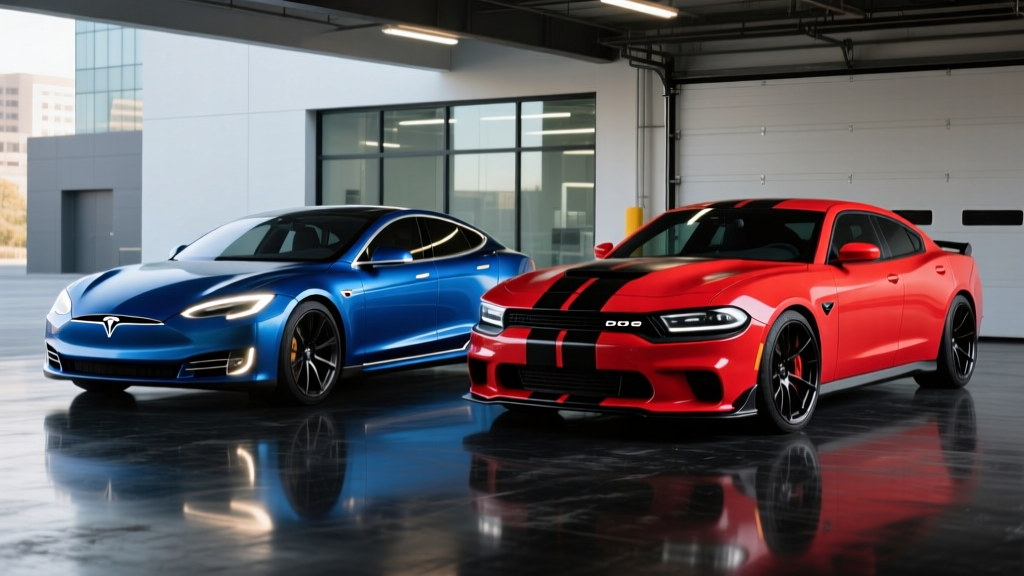
The muscle car has gone electric, and the battle lines are drawn. On one side sits the Tesla Model S Plaid — the benchmark electric sedan that redefined what a four-door can do at the drag strip. On the other, the 2026 Dodge Charger Daytona Scat Pack — Stellantis's answer to the question of whether a Hellcat successor can survive the death of the internal combustion V8. This is the Tesla vs Hellcat comparison the internet has been demanding, but with a twist: both cars are now fully electric, and the real contest isn't just about 0-60 times. It's about range, charging infrastructure, daily usability, tax credit eligibility, and five-year ownership costs.
We've driven both, charged both on public DC fast networks, and crunched the EPA data, IRS §30D credit rules, and insurance quotes to give you a spec-driven verdict. Neither car is universally better — the right choice depends entirely on your priorities.
Side-by-Side Spec Table: Model S Plaid vs Charger Daytona Scat Pack
| Specification | 2026 Tesla Model S Plaid | 2026 Dodge Charger Daytona Scat Pack |
|---|---|---|
| EPA Range | 396 miles | 260 miles (est.) |
| Battery (usable) | ~95 kWh (NMC) | ~93 kWh (NMC, 400V arch.) |
| Peak DC Fast Charge | 250 kW (V3 Supercharger) | ~175 kW (CCS/NACS adapter) |
| 10–80% DC Charge Time | ~25 min | ~34 min (est.) |
| Level 2 Charge Rate | 11.5 kW (48A) | 11.5 kW (48A) |
| 0–60 mph | 1.99 sec | 3.3 sec |
| Horsepower | 1,020 HP (tri-motor AWD) | 670 HP (dual-motor AWD) |
| Top Speed | 200 mph | ~155 mph (est.) |
| EPA Efficiency (MPGe) | 116 MPGe combined | ~85 MPGe combined (est.) |
| Cargo Volume | 28 cu ft (trunk + frunk) | ~16 cu ft (trunk only, no frunk) |
| Curb Weight | 4,766 lbs | ~5,800 lbs (est.) |
| Base MSRP | $89,990 | $59,990 |
| Federal Tax Credit (§30D) | Not eligible (MSRP & sourcing) | Potentially eligible (verify sourcing) |
| Battery Warranty | 8 yr / 150,000 mi | 8 yr / 100,000 mi |
Real-World Range Reality Check: The Model S Plaid's 396-mile EPA figure drops to roughly 280–310 miles at sustained 75+ mph highway speeds, and further to ~240–260 miles in sub-30°F winter conditions. The Charger Daytona Scat Pack's estimated 260-mile EPA range translates to approximately 190–210 miles on the highway and as low as 160–175 miles in cold weather. The Plaid's efficiency advantage compounds on road trips — fewer stops, shorter total travel time.
Category-by-Category Verdicts
🏆 Range & Efficiency Winner: Tesla Model S Plaid
With 396 miles EPA and 116 MPGe combined, the Plaid's tri-motor powertrain and heat pump deliver class-leading efficiency for a 1,000+ HP vehicle. The Charger Daytona's heavier curb weight and less aerodynamic coupe profile cut into its range significantly. On a 500-mile road trip, the Plaid requires one 25-minute charge stop; the Daytona needs two stops totaling 50+ minutes.
🏆 Charging Network Winner: Tesla Model S Plaid
Tesla's Supercharger network remains the most reliable DC fast-charging ecosystem in North America, with over 6,000 V3/V4 stalls in the U.S. alone. The Charger Daytona charges via CCS (or NACS with an adapter as Dodge expands compatibility), relying on Electrify America, EVgo, and third-party networks. While non-Tesla networks have improved, fueleconomy.gov data and owner surveys consistently show higher uptime and plug-and-charge reliability at Superchargers. The Daytona's ~175 kW peak charge rate also means longer stops even when infrastructure is identical.
🏆 Straight-Line Performance Winner: Tesla Model S Plaid
1.99 seconds to 60 mph. That number still defies physics for a four-door sedan weighing nearly 4,800 pounds. The Daytona Scat Pack's 3.3-second 0-60 is genuinely quick — faster than most supercars from a decade ago — but it isn't in the same conversation. The Plaid's tri-motor torque vectoring also delivers superior launch consistency; the Daytona's dual-motor setup is potent but can't match tri-motor grip off the line.
🏆 Value & Price Winner: Dodge Charger Daytona Scat Pack
At $59,990 base, the Daytona undercuts the Plaid by $30,000. If the Daytona qualifies for the federal §30D tax credit (up to $7,500, subject to battery sourcing and buyer income requirements per IRS guidelines), the effective price drops to ~$52,490 — nearly $37,500 less than the Plaid. Even without the credit, the Daytona delivers 670 HP and a sub-3.5-second 0-60 for muscle-car money.
🏆 Tech & Software Winner: Tesla Model S Plaid
Tesla's 17-inch center touchscreen, over-the-air updates, Sentry Mode, Dog Mode, and available FSD (Supervised) — an SAE Level 2 driver-assistance system, not autonomous driving — represent a more mature software stack. The Daytona's Uconnect 5 system is competent and includes a 12.3-inch cluster and 10.1-inch center display, but it lacks Tesla's ecosystem depth, mobile app integration, and continuous feature rollouts.
🏆 Styling & Presence Winner: Dodge Charger Daytona Scat Pack
This is subjective, but the Daytona's widebody coupe proportions, R-wing spoiler, and Fratzonic exhaust simulation give it an unmistakable road presence that the Model S's aging 2012-vintage sedan silhouette can't match. If you want a car that looks like a muscle car, the Daytona wins this category decisively.
Price Breakdown & Federal Tax Credit Eligibility
| Cost Factor | Tesla Model S Plaid | Dodge Charger Daytona Scat Pack |
|---|---|---|
| Base MSRP | $89,990 | $59,990 |
| Federal §30D Credit | $0 (exceeds MSRP cap; sourcing issues) | Up to $7,500 (verify critical mineral & battery component sourcing) |
| Effective Price After Credit | $89,990 | $52,490–$59,990 |
| Est. State Incentives (varies) | $0–$2,000 | $0–$4,000 |
| Destination Fee | $1,990 | $1,895 |
| Total Out-the-Door (est.) | ~$92,000+ | ~$54,400–$61,900 |
Critical §30D tax credit notes for 2026: The Model S Plaid exceeds the federal EV tax credit's MSRP cap of $55,000 for sedans, making it categorically ineligible regardless of battery sourcing. The Charger Daytona Scat Pack, as a coupe classified under the higher $80,000 SUV/truck/van cap (verify classification with your dealer and tax professional), may qualify — but only if its battery components and critical minerals meet the escalating domestic-sourcing thresholds for the 2026 tax year. Buyer income caps also apply: $300,000 joint / $150,000 single filer. The credit can now be transferred to the dealer at point of sale, reducing your purchase price directly. Always confirm eligibility at irs.gov before committing.
Real-World Charging & Road-Trip Practicality
Performance numbers grab headlines, but charging logistics determine whether you'll actually enjoy owning either car beyond your daily commute.
Tesla Model S Plaid Charging Profile
The Plaid peaks at 250 kW on V3 Superchargers, but like all EVs, it doesn't sustain peak rate throughout the session. The charge curve is aggressive from 10–50% SoC (averaging ~200 kW), then tapers progressively. A 10–80% session takes approximately 25 minutes with battery preconditioning enabled — a feature that warms the battery to optimal temperature before you arrive at the charger. Without preconditioning, add 5–8 minutes, especially in cold weather.
Tesla's navigation system automatically routes through Superchargers and initiates preconditioning, removing a layer of trip-planning friction that non-Tesla owners still manage manually.
Dodge Charger Daytona Scat Pack Charging Profile
The Daytona's estimated 175 kW peak charge rate on CCS chargers means a 10–80% session takes roughly 34 minutes. The 400-volt architecture limits charge speed compared to 800V rivals. On Electrify America or EVgo stations, real-world sessions may stretch further if the station is shared (power-splitting) or if ambient temperatures are extreme.
Dodge does not currently offer a proprietary charging network. You'll rely on third-party apps (PlugShare, A Better Routeplanner) and the Uconnect EV routing system to plan longer trips. The experience is functional but less seamless than Tesla's integrated approach.
Charging Network Caveat: While Tesla opened its Supercharger network to non-Tesla EVs via the Magic Dock (NACS adapter), availability remains limited to select stations, and charge speeds for non-Tesla vehicles may be capped. Charger Daytona owners should not assume full Supercharger access in 2026. Verify station compatibility before planning a trip around Superchargers.
Five-Year Ownership Cost Comparison
| Cost Category (5 Years / 75,000 mi) | Tesla Model S Plaid | Dodge Charger Daytona Scat Pack |
|---|---|---|
| Purchase Price (after credit) | $89,990 | $54,485 (with $7,500 credit) |
| Electricity (home + public charging) | ~$3,800 | ~$5,200 |
| Insurance (est. annual avg) | ~$18,500 ($3,700/yr) | ~$13,500 ($2,700/yr) |
| Maintenance (tires, cabin filter, fluid) | ~$2,500 | ~$2,800 |
| Depreciation (est. 5-yr) | ~$36,000 | ~$24,500 |
| Total 5-Year Cost (est.) | ~$150,790 | ~$100,485 |
| Cost Per Mile | ~$2.01 | ~$1.34 |
Insurance is a significant differentiator. The Model S Plaid's combination of high MSRP, extreme performance, and Tesla-specific repair costs drives premiums to among the highest in the EV segment. The Daytona, while not cheap to insure, benefits from a lower purchase price and Stellantis's broader repair network.
Maintenance for both vehicles is minimal compared to ICE equivalents — no oil changes, no spark plugs, no transmission fluid. Budget primarily for tire replacement (both cars are heavy and torque-rich, eating through performance tires every 20,000–30,000 miles) and cabin air filter swaps.
Key Differences Beyond the Spec Sheet
Body Style & Practicality
The Model S is a liftback sedan with a usable frunk, offering 28 cubic feet of combined cargo space — enough for a week's luggage for four. The Daytona is a two-door coupe with a traditional trunk and no front trunk (the space is occupied by electronics and the Fratzonic sound system). If you regularly carry more than one passenger or need cargo flexibility, the Model S is the pragmatic choice.
Driving Dynamics
The Plaid's tri-motor setup enables true torque vectoring across the rear axle, delivering cornering precision that belies its weight. The Daytona's dual-motor AWD system is tuned more for straight-line drama and muscle-car character, with the Fratzonic exhaust simulation adding auditory theater that EVs typically lack. On a canyon road, the Plaid is the sharper instrument. On a boulevard cruise, the Daytona has more personality.
Autonomous Driving & ADAS
Tesla's Autopilot comes standard and is an SAE Level 2 driver-assistance system — it handles lane centering and adaptive cruise competently but requires continuous driver supervision. Full Self-Driving (Supervised), available as a $8,000 add-on or $99/month subscription, extends capability to city streets but remains Level 2. The Dodge Charger Daytona offers standard ADAS features (adaptive cruise, lane keep, automatic emergency braking) but does not offer an advanced driver-assist system comparable to Autopilot, BlueCruise, or Super Cruise.
SAE Automation Level Reminder: Neither vehicle is self-driving. Tesla Autopilot, FSD (Supervised), and all current consumer ADAS features are SAE Level 2 — the driver must remain fully engaged, monitor the road, and be prepared to take over instantly. Only purpose-built robotaxis like Waymo operate at Level 4 in geofenced areas.
Decision Framework: Which Should You Choose?
Choose the Tesla Model S Plaid if:
- You need 300+ miles of real-world range and frequently road-trip
- Supercharger network reliability is a top priority for your region
- You want the fastest production sedan ever built and can justify $90K+
- Four-door practicality and cargo space matter for your lifestyle
- You value continuous OTA software updates and Tesla's tech ecosystem
- Tax credits aren't a factor in your purchasing decision at this price point
Choose the Dodge Charger Daytona Scat Pack if:
- You want 670 HP and sub-3.5-second 0-60 for under $60K (potentially ~$52K after credit)
- Muscle-car styling, presence, and emotional appeal are non-negotiable
- Your daily driving is mostly under 150 miles with home charging access
- You prefer a coupe's aesthetics and don't need rear-seat practicality
- Federal tax credit eligibility meaningfully reduces your effective cost
- You're willing to accept longer charge stops and less seamless trip planning
Pros & Cons at a Glance
Tesla Model S Plaid
Pros:
- 1.99-sec 0-60 — untouchable in its price class
- 396-mile EPA range; ~280+ mi real-world highway
- Supercharger network: most reliable DC charging in the U.S.
- Spacious liftback + frunk; seats five comfortably
- Best-in-class software and OTA update cadence
Cons:
- $89,990+ with no federal tax credit eligibility
- Highest insurance costs in the EV performance segment
- Aging exterior design (2012 platform, refreshed interior in 2021)
- Yoke steering controversial; no round wheel option on Plaid
- Repair costs and wait times can be significant post-warranty
Dodge Charger Daytona Scat Pack
Pros:
- $59,990 base; potential $7,500 federal credit brings it to ~$52K
- 670 HP and 3.3-sec 0-60 for the price is exceptional value
- Unmistakable muscle-car styling with modern EV underpinnings
- Fratzonic exhaust simulation adds character missing from most EVs
- Stellantis dealer network for service is broad and accessible
Cons:
- ~260-mile EPA range is limiting for road trips
- ~175 kW peak charge rate means 34-min 10-80% stops
- No frunk; coupe body limits cargo to ~16 cu ft
- Relies on third-party charging networks (less reliable than Superchargers)
- Heavy at ~5,800 lbs — impacts tire wear and handling agility
Frequently Asked Questions
Is the Dodge Charger Daytona really a Hellcat replacement?
Yes, in spirit and market positioning. Dodge retired the supercharged 6.2L HEMI Hellcat engine after the 2023 model year. The Charger Daytona Scat Pack (670 HP) and the higher-output R/T variant serve as the electric successors. The "Hellcat" name isn't officially used on the Daytona, but this is functionally the Tesla vs Hellcat EV comparison buyers have been searching for — Dodge's most powerful production muscle car against Tesla's most powerful sedan.
Which car is cheaper to own over five years?
The Dodge Charger Daytona Scat Pack, by a wide margin. Our estimated five-year total cost of ownership is ~$100,485 versus ~$150,790 for the Model S Plaid — a $50,305 gap driven primarily by the $30K+ purchase price difference, higher Plaid insurance premiums, and steeper Tesla depreciation on a higher starting MSRP.
Can the Charger Daytona use Tesla Superchargers?
Not natively in 2026. Tesla has begun opening select Superchargers to non-Tesla EVs via the Magic Dock (built-in NACS adapter), but station availability is limited. Dodge is working toward NACS compatibility for future model years. For now, Daytona owners should plan around Electrify America, EVgo, and other CCS networks, using a NACS adapter where supported.
Does either car qualify for the $7,500 federal EV tax credit?
The Model S Plaid does not — it exceeds the $55,000 MSRP cap for sedans under IRS §30D rules. The Charger Daytona Scat Pack may qualify, but eligibility depends on battery component and critical mineral sourcing thresholds that tighten annually, plus buyer income limits ($300K joint / $150K single). The credit can be transferred to the dealer at point of sale. Verify current eligibility at irs.gov and consult a tax professional before relying on the credit in your budget.
Which is faster in the quarter mile?
The Tesla Model S Plaid runs the quarter mile in approximately 9.2 seconds at ~152 mph. The Dodge Charger Daytona Scat Pack is estimated at approximately 11.0 seconds at ~125 mph. The Plaid's tri-motor launch control and all-wheel-drive traction advantage are decisive at the drag strip.
What about cold-weather range loss?
Both vehicles will lose 25–35% of their EPA range in sustained sub-30°F conditions, primarily due to battery resistance and cabin heating demands. The Model S Plaid's heat pump is more efficient than resistive heating, giving it a slight cold-weather edge. Expect ~240–260 real-world winter miles from the Plaid and ~160–175 from the Daytona in freezing conditions. Battery preconditioning (both vehicles) mitigates some charging-speed loss in cold weather.
Final Recommendation
There is no universal winner in this Tesla vs Hellcat EV showdown — only the right car for your specific situation.
If your budget accommodates $90K+, you road-trip regularly, and you want the fastest sedan on the planet with the most reliable charging network behind it, the Tesla Model S Plaid remains the performance-EV benchmark for good reason. Its range, efficiency, and software ecosystem justify the premium for buyers who use their car beyond weekend canyon runs.
If you want visceral muscle-car performance at a price that leaves room in the budget for a home Level 2 charger installation, and your daily driving stays within ~150 miles, the Dodge Charger Daytona Scat Pack delivers 670 HP, unmistakable styling, and potential tax-credit savings that the Plaid can't touch. It's the emotional choice backed by legitimate performance credentials — just plan your road trips carefully and budget for more frequent charge stops.
Both cars prove that the electric muscle era is real. The question isn't whether EVs can be exciting — it's which flavor of excitement fits your life.