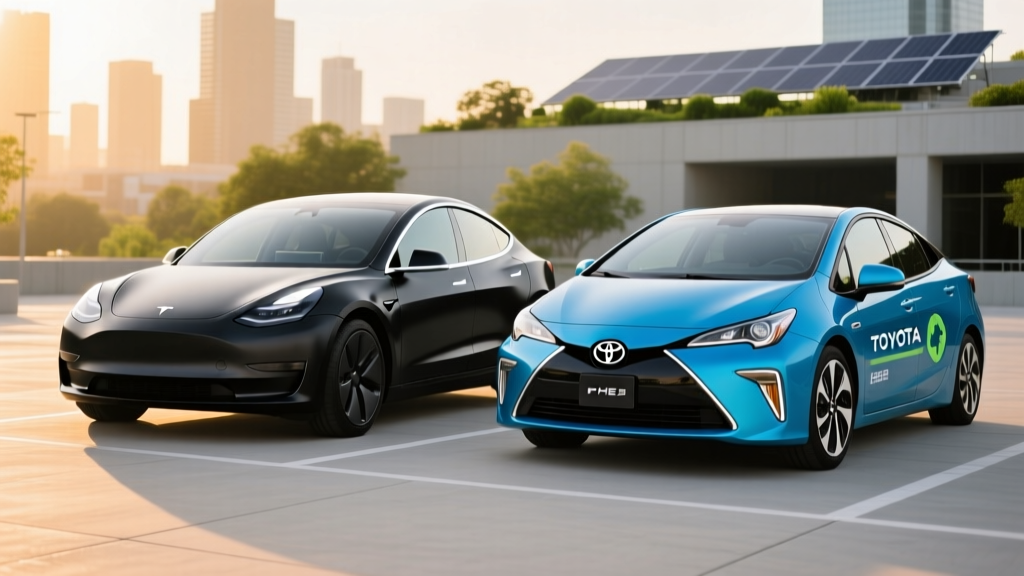
Comparing a battery-electric sedan to a plug-in hybrid might seem like matching a marathon runner against a sprinter, but the 2026 Tesla Model 3 and 2026 Toyota Prius Prime occupy the same $30,000–$40,000 decision space for efficiency-minded buyers. Both deliver electric-only commuting, low running costs, and strong reliability reputations — but they get there through fundamentally different engineering philosophies. This tesla vs prius comparison breaks down every number that matters: real-world range, charging infrastructure, federal tax credit eligibility, and five-year ownership cost.
Side-by-Side Specs: Model 3 Long Range vs Prius Prime XSE
Before diving into subjective categories, let's ground this comparison in hard data. The table below uses the most popular trims: the Tesla Model 3 Long Range AWD (the volume seller) and the Toyota Prius Prime XSE (the top-trim PHEV most cross-shoppers consider).
| Specification | Tesla Model 3 Long Range AWD | Toyota Prius Prime XSE |
|---|---|---|
| Powertrain | BEV (Dual Motor AWD) | PHEV (2.0L I4 + 2 Motors, FWD) |
| EPA Electric Range | 341 miles | 44 miles (EV-only), 430+ miles total |
| Battery Capacity (usable) | ~75 kWh (NMC) | 13.6 kWh (Lithium-ion) |
| EPA Efficiency | 132 MPGe (25 kWh/100mi) | 114 MPGe (EV) / 52 MPG combined (hybrid) |
| Max DC Fast Charge | 250 kW (peak) | No DC fast charging (Level 2 max) |
| 10–80% Charge Time | ~25 min (DC fast, preconditioned) | ~4 hours (Level 2, 240V/16A) |
| Level 2 Charge Rate | 11.5 kW (44 mi/hr) | 3.5 kW (est. 12–15 mi/hr EV range added) |
| Horsepower (combined) | 346 hp | 220 hp (net system) |
| 0–60 mph | 4.2 seconds | 6.6 seconds |
| Cargo Volume | 23 cu ft (trunk) + 3.1 cu ft (frunk) | 20.3 cu ft (trunk) |
| Base MSRP | $42,380 | $36,695 |
| Drivetrain | AWD | FWD |
| Battery Warranty | 8 yr / 120,000 mi | 10 yr / 150,000 mi (hybrid battery) |
Sources: fueleconomy.gov (EPA data), Tesla.com, Toyota.com. Specs reflect 2026 model year.
Range and Efficiency: How Far Can You Really Go?
Tesla Model 3 LR — Real-World Range Reality:
EPA sticker: 341 miles. Expect ~280–300 miles at sustained 75 mph highway speeds in moderate weather. In sub-30°F winter conditions, plan for ~230–260 miles before needing a charge. Tesla's heat pump helps, but cold still saps 15–25% of usable range.
Prius Prime XSE — Real-World Range Reality:
EPA EV-only: 44 miles. Expect ~35–40 miles of electric driving at highway speeds or in cold weather before the 2.0L gas engine engages. Once in hybrid mode, the combined 430+ mile total range holds up well — fueleconomy.gov lists 52 MPG combined, and real-world drivers commonly report 48–54 MPG in mixed driving.
The fundamental difference: the Model 3 gives you one long electric leash with no backup. The Prius Prime gives you a short electric leash with an unlimited gas safety net. For a 30-mile round-trip commute with home charging, the Prius Prime runs on electrons most days. For a 400-mile road trip, the Model 3 does it in one charge plus a 25-minute fast-charge stop, while the Prius Prime switches seamlessly to its 52-MPG hybrid mode with zero planning required.
Charging Infrastructure and Daily Convenience
This is where the ownership experience diverges sharply.
Tesla Model 3: Access to the Supercharger network — over 6,000 stations and 60,000+ stalls in North America as of 2026 — remains Tesla's strongest moat. Peak charging at 250 kW means a 10–80% session takes roughly 25 minutes when the battery is preconditioned (the car does this automatically when you navigate to a Supercharger). However, charging above 80% slows dramatically due to the charge curve taper, so road-trip strategy means charging to 80% and moving on. Home Level 2 charging at 11.5 kW adds about 44 miles of range per hour — an overnight session from 20% to full is roughly 7 hours.
Prius Prime: The Prius Prime does not offer DC fast charging. Its 13.6 kWh battery tops up via Level 2 (240V) in about 4 hours, or roughly 10–12 hours on a standard 120V household outlet (Level 1). For a PHEV with 44 miles of EV range, this is adequate: most owners plug in overnight and wake up to a full charge. The trade-off is that on long trips, you can't "fast charge" — you simply drive in hybrid mode on gasoline. The Prius Prime relies on the public Level 2 network (ChargePoint, EVgo L2, etc.) for opportunistic top-ups, but the small battery means the payoff is modest.
⚡ Charging Winner: Tesla Model 3
250 kW DC fast charging + Supercharger network reliability is unmatched for road-trip practicality. The Prius Prime's lack of DCFC is its biggest technical limitation — though for a PHEV with a 44-mile battery, it's less critical than it sounds.
🏠 Home Charging Simplicity: Prius Prime
No panel upgrade needed. A standard 120V outlet fully replenishes the small battery overnight. The Model 3's 11.5 kW Level 2 charging demands a 60A circuit and a professional install (typically $800–$2,000+ for the electrician work).
Price, Tax Credits, and True Cost to Buy
Sticker price tells only part of the story. Federal tax credit eligibility under IRS §30D can shift the value equation dramatically — but the rules are specific and not every buyer qualifies.
| Cost Factor | Tesla Model 3 LR AWD | Toyota Prius Prime XSE |
|---|---|---|
| Base MSRP | $42,380 | $36,695 |
| Destination Fee | $1,390 | $1,195 |
| Federal §30D Tax Credit (max) | Up to $7,500* | Up to $7,500* |
| Estimated Price After Credit | ~$36,270* | ~$30,390* |
| Home Charger Install (typical) | $1,200–$2,500 (240V/60A) | $0–$300 (120V outlet sufficient) |
| Effective First-Year Cost | ~$37,500–$38,800* | ~$30,400–$30,700* |
*§30D Tax Credit Caveats: Both vehicles may qualify for up to $7,500 under current IRS rules, but eligibility depends on: (1) buyer income caps ($150K single / $300K joint modified AGI), (2) MSRP caps ($55,000 for sedans — both qualify), (3) battery critical-mineral and component sourcing requirements that change annually, and (4) point-of-sale transfer availability. The Model 3 and Prius Prime have both qualified in recent years, but battery-sourcing rules tighten each year. Always verify current eligibility on the IRS clean vehicle credit page or with a tax professional before purchase.
💰 Value Winner: Toyota Prius Prime
Even with identical $7,500 credits, the Prius Prime starts $5,685 cheaper and requires minimal home charging investment. Effective first-year cost can be $7,000+ lower than the Model 3.
Performance, Tech, and Daily Driving Experience
Performance: The Model 3's 346 hp and 4.2-second 0–60 time put it in sports-sedan territory. Dual-motor AWD provides confident all-weather traction. The Prius Prime's 220 hp and 6.6-second 0–60 are respectable — the current-generation Prius is genuinely quick by PHEV standards — but it's FWD only, which matters in snow-belt states.
Technology: Tesla's minimalist interior centers on a 15.4-inch touchscreen controlling virtually every function. Over-the-air updates continuously add features. The Tesla app provides granular energy monitoring, scheduled charging, and cabin preconditioning. Autopilot (SAE Level 2) is standard; Full Self-Driving (Supervised) is a $8,000 add-on — and it's critical to understand that FSD is not autonomous driving. It requires active driver supervision at all times.
The Prius Prime takes a more traditional approach: physical buttons for climate and volume, a 12.3-inch infotainment screen with wireless Apple CarPlay and Android Auto, and Toyota Safety Sense 3.0 (adaptive cruise, lane-keeping, automatic emergency braking) as standard equipment. Toyota's driver-assist suite is solidly SAE Level 2 — no hands-off pretensions, just competent assistance.
SAE Automation Level Reminder: Both Tesla Autopilot/FSD (Supervised) and Toyota Safety Sense are SAE Level 2 driver-assistance systems. The driver must remain engaged, hands on or near the wheel, and eyes on the road at all times. Neither vehicle is "self-driving." Only Level 4 services like Waymo operate without a human driver — and those are limited to specific geofenced areas.
🏎️ Performance Winner: Tesla Model 3
346 hp, 4.2s 0–60, and AWD make this no contest. The Model 3 is one of the quickest sedans under $50K.
🖥️ Tech Winner: Tesla Model 3 (for enthusiasts) / Prius Prime (for pragmatists)
Tesla wins on software depth and OTA evolution. Toyota wins on intuitive controls, physical buttons, and zero learning curve.
Five-Year Ownership Cost Breakdown
The purchase price is just the opening move. Here's how the two vehicles compare over five years and 75,000 miles, assuming 15,000 miles/year, $0.14/kWh home electricity, $3.50/gallon gasoline, and the Prius Prime driven 70% in EV mode for daily commuting.
| Cost Category | Tesla Model 3 LR | Prius Prime XSE |
|---|---|---|
| Purchase (after $7,500 credit)* | $36,270 | $30,390 |
| Home Charger Install | $1,800 | $150 |
| Energy / Fuel (5 years) | $3,675 (electricity) | $3,100 (electricity + gasoline) |
| Maintenance (5 years) | $1,500 (tires, cabin filter, fluid top-offs) | $3,200 (oil changes, filters, brakes, tires) |
| Insurance (5-year avg) | $9,500 (higher EV premiums) | $7,000 |
| Estimated Depreciation | $16,000 | $11,500 |
| 5-Year Total | ~$72,745 | ~$55,340 |
| Cost Per Mile | ~$0.97 | ~$0.74 |
*Assumes full §30D eligibility. Actual credit may vary. Insurance estimates based on national averages; individual premiums vary significantly by state, driving record, and insurer. Depreciation estimates based on historical brand retention data from Kelley Blue Book and Edmunds. Consult irs.gov for current credit rules.
The Prius Prime's ownership advantage is substantial — roughly $17,400 over five years, or about $290/month. The main drivers are lower insurance premiums (Teslas consistently carry 25–40% higher insurance costs), lower depreciation (Toyota's resale value is among the strongest in the industry), and a lower initial purchase price. The Model 3 fights back with lower maintenance costs — no oil changes, fewer moving parts, and regenerative braking that extends brake pad life to 100,000+ miles in many cases.
📉 Ownership Cost Winner: Toyota Prius Prime
Lower purchase price, cheaper insurance, and strong resale value give the Prius Prime a commanding ~$17K five-year advantage for most buyers.
The Decision Framework: Which One Matches Your Life?
Choose the Tesla Model 3 Long Range if:
- You can install a Level 2 home charger (or already have one)
- Your daily commute is under 280 miles round-trip and you want zero gas expenses
- You take road trips and value 250 kW DC fast charging + Supercharger access
- Performance matters — you want AWD, 346 hp, and sub-4.5s 0–60
- You prefer a tech-forward, minimalist cabin with OTA updates
- You live in a state with high gas prices ($4.50+/gal) where electricity savings are maximized
Choose the Toyota Prius Prime XSE if:
- You can't install a Level 2 charger at home (apartment, no garage, panel limitations)
- Your commute is under 40 miles and you want EV-only daily driving with gas-engine freedom for longer trips
- You want the lowest total cost of ownership and don't want to think about charging logistics
- You live in a rural area or charging-desert region where public DCFC is scarce
- You value physical buttons, proven reliability, and a dealership service network within 20 miles
- You want AWD isn't critical (Prius Prime is FWD only)
Key Differences Summarized
Tesla Model 3 LR — Pros & Cons
Pros:
- 341-mile EPA range eliminates most range anxiety
- Supercharger network is the most reliable DCFC ecosystem in North America
- 346 hp AWD performance punches far above its price class
- Lowest maintenance costs of any vehicle in this comparison
- Continuous OTA software improvements
Cons:
- Higher insurance premiums ($2,500+ more over 5 years)
- Requires Level 2 home install for practical daily use
- Cold-weather range loss of 15–25% is real and measurable
- Minimalist interior frustrates some buyers (no instrument cluster, stalkless steering column)
- Tesla service center availability varies by region
Toyota Prius Prime XSE — Pros & Cons
Pros:
- 44-mile EV range covers most commutes; gas engine eliminates range anxiety entirely
- No home charging infrastructure investment required (120V works fine)
- 52 MPG hybrid mode is best-in-class when the battery depletes
- Toyota's resale value and dealer network provide long-term security
- Lower insurance, lower purchase price, lower five-year cost
Cons:
- No DC fast charging — long trips run on gasoline only
- FWD only — not ideal for heavy snow or mountain driving
- 220 hp is adequate, not thrilling
- EV-only range drops to ~35 miles in cold weather or at highway speeds
- Smaller EV battery means more frequent gas-engine engagement on longer commutes
Frequently Asked Questions
Is the Tesla Model 3 cheaper to own than the Prius Prime?
Not for most buyers. Over five years and 75,000 miles, the Prius Prime typically costs roughly $17,000 less in total ownership, driven by lower purchase price, cheaper insurance, and stronger resale value. The Model 3 saves on fuel and maintenance, but those savings don't overcome the insurance and depreciation gap. The math flips if you drive 25,000+ miles/year in a high-gas-price state and have cheap home electricity.
Can the Prius Prime really replace a gas car for road trips?
Yes — that's the PHEV advantage. Once the 44-mile EV battery is depleted, the Prius Prime operates as a conventional hybrid achieving 52 MPG combined. You refuel at any gas station in 5 minutes. A 600-mile road trip requires one or two gas stops, just like any efficient gasoline car. There is zero route planning or charging-app dependency.
Do both cars qualify for the $7,500 federal tax credit?
Both may qualify under IRS §30D rules, but eligibility is not guaranteed. It depends on your income (caps: $150K single, $300K joint), the vehicle's battery sourcing compliance (which changes annually), and MSRP limits ($55K for sedans — both qualify). The credit can be transferred to the dealer at point of sale as an instant discount. Always check the current IRS clean vehicle credit list before purchasing, as battery-sourcing compliance can change mid-year.
What happens to the Tesla's battery after 100,000 miles?
Tesla's NMC battery pack is warrantied for 8 years or 120,000 miles (whichever comes first) with a minimum 70% capacity retention threshold. Real-world data from high-mileage Model 3 owners shows typical degradation of 8–12% at 100,000 miles, meaning a 341-mile-new range drops to roughly 300–312 miles. Battery replacement, if needed out of warranty, runs $12,000–$16,000 at current pricing — a significant cost to factor into long-term ownership.
Which is better for apartment dwellers who can't charge at home?
The Prius Prime, decisively. A standard 120V outlet provides enough overnight charge for ~35–40 miles of EV commuting. Even without any home charging, the Prius Prime operates as a 52-MPG hybrid — still more efficient than most gas-only cars. The Model 3 can work without home charging if you have reliable workplace or public Level 2/DCFC access, but it adds daily logistics friction that the PHEV avoids entirely.
Final Verdict: Your Priorities Decide
There is no universal winner in the tesla vs prius debate — only the right answer for your specific situation. The Tesla Model 3 Long Range is the superior electric vehicle: longer range, faster charging, better performance, and a more advanced tech platform. If you have home Level 2 charging, drive under 280 miles daily, and value driving dynamics, it's the more rewarding car.
The Toyota Prius Prime XSE is the superior financial decision for most buyers: lower purchase price, dramatically lower five-year ownership cost, zero charging-infrastructure requirements, and the flexibility to drive anywhere without route planning. If your priority is minimizing cost and complexity while still electrifying your daily commute, the Prius Prime is the pragmatic choice.
The real question isn't which car is "better" — it's whether your lifestyle supports a full BEV or whether a PHEV bridge makes more sense for where you are today.