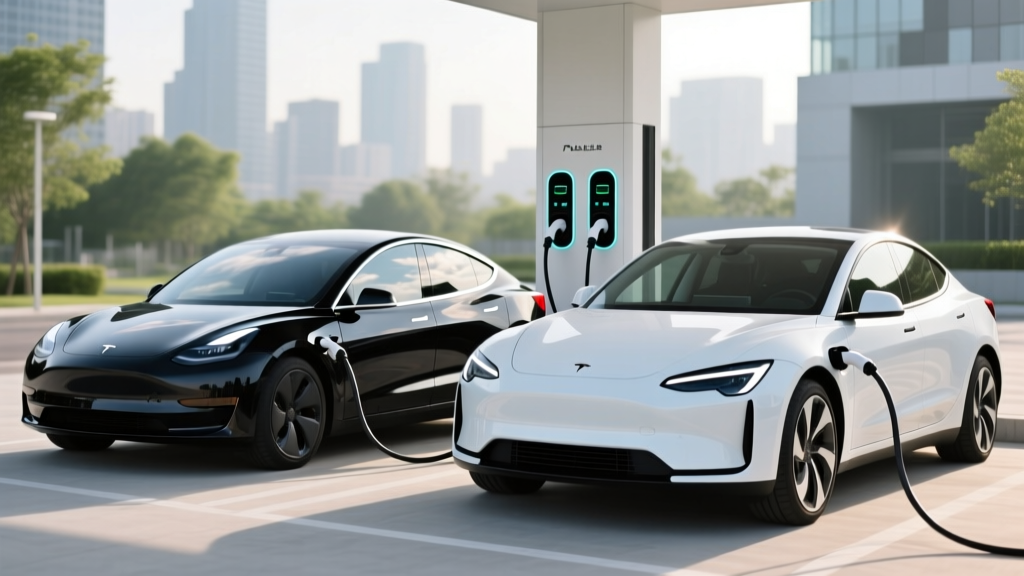
The premium electric sedan segment remains fiercely contested, and two nameplates consistently top buyer shortlists: the Tesla Model 3 and the Polestar 2. Both deliver compelling range, brisk acceleration, and tech-forward cabins. But beneath the surface, they diverge sharply on charging architecture, software philosophy, driver-assist capability, and ownership economics.
This comparison pits the 2026 Tesla Model 3 Long Range RWD against the 2026 Polestar 2 Long Range Dual Motor with Performance Pack. We're using EPA data, manufacturer specs, real-world charging observations, and current IRS §30D tax-credit rules to separate marketing from measurable reality.
Side-by-Side Specs at a Glance
| Spec | Tesla Model 3 Long Range RWD | Polestar 2 LR Dual Motor (Perf.) |
|---|---|---|
| EPA Range | 363 miles | 276 miles |
| Battery (usable) | 75 kWh (NMC) | 79 kWh (NMC, LG) |
| Peak DC Charge Rate | 250 kW | 205 kW |
| 10–80% DC Fast Charge | ~25 min | ~27 min |
| Level 2 Charge Rate | 11.5 kW (44 mi/hr) | 11 kW (40 mi/hr) |
| 0–60 mph | 4.9 sec | 4.1 sec |
| Horsepower | 346 hp | 476 hp |
| Drivetrain | RWD | AWD |
| EPA Efficiency | 132 MPGe (25 kWh/100mi) | 100 MPGe (34 kWh/100mi) |
| Cargo Volume | 23 cu ft (trunk + frunk) | 14.4 cu ft (liftback + frunk) |
| Base MSRP | $47,740 | $54,300 |
| Battery/Powertrain Warranty | 8 yr / 120,000 mi | 8 yr / 100,000 mi |
Sources: EPA fueleconomy.gov, Tesla and Polestar official spec sheets.
Range and Efficiency: Real-World Expectations
The Model 3 Long Range RWD posts an EPA-estimated 363 miles — among the highest of any sedan under $55,000. The Polestar 2 LR Dual Motor with the Performance Pack lands at 276 miles. That 87-mile gap is substantial and shows up on road trips: the Tesla can stretch from Los Angeles to Las Vegas with a brief top-up, while the Polestar typically requires two charging stops on the same route.
Tesla Model 3 LR: EPA 363 mi. Expect ~300–320 mi at sustained 75 mph highway speeds; ~250–270 mi in sub-30°F cold without preconditioning.
Polestar 2 LR DM: EPA 276 mi. Expect ~230–245 mi highway; ~190–210 mi in freezing temperatures. The heat pump (standard) helps mitigate winter loss but cannot fully offset the physics of cold battery chemistry.
Efficiency is where the Tesla truly separates itself. At 132 MPGe (25 kWh per 100 miles), the Model 3 sips electrons. The Polestar consumes 34 kWh per 100 miles — a 36% penalty. Over 15,000 miles of annual driving at $0.16/kWh national average, that translates to roughly $600/year for the Tesla versus $816/year for the Polestar in home-charging electricity costs.
Charging Speed and Network Access
Peak charge rate matters less than sustained charge rate. The Model 3 peaks at 250 kW on V3 Superchargers and sustains above 150 kW through roughly 55% state of charge before tapering. A 10–80% session takes approximately 25 minutes.
The Polestar 2 peaks at 205 kW but holds a strong curve through ~50% SoC, reaching 10–80% in about 27 minutes. The two-minute gap is negligible in practice.
Where the gap widens dramatically is network access. Tesla owners use the Supercharger network — over 25,000 stalls in North America with near-universal reliability, automatic plug-and-charge billing, and integrated navigation preconditioning. Polestar owners rely on third-party networks: Electrify America, EVgo, and ChargePoint. While these networks have improved, uptime inconsistencies and fragmented payment apps remain pain points. Polestar does offer a Plug & Charge experience on Electrify America, but stall availability is far lower than Tesla's footprint.
Notably, Tesla opened select Superchargers to non-Tesla EVs via the Magic Dock adapter, but Polestar 2 drivers using CCS-to-NACS adapters may see reduced peak speeds at some stations, and availability at Tesla stalls remains limited to specific locations.
Performance and Driving Dynamics
This is where the Polestar fights back hard. The LR Dual Motor with Performance Pack delivers 476 hp and 502 lb-ft of torque to all four wheels, hitting 60 mph in 4.1 seconds. The Öhlins dampers (Performance Pack), Brembo brakes, and 20-inch forged wheels give the Polestar a chassis feel that's genuinely sporty — communicative steering, flat cornering, and a ride that's firm but controlled.
The Model 3 LR RWD makes 346 hp and reaches 60 mph in 4.9 seconds. It's quick, and the refreshed Highland chassis is more refined than earlier generations, but it's rear-drive only and tuned more for comfort than engagement. Drivers who prioritize handling precision will notice the difference.
For winter and rain-belt buyers, the Polestar's AWD system provides traction confidence the RWD Model 3 cannot match, though Tesla's AWD variants are available at higher trims.
Interior, Tech, and Driver Assistance
Tesla's minimalist cabin centers on a single 15.4-inch touchscreen handling virtually all vehicle functions — climate, mirrors, glovebox, and navigation. The interface is fast, responsive, and receives frequent over-the-air updates. However, the absence of physical controls frustrates some buyers, and the camera-only vision approach to driver assist means no radar redundancy.
Polestar runs Google Automotive OS natively, with Google Maps navigation, Google Assistant voice control, and Play Store apps built in. The 11.2-inch portrait screen is supplemented by physical climate controls and a traditional instrument cluster display. Materials quality edges higher: woven textile or Nappa leather options, real wood or aluminum inlays, and a cabin that feels more traditionally premium.
Both Tesla Autopilot/FSD (Supervised) and Polestar's Pilot Pack are SAE Level 2 driver-assist systems. The driver must remain engaged, hands on or near the wheel, and eyes on the road at all times. Neither vehicle is self-driving. Tesla's FSD (Supervised) handles more complex urban scenarios but still requires active supervision. Only Level 4 robotaxi services (Waymo, Zoox) operate without a human driver in defined areas.
Tesla's Autopilot is standard; FSD (Supervised) adds $8,000 or $99/month. Polestar's Pilot Pack (adaptive cruise, lane centering, 360° camera) is included or available as a ~$3,000 option depending on trim. Both are competent Level 2 systems, but Tesla's is more feature-rich — at a steep add-on price.
Pricing, Tax Credits, and Total Cost of Ownership
Base pricing tells only part of the story. The 2026 Model 3 Long Range RWD starts at $47,740 (including destination). The 2026 Polestar 2 Long Range Dual Motor with Performance Pack starts at $54,300. Both fall under the IRS §30D MSRP cap of $55,000 for sedans.
Federal Tax Credit Eligibility (§30D)
- Tesla Model 3 LR RWD: Currently eligible for the full $7,500 credit, transferable at point of sale as a down-payment reduction. Battery sourcing and critical-mineral requirements are met per IRS guidance.
- Polestar 2 LR DM: Credit eligibility is more limited. As a Volvo/Geely product with LG battery cells, critical-mineral and battery-component sourcing rules may reduce or eliminate the credit depending on the specific build month. Verify with your dealer and tax professional before purchase.
Buyer income caps apply: $150K single / $225K head of household / $300K joint filers. Rules are subject to change — always confirm current-year eligibility at irs.gov.
| Category | Tesla Model 3 LR | Polestar 2 LR DM |
|---|---|---|
| Purchase (after credit) | ~$40,240 | ~$54,300 (credit TBD) |
| Electricity (5 yr) | ~$3,000 | ~$4,080 |
| Insurance (5 yr avg) | ~$9,500 | ~$8,800 |
| Maintenance (5 yr) | ~$1,500 | ~$1,800 |
| Est. Depreciation | ~$18,000 | ~$22,000 |
| 5-Year Total | ~$72,240 | ~$90,980 |
Tesla insurance premiums tend to run higher due to repair-cost data, but the $7,500 credit advantage and superior efficiency narrow the gap. The Polestar's higher purchase price and uncertain credit eligibility create a ~$18,000 five-year cost disadvantage in this comparison.
Pros and Cons
- Best-in-class EPA range (363 mi)
- Supercharger network access
- Full $7,500 federal tax credit
- Top-tier efficiency (132 MPGe)
- OTA updates and strong resale
- Minimalist interior not for everyone
- No physical climate controls
- FSD costs $8K extra
- Higher insurance premiums
- RWD only at this trim level
- Engaging chassis, Öhlins dampers
- AWD standard on Dual Motor
- Google Automotive OS with native Maps
- Premium cabin materials
- Physical controls complement touchscreen
- 87-mile range deficit vs Model 3
- Tax credit eligibility uncertain
- Higher purchase price
- Relies on third-party charging networks
- Lower efficiency (100 MPGe)
Which Should You Choose?
Choose the Tesla Model 3 Long Range if:
- Maximizing range and minimizing charging stops is your top priority
- You road-trip frequently and want Supercharger reliability
- You want the lowest total cost of ownership with a confirmed $7,500 credit
- You prefer a software-first, minimalist interface
- RWD is sufficient for your climate
Choose the Polestar 2 LR Dual Motor if:
- You value driving dynamics, AWD traction, and a premium cabin
- Your daily commute is under 100 miles and road trips are occasional
- You want physical controls alongside a Google-powered infotainment system
- You prioritize Scandinavian design and build quality over maximum range
- Tax credit ineligibility doesn't break your budget
Final Verdict
On paper and in total-cost terms, the 2026 Tesla Model 3 Long Range RWD is the more rational buy: longer range, faster real-world charging access, confirmed tax credit, and lower electricity consumption. It's the default recommendation for most sedan shoppers entering the EV space.
But the Polestar 2 is the more emotionally satisfying car to drive and live with. Its chassis, materials, and design language deliver a premium experience the Model 3's utilitarian cabin can't match. If your budget absorbs the price premium and your driving pattern keeps you within its range envelope, the Polestar 2 is a compelling alternative that rewards the enthusiast buyer.
Neither is a wrong choice — they're simply optimized for different priorities. Test-drive both, verify your tax-credit eligibility with a tax professional, and let your daily driving data — not marketing — guide the decision.
Frequently Asked Questions
Does the Polestar 2 qualify for the $7,500 federal tax credit?
Eligibility is uncertain and build-month dependent. The Polestar 2 uses LG battery cells, and critical-mineral and battery-component sourcing requirements under IRS §30D may limit or eliminate the credit. Always verify with your dealer and the IRS clean vehicle credit page before purchasing.
Can I charge a Polestar 2 at Tesla Superchargers?
Some Tesla Supercharger stations have been opened to non-Tesla EVs via the Magic Dock CCS adapter, and Tesla is expanding access via NACS adapters. However, availability is limited to specific locations, and peak charge speeds may be reduced. You cannot assume universal Supercharger access with a Polestar 2.
Which is better in snow and ice?
The Polestar 2 Dual Motor's AWD system provides superior traction in snow and ice compared to the RWD Model 3 Long Range. If winter driving is a priority and you want the Tesla, consider the Model 3 Long Range AWD variant at a higher price point.
How do insurance costs compare?
Tesla Model 3 insurance averages 5–15% higher than the Polestar 2, driven by Tesla's higher repair costs and parts pricing. Get quotes from your insurer for both vehicles before deciding — the spread varies significantly by state and driver profile.
Which has better resale value?
Historically, Tesla vehicles have held value better than most EV competitors, though recent price cuts have compressed resale values across the board. The Polestar 2, as a lower-volume brand, tends to depreciate faster. Check current market data on sites like Kelley Blue Book for real-time residual values.