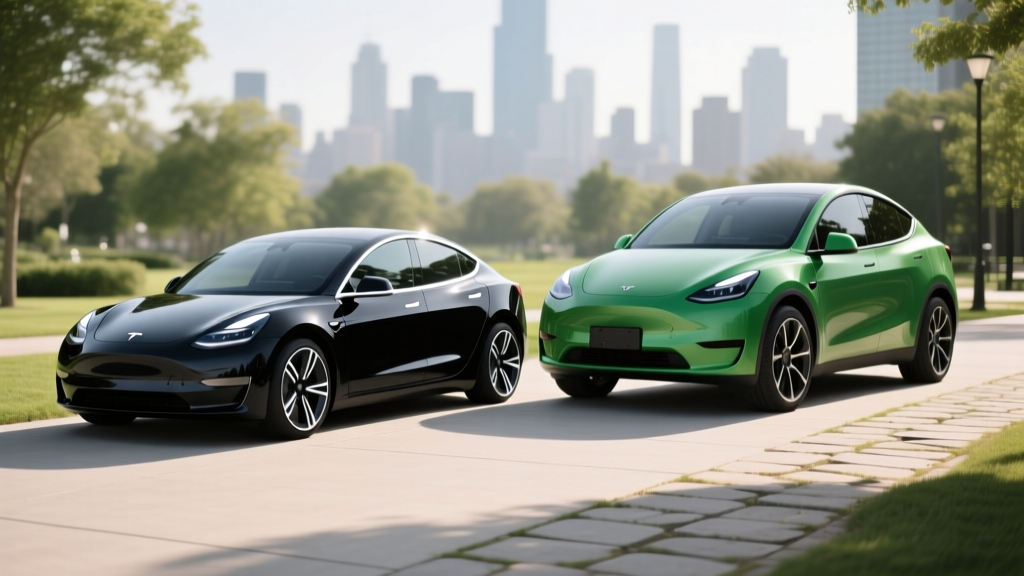
If you're narrowing your Tesla shortlist, the decision almost always comes down to two vehicles: the refreshed Model 3 sedan and the Model Y crossover. They share Tesla's core software stack, Supercharger access, and minimalist interior philosophy, but the differences in range, charging speed, cargo utility, and pricing are significant enough to change which one you should actually buy.
This comparison uses the latest 2026 model-year specs from Tesla's configurator and fueleconomy.gov EPA data. We'll break down every measurable difference — from battery chemistry and charge curves to insurance costs and §30D tax credit eligibility — so you can match the right car to your actual driving life.
Side-by-Side Spec Table: 2026 Model 3 vs Model Y
Before we declare any category winners, here are the hard numbers. All specs reflect the Long Range AWD trims, which represent the highest-volume configurations for both vehicles. Base RWD and Performance trims are noted where relevant.
| Specification | Model 3 Long Range AWD | Model Y Long Range AWD |
|---|---|---|
| EPA Range | 341 miles | 320 miles |
| Battery Capacity (usable) | ~79 kWh (NMC) | ~78 kWh (NMC) |
| Battery Chemistry | NMC (Nickel Manganese Cobalt) | NMC (Nickel Manganese Cobalt) |
| Efficiency (MPGe combined) | 132 MPGe | 122 MPGe |
| Peak DC Fast Charge Rate | 250 kW | 250 kW |
| 10–80% DC Fast Charge Time | ~27 minutes | ~30 minutes |
| Level 2 Charge Rate (AC) | 11.5 kW | 11.5 kW |
| 0–60 mph | 4.2 seconds | 4.8 seconds |
| Horsepower | 384 hp | 384 hp |
| Cargo Volume (rear seats up) | 23 cu ft (trunk + frunk) | 72 cu ft (cargo + frunk) |
| Cargo Volume (rear seats folded) | 23 cu ft (no fold-flat hatch) | 76 cu ft |
| Seating Capacity | 5 passengers | 5 (optional 7 with third row) |
| Base MSRP (Long Range AWD) | $47,240 | $48,240 |
| Battery & Drive Unit Warranty | 8 years / 120,000 miles | 8 years / 120,000 miles |
Range and Efficiency: Where the Sedan's Aero Advantage Shows
The Model 3 Long Range AWD carries a 21-mile EPA range advantage over the Model Y Long Range AWD (341 vs. 320 miles). This gap is almost entirely a function of aerodynamics and weight. The Model 3's lower roofline, smaller frontal area, and roughly 250-pound weight advantage let it achieve 132 MPGe combined versus the Model Y's 122 MPGe.
EPA range is measured under controlled lab conditions. In real-world driving, plan on the following adjustments:
- Highway cruising (70–80 mph): Expect ~270–290 miles from the Model 3 and ~250–270 miles from the Model Y. Aerodynamic drag disproportionately impacts the taller Model Y at speed.
- Cold weather (below 32°F): Both vehicles lose 15–30% of range depending on temperature severity and whether you use cabin heat. The Model 3's heat pump (standard on all trims) helps, but physics still wins. Expect ~230–270 miles from the Model 3 and ~215–255 miles from the Model Y in freezing conditions.
- Combined real-world daily average: Most owners report 285–310 miles (Model 3) and 265–290 miles (Model Y) across mixed driving.
On efficiency alone, the Model 3 extracts more miles per kilowatt-hour. Over a year of 12,000 miles of driving, the Model 3 will consume roughly 2,600 kWh versus the Model Y's ~2,800 kWh — a difference of about $30–$50 in annual electricity cost depending on your local rates.
Charging Speed and Network Access
Both vehicles peak at 250 kW on DC fast chargers and share identical NACS (North American Charging Standard) connectors, meaning full access to Tesla's Supercharger network — over 6,000 stalls in North America as of early 2026 — without an adapter.
The Model 3 charges slightly faster in practice due to its smaller battery and lower consumption rate: a 10–80% session takes approximately 27 minutes versus 30 minutes for the Model Y. This difference is modest but compounds on road trips with multiple charging stops.
Both vehicles support 11.5 kW Level 2 AC charging at home, meaning a full charge from near-empty takes roughly 7–8 hours on a 48-amp Level 2 home charger. The charge curve on both vehicles tapers significantly above 80% State of Charge (SoC) — a 10–80% session is dramatically faster than a 10–100% session. Plan your road-trip charging around the 80% threshold to minimize time at stalls.
Cargo, Space, and Practicality: The Crossover's Clear Win
This is where the Model Y's crossover form factor creates a decisive gap. With 72 cubic feet of cargo space behind the second row (and 76 cu ft with seats folded), the Model Y functions as a legitimate family hauler. The hatchback liftgate accommodates strollers, furniture, camping gear, and large grocery runs with ease.
The Model 3's trunk offers 23 cubic feet including its front trunk (frunk). It's a conventional sedan trunk with a relatively narrow opening — adequate for luggage and weekly groceries, but it cannot accommodate bulky items the way the Model Y's hatch can.
The Model Y also offers an optional third-row seat ($3,000), expanding capacity to seven passengers. The third row is best suited for children on short trips — adults will find it cramped — but it's an option the Model 3 simply doesn't offer.
Interior passenger space is closer than cargo figures suggest. Rear-seat legroom in the Model 3 (35.2 inches) actually edges out the Model Y (34.4 inches) due to packaging differences. Both vehicles seat five adults comfortably for long trips.
Pricing, Tax Credits, and Total Purchase Cost
On MSRP alone, the gap is narrow: the Model 3 Long Range AWD starts at $47,240 and the Model Y Long Range AWD at $48,240 — a $1,000 difference. But the real purchase-price story involves the federal EV tax credit under IRS §30D.
As of 2026, both the Model 3 and Model Y Long Range AWD qualify for the full $7,500 federal tax credit when purchased new, provided the buyer meets income requirements and the vehicle's battery components and critical minerals satisfy domestic sourcing thresholds. Key eligibility rules:
- MSRP cap: Sedans (Model 3) must be under $55,000; SUVs/trucks/vans (Model Y) under $80,000. Both trims clear these caps.
- Buyer income cap: Modified AGI must not exceed $150,000 (single), $225,000 (head of household), or $300,000 (joint filers).
- Battery sourcing: A percentage of critical minerals and battery components must be sourced from the US or FTA partners. Tesla's US-built batteries currently satisfy these thresholds for both vehicles.
- Point-of-sale transfer: Buyers can transfer the credit to the dealer at purchase, reducing the out-of-pocket price by $7,500 immediately rather than waiting for a tax refund.
Always verify current eligibility at irs.gov before purchasing — sourcing rules and qualifying configurations can change.
After applying the $7,500 credit, the effective prices become:
| Model 3 LR AWD | Model Y LR AWD | |
|---|---|---|
| MSRP | $47,240 | $48,240 |
| Federal Tax Credit | −$7,500 | −$7,500 |
| Effective Price (before state incentives) | $39,740 | $40,740 |
The $1,000 gap persists post-credit. State incentives vary widely — check afdc.energy.gov for your jurisdiction's current programs.
Ownership Costs: Insurance, Maintenance, and Efficiency
Beyond purchase price, the ongoing cost picture slightly favors the Model 3:
- Insurance: Model 3 premiums average $1,800–$2,400/year depending on state and driver profile. Model Y premiums run 5–10% higher ($1,900–$2,600/year) due to higher repair costs associated with the larger body and liftgate. Always get quotes for both before deciding.
- Electricity cost: At the US average residential rate of ~$0.16/kWh, the Model 3's superior efficiency saves roughly $30–$50 per year over the Model Y at 12,000 miles of annual driving.
- Maintenance: Both vehicles are nearly identical — no oil changes, minimal brake wear thanks to regenerative braking, cabin air filter replacement every 2 years (~$50–$80), tire rotation every 6,250 miles. Annual maintenance cost averages $200–$350 for either vehicle.
- Tires: The Model Y's heavier weight and taller profile tend to wear tires slightly faster. Budget $800–$1,200 for a set of four replacement tires every 30,000–40,000 miles for either vehicle.
- Depreciation: Both Teslas depreciate faster than the segment average. The Model Y historically holds value slightly better due to higher demand in the crossover segment, but the gap has narrowed as the refreshed Model 3 gained popularity.
Performance, Tech, and Driving Experience
Both vehicles share Tesla's dual-motor AWD powertrain producing 384 horsepower in Long Range trim. The Model 3's lighter weight gives it a 0.6-second advantage to 60 mph (4.2 vs. 4.8 seconds). Neither is slow — both deliver instant electric torque that makes highway merging and city driving effortless.
The Model 3's lower center of gravity and sedan chassis tuning produce noticeably sharper cornering and more planted highway stability. The Model Y rides higher, which improves visibility and eases entry/exit but introduces more body roll in curves. For driving enthusiasts, the Model 3 is the more engaging car.
Tech is identical across both: 15.4-inch central touchscreen, Tesla's latest software (including Apple CarPlay via the Tesla app, theater mode for rear-seat entertainment), over-the-air updates, and the full Tesla Autopilot suite. Both offer the optional FSD (Supervised) package — note that this remains a SAE Level 2 driver-assistance system requiring active driver supervision, not a self-driving system.
Category Winners
341 miles EPA, 132 MPGe. The sedan's aero advantage delivers 21 more miles per charge and lower electricity costs.
72 cu ft of hatchback cargo space and optional 7-seat layout. No contest for families or anyone hauling bulky items.
3 minutes faster to 80% on DC fast charging. Marginal but real on multi-stop road trips.
4.2-second 0–60, sharper handling, and a lower center of gravity make it the driver's choice.
$1,000 less at MSRP, lower insurance, and better efficiency. The gap is narrow but consistent.
Model 3 has more rear legroom; Model Y has easier entry/exit and more headroom. Depends on your priorities.
Identical screens, software, Autopilot hardware, and update cadence across both vehicles.
Crossover demand keeps Model Y residual values slightly stronger, though the gap has narrowed.
Decision Framework: Which Should You Buy?
Choose the Model 3 if:
- You prioritize maximum range and efficiency — especially if you commute long distances or take frequent highway road trips.
- You don't regularly haul large cargo, strollers, or more than four passengers.
- You value sportier handling and a lower, more car-like driving position.
- You want the lowest total cost of ownership in Tesla's lineup.
- You primarily drive solo or with one passenger and rarely need rear-seat access for adults.
Choose the Model Y if:
- You have children, regularly carry cargo, or need hatchback versatility for hobbies (camping, sports gear, furniture).
- You want the optional third-row seat for occasional 7-passenger needs.
- You prefer the elevated seating position and easier step-in height of a crossover.
- You frequently transport rear-seat passengers (kids in car seats, elderly passengers) who benefit from the larger door openings.
- Cargo flexibility matters more to you than squeezing out an extra 21 miles of range.
Frequently Asked Questions
Is the Model Y just a bigger Model 3?
Structurally, yes — they share the same platform, powertrain, and software. But the Model Y is approximately 10 inches taller, 2 inches wider, and 220 pounds heavier. Those differences meaningfully change the driving dynamics, efficiency, cargo capacity, and passenger experience. Think of them as siblings, not clones.
Do both qualify for the $7,500 federal tax credit?
As of 2026, both the Model 3 and Model Y Long Range AWD qualify for the full $7,500 §30D credit, assuming the buyer meets income caps ($150K single / $300K joint) and the vehicle's battery sourcing satisfies current requirements. The Model 3 falls under the $55,000 sedan MSRP cap; the Model Y falls under the $80,000 SUV cap. Both clear their respective thresholds. Verify at irs.gov before purchasing.
Which is better for road trips?
The Model 3 wins on range (21 more EPA miles) and charges slightly faster, giving it an edge on long highway drives. But the Model Y's hatchback cargo area makes packing for road trips significantly easier. If your trips involve lots of luggage or outdoor gear, the Model Y's practicality may outweigh the range advantage.
Can I get the Model 3 with a hatchback?
No. The Model 3 has a conventional sedan trunk lid. If you want a Tesla with a hatchback opening, the Model Y is your only current option (the Model S also has a liftgate but sits in a much higher price bracket).
Which has lower insurance costs?
The Model 3 typically costs 5–10% less to insure than the Model Y. Average annual premiums for the Model 3 run $1,800–$2,400 versus $1,900–$2,600 for the Model Y, though rates vary heavily by state, age, driving history, and coverage level. Get quotes for both vehicles before committing.
Is the Model Y's optional third row worth it?
Only if you need it occasionally for children. The third row has limited legroom and headroom — it's not comfortable for adults on anything beyond short trips. If you regularly need to carry more than five passengers, a dedicated 3-row SUV (electric or otherwise) will serve you better. For occasional carpools or school runs, it's a useful $3,000 option.
What's the real difference in daily driving?
Day to day, both feel like Teslas: quick, quiet, software-forward, and one-pedal-drive capable. The Model 3 feels tighter and more agile in city traffic. The Model Y gives you a commanding view of the road and makes loading groceries, kids, and dogs trivially easy. The driving experience diverges most on twisty roads (Model 3 wins) and at the school drop-off line (Model Y wins).