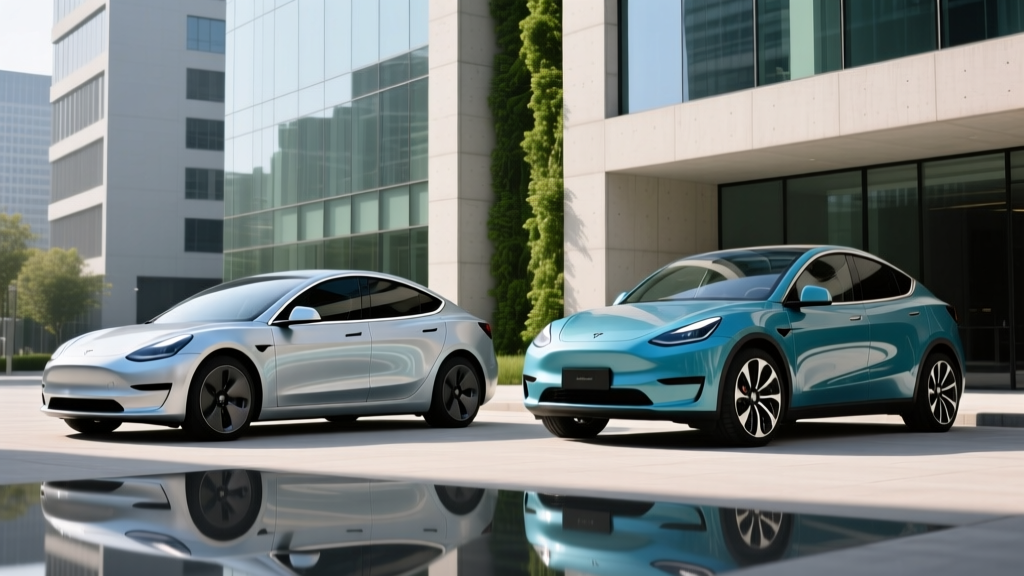
Search for "Tesla Model 3 vs Tesla Model Y images" and you will see two nearly identical silhouettes — a sleek sedan and a slightly taller crossover sibling. But the real differences that matter to buyers are hidden in the spec sheets: range deltas, cargo geometry, charging curves, insurance premiums, and how each interacts with the 2026 federal §30D tax credit. This comparison strips the marketing away and puts the current-year numbers head to head so you can pick the one that actually fits your driving life.
Side-by-Side Specs: 2026 Model 3 vs Model Y at a Glance
The table below uses the most common trims buyers actually cross-shop: the Long Range AWD versions of both vehicles, which represent the best balance of range, performance, and price in the 2026 lineup. All figures are EPA or manufacturer-published unless noted.
| Spec | Model 3 LR AWD | Model Y LR AWD |
|---|---|---|
| Base MSRP | $47,740 | $50,630 |
| EPA Range | 363 mi | 337 mi |
| Battery (usable) | ~79 kWh (NMC) | ~79 kWh (NMC) |
| Efficiency (MPGe combined) | 125 MPGe | 117 MPGe |
| kWh/100 mi | 27 | 29 |
| Peak DC Fast Charge | ~250 kW | ~250 kW |
| 10–80% DCFC Time | ~26 min | ~27 min |
| Level 2 Charge Rate | 11.5 kW (~44 mi/hr) | 11.5 kW (~41 mi/hr) |
| 0–60 mph | 4.2 sec | 4.8 sec |
| Horsepower | ~346 hp | ~384 hp |
| Cargo (rear seats up) | 23 cu ft | 30 cu ft |
| Cargo (rear seats folded) | ~47 cu ft | ~72 cu ft |
| Towing Capacity | Not rated | 3,500 lb |
| Drivetrain | Dual Motor AWD | Dual Motor AWD |
| Basic / Battery Warranty | 4 yr/50k mi / 8 yr/120k mi | 4 yr/50k mi / 8 yr/120k mi |
Sources: fueleconomy.gov, Tesla spec sheets. Real-world range and charging times will vary with temperature, terrain, and preconditioning.
Range and Efficiency: Where the Sedan Wins on Physics
The Model 3 Long Range holds a 26-mile EPA advantage over the Model Y Long Range — 363 miles versus 337 miles — despite sharing essentially the same ~79 kWh NMC battery pack. The reason is simple physics: the Model 3 is lighter (by roughly 150–200 lb), more aerodynamic (lower drag coefficient), and has less frontal area. At highway speeds, those differences compound.
EPA numbers assume mixed driving at moderate temperatures. Expect these in practice:
- Model 3 LR: ~300–320 mi highway-only in 70°F weather; ~230–260 mi highway in sub-30°F cold.
- Model Y LR: ~280–300 mi highway-only in 70°F weather; ~210–240 mi highway in sub-30°F cold.
Cold weather hits both cars hard — battery chemistry slows, cabin heating draws power, and regen braking weakens. The Model 3's heat pump helps, but the crossover's larger cabin volume demands more energy to keep warm.
If your commute is under 60 miles round-trip and you charge at home, this difference is academic. If you regularly drive 250+ miles between charges — say, Denver to Grand Junction or LA to Vegas — those 26 extra miles in the Model 3 can mean the difference between a single fast-charge stop and two.
Charging Speed and Network: Nearly Identical Hardware
Both vehicles peak at approximately 250 kW on DC fast chargers and use the NACS connector natively, which in 2026 means full access to Tesla's Supercharger network — the most reliable public charging infrastructure in the U.S. by a wide margin, with consistently high uptime and straightforward plug-and-charge billing.
| Level | Model 3 LR | Model Y LR |
|---|---|---|
| Level 1 (120V, ~1.4 kW) | ~3–4 mi/hr | ~3–4 mi/hr |
| Level 2 (240V, 11.5 kW) | ~44 mi/hr | ~41 mi/hr |
| DC Fast (peak 250 kW) | ~175 mi in 15 min | ~162 mi in 15 min |
| 10–80% DCFC | ~26 min | ~27 min |
The charging curve — how the car tapers power as the battery fills — is nearly identical between the two. Both hold close to peak kW between 10% and roughly 50% state of charge, then gradually step down. Above 80%, charging slows dramatically to protect the NMC cells, which is why you should plan road-trip stops around the 10–80% window rather than topping off to 100%.
One practical note: preconditioning the battery before arriving at a Supercharger (automatic when you navigate to one in the Tesla nav) is critical in cold weather. Without it, you may arrive at a charger and see only 50–80 kW instead of the 250 kW peak. This applies equally to both cars.
Performance, Cargo, and Daily Practicality
The Model 3 is the quicker car — 4.2 seconds to 60 mph versus 4.8 seconds for the Model Y. That half-second gap is noticeable in merge-lane acceleration but irrelevant for most daily driving. The Model Y actually produces slightly more horsepower (~384 vs ~346), but its extra weight and taller profile absorb the advantage.
Where the Model Y decisively wins is utility. With 30 cubic feet behind the second row and up to 72 cubic feet with the rear seats folded, the Model Y handles Costco runs, camping gear, and child seats far more gracefully. The Model 3's trunk, while well-shaped, maxes out around 47 cubic feet and lacks the tall vertical opening that makes loading bulky items easy.
The Model Y is also the only one of the two rated for towing — 3,500 pounds when properly equipped. If you need to pull a small utility trailer or a pair of jet skis, the decision makes itself. The Model 3 has no factory tow rating.
363 mi EPA, 125 MPGe combined. Lighter, sleeker, goes farther per kWh.
30 cu ft rear / 72 cu ft folded, 3,500-lb tow rating, available 7-seat option.
4.2-sec 0–60, lower center of gravity, sharper handling feel.
Same 15.4-inch touchscreen, same software stack, same Autopilot hardware (HW4). Model Y has slightly more rear headroom.
Pricing, Tax Credits, and Total Cost to Buy
As of 2026, both vehicles are eligible for the full $7,500 federal §30D tax credit — provided you meet all current requirements. This credit can now be transferred to the dealer at point of sale, effectively reducing your purchase price on the spot. However, eligibility is not automatic.
- Buyer income cap: AGI ≤ $150,000 (single) / $300,000 (joint)
- MSRP cap: ≤ $55,000 for sedans (Model 3) / ≤ $80,000 for SUVs (Model Y)
- Battery sourcing: Critical minerals and battery components must meet phased-in domestic/free-trade-agreement thresholds per IRS guidelines
- Assembly: Final assembly in North America (both qualify)
- Transfer option: Credit can be applied at point of sale or claimed on tax return
Rules change frequently. Verify your eligibility on irs.gov or consult a tax professional before purchasing.
| Model 3 LR AWD | Model Y LR AWD | |
|---|---|---|
| Base MSRP | $47,740 | $50,630 |
| After $7,500 §30D Credit | ~$40,240 | ~$43,130 |
| Destination Fee | $1,390 | $1,390 |
| Effective Starting Price | ~$41,630 | ~$44,520 |
The ~$2,890 price gap after credits is meaningful but not enormous. The bigger financial question is what happens downstream in ownership costs.
Ownership Costs: Insurance, Efficiency, and Maintenance
Teslas carry higher-than-average insurance premiums, and the Model Y typically costs 5–10% more to insure than the Model 3 due to its higher replacement cost and slightly higher repair frequency (more body panels, larger glass). National average annual premiums in 2026 run roughly $2,400–$3,200 for the Model 3 and $2,700–$3,600 for the Model Y, depending on your state, driving record, and coverage level.
| Category | Model 3 LR AWD | Model Y LR AWD |
|---|---|---|
| Purchase (after credit) | ~$41,630 | ~$44,520 |
| Electricity (15k mi/yr, $0.14/kWh avg) | ~$2,835 | ~$3,045 |
| Insurance (5-yr avg) | ~$14,000 | ~$15,750 |
| Maintenance (tires, wipers, cabin filter) | ~$1,500 | ~$1,700 |
| Est. Depreciation (5 yr) | ~$16,500 | ~$17,800 |
| 5-Year Total (est.) | ~$76,465 | ~$82,815 |
Over five years, the Model 3 costs roughly $6,000–$6,500 less to own. The gap widens if you drive more than 15,000 miles per year (efficiency compounds) or narrow if you need the Model Y's cargo space and would otherwise be renting SUVs or paying for a second vehicle.
Maintenance on both is minimal — no oil changes, no transmission fluid, no spark plugs. Budget for tire rotations every 6,000–8,000 miles (EVs wear tires faster due to instant torque and heavy curb weight), cabin air filter replacement annually, and windshield washer fluid. That's essentially it.
Autopilot, FSD, and Smart Driving: Identical Software Stack
Both the Model 3 and Model Y ship with Tesla's HW4 computer and the same Autopilot suite. Basic Autopilot (Traffic-Aware Cruise Control and Autosteer) is included. Full Self-Driving (Supervised) is an $8,000 add-on or $99/month subscription that adds Navigate on Autopilot, Auto Lane Change, Autopark, and Smart Summon.
Despite the name, Tesla FSD (Supervised) is an SAE Level 2 driver-assistance system. You must keep your hands on the wheel, eyes on the road, and remain prepared to take over at any moment. Only fully driverless services like Waymo operate at SAE Level 4. See NHTSA's guidance on automated vehicles for details on automation levels.
Neither car has a meaningful advantage here — the software, camera suite, and processing hardware are identical. If advanced driver-assist is a priority, both deliver the same experience. What matters is whether the feature justifies its cost for your commute pattern, which is a personal calculation rather than a vehicle-comparison one.
Decision Framework: Which Tesla Should You Buy?
- Maximum range per charge is your top priority (363 mi EPA)
- You want the lowest purchase price and total cost of ownership
- Your daily driving is mostly commuting and you rarely haul large cargo
- You prefer a sportier, lower-to-the-ground driving feel
- You don't need towing capability
- You regularly carry passengers and cargo together (strollers, gear, groceries)
- You want the option of a third-row seat for occasional 7-passenger use
- You need to tow (3,500-lb rating)
- You prefer the elevated seating position and easier ingress/egress of a crossover
- The $2,890 price premium after tax credits is acceptable for the utility gain
Frequently Asked Questions
Is the Model Y just a taller Model 3?
Structurally, they share a platform and many components, but the Model Y is a distinct vehicle with its own body stampings, suspension tuning, and interior packaging. The rear seat is notably more spacious in the Model Y, and the cargo area is fundamentally different in shape and volume. Think of them as siblings, not clones.
Which gets better real-world highway range?
The Model 3, consistently. Expect roughly 300–320 miles at 70–75 mph in fair weather versus 280–300 miles for the Model Y. The gap widens in cold weather and at higher speeds. If highway range is your single most important metric, the Model 3 is the answer.
Do both qualify for the full $7,500 federal tax credit in 2026?
Both currently qualify, but only if you meet the income caps ($150k single / $300k joint AGI) and the battery sourcing requirements are met for the specific vehicle you receive. The MSRP caps differ — $55,000 for the sedan-class Model 3 and $80,000 for the SUV-class Model Y — but both base Long Range trims fall well under their respective limits. Always verify on IRS.gov before purchasing, as sourcing rules have phased in progressively.
Which is cheaper to insure?
The Model 3, by roughly 5–10%. Average annual premiums run $300–$400 less than the Model Y. Get quotes from your insurer for both before deciding — the gap can vary significantly by state and driver profile. Tesla also offers its own insurance product in many states, priced on real-time driving data.
Is the Model Y worth the extra $2,890 over the Model 3?
If you need the cargo space, towing, or optional third row — yes, absolutely. The utility gain per dollar is substantial. If you are a solo commuter or a couple without bulky hauling needs, the Model 3 offers better range, lower running costs, and a more engaging drive for less money. There is no universal winner; the right answer depends on your household's specific needs.