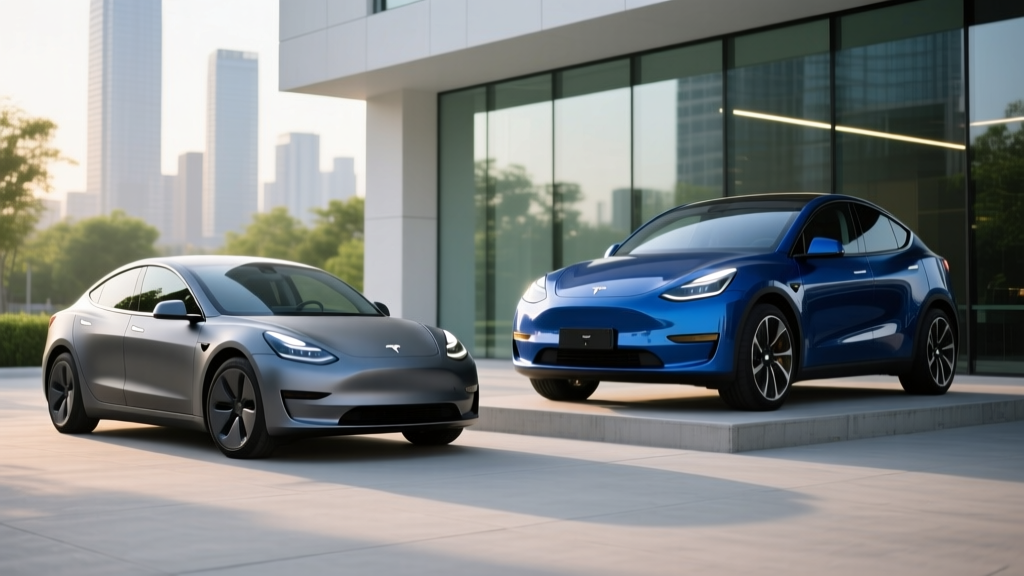
If you're narrowing your EV shortlist to Tesla, you're almost certainly cross-shopping the Model 3 sedan and the Model Y crossover. They share the same platform, the same Supercharger network, and much of the same software stack — but the differences in cargo space, efficiency, pricing, and real-world range are large enough to swing a purchase decision either way. This guide puts the two head-to-head using current 2026 model-year data so you can stop guessing and pick the right one.
At a Glance: 2026 Model 3 vs Model Y Specs
The table below uses the most popular trims for each — the Long Range AWD variants — because they represent the best balance of range, performance, and value in Tesla's current lineup. We'll address Performance and base RWD trims in the pricing section.
| Spec | 2026 Tesla Model 3 Long Range AWD | 2026 Tesla Model Y Long Range AWD |
|---|---|---|
| EPA Range | 341 miles | 320 miles |
| Battery (usable) | ~75 kWh (NMC) | ~75 kWh (NMC) |
| Efficiency | 132 MPGe (25 kWh/100mi) | 122 MPGe (27 kWh/100mi) |
| Peak DC Fast Charge | 250 kW | 250 kW |
| 10-80% DC Fast Charge | ~27 minutes | ~29 minutes |
| Level 2 Charge Rate | 11.5 kW (44 mi/hr) | 11.5 kW (41 mi/hr) |
| 0-60 mph | 4.2 seconds | 4.8 seconds |
| Horsepower | 346 hp | 384 hp |
| Cargo Volume | 23 cu ft (trunk + frunk) | 72 cu ft (rear seats folded + frunk) |
| Seating | 5 passengers | 5 (optional 7 with third row) |
| Base MSRP (Long Range AWD) | $47,740 | $50,240 |
| Warranty (Battery/Drive Unit) | 8 yr / 120,000 mi | 8 yr / 120,000 mi |
Real-world range reality check: The EPA numbers above assume a mix of city and highway driving at moderate temperatures. On a sustained 75 mph highway run in 40°F weather, expect the Model 3 Long Range to deliver roughly 270-290 miles and the Model Y Long Range around 250-270 miles. Tesla's heat pump helps mitigate cold-weather losses compared to older EVs, but physics still applies — plan charging stops around 200-220 miles apart in winter conditions.
Range and Efficiency: Sedan Aero Wins
The Model 3's lower, sleeker profile gives it a meaningful aerodynamic advantage. At 132 MPGe combined, it consumes roughly 8% less energy per mile than the Model Y (122 MPGe). Over 15,000 miles of annual driving at the U.S. average electricity rate of $0.17/kWh, that translates to approximately $640 per year for the Model 3 versus $695 for the Model Y — a modest but real gap that compounds over ownership.
Where the efficiency gap matters most is road trips. The Model 3's extra 21 miles of EPA range, combined with its lower consumption, means you'll arrive at each Supercharger stop with a slightly larger buffer or charge slightly less frequently. On a 600-mile drive, that could mean one fewer 15-minute stop.
Charging Speed and Network Access
Both vehicles peak at 250 kW on V3 Superchargers and share Tesla's NACS connector — now the industry standard adopted by Ford, GM, Rivian, and others. Neither vehicle has a charging advantage in peak rate, but the Model 3's smaller battery and better efficiency mean it adds miles slightly faster in practice.
| Charging Level | Model 3 LR (mi/hr) | Model Y LR (mi/hr) |
|---|---|---|
| Level 1 (120V, 1.4 kW) | ~5 mi/hr | ~4 mi/hr |
| Level 2 (240V, 11.5 kW) | ~44 mi/hr | ~41 mi/hr |
| DC Fast (250 kW peak) | ~170 mi in 15 min | ~155 mi in 15 min |
Charge curve note: Both vehicles sustain near-peak charging rates up to roughly 50% State of Charge (SoC), then taper progressively. The 10-80% time of ~27-29 minutes reflects this taper — if you're charging from 20-60%, expect it to take under 15 minutes. Tesla's battery preconditioning, activated when you navigate to a Supercharger, is critical for achieving these speeds in cold weather. Without it, charge rates can drop by 40-60%.
The Tesla Supercharger network remains the most reliable public charging infrastructure in the U.S., with over 25,000 stalls nationally and a 95%+ uptime rate according to Tesla's own data. This is a shared advantage for both vehicles over competitors relying on third-party networks.
Performance and Driving Dynamics
🏆 Performance Winner: Model 3
The sedan's 4.2-second 0-60 time beats the Model Y's 4.8 seconds, and its lower center of gravity makes it noticeably more agile on back roads. The Model Y's extra 38 hp can't overcome its ~350-lb weight penalty.
🏆 Practicality Winner: Model Y
72 cu ft of cargo space (with rear seats folded) versus 23 cu ft. The Model Y also offers an optional third row for families with small children, and its hatchback design makes loading bulky items trivial.
On the road, the Model 3 feels like a sport sedan — direct steering, flat cornering, and a firm but controlled ride. The refreshed Highland-and-beyond interior has improved noise isolation substantially. The Model Y rides higher, absorbs bumps more comfortably, and provides the commanding seating position that crossover buyers prefer. Neither is a luxury-car quiet experience at 80 mph, but the gap between Tesla's current generation and its 2020 predecessors is significant.
Pricing and Federal Tax Credit Eligibility
Pricing is where the decision often crystallizes. Here's a breakdown of the current lineup with the federal EV tax credit factored in:
| Trim | Model 3 MSRP | Model Y MSRP | §30D Credit Eligibility |
|---|---|---|---|
| Base RWD | $39,740 | — | Up to $7,500 (point-of-sale) |
| Long Range AWD | $47,740 | $50,240 | Up to $7,500 (point-of-sale) |
| Performance | $54,740 | $54,240 | Up to $7,500 (point-of-sale) |
Important §30D eligibility details for 2026: Both the Model 3 and Model Y qualify for the full $7,500 federal tax credit under IRS §30D rules, provided you meet the requirements. The credit is now available as a point-of-sale transfer, meaning the dealer reduces your purchase price by $7,500 at signing, and the credit transfers to Tesla. However, eligibility depends on:
- Income caps: AGI must not exceed $150,000 (single), $225,000 (head of household), or $300,000 (joint filers)
- MSRP caps: Sedans (Model 3) must be under $55,000; SUVs/trucks (Model Y) must be under $80,000 — both clear these limits on most trims
- Battery sourcing: Critical minerals and battery components must meet phased-in domestic-content thresholds that tighten annually through 2029
- Vehicle assembly: Must be assembled in North America (both are built at Fremont, CA and Austin, TX)
Because the Model Y is classified as an SUV by the IRS, it has a much higher $80,000 MSRP cap — meaning even a fully loaded Performance trim with FSD and every option still qualifies. The Model 3's $55,000 sedan cap means a Performance trim with extensive options could push over the limit. Check the specific VIN on fueleconomy.gov before purchasing to confirm eligibility.
Total Ownership Cost: 5-Year Breakdown
Purchase price is only part of the equation. Here's how the two stack up over five years and 75,000 miles:
| Cost Category | Model 3 LR AWD | Model Y LR AWD |
|---|---|---|
| Purchase (after $7,500 credit) | $40,240 | $42,740 |
| Electricity (75,000 mi, $0.17/kWh avg) | $3,188 | $3,443 |
| Insurance (5-yr avg) | $9,200 | $9,800 |
| Maintenance (tires, cabin filter, fluid) | $1,800 | $2,000 |
| Estimated Depreciation (5 yr) | ~$16,000 | ~$17,500 |
| Total 5-Year Cost | ~$70,428 | ~$75,483 |
The Model 3 saves roughly $5,000 over five years. The largest contributors are the lower purchase price, slightly better efficiency, and marginally lower insurance premiums (sedans typically cost 5-8% less to insure than crossovers, per IIHS data). Depreciation estimates are based on historical Tesla resale trends, though the EV market's rapid evolution makes long-term projections uncertain.
Technology and Autopilot: Shared DNA
Both vehicles ship with Tesla's current-generation infotainment and Basic Autopilot, which includes Traffic-Aware Cruise Control and Autosteer. This is an SAE Level 2 driver-assistance system — you must keep your hands on the wheel and eyes on the road at all times. It is not self-driving.
SAE Level 2 clarification: Tesla's Autopilot and optional FSD (Supervised) are Level 2 systems. The driver is always responsible for vehicle operation. True self-driving (Level 4) is currently only available in limited robotaxi services like Waymo in select metro areas. Do not confuse marketing names with automation capability.
Full Self-Driving (Supervised) remains a $8,000 add-on (or $99/month subscription) and adds features like automatic lane changes, traffic light and stop sign recognition, and Navigate on Autopilot. As of early 2026, FSD Supervised has improved significantly in urban environments but still requires active supervision. Neither the Model 3 nor the Model Y has a technology advantage — the hardware suite (cameras, processor) is identical.
Safety Ratings
Both vehicles earn top marks from the NHTSA (5-star overall) and the IIHS (Top Safety Pick+ when equipped with acceptable headlights). Their low center of gravity from the floor-mounted battery pack gives them excellent rollover resistance. The Model Y's taller profile offers slightly better outward visibility, particularly for shorter drivers, while the Model 3's rear visibility is more limited due to its sloping roofline — a backup camera is essential in either vehicle.
Decision Framework: Which Tesla Fits You?
Choose the Model 3 if:
- You prioritize maximum range and efficiency (341 mi EPA, 132 MPGe)
- You want the lowest total cost of ownership
- You prefer a sportier, lower driving position
- You don't regularly haul large cargo or more than 4 passengers
- Most of your driving is commuting and road trips where aero efficiency matters
Choose the Model Y if:
- You need serious cargo space (72 cu ft) or an optional third row
- You prefer a higher, crossover-style seating position with better visibility
- You have a family and need easy car-seat installation and stroller loading
- You want the hatchback versatility for bikes, furniture, or camping gear
- The $2,500 price premium and ~20-mile range loss are acceptable trade-offs
Model 3 LR AWD
Pros: Best-in-class efficiency, lowest 5-year cost, engaging driving dynamics, qualifies under $55K sedan MSRP cap on most trims
Cons: Limited cargo space, tighter rear seat, lower seating position not for everyone, rear visibility
Model Y LR AWD
Pros: Massive cargo versatility, optional 7-seat config, comfortable ride height, family-friendly hatchback design, $80K SUV MSRP cap gives more option flexibility
Cons: Lower efficiency (122 MPGe), higher purchase price, slightly slower charging and acceleration, higher insurance costs
Frequently Asked Questions
Is the Model Y really worth $2,500 more than the Model 3?
If you need the cargo space or crossover seating position, yes. The 49 additional cubic feet of cargo room (with seats folded) and the available third row are things the Model 3 simply cannot offer. If you're a solo commuter or a couple without bulky hauling needs, the Model 3 is the more rational financial choice.
Do both models qualify for the full $7,500 federal tax credit in 2026?
Yes, both the Model 3 and Model Y currently qualify for the full $7,500 §30D credit, available as a point-of-sale transfer. However, eligibility depends on your income, the specific trim's MSRP relative to the sedan/SUV cap, and battery sourcing requirements. Always verify on fueleconomy.gov using the exact VIN before purchasing.
Which Tesla charges faster on road trips?
Both peak at 250 kW, but the Model 3 adds miles slightly faster due to its higher efficiency. In a 15-minute Supercharger session, the Model 3 adds approximately 170 miles of range versus the Model Y's 155 miles. The real-world difference is small but meaningful on long trips.
How does cold weather affect range on each model?
Expect a 15-25% range reduction in sustained sub-freezing temperatures for both vehicles. Tesla's heat pump system is among the best in the industry for minimizing this loss, but the Model 3's superior efficiency gives it a slightly larger buffer. Preconditioning the battery before driving and while charging is essential in cold climates.
Can I get a Model 3 or Model Y with LFP battery chemistry?
Tesla has used LFP (lithium iron phosphate) batteries in some Standard Range/RWD variants, which offer longer cycle life and can be charged to 100% daily without degradation concerns. The Long Range AWD trims compared here use NMC (nickel manganese cobalt) chemistry for higher energy density. Tesla's battery sourcing varies by production batch — check the window sticker or ask your advisor for the specific chemistry in your vehicle.
Is FSD worth buying on either model?
As of 2026, FSD (Supervised) remains a Level 2 system requiring active driver engagement. It's improved substantially in city driving but is not a replacement for attention. At $8,000 or $99/month, it's a personal value judgment. For most buyers, Basic Autopilot (included) handles highway driving well. We recommend trying the monthly subscription before committing to a purchase.