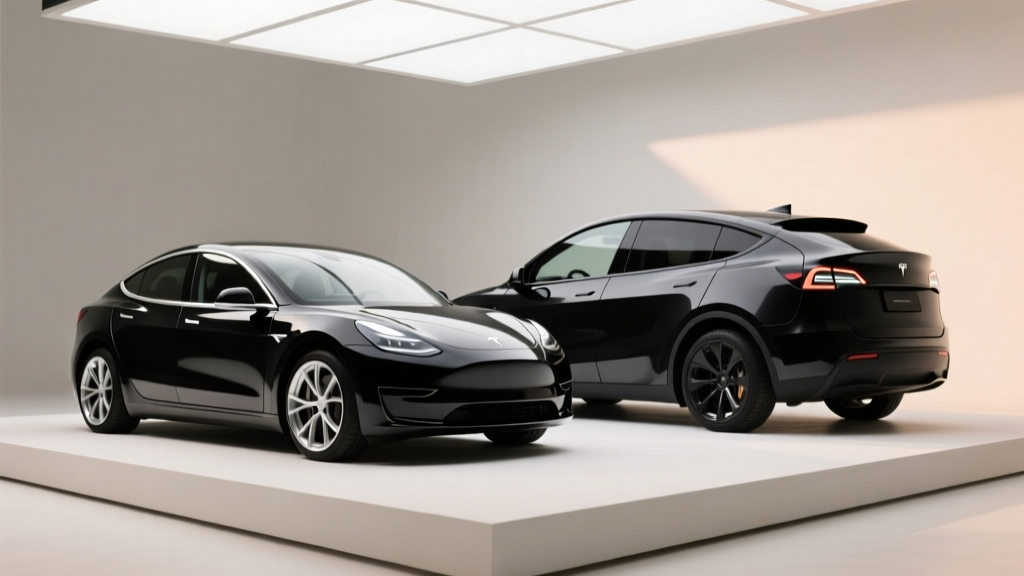
Tesla's two highest-volume vehicles share a platform, a software stack, and access to the Supercharger network — but the gap between a 2026 Model 3 sedan and a 2026 Model Y crossover is wider than most shoppers expect. If you're running a Tesla model compare to figure out which one fits your budget, commute, and cargo needs, this guide breaks down every spec that matters: EPA range, battery chemistry, real-world charging curves, federal tax credit eligibility under current §30D rules, and five-year ownership costs.
Both vehicles are built on Tesla's updated architecture with the HW4 sensor suite, a heat pump for cold-weather efficiency, and NACS charging native. Neither requires an adapter for Tesla Superchargers. But trim-level pricing, usable battery capacity, and cargo geometry push these two into different buyer lanes. Here's the data.
Side-by-Side Specs: 2026 Model 3 vs Model Y
| Spec | 2026 Model 3 Long Range AWD | 2026 Model Y Long Range AWD |
|---|---|---|
| EPA Range | 341 mi | 320 mi |
| Battery (Usable) | ~75 kWh, NMC | ~75 kWh, NMC |
| Peak DC Fast Charge | 250 kW | 250 kW |
| 10–80% DC Charge Time | ~27 min | ~28 min |
| Level 2 Charge Rate | 11.5 kW (44 mi/hr) | 11.5 kW (44 mi/hr) |
| 0–60 mph | 4.2 sec | 4.8 sec |
| Horsepower | 346 hp | 384 hp |
| Efficiency (MPGe) | 132 MPGe combined | 122 MPGe combined |
| Cargo Volume | 23 cu ft (trunk + frunk) | 76 cu ft (rear seats folded + frunk) |
| Base MSRP | $47,740 | $48,240 |
| Battery/Drive Warranty | 8 yr / 120,000 mi | 8 yr / 120,000 mi |
Sources: EPA fueleconomy.gov, Tesla Specifications.
Range and Efficiency: Sedan Aerodynamics Win
The Model 3's lower ride height, lighter curb weight (~4,034 lbs vs ~4,363 lbs for the Model Y), and sleeker drag coefficient translate directly into better energy efficiency. At 132 MPGe combined versus 122 MPGe, the Model 3 uses roughly 8% less energy per mile. Over 15,000 miles of annual driving, that's approximately 250 fewer kWh consumed — roughly $35–$50 in electricity savings per year depending on your local rate.
More meaningfully, the Model 3's 341-mile EPA range gives it a tangible buffer for road trips. On a 300-mile interstate drive in moderate weather, the Model 3 arrives with ~40 miles of buffer remaining. The Model Y arrives closer to 20–30 miles, meaning you're more likely to add a short charge stop. For buyers in cold climates (Upper Midwest, Northeast), the Model 3's efficiency edge compounds — it simply has less mass to heat and move.
Charging Speed and Network Access
Both vehicles peak at 250 kW on V3 Superchargers and share the same NACS connector. The charge curve is nearly identical: aggressive ramp from 10–50% SoC, a plateau around 200–250 kW through ~60%, then a gradual taper. Neither vehicle sustains peak rate for the full session — expect an average of roughly 150–170 kW across the 10–80% window, which is why the advertised time is ~27–28 minutes rather than the ~18 minutes peak rate alone would suggest.
Tesla's Supercharger network remains the most reliable public DC fast-charging ecosystem in the U.S., with over 20,000 V3/V4 stalls nationally. Both vehicles benefit equally here. The key charging differentiator isn't speed — it's that neither car needs a CCS-to-NACS adapter, unlike competitors from Hyundai, Ford, or Rivian that still require one for Supercharger access in 2026.
For home Level 2 charging, both accept 11.5 kW on a 48-amp circuit (requiring a 60-amp breaker). A full overnight session (8 hours) adds roughly 300+ miles to either vehicle — more than enough for daily replenishment.
Price, Tax Credits, and Value
| Cost Factor | 2026 Model 3 LR AWD | 2026 Model Y LR AWD |
|---|---|---|
| Base MSRP (incl. destination) | $47,740 | $48,240 |
| Federal §30D Credit (est.) | $7,500 (point-of-sale) | $7,500 (point-of-sale) |
| Effective Price After Credit | ~$40,240 | ~$40,740 |
| MSRP Cap (SUVs: $80K / Sedans: $55K) | Under $55K sedan cap ✓ | Under $80K SUV cap ✓ |
Under current IRS §30D rules, both the Model 3 and Model Y qualify for the full $7,500 federal tax credit, transferable at point of sale as an instant rebate. However, buyer eligibility depends on adjusted gross income caps ($150K single / $300K joint), and the vehicle's battery components and critical minerals must meet domestic-sourcing thresholds that Tesla has largely satisfied for 2026 U.S.-built units.
The MSRP cap is a nuance worth flagging: sedans are capped at $55,000 while SUVs/trucks are capped at $80,000. The Model 3, classified as a sedan, has less headroom for higher trims before losing credit eligibility. The Performance variant of the Model 3 (if optioned above $55K) would lose the credit — the Model Y Performance would not, thanks to the higher SUV cap. Always verify the exact build price against current IRS guidance before ordering.
Performance and Driving Dynamics
The Model 3 is the driver's car in this lineup. Lower center of gravity, quicker steering ratio, and 300+ fewer pounds give it sharper turn-in and less body roll. The 4.2-second 0–60 time is a half-second quicker than the Model Y, and the difference is noticeable in merging and passing situations.
The Model Y counters with more horsepower (384 vs 346), which helps it manage its extra weight when loaded with passengers and cargo. Ride quality in the 2026 Model Y has improved significantly over earlier model years — the updated suspension tuning absorbs road imperfections more compliantly, closing the comfort gap that used to favor the Model 3 exclusively.
Neither vehicle offers adaptive air suspension at these trims. Both come with Tesla's base Autopilot (SAE Level 2) — adaptive cruise and lane centering. Full Self-Driving (Supervised) remains a $8,000 option and is still Level 2: the driver must remain attentive and keep hands on the wheel at all times.
Cargo, Interior Space, and Practicality
This is where the Model Y pulls decisively ahead. With 76 cubic feet of cargo volume (rear seats folded) and a tall hatchback opening, it swallows strollers, furniture, and camping gear that the Model 3's sedan trunk simply cannot accommodate. The Model 3's 23 cubic feet (trunk plus frunk combined) is competitive with other midsize sedans but limiting for families or anyone who regularly hauls bulky items.
Passenger space tells a similar story. The Model Y's higher roofline and elevated seating position provide easier entry/exit — a meaningful factor for older adults or parents loading children into car seats. Rear legroom is comparable between the two, but the Model Y's upright seating posture feels roomier on long trips.
The Model 3's interior is minimalist in both vehicles: a single 15.4-inch center touchscreen, no instrument cluster, and Tesla's latest ambient lighting treatment. Build quality in the 2026 Highland/Juniper generations is substantially better than pre-2024 vehicles, with tighter panel gaps and improved sound insulation.
Ownership Costs: Insurance, Maintenance, and Depreciation
| Annual Cost (Est.) | Model 3 LR AWD | Model Y LR AWD |
|---|---|---|
| Insurance (national avg.) | $2,100–$2,600/yr | $2,200–$2,800/yr |
| Electricity (15K mi/yr, $0.16/kWh avg.) | ~$480/yr | ~$520/yr |
| Maintenance | ~$300/yr | ~$300/yr |
| 5-Year Depreciation (est.) | ~40–45% | ~38–43% |
Insurance premiums for both vehicles run higher than segment averages due to Tesla's repair-cost profile (specialized body panels, sensor recalibration). The Model Y tends to cost $100–$200 more per year to insure due to its higher replacement value and SUV classification.
Maintenance is minimal for both: cabin air filter replacements every 2 years, tire rotations every 6,250 miles, brake fluid checks, and wiper fluid. There are no oil changes, transmission services, or spark plugs. Expect roughly $1,500 in maintenance over five years for either vehicle.
Depreciation slightly favors the Model Y, which benefits from stronger used-SUV demand. The Model 3 has seen steeper depreciation in recent years as the used-sedan EV market has saturated. However, both vehicles depreciate more than comparable Toyota or Honda hybrids in the short term.
Category Verdicts
Model 3 Long Range — 341 mi EPA, 132 MPGe, lighter and more aerodynamic.
Model Y Long Range — 76 cu ft hatchback space, taller seating, family-ready.
Tie — Both peak at 250 kW, ~27–28 min 10–80%, identical Supercharger access.
Model 3 Long Range — Lower, lighter, quicker steering, 4.2s 0–60.
Tie — $500 MSRP gap is negligible; both get full $7,500 §30D credit.
Model Y — SUV demand holds value marginally better in the used market.
The Decision Framework
Choose the Model 3 Long Range If:
- Your priority is maximum range and efficiency per mile
- You commute long distances solo or with one passenger
- You prefer a sedan's driving dynamics and lower ride height
- You rarely haul large cargo or more than two passengers
- You live in a cold climate where efficiency losses compound
Choose the Model Y Long Range If:
- You need hatchback cargo space for family gear, strollers, or hobbies
- You regularly carry rear-seat passengers (kids, car seats, adults)
- You prefer the elevated seating position of a crossover
- You want slightly better long-term resale value
- You're willing to trade 21 miles of EPA range for 53 extra cubic feet of cargo
Frequently Asked Questions
Is the Model Y just a taller Model 3?
Structurally, they share the same platform, battery pack, and powertrain architecture. But the Model Y is roughly 330 lbs heavier, has different suspension tuning, a taller body, and a hatchback. The driving experience, cargo capacity, and efficiency figures are meaningfully different — they're siblings, not twins.
Which Tesla qualifies for the $7,500 tax credit in 2026?
Both the Model 3 and Model Y Long Range AWD qualify for the full $7,500 federal §30D credit at point of sale, provided the buyer meets income caps ($150K single / $300K joint) and the vehicle meets battery-sourcing requirements. Always confirm eligibility at purchase, as IRS rules and Tesla's supply chain compliance can shift. See IRS.gov for current guidance.
Does the Model 3 charge faster than the Model Y?
Effectively no. Both peak at 250 kW on V3 Superchargers and have nearly identical 10–80% charge times (~27–28 minutes). The Model 3's slightly better efficiency means each minute of charging adds marginally more miles of range, but the difference is negligible in practice.
Which is cheaper to insure?
The Model 3 typically costs $100–$200 less per year to insure than the Model Y, though both are above the average for their respective segments. Tesla insurance (available in many states) can sometimes undercut third-party quotes — always compare at least three providers.
Should I wait for the Model 3 Performance or Model Y refresh?
The Model 3 Performance is already available for 2026 at ~$52,990 (still under the $55K sedan cap). If Tesla announces a mid-cycle Model Y refresh later in 2026, it may bring minor efficiency or interior updates, but waiting means forgoing current incentives and delivery timelines. For most buyers, the current-generation vehicles are mature and well-equipped.
Which is better for road trips?
The Model 3 wins on range and efficiency — fewer charge stops on long interstate drives. The Model Y wins on comfort for rear-seat passengers and cargo flexibility. If your road trips involve camping gear or multiple passengers, the Model Y's practicality outweighs the Model 3's ~21-mile range advantage.