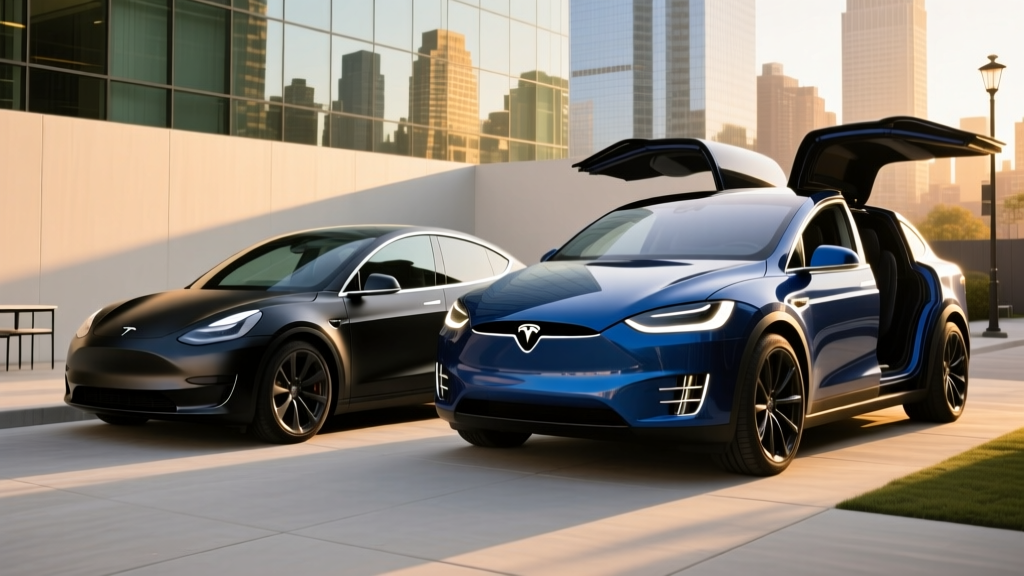
Comparing the Tesla Model 3 to the Tesla Model X is less about which car is "better" and more about which life you're living. One is a compact executive sedan that punches well above its price in efficiency and tech. The other is a three-row, falcon-wing SUV built for families who need space and don't mind paying for it. Both share Tesla's Supercharger network, software stack, and SAE Level 2 driver-assist, but the gap between them—in price, mass, and running costs—is enormous.
This guide uses current 2026 model-year specifications, EPA data, and IRS §30D tax-credit rules to give you the numbers you actually need before you configure either car.
Side-by-Side Specs: Tesla Model 3 vs Model X at a Glance
| Spec | 2026 Tesla Model 3 Long Range AWD | 2026 Tesla Model X Long Range |
|---|---|---|
| EPA Range | 341 miles | 335 miles |
| Battery (usable) | ~79 kWh (NMC) | ~100 kWh (NMC) |
| Efficiency | 132 MPGe (25 kWh/100mi) | 104 MPGe (32 kWh/100mi) |
| Peak DC Fast Charge | 250 kW | 250 kW |
| 10–80% DCFC Time | ~25 min | ~32 min |
| Level 2 Charge Rate | 11.5 kW (44 mi/hr) | 11.5 kW (34 mi/hr) |
| 0–60 mph | 4.2 sec | 3.8 sec |
| Horsepower | ~346 hp | ~670 hp |
| Cargo Volume | 23 cu ft (rear seats up) | 88 cu ft (max, seats folded) |
| Seating | 5 | 5, 6, or 7 (config-dependent) |
| Base MSRP | $47,740 | $79,990 |
| Battery/Drive Warranty | 8 yr / 120,000 mi | 8 yr / 150,000 mi |
Sources: EPA fueleconomy.gov, Tesla Model 3 specs, Tesla Model X specs. Real-world highway range is typically 10–15% below EPA; cold weather (below 32°F) can reduce range by 20–30%.
Range & Efficiency: The Physics of Mass
The Model 3 Long Range AWD posts an EPA 341 miles—impressive for any sedan, let alone one at this price point. In real-world highway driving at 75 mph in moderate temperatures, expect roughly 290–310 miles before you're hunting for a Supercharger. In freezing conditions with cabin heat running, plan for 240–260 miles. The Model 3's efficiency is its secret weapon: at 25 kWh per 100 miles, it sips electricity compared to most EVs on the road.
Real-World Range Reality Check:
- Model 3 LR AWD: EPA 341 mi → expect ~290–310 mi highway, ~240–260 mi in freezing weather.
- Model X LR: EPA 335 mi → expect ~280–300 mi highway, ~220–250 mi in freezing weather.
The Model X's larger frontal area and 5,100+ lb curb weight mean it loses more energy to air resistance and rolling resistance, especially at highway speed.
The Model X Long Range delivers an EPA 335 miles from its ~100 kWh pack. Despite having 21 kWh more usable capacity than the Model 3, it goes slightly fewer miles on a charge. That's the cost of hauling a large SUV: 32 kWh/100mi means every mile costs roughly 28% more in electricity. On a 300-mile road trip, the Model X will consume about 96 kWh versus the Model 3's 75 kWh—a meaningful difference when you're paying per kWh at a public DC fast charger.
Charging Speed & Network Considerations
Both vehicles peak at 250 kW on a V3 Supercharger and use the NACS connector natively (no adapter needed at any Tesla stall). But peak rate isn't sustained rate, and here the Model 3 has an edge.
| Charging Metric | Model 3 LR AWD | Model X LR |
|---|---|---|
| Peak DC Rate | 250 kW | 250 kW |
| Sustained Rate (10–50%) | ~190 kW avg | ~170 kW avg |
| 10–80% Time | ~25 min | ~32 min |
| Miles Added in 15 min | ~175 mi | ~150 mi |
| Level 2 (240V/48A) | 11.5 kW / 44 mi/hr | 11.5 kW / 34 mi/hr |
The Model 3's smaller battery fills faster in absolute time because there are fewer kWh to push through the charge curve. Both vehicles taper significantly above 80% state of charge—a protection measure for NMC chemistry. On road trips, plan your stops to charge to 80% and move on; lingering at a Supercharger from 80–100% can take as long as the 10–80% session.
At home on a Level 2 wall connector, the Model 3 gains 44 miles of range per hour of charging versus the Model X's 34 mi/hr. Over an 8-hour overnight session, that's 352 miles for the Model 3 (a full refill) versus 272 miles for the Model X (roughly 80% of its pack). Both are sufficient for daily driving, but the Model X benefits from a 60-amp circuit to maximize its 11.5 kW onboard charger.
Category Verdicts: Where Each Tesla Wins
🏆 Range & Efficiency Winner: Model 3
At 341 EPA miles and 132 MPGe, the Model 3 costs less per mile to drive and goes further on a charge despite a smaller battery. For commuters and road-trippers who count kWh, this is the clear pick.
🏆 Performance Winner: Model X
670 hp and a 3.8-second 0–60 in a 5,100-lb SUV is genuinely startling. The Model X Long Range outruns the Model 3 in a straight line and offers available Plaid trim (2.5 sec) for those who want supercar acceleration in a family hauler.
🏆 Charging Speed Winner: Model 3
Same peak kW, but the smaller pack fills 10–80% roughly 7 minutes faster and adds more miles per minute of charging. On road trips, that compounds across multiple stops.
🏆 Space & Utility Winner: Model X
Up to 88 cu ft of cargo, optional third row, falcon-wing rear doors for easy car-seat access, and available towing (up to 3,500 lbs). The Model 3's 23 cu ft trunk and frunk can't compete with family-hauler duty.
🏆 Value Winner: Model 3
At $47,740 versus $79,990, the Model 3 costs $32,250 less before incentives. That gap widens when you factor in efficiency savings, lower insurance premiums, and tax-credit eligibility (see below).
🏆 Tech & ADAS: Tie
Both run Tesla's current software stack with Autopilot standard and FSD (Supervised) available as an add-on. Both are SAE Level 2 driver-assist systems requiring full driver engagement—neither is self-driving.
Price, Tax Credits & Total Cost of Ownership
The sticker-price gap between these two vehicles is the single biggest factor in most purchase decisions. But the post-incentive picture makes the Model 3's value proposition even stronger for eligible buyers.
| Cost Factor | Model 3 LR AWD | Model X LR |
|---|---|---|
| Base MSRP | $47,740 | $79,990 |
| Federal §30D Credit Eligibility | Up to $7,500 (if income, sourcing, and MSRP cap met) | Eligible (SUV MSRP cap is $80,000) |
| Estimated Net Price (with max credit) | ~$40,240 | ~$72,490 |
| 5-Year Electricity Cost (15k mi/yr) | ~$4,690 (at $0.13/kWh avg) | ~$6,000 |
| Estimated Annual Insurance | ~$1,800–$2,400 | ~$2,800–$3,600 |
| Maintenance (5-yr estimate) | ~$1,500 | ~$2,200 |
| 5-Year Estimated Total Cost | ~$55,000–$58,000 | ~$88,000–$95,000 |
Tax Credit Nuances That Matter
Under current IRS §30D rules, the Model 3 qualifies for up to $7,500 in federal tax credit—provided you meet all requirements:
- Income caps: Modified AGI ≤ $150,000 (single), $225,000 (head of household), $300,000 (joint).
- MSRP cap: $55,000 for sedans (Model 3 qualifies at base; higher trims may exceed).
- Battery sourcing: Critical-minerals and battery-component requirements phase in annually—check the current-year eligible vehicle list on fueleconomy.gov before purchasing.
- Point-of-sale transfer: You can transfer the credit to the dealer at purchase to reduce your out-of-pocket cost immediately.
The Model X qualifies under the higher $80,000 SUV MSRP cap, but at $79,990 base, any added options (paint, wheels, FSD) push it over the threshold—eliminating credit eligibility. This is a critical configuration trap. Buyers wanting the credit must spec carefully.
Insurance premiums run 25–40% higher for the Model X due to its higher repair costs, greater mass, and more expensive replacement parts. Over five years, that gap adds $5,000–$8,000 in additional insurance expense.
Driving Dynamics & Daily Usability
The Model 3 feels like a sports sedan: low center of gravity, sharp turn-in, and a ride that's firm but controlled. The refreshed Highland-generation cabin is noticeably quieter than pre-2024 models, with ventilated front seats and a rear touchscreen. At 3,860 lbs, it's one of the lighter EVs in its class, which shows in its handling and efficiency.
The Model X drives surprisingly well for its size—the air suspension smooths out rough pavement, and the acceleration is relentless. But you feel the weight in corners and during emergency braking. The falcon-wing doors are genuinely useful in tight parking spaces (they need less lateral clearance than conventional doors) but add mechanical complexity and potential long-term maintenance cost. The available third row is best suited for children; adults will find it cramped on longer trips.
ADAS Reality Check: Both the Model 3 and Model X offer Autopilot (standard) and FSD Supervised (paid add-on). These are SAE Level 2 driver-assistance systems. You must keep your hands on the wheel and eyes on the road at all times. Tesla's system is capable on highways but does not make either vehicle autonomous. Full self-driving capability (SAE Level 4/5) is not available on any consumer Tesla as of 2026.
Pros and Cons at a Glance
Tesla Model 3 LR AWD
Pros:
- Class-leading efficiency (132 MPGe)
- Fastest 10–80% charging in its segment
- Lowest total cost of ownership in Tesla's lineup
- Strong §30D tax-credit eligibility at base MSRP
- Refined Highland cabin with low NVH
Cons:
- No third-row option; limited cargo for families
- Rear touchscreen HVAC controls frustrate some passengers
- No towing capability
- Higher trims may exceed $55K MSRP cap for tax credit
Tesla Model X LR
Pros:
- Up to 7 seats and 88 cu ft cargo volume
- 670 hp with 3.8-sec 0–60 (Plaid available at 2.5 sec)
- Falcon-wing doors ease car-seat loading
- 3,500-lb towing capacity
- Air suspension with adjustable ride height
Cons:
- $32,250 more expensive than Model 3 at base
- Lower efficiency (104 MPGe) raises running costs
- Options easily push MSRP past $80K tax-credit cap
- Higher insurance premiums
- Falcon-wing door mechanism adds complexity
Decision Framework: Which Tesla Fits Your Life?
Choose the Tesla Model 3 if:
- You commute solo or with one passenger most days
- You want the lowest cost-per-mile in Tesla's lineup
- You prioritize tax-credit eligibility and sub-$50K pricing
- You take regular road trips and want the fastest charging stops
- You don't need more than 23 cu ft of cargo space
Choose the Tesla Model X if:
- You regularly carry 5+ passengers or need a third row for kids
- You need 80+ cu ft of cargo or tow a small trailer
- You want SUV-class ground clearance and air suspension
- You value the falcon-wing doors for tight urban parking and car-seat access
- Budget is flexible and you'll accept higher insurance and energy costs
The honest truth: most buyers who cross-shop these two vehicles end up happier with the Model 3 unless they have a hard requirement for a third row or maximum cargo. The $32,000 price gap buys a lot of charging, insurance, and tire replacements. But if your life involves carpool lanes full of kids, weekend camping gear, or a boat trailer, the Model X does things the Model 3 physically cannot.
Frequently Asked Questions
Is the Tesla Model X worth $32,000 more than the Model 3?
Only if you need its unique capabilities: three-row seating, 88 cu ft of cargo space, towing, or air suspension. For daily commuting and most road trips, the Model 3 delivers comparable tech and better efficiency at a fraction of the cost. The value gap widens further when you factor in the Model X's higher insurance and electricity costs over five years.
Do both the Model 3 and Model X qualify for the $7,500 federal tax credit?
Both can qualify under IRS §30D, but eligibility depends on your income, the vehicle's battery sourcing, and MSRP caps. The Model 3 (sedan cap: $55K) qualifies at base but may lose eligibility with options. The Model X (SUV cap: $80K) barely fits at its $79,990 base—adding paint, wheels, or FSD pushes it over the limit. Always verify current eligibility on fueleconomy.gov before ordering.
Which Tesla charges faster on road trips?
The Model 3, despite both vehicles sharing a 250 kW peak rate. The Model 3's smaller ~79 kWh battery fills from 10–80% in about 25 minutes versus the Model X's ~32 minutes. The Model 3 also adds more miles of range per minute of charging due to its superior efficiency.
Can the Model 3 tow?
No. The Model 3 has no factory towing rating. The Model X can tow up to 3,500 lbs when properly equipped, making it suitable for small utility trailers, bike racks, or light campers.
How does real-world range compare to the EPA sticker for both?
Expect roughly 85–90% of EPA range in moderate-temperature highway driving and 70–80% in freezing conditions with cabin heat. The Model 3 LR AWD's real-world highway range is approximately 290–310 miles; the Model X LR delivers about 280–300 miles. Both vehicles' NMC batteries should be preconditioned before DC fast charging to achieve peak charge rates—Tesla's navigation system does this automatically when a Supercharger is set as your destination.
Are Autopilot and FSD the same on both vehicles?
Yes. Both the Model 3 and Model X ship with the same hardware suite and software stack. Autopilot (adaptive cruise + lane centering) is standard; FSD (Supervised) is an optional upgrade. Both remain SAE Level 2 systems requiring active driver supervision—they are not self-driving.