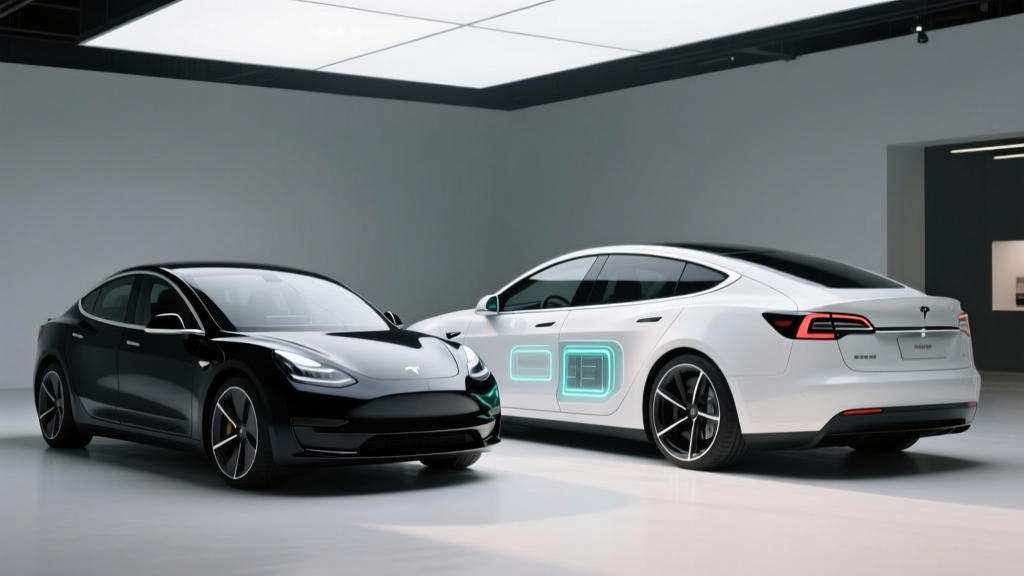
The Tesla Model 3 and Model S share a badge, a Supercharger network, and a software ecosystem — but they target fundamentally different buyers. The Model 3 is Tesla's high-volume compact executive sedan, optimized for efficiency and value. The Model S is the flagship luxury sedan, built around air suspension, dual-motor performance, and long-distance comfort. This comparison breaks down the 2026 model-year specs, real-world range, charging behavior, pricing, and total ownership cost so you can make a spec-driven decision.
Side-by-Side Specs: Model 3 vs Model S at a Glance
| Specification | 2026 Tesla Model 3 Long Range AWD | 2026 Tesla Model S Long Range |
|---|---|---|
| EPA Range | 363 miles | 402 miles |
| Battery (usable, est.) | ~79 kWh (NMC) | ~95 kWh (NMC) |
| Efficiency (MPGe combined) | 134 MPGe | 120 MPGe |
| Efficiency (kWh/100 mi) | 25 kWh | 28 kWh |
| Peak DC Fast Charge | 250 kW | 250 kW |
| 10–80% DC Charge Time | ~25 min | ~29 min |
| Level 2 Charge Rate | 11.5 kW (44 mi/hr) | 11.5 kW (37 mi/hr) |
| 0–60 mph | 4.2 sec | 3.1 sec |
| Horsepower | 346 hp | 670 hp |
| Cargo Volume | 23 cu ft (trunk + frunk) | 28 cu ft (trunk + frunk) |
| Base MSRP | $47,740 | $79,990 |
| Drivetrain | Dual Motor AWD | Dual Motor AWD |
| Suspension | Fixed coil | Adaptive air |
| Warranty (battery/drivetrain) | 8 yr / 120,000 mi | 8 yr / 150,000 mi |
Sources: EPA Fuel Economy, Tesla Model S specs, Tesla Model 3 specs.
Range and Efficiency: Where the Real-World Gap Widens
Model 3 Long Range AWD: EPA 363 mi — expect ~300–320 mi on highway trips at 70+ mph; ~250–275 mi in freezing weather.
Model S Long Range: EPA 402 mi — expect ~330–350 mi highway; ~280–305 mi in freezing weather.
The Model S carries a larger battery pack (~95 kWh usable vs. ~79 kWh in the Model 3), which delivers more absolute range but at a lower efficiency per mile. The Model 3's lighter curb weight (~4,034 lb vs. ~4,766 lb) means it converts each kWh into more miles. On the highway, the Model 3 averages roughly 25 kWh/100 mi, while the Model S draws closer to 28 kWh/100 mi.
Cold-weather range loss affects both vehicles similarly — expect a 20–30% reduction when temperatures drop below freezing, mitigated somewhat by Tesla's battery preconditioning and heat pump (standard on both models). The Model S's larger pack provides a bigger absolute buffer, so even with 25% cold-weather loss, you still have ~280 miles — enough for most single-day drives without stopping.
402 EPA miles gives it a ~39-mile advantage. For drivers who regularly cover 300+ miles between charges, the extra buffer matters.
134 MPGe combined vs. 120 MPGe. The Model 3 uses less energy per mile, lowering charging costs over time.
Charging Speed and Network Access
Both vehicles peak at 250 kW on V3 Superchargers and use the NACS (North American Charging Standard) connector natively — no adapter required at Tesla stations. However, charging dynamics differ because of pack size:
| Charging Level | Model 3 Long Range | Model S Long Range |
|---|---|---|
| Level 1 (120V / 12A) | ~1.4 kW — 3–4 mi/hr | ~1.4 kW — 3 mi/hr |
| Level 2 (240V / 48A) | 11.5 kW — 44 mi/hr | 11.5 kW — 37 mi/hr |
| DC Fast (V3 Supercharger) | 250 kW peak — 10–80% in ~25 min | 250 kW peak — 10–80% in ~29 min |
The Model 3 charges slightly faster on DC because it needs to fill a smaller battery. Both vehicles taper charging speed significantly above 80% SoC to protect the NMC cells — a 10–90% session can take nearly as long as 10–80%, so plan stops around the 80% mark on road trips.
At home on Level 2, the Model 3 gains range faster (44 mi/hr vs. 37 mi/hr) because each kWh goes further. A full overnight charge from 20% to 80% takes roughly 4.5 hours on the Model 3 and 5.5 hours on the Model S — both easily managed with a Wall Connector or comparable Level 2 unit.
Smaller pack fills faster; adds more miles per minute at Level 2 thanks to higher efficiency.
Both use NACS natively and access the full Tesla Supercharger network — over 6,500 V3/V4 stalls in the U.S.
Performance and Driving Dynamics
The Model S Long Range's 670 hp and 3.1-second 0–60 time put it in supercar territory, while the Model 3's 346 hp and 4.2-second sprint are quick by any mainstream sedan standard. The real difference is how they feel:
- Model S: Air suspension adjusts ride height and damping automatically. At highway speed, it lowers for aerodynamics; on rough roads, it softens. The cabin is noticeably quieter thanks to acoustic glass and more insulation.
- Model 3: The fixed coil suspension (refreshed for the "Highland" generation) is firmer but well-tuned. It's more agile in corners due to lower weight, but road noise is more pronounced than in the Model S.
Both vehicles include Tesla's basic Autopilot (lane centering + adaptive cruise) as standard. Full Self-Driving (Supervised) remains a SAE Level 2 driver-assistance system — the driver must remain engaged and hands on or near the wheel at all times.
670 hp, 3.1 sec 0–60, and air suspension deliver flagship-tier acceleration and ride quality.
Lighter weight and shorter wheelbase make it more engaging on back roads.
Pricing, Tax Credits, and the Value Equation
This is where the comparison becomes decisive for most buyers. The MSRP gap is over $32,000, and federal tax credit eligibility widens it further.
| Cost Factor | Model 3 Long Range AWD | Model S Long Range |
|---|---|---|
| Base MSRP | $47,740 | $79,990 |
| Federal §30D Tax Credit | Up to $7,500 (if eligible) | $0 (exceeds MSRP cap) |
| Effective Price After Credit | ~$40,240 | $79,990 |
| Destination Fee | $1,390 | $1,390 |
The IRS §30D federal tax credit has an MSRP cap of $55,000 for sedans. The Model S at $79,990 does not qualify — period. The Model 3 Long Range at $47,740 falls under the cap, but the full $7,500 credit depends on battery-component and critical-mineral sourcing requirements, plus buyer income limits ($150K single / $300K joint for new vehicles). The credit can now be transferred at the point of sale, reducing your purchase price directly.
- Model 3 eligibility: MSRP under $55K cap ✓ | Income limits apply | Battery sourcing rules apply — verify current-year IRS guidance before purchasing
- Model S eligibility: MSRP exceeds $55K sedan cap ✗ — no federal credit regardless of income or sourcing
~$40K after credit is one of the best deals in the EV market for a 363-mile AWD sedan.
If budget isn't the constraint, the Model S delivers a tier-above experience the Model 3 can't match.
Total Cost of Ownership: 5-Year Breakdown
| Cost Category (5 years / 75,000 mi) | Model 3 LR AWD | Model S LR |
|---|---|---|
| Purchase (after credit, before state incentives) | ~$41,630 | $81,380 |
| Electricity (home + Supercharger blend at $0.16/kWh avg) | ~$3,000 | ~$3,360 |
| Insurance (national avg, varies widely by driver/region) | ~$9,500 | ~$14,000 |
| Maintenance (tires, cabin filter, wiper fluid, brake fluid) | ~$1,800 | ~$2,400 |
| Estimated Depreciation | ~$16,000 | ~$30,000 |
| Estimated 5-Year Total | ~$71,930 | ~$131,140 |
The Model 3 wins on nearly every ongoing cost line. Insurance is notably higher on the Model S due to its repair costs, higher value, and performance profile. Depreciation in dollar terms is also steeper on the Model S, though percentage depreciation is comparable. The Model 3's lower energy consumption saves roughly $360 in electricity over five years — a modest amount, but it compounds alongside the purchase-price gap.
~$59,000 less over five years. The savings could fund a home solar array, a second EV, or a decade of Supercharging.
Interior, Tech, and Daily Livability
Both vehicles share Tesla's minimalist interior architecture: a 15.4-inch central touchscreen, no physical instrument cluster, and steering-wheel-integrated controls. Key differences:
- Model S: Ventilated front seats, premium audio (22 speakers), rear-seat touchscreen, powered rear sunshade, more rear legroom (35.4 in vs. 33.9 in), and a power-folding second row. The hatchback-style liftgate makes loading bulky items easier despite the sedan profile.
- Model 3: Heated front and rear seats, 17-speaker audio, ventilated front seats (post-Highland refresh), and a rear touchscreen for climate/media. Tighter rear seat but adequate for adults on shorter trips. The trunk is a traditional sedan opening, though the frunk adds useful cargo space.
Both vehicles receive over-the-air software updates, support Tesla's app-based preconditioning and Summon, and include the same active-safety suite (automatic emergency braking, blind-spot monitoring, lane-departure prevention). The Model S adds a yoke steering option and a more configurable air-suspension interface.
Decision Framework: Which One Fits Your Life?
Choose the Model 3 Long Range if:
- You want the best value-per-mile-of-range in Tesla's lineup
- Your daily commute is under 80 miles and you charge at home
- Federal tax credit eligibility matters to your budget
- You prioritize efficiency and lower insurance premiums
- You don't need air suspension or flagship luxury appointments
Choose the Model S Long Range if:
- You regularly drive 300+ miles in a single day and want the largest range buffer
- Air suspension and a quieter cabin are non-negotiable for long trips
- You need 670 hp and 3.1-second 0–60 performance
- You carry rear-seat passengers often and value the extra legroom
- Budget is flexible and the $40K premium over the Model 3 is acceptable
Frequently Asked Questions
Is the Model S worth $40,000 more than the Model 3?
It depends on what you value. The Model S adds 39 miles of EPA range, 324 more horsepower, air suspension, a larger and quieter cabin, and hatchback utility. If those features align with your driving patterns and budget, the premium is justified. If your priority is cost-efficient daily transportation with excellent range, the Model 3 delivers 90% of the experience at half the price.
Does the Model 3 qualify for the $7,500 federal tax credit?
The Model 3 Long Range AWD is under the $55,000 MSRP sedan cap, making it potentially eligible. However, the full $7,500 depends on battery-component and critical-mineral sourcing compliance, as well as buyer income limits ($150K single / $300K joint). Check the latest IRS §30D guidance and confirm with your tax professional before purchasing. The credit can be applied at point of sale.
Which is cheaper to insure?
The Model 3 is significantly cheaper to insure. National averages put Model 3 insurance at roughly $1,900/year vs. $2,800/year for the Model S, though rates vary widely by state, driving record, and coverage level. The Model S's higher repair costs and performance profile drive the premium gap.
Can I charge either car on non-Tesla networks?
Both vehicles use the NACS connector natively. As of 2026, most major charging networks (Electrify America, EVgo, ChargePoint) have begun adding NACS cables at new stations. For older CCS-only stalls, Tesla sells a CCS adapter (~$175) that unlocks access to non-Tesla DC fast chargers.
Which has better real-world highway range?
Expect roughly 300–320 real-world highway miles from the Model 3 and 330–350 from the Model S at 70–75 mph in moderate temperatures. The Model S's larger battery provides a bigger buffer, but the Model 3's efficiency means it can stretch further per kWh when driven conservatively.
Do both come with Autopilot?
Yes. Basic Autopilot (Traffic-Aware Cruise Control + Autosteer) is standard on both. Full Self-Driving (Supervised) is an optional upgrade on both vehicles and remains a Level 2 driver-assist system — not autonomous driving.