The Core Matchup: Premium Sedan vs Budget-Friendly Hatchback
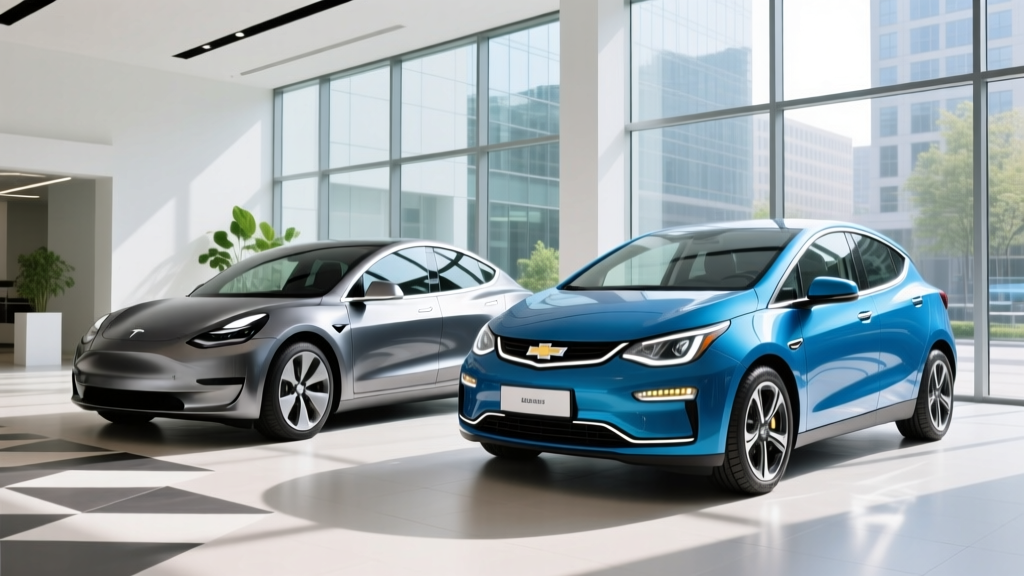
Shoppers cross-referencing the Tesla Model 3 and Chevrolet Bolt EV are usually asking one question: is the Tesla worth the premium, or does the Bolt deliver enough EV for the money? These two vehicles occupy fundamentally different segments. The Model 3 is a compact luxury sport sedan built for highway efficiency, fast charging, and software-forward tech. The Bolt EV is a subcompact hatchback optimized for city driving, low purchase price, and maximum cargo flexibility. Neither is universally better — the right answer depends entirely on your commute, charging access, and budget.
This comparison uses current 2025/2026 model-year specifications from fueleconomy.gov and manufacturer data. Prices reflect base MSRP before destination charges, and tax credit figures reference IRS §30D rules, which include income caps, MSRP caps, and battery-sourcing requirements that change periodically.
Side-by-Side Specs: Model 3 vs Bolt EV at a Glance
| Specification | Tesla Model 3 Long Range RWD | Chevrolet Bolt EV 2LT |
|---|---|---|
| EPA Range | 363 miles | 259 miles |
| Battery Capacity (usable) | ~75 kWh (NMC) | ~65 kWh (NMC) |
| EPA Efficiency | 132 MPGe (25 kWh/100 mi) | 120 MPGe (28 kWh/100 mi) |
| Peak DC Fast Charge Rate | 250 kW (NACS) | 115 kW (CCS1) |
| 10–80% DC Fast Charge Time | ~25 minutes | ~30 minutes (to ~80%); ~60 min to full |
| Level 2 AC Charging (max) | 11.5 kW (48A) | 11.5 kW (48A) |
| Horsepower | 346 hp (single motor RWD LR) | 200 hp |
| 0–60 mph | 4.9 seconds | 6.5 seconds |
| Cargo Volume | 23 cu ft (rear seats up) + 3.1 cu ft frunk | 16.3 cu ft (rear seats up, behind seats); 57 cu ft (rear seats folded) |
| Base MSRP | ~$47,740 (Long Range RWD) | ~$28,785 (1LT); ~$31,785 (2LT) |
| Battery/Powertrain Warranty | 8 years / 120,000 miles | 8 years / 100,000 miles |
| ADAS Suite | Autopilot (SAE Level 2) | Chevy Safety Assist (SAE Level 1–2) |
Important caveats: Tesla also offers the Model 3 Standard Range RWD at ~$38,990 with 341 miles EPA and 275 hp, which narrows the price gap. The Bolt EV was redesigned for the 2025 model year with a new battery pack and CCS1 charging port (replacing the older Bolt's notoriously slow 50 kW DC charging). Always confirm current-year specs on the manufacturer site, as trims and pricing shift with each model year.
Range and Efficiency: Highway Cruising vs City Sipping
Tesla Model 3 LR: EPA 363 mi — expect ~300–320 mi in mixed highway driving at 70 mph; ~240–270 mi in sustained cold weather (below 30°F) without preconditioning.
Chevy Bolt EV: EPA 259 mi — expect ~220–240 mi in mixed highway driving; ~170–200 mi in sustained cold weather. The Bolt's taller, less aerodynamic hatchback shape costs it more at highway speeds than the Model 3's slippery sedan profile.
The Model 3 Long Range's 104-mile EPA advantage is significant and shows up most on road trips. Its lower drag coefficient (Cd ~0.219) and larger battery mean it holds range better at sustained 70–80 mph speeds. The Bolt EV, with a Cd around 0.308, loses efficiency faster as speed increases. Around town at 25–45 mph, the gap narrows considerably — regenerative braking recaptures energy in stop-and-go traffic, and the Bolt's lighter curb weight (~3,600 lbs vs ~4,000 lbs for the Model 3 LR) helps it punch above its EPA rating in city driving.
According to fueleconomy.gov, the Model 3 LR consumes 25 kWh per 100 miles combined, while the Bolt EV uses 28 kWh per 100 miles. That 3 kWh/100mi difference adds up over a year of driving — roughly $60–$90 in additional electricity cost for the Bolt at the national average rate of $0.17/kWh and 12,000 miles driven annually.
Charging Speed and Network Access
This is where the two vehicles diverge most dramatically, and it's the single biggest factor for anyone without reliable home charging.
| Charging Level | Tesla Model 3 LR | Chevrolet Bolt EV |
|---|---|---|
| Level 1 (120V, 12A) | ~1.4 kW / ~5 mi/hr | ~1.4 kW / ~4 mi/hr |
| Level 2 (240V, 48A) | 11.5 kW / ~44 mi/hr | 11.5 kW / ~39 mi/hr |
| DC Fast Charge (peak) | 250 kW (NACS) | 115 kW (CCS1) |
| 10–80% DCFC Time | ~25 minutes | ~30 minutes |
| Added Range in 15 min DCFC | ~175 miles | ~100 miles |
Understanding kW vs kWh: kW (kilowatts) measures charging power — how fast energy flows into the battery. kWh (kilowatt-hours) measures battery capacity — how much energy the battery holds. The Model 3's 250 kW peak charge rate means it can accept energy roughly 2.2x faster than the Bolt's 115 kW peak. However, neither vehicle sustains its peak rate for the entire session — charge curves taper significantly above 50–60% state of charge (SoC), and especially above 80%.
The Tesla Supercharger network remains the most reliable and widespread DC fast-charging ecosystem in North America, with over 6,000 stations and 30,000+ stalls. Model 3 owners get native NACS access with no adapter needed. The Bolt EV uses the CCS1 connector, which works with Electrify America, EVgo, and other public networks. Reliability on non-Tesla networks remains inconsistent — a 2024 J.D. Power study found CCS networks averaging 20%+ failure rates at some providers.
Starting in 2025, GM began providing Bolt EV owners with a NACS adapter for access to Tesla Superchargers (V3 stalls, capped at 150 kW for non-Tesla vehicles). This partially closes the network gap, but the Bolt's lower peak charge rate means even on a Supercharger, it charges slower than the Model 3.
Performance and Driving Dynamics
The Model 3 Long Range RWD delivers 346 hp and hits 60 mph in 4.9 seconds — genuinely quick for a daily driver and sporty on highway on-ramps. The dual-motor AWD Performance variant drops that to 2.9 seconds, but at a significant price premium. The steering is precise, the chassis is taut, and the low center of gravity from the under-floor battery pack keeps body roll minimal.
The Bolt EV's 200 hp and 6.5-second 0–60 time are perfectly adequate for merging and city driving but won't excite anyone. The ride quality is softer and more compliant over rough pavement — a trade-off that favors comfort over sportiness. The Bolt's compact dimensions (169 inches long vs the Model 3's 189 inches) make it significantly easier to park in tight urban spaces.
Both vehicles offer one-pedal driving modes with strong regenerative braking. Tesla's regen is slightly more aggressive and consistent, while the Bolt's Regen on Demand paddle gives drivers granular control over deceleration force.
Interior, Tech, and Driver Assistance
The Model 3's minimalist interior centers on a 15.4-inch touchscreen that controls virtually every vehicle function — climate, mirrors, glovebox, and driving settings. There is no instrument cluster; speed and navigation appear on the left side of the central screen. This design polarizes buyers: some love the clean aesthetic, others find it distracting. Build quality has improved significantly with the 2024 "Highland" refresh, with better materials, ventilated front seats, ambient lighting, and a rear passenger screen.
The Bolt EV uses a more traditional layout with an 11-inch digital instrument cluster and an 11.3-inch infotainment touchscreen running Google Built-In (Google Maps, Google Assistant, Play Store). Physical buttons for climate and volume are a usability win. The interior materials are hard-plastic-heavy — appropriate for the price point but noticeably less premium than the refreshed Model 3.
Driver Assistance (SAE Level 2 — driver must remain engaged at all times):
Tesla's Autopilot (standard) includes adaptive cruise control, lane centering, and automatic emergency braking. Enhanced Autopilot ($6,000 add-on) adds auto lane change, autosteer on navigation routes, and Smart Summon. FSD (Supervised) ($8,000 or $99/month) attempts full point-to-point navigation but still requires active supervision and is not available everywhere.
The Bolt EV's Chevy Safety Assist suite (standard) includes automatic emergency braking, lane keep assist, following distance indicator, and adaptive cruise control on higher trims. It's a competent Level 1–2 system but lacks the advanced lane-change and navigation-linked features of Tesla's premium tiers. Super Cruise (GM's hands-off-highway Level 2 system) is not available on the Bolt EV — it's reserved for Cadillac, GMC, and higher-end Chevy models.
Pricing, Tax Credits, and Total Cost of Ownership
Price is where the Bolt EV fights back hardest. Let's break down the numbers.
| Cost Factor | Tesla Model 3 LR RWD | Chevrolet Bolt EV 2LT |
|---|---|---|
| Base MSRP | ~$47,740 | ~$31,785 |
| Destination Charge | ~$1,390 | ~$1,195 |
| Federal §30D Tax Credit (max) | $7,500 (if eligible) | $7,500 (if eligible) |
| Effective Price After Max Credit | ~$41,630 | ~$25,480 |
| MSRP Cap (§30D — sedans: $55K; SUVs/vans: $80K) | Passes (sedan, under $55K) | Passes (under $55K) |
| Point-of-Sale Transfer | Available — credit applied at dealer | Available — credit applied at dealer |
- Income caps: AGI ≤ $150K (single), $225K (head of household), $300K (joint)
- MSRP caps: ≤ $55,000 for sedans (Model 3 qualifies); ≤ $80,000 for SUVs/trucks/vans
- Battery sourcing: Critical minerals and battery components must meet phased-in percentage thresholds from US or FTA-partner countries — both vehicles currently qualify for the full $7,500, but sourcing rules tighten annually
- Point-of-sale transfer: Both vehicles allow the credit to be transferred to the dealer at purchase, reducing the upfront cash price rather than waiting for a tax refund
- Tax liability: If transferred at POS, no tax liability requirement; if claimed on return, credit is non-refundable and limited to your tax liability
Always confirm eligibility with a tax professional and check the latest IRS guidance — battery sourcing requirements change annually and can affect credit availability mid-year.
Five-Year Ownership Cost Estimate
| Cost Category | Tesla Model 3 LR | Chevrolet Bolt EV 2LT |
|---|---|---|
| Purchase Price (after $7,500 credit) | ~$41,630 | ~$25,480 |
| Electricity (12K mi/yr, $0.17/kWh avg) | ~$2,550 (25 kWh/100mi) | ~$2,856 (28 kWh/100mi) |
| Insurance (national avg) | ~$10,800 (~$2,160/yr) | ~$7,500 (~$1,500/yr) |
| Maintenance (tires, cabin filter, fluid top-off) | ~$1,500 | ~$1,200 |
| Estimated Depreciation (5 yr) | ~$18,000 | ~$10,000 |
| Total 5-Year Cost (est.) | ~$74,480 | ~$47,036 |
The Bolt EV saves roughly $27,000 over five years, driven primarily by its lower purchase price, cheaper insurance, and slower absolute depreciation (a smaller starting number depreciates less in dollar terms). The Model 3's electricity cost advantage (~$300 over five years) is negligible compared to the insurance gap — Tesla insurance averages 30–40% higher than comparable EVs due to higher repair costs and parts pricing.
Cargo, Practicality, and Daily Use
The Bolt EV's hatchback design is its secret weapon. With 16.3 cubic feet behind the rear seats and 57 cubic feet with seats folded, it swallows bulkier cargo than the Model 3's traditional sedan trunk (23 cu ft total, but with a narrower opening). A bicycle, large dog crate, or IKEA furniture run fits the Bolt more easily than the Model 3.
The Model 3 compensates with a 3.1 cu ft front trunk (frunk) — useful for charging cables, groceries, or a laptop bag. The Bolt EV has no frunk. Rear-seat legroom is comparable (35.2 inches in the Model 3 vs 35.8 inches in the Bolt), but the Model 3's lower roofline makes entry/exit slightly less convenient for taller passengers.
Ground clearance: the Model 3 sits at 5.5 inches, which can be a concern on steep driveways or speed bumps. The Bolt EV's 6.3 inches provides a bit more margin.
Decision Framework: Which Should You Choose?
Choose the Tesla Model 3 if:
- You regularly drive more than 50 miles round-trip or take road trips exceeding 200 miles — the 363-mile EPA range and 250 kW Supercharger access reduce stops and wait times significantly
- You rely on public DC fast charging (no home charger) — Supercharger reliability and speed are meaningfully better than CCS networks
- You value performance: 4.9-second 0–60, precise handling, and strong regen make the Model 3 genuinely engaging to drive
- You want advanced driver assistance (Autopilot/FSD) for highway commuting — noting that active supervision is always required (SAE Level 2)
- You plan to keep the vehicle 7+ years and value over-the-air feature updates
Choose the Chevrolet Bolt EV if:
- Your daily driving is under 50 miles and you have reliable Level 2 home charging — the 259-mile range is more than sufficient, and you'll rarely use DC fast charging
- Minimizing upfront cost is a priority — the Bolt starts ~$16,000 lower than the Model 3 LR, and ~$27,000 lower in 5-year total cost
- You need hatchback cargo flexibility for gear, pets, or bulky items
- You prefer physical buttons, a traditional instrument cluster, and Google Built-In infotainment over a screen-only interface
- You want a compact vehicle that's easy to park in tight urban environments
- You're a first-time EV buyer testing whether electric works for your lifestyle before committing to a premium-priced EV
Pros and Cons at a Glance
Tesla Model 3 — Pros
- 363-mile EPA range — best in class for sedans under $50K
- 250 kW DC fast charging with native Supercharger access
- Strong performance (4.9s 0–60) and engaging driving dynamics
- Best-in-class ADAS suite and OTA software updates
- Lower electricity consumption (25 kWh/100mi)
Tesla Model 3 — Cons
- ~$47,740 starting price — significant premium over the Bolt
- Higher insurance costs (~$2,160/yr national average)
- Screen-only controls polarize some drivers
- Low ground clearance (5.5 in) scrapes on steep driveways
- Repair costs and wait times can be high post-collision
Chevrolet Bolt EV — Pros
- ~$31,785 MSRP — one of the most affordable new EVs available
- 259-mile EPA range is ample for most daily commutes
- Hatchback cargo versatility (57 cu ft seats folded)
- Compact dimensions for easy urban parking
- Google Built-In infotainment with physical climate controls
- Significantly lower insurance and maintenance costs
Chevrolet Bolt EV — Cons
- 115 kW peak DC charging — slow for road trips compared to rivals
- CCS1 connector (requires NACS adapter for Supercharger access)
- 200 hp / 6.5s 0–60 — adequate but not quick
- No frunk; hard-plastic interior at this price point
- Highway range drops noticeably at 75+ mph due to aerodynamics
- No Super Cruise availability
Frequently Asked Questions
Is the Tesla Model 3 worth the extra cost over the Bolt EV?
If you regularly drive long distances, rely on public charging, or value performance and advanced driver assistance, yes — the Model 3's 104-mile range advantage, 250 kW Supercharger access, and 4.9-second 0–60 time justify the premium. If your commute is short, you charge at home, and budget is a priority, the Bolt EV delivers strong EV value at ~$16,000 less.
Can the Chevy Bolt EV use Tesla Superchargers?
Yes, with a NACS adapter provided by GM (included or available depending on model year). However, the Bolt's 115 kW peak charge rate limits it to ~150 kW even on V3 Superchargers, and charging speeds remain slower than the Model 3's native 250 kW capability.
Which qualifies for the full $7,500 federal tax credit?
Both vehicles currently qualify for the full §30D credit, subject to buyer income caps ($150K single / $300K joint), MSRP caps (both pass), and battery sourcing requirements that tighten annually. The credit can be transferred at the point of sale to reduce the purchase price directly. Verify current eligibility at irs.gov and consult a tax professional, as sourcing rules change and can affect eligibility mid-year.
How does cold weather affect range on each vehicle?
Expect 20–30% range loss in sustained sub-30°F driving for both vehicles. The Model 3's heat pump (standard since 2021) helps mitigate cabin heating energy draw, but battery chemistry slows in cold regardless. The Bolt EV also uses a heat pump in the latest generation. Preconditioning the battery while plugged in (both vehicles support this) recovers some lost range by warming the pack before departure.
Which is cheaper to insure?
The Chevrolet Bolt EV, by a significant margin. National average EV insurance for the Bolt runs ~$1,500/year, while the Model 3 averages ~$2,160/year. Tesla's higher repair costs, specialized parts, and aluminum-intensive construction drive premiums higher. Get quotes from your insurer before purchasing — individual rates vary widely by state, driving record, and coverage level.
Which has better long-term battery reliability?
Both use NMC (nickel manganese cobalt) lithium-ion chemistries with active liquid thermal management. Tesla's battery management system has a long track record — Model 3 packs have shown ~10–12% degradation at 100,000 miles in fleet data. GM's new Bolt battery (redesigned for 2025) is newer to market with less long-term data, but GM's 8-year/100,000-mile battery warranty (covering capacity below 70%) provides comparable protection. Neither vehicle currently offers LFP chemistry, which would trade energy density for longer cycle life.