Quick Verdict: Two Very Different EVs
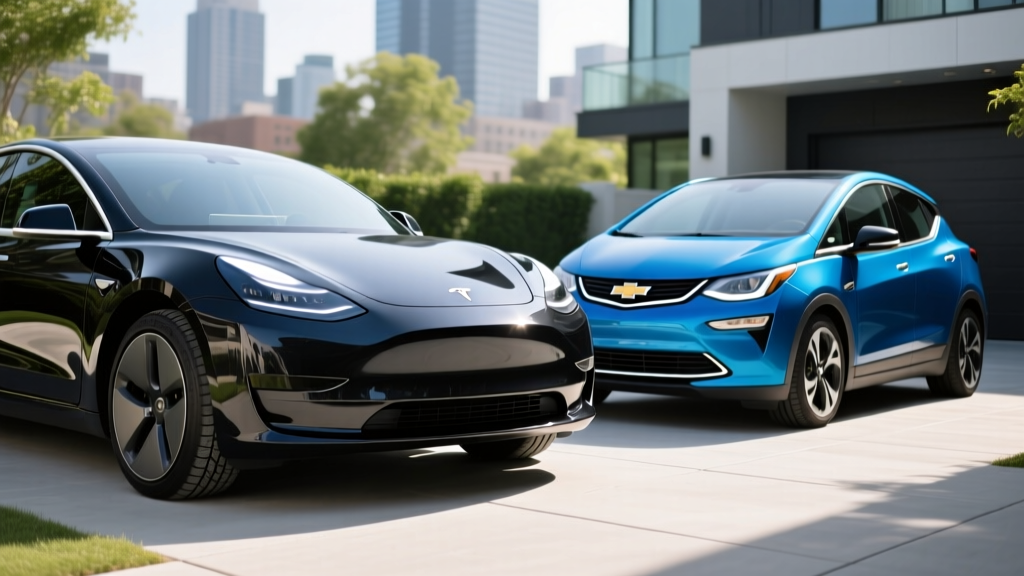
The Tesla Model 3 and Chevrolet Bolt represent opposite ends of the mainstream EV market. The Model 3 targets tech-forward buyers willing to pay a premium for performance, Supercharger access, and advanced driver assistance. The Bolt prioritizes affordability and practicality, undercutting the Tesla by $10,000+ before incentives while delivering solid range and everyday usability.
Neither is universally "better" — your choice depends on budget, charging access, and feature priorities. Let's break down the numbers.
Side-by-Side Specifications
| Specification | 2026 Tesla Model 3 (Long Range) | 2026 Chevrolet Bolt EV (2LT) |
|---|---|---|
| EPA Range | 341 miles | 259 miles |
| Battery Capacity | 75 kWh (NMC) | 65 kWh (NMC) |
| Peak DC Fast Charge | 250 kW | 55 kW |
| 10-80% Charge Time | ~25 minutes | ~60 minutes |
| Level 2 Charging | 11.5 kW (44 mi/hr) | 11.5 kW (39 mi/hr) |
| 0-60 mph | 4.2 seconds | 6.5 seconds |
| Horsepower | 346 hp (dual motor AWD) | 200 hp (FWD) |
| EPA Efficiency | 132 MPGe (25 kWh/100mi) | 120 MPGe (28 kWh/100mi) |
| Cargo Volume | 23 cu ft (rear seats up) | 19 cu ft (rear seats up) |
| Base MSRP | $42,990 | $28,995 |
| Battery Warranty | 8 years / 120,000 miles | 8 years / 100,000 miles |
Range Winner: Tesla Model 3
EPA vs Real-World Reality: The Model 3 Long Range's 341-mile EPA estimate translates to roughly 280-300 miles in mixed highway driving at 70+ mph, dropping to 230-250 miles in freezing temperatures. The Bolt's 259-mile EPA figure becomes 220-240 miles highway, or 180-200 miles in cold weather.
For road trips, the Model 3's 80+ mile advantage means fewer charging stops — typically one less stop on a 500-mile journey.
Charging Winner: Tesla Model 3 (By a Wide Margin)
This is where the gap widens dramatically. The Model 3's 250 kW peak charge rate on V3 Superchargers adds up to 170 miles in 15 minutes. The Bolt's 55 kW cap — a carryover limitation from its older platform — means 60+ minutes for a 10-80% charge, adding only ~80 miles in that same 15-minute window.
Charging Network Access
Tesla owners benefit from the Supercharger network's reliability and density (20,000+ stalls in North America). While non-Tesla EVs now access some Superchargers via NACS adapters, Bolt owners face:
- Limited Supercharger access (requires Magic Dock-equipped stations)
- Reliance on Electrify America, EVgo, and ChargePoint — networks with inconsistent uptime
- CCS1 connector compatibility issues at older stations
Real-World Charging Reality: The Bolt's 55 kW cap makes it poorly suited for frequent road trips. A 400-mile journey requires 2-3 charging stops totaling 2+ hours of downtime, versus ~45 minutes in the Model 3. If you road-trip more than 3-4 times per year, this becomes a significant quality-of-life difference.
Performance Winner: Tesla Model 3
The Model 3 Long Range's dual-motor AWD delivers 346 hp and a 4.2-second 0-60 time — sports-car territory. The Bolt's 200 hp and 6.5-second 0-60 are adequate for daily driving but feel pedestrian by comparison.
More importantly, the Model 3's all-wheel drive provides better traction in snow and rain, while the Bolt's front-wheel drive can struggle in low-grip conditions despite winter tires.
Value Winner: Chevrolet Bolt
| Cost Factor | Tesla Model 3 LR | Chevy Bolt 2LT |
|---|---|---|
| Base MSRP | $42,990 | $28,995 |
| Federal Tax Credit (§30D) | $7,500 (if eligible) | $7,500 (if eligible) |
| After-credit Price | $35,490 | $21,495 |
| Destination Fee | $1,390 | $1,195 |
| Total with Credit | $36,880 | $22,690 |
Tax Credit Eligibility Caveats
Both vehicles can qualify for the full $7,500 federal tax credit under IRS §30D rules, but eligibility depends on:
- Buyer income limits: $150K single / $300K joint MAGI
- MSRP caps: $55K for sedans (both qualify)
- Battery sourcing: Critical minerals and component requirements phase in annually through 2030
- Point-of-sale transfer: Both offer dealer-applied credit at purchase (reduces upfront cost)
Key difference: The Bolt's lower base price means the credit represents 26% of the purchase price versus 17% for the Model 3 — a proportionally larger impact on affordability.
Technology & Features Winner: Tesla Model 3
Tesla Advantages
- 15.4" touchscreen with responsive UI
- Over-the-air updates add features post-purchase
- Autopilot standard (adaptive cruise + lane centering)
- FSD (Supervised) available for $8K or $99/month
- Sentry Mode dashcam recording
- Phone-as-key with automatic unlock
Chevrolet Advantages
- Physical buttons for climate/audio (less distraction)
- Apple CarPlay / Android Auto standard
- Super Cruise available on higher trims (hands-free highway driving)
- Traditional dealer service network
Automation Level Reality Check: Tesla Autopilot, FSD (Supervised), and GM Super Cruise are all SAE Level 2 driver-assist systems — you must remain engaged and ready to take over. Neither system is "self-driving" (that's Level 4, currently limited to Waymo/Zoox robotaxis in specific cities).
Ownership Cost Comparison (5 Years / 75,000 Miles)
| Cost Category | Tesla Model 3 LR | Chevy Bolt 2LT |
|---|---|---|
| Purchase (after credit) | $36,880 | $22,690 |
| Electricity (home charging @ $0.14/kWh) | $2,625 | $2,940 |
| Insurance (national average) | $9,500 | $7,200 |
| Maintenance | $1,200 | $1,400 |
| Depreciation (est. 5-yr) | $14,750 | $8,900 |
| Total 5-Year Cost | $64,955 | $43,130 |
| Cost Per Mile | $0.87 | $0.57 |
Key insight: The Bolt saves ~$21,800 over five years despite slightly higher electricity costs (due to lower efficiency). Insurance is the biggest variable — Teslas cost 30-40% more to insure due to repair complexity and parts costs.
Decision Framework: Which Should You Choose?
Choose the Tesla Model 3 if:
- You road-trip 4+ times per year and need fast charging
- You want AWD for snow/rain traction
- You value cutting-edge tech and OTA updates
- You can charge at home and rarely need public charging
- Performance (0-60, handling) matters to you
- You're comfortable with touchscreen-only controls
Choose the Chevrolet Bolt if:
- Budget is your primary concern (saves $14K+ upfront)
- You drive <15,000 miles/year and mostly commute locally
- You have reliable home Level 2 charging
- You rarely take trips over 200 miles
- You prefer physical buttons and CarPlay/Android Auto
- You want lower insurance costs
- You value traditional dealer service over mobile technicians
Final Recommendation
The Chevrolet Bolt is the smarter financial choice for budget-conscious buyers with home charging and local driving patterns. At $22,690 after the federal credit, it's one of the most affordable 250+ mile EVs available, with lower insurance and comparable maintenance costs.
The Tesla Model 3 justifies its premium for road-trippers, performance enthusiasts, and tech-focused buyers. The Supercharger network, 250 kW charging, and AWD deliver tangible benefits that translate to real-world convenience and capability.
Bottom line: If you can afford the Model 3 and road-trip regularly, the charging speed and network access alone justify the cost. If you're budget-focused and mostly commute locally, the Bolt delivers 90% of the EV experience at 60% of the price.
FAQ
Which has better real-world range?
The Model 3 Long Range delivers 280-300 miles highway versus 220-240 for the Bolt. In cold weather (below 32°F), expect 230-250 miles from the Tesla and 180-200 from the Bolt. The Tesla's larger battery and better efficiency give it a consistent 60-80 mile advantage.
Can I use Tesla Superchargers with a Chevy Bolt?
Limited access is now available. GM provides a NACS adapter for Bolt owners, but only Superchargers equipped with Tesla's "Magic Dock" (built-in CCS adapter) accept non-Tesla vehicles. As of 2026, Magic Dock is available at ~20% of Supercharger locations, primarily in urban areas. For road trips, you'll still rely mainly on Electrify America and other networks.
Which is cheaper to insure?
The Bolt costs 30-40% less to insure — typically $1,440/year versus $1,900/year for the Model 3 (national averages). Tesla's higher repair costs, aluminum body panels, and specialized parts drive up premiums. Get quotes from both vehicles before deciding.
Do both qualify for the $7,500 federal tax credit?
Both can qualify, but eligibility depends on your income (≤$150K single / ≤$300K joint), the vehicle's battery sourcing compliance, and MSRP caps. Both fall under the $55K sedan cap. Check the EPA's qualified vehicles list for current-year eligibility, as battery sourcing rules tighten annually.
Which charges faster at home?
Both accept 11.5 kW on Level 2 (240V/48A), adding ~39-44 miles per hour of charging. A full charge takes 7-8 hours for the Bolt and 8-9 hours for the Model 3 (larger battery). For home charging, both are equally practical with a properly installed Level 2 station.