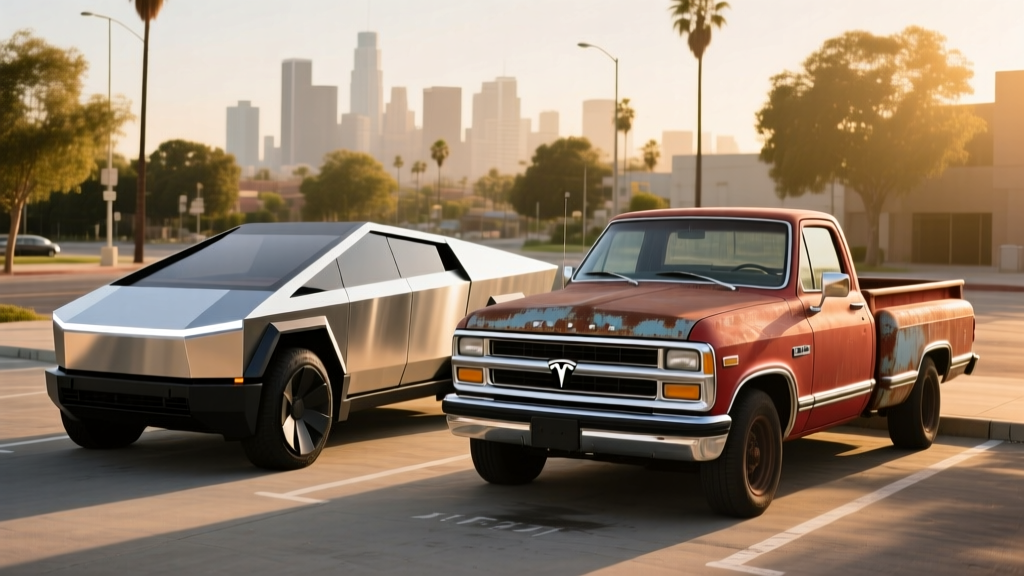
It sounds like a joke setup: a stainless-steel electric pickup versus a second-generation Dodge Ram with a 5.9L V8. But the search interest in a Tesla Cybertruck vs 1990s Ram comparison reveals something genuine — buyers want to know whether a modern EV truck actually delivers more utility, value, and capability than the gas trucks that defined a generation. This isn't nostalgia versus futurism; it's a data-driven look at what you gain, what you lose, and what it actually costs to own each one today.
We're comparing the 2025 Tesla Cybertruck Dual Motor AWD (the volume-selling trim) against a representative 1996–1998 Dodge Ram 1500 4x4 with the 5.9L Magnum V8 — the most sought-after configuration of that era. We'll cover specs, real-world performance, ownership economics, and which truck actually makes sense for different buyers.
Side-by-Side Specs: Cybertruck vs '90s Ram 1500
Before we get into subjective categories, here's the raw data. The Cybertruck specs reflect the current 2025 model year. The Ram 1500 specs reflect factory-original 1996–1998 figures; individual examples will vary with mileage and condition.
| Specification | Tesla Cybertruck (Dual Motor) | Dodge Ram 1500 (1996–98) |
|---|---|---|
| Powertrain | Dual motor AWD, BEV | 5.9L Magnum V8, 4-speed auto, 4WD |
| Horsepower | 600 hp | 245 hp |
| Torque | 743 lb-ft | 335 lb-ft |
| 0–60 mph | 3.9 seconds | ~8.5 seconds (est.) |
| Battery / Fuel Tank | ~123 kWh usable (NMC) | 26-gallon fuel tank |
| Range / Distance | EPA 340 mi (est. ~280 mi real-world highway) | ~312 mi (12 mpg combined × 26 gal) |
| Efficiency | ~56 MPGe combined (~58 kWh/100 mi) | 12 mpg combined |
| DC Fast Charging | Peak 250 kW; 10–80% in ~28 min | N/A (refuel in ~5 min) |
| Level 2 Charging | 11.5 kW (~44 mi/hr) | N/A |
| Max Towing | 7,500 lbs | ~8,200 lbs (properly equipped) |
| Payload | ~2,500 lbs | ~1,200 lbs (half-ton rating) |
| Bed Length | 6 ft (vault-style with tonneau) | 6.5 ft or 8 ft |
| Cargo Volume (bed) | ~56 cu ft | ~58 cu ft (6.5 ft bed) |
| Curb Weight | ~6,700 lbs | ~4,800 lbs |
| Base Price (new) | $79,990 MSRP (Dual Motor) | $21,000–$25,000 (1996–98 MSRP) |
| Current Market Price | $79,990+ (new) | $5,000–$18,000 (used, condition-dependent) |
| Powertrain Warranty | 8 yr / 120,000 mi (battery & drive unit) | Expired (original 3/36 or 5/50) |
Category Winners: Where Each Truck Excels
🏆 Performance: Tesla Cybertruck
There's no contest here. The Dual Motor Cybertruck's 3.9-second 0–60 time demolishes the Ram's ~8.5 seconds. The instant torque delivery (743 lb-ft from 0 rpm) means the Cybertruck pulls away from stoplights with supercar urgency while weighing 6,700 lbs. The Ram's 5.9L Magnum is a torquey, lovable V8, but 245 hp and a 4-speed automatic can't compete with dual electric motors. Even the Cybertruck's single-pedal driving and regenerative braking give it a more refined stop-and-go experience.
🏆 Value (Purchase Price): 1990s Dodge Ram
A clean, well-maintained 1996–1998 Ram 1500 4x4 with the 5.9L V8 trades between $8,000 and $18,000 depending on mileage, condition, and rust. That's roughly one-tenth the cost of a new Cybertruck. Even factoring in immediate maintenance needs (brakes, suspension bushings, hoses), you're into a running '90s Ram for under $20,000 — a fraction of the $79,990 Cybertruck MSRP before any options. For pure dollars-to-driveway, the Ram wins overwhelmingly.
🏆 Towing: Dodge Ram (Narrow Edge)
The Ram 1500's 8,200-lb max towing rating (with proper hitch and cooling) slightly edges the Cybertruck's 7,500-lb limit. More importantly, the Ram doesn't lose half its range when towing. The Cybertruck's range drops to ~170 miles with a 5,000-lb trailer, making long towing trips a charging-logistics challenge. The Ram simply refuels in five minutes at any truck stop. If you tow frequently over distance, the Ram's practical advantage is significant.
🏆 Technology & Features: Tesla Cybertruck
This category barely needs explanation. The Cybertruck includes a 18.5-inch center touchscreen, 9.4-inch rear display, over-the-air software updates, Tesla's Autopilot (SAE Level 2 driver assistance — not self-driving; the driver must remain engaged at all times), steer-by-wire, four-wheel steering, adaptive air suspension, powered tonneau bed cover, built-in air compressor, 120V/240V bed outlets (PowerShare), and Sentry Mode dashcam recording. The Ram has… an AM/FM/cassette deck and manual windows if you're lucky.
🏆 Cargo Flexibility: Dodge Ram
The Ram's conventional 6.5- or 8-foot bed with open top and fold-down tailgate handles plywood sheets, furniture, and oversized loads that simply won't fit in the Cybertruck's enclosed vault. The Cybertruck's bed is 6 feet long with a locking powered tonneau — great for secure, weatherproof cargo but limited to ~56 cu ft and roughly 4 feet of vertical clearance with the cover closed. The Ram's bed can be loaded from above with a crane or forklift, and an 8-foot bed handles 4x8 sheets of plywood flat. For work-site versatility, the traditional bed wins.
🏆 Charging & Refueling Network: Dodge Ram
Gas stations are everywhere, and refueling takes five minutes. The Cybertruck uses Tesla's NACS connector and has access to the Tesla Supercharger network (over 50,000 stalls globally, growing). However, the Cybertruck's large, angular form factor doesn't fit all existing Supercharger stalls cleanly, and charging at 250 kW means a 10–80% session takes about 28 minutes — with tapering above 80% making full charges significantly longer. For rural owners or those without home Level 2 charging, the Ram's refueling convenience is a real-world advantage that spec sheets understate.
Price & Tax Credit Comparison: What You'll Actually Pay
| Cost Factor | Tesla Cybertruck (Dual Motor) | 1990s Dodge Ram 1500 |
|---|---|---|
| Sticker / Asking Price | $79,990 MSRP | $8,000–$18,000 (used market) |
| Federal EV Tax Credit (§30D) | Potentially up to $7,500 — subject to income caps, critical-mineral and battery-component sourcing rules per IRS §30D guidelines. Eligibility changes frequently; verify current-year rules. | Not eligible (used vehicle pre-dates EV credits; the used EV credit applies only to qualifying used EVs under $25,000) |
| Estimated Net Price | ~$72,490 (if full credit applies) | $8,000–$18,000 |
| Sales Tax | Varies by state (on full MSRP in most states) | Varies by state (on used purchase price) |
| Registration | Higher in many states (EV weight/registration fees apply in 30+ states) | Standard light-truck registration |
The Cybertruck's MSRP exceeds the $80,000 cap for trucks under §30D, which means only the Dual Motor trim (at $79,990) potentially qualifies — the tri-motor Cyberbeast at $99,990 does not. Additionally, buyer income caps ($300,000 joint / $150,000 single for new vehicles) and battery-sourcing requirements may reduce or eliminate the credit. Always consult a tax professional and check current IRS guidance before assuming eligibility.
5-Year Ownership Cost Breakdown
| Cost Category | Tesla Cybertruck | 1990s Dodge Ram 1500 |
|---|---|---|
| Purchase (net of credit) | $72,490 | $13,000 (mid-range example) |
| Fuel / Electricity | ~$5,250 (home charging at $0.14/kWh avg; ~4,350 kWh needed for 75k mi at 58 kWh/100mi) | ~$21,875 (6,250 gallons at $3.50/gal avg, 12 mpg) |
| Maintenance | ~$1,500 (cabin filter, wiper fluid, tire rotation, brake fluid check — no oil changes) | ~$6,000–$10,000 (oil changes, timing chain, water pump, suspension, brakes — aging vehicle repairs) |
| Tires | ~$2,400 (heavy EV wear; 35-inch tires ~$400 each × 6 replacements over 75k mi) | ~$1,600 (lighter vehicle; standard LT tires ~$200 each × 8 replacements) |
| Insurance (est.) | ~$12,000–$15,000 (EV truck premiums are elevated; ~$2,400–$3,000/yr) | ~$4,500–$6,000 (older, lower-value vehicle; ~$900–$1,200/yr) |
| Depreciation (5 yr) | ~$28,000–$35,000 (EV depreciation remains steep; ~40–45% over 5 years) | ~$3,000–$5,000 (already heavily depreciated; collector interest may stabilize value) |
| Estimated 5-Year Total | ~$122,000–$130,000 | ~$50,000–$62,000 |
The Cybertruck saves dramatically on fuel — roughly $16,600 less in energy costs over 75,000 miles. But those savings are overwhelmed by the higher purchase price, insurance premiums, and depreciation. The '90s Ram costs more to fuel and maintain, but its rock-bottom purchase price and minimal depreciation keep the total cost of ownership far lower. If you're purely optimizing for dollars spent, the used Ram is the clear winner.
Real-World Usability: Daily Driving, Road Trips, and Work
Daily Commuting
For a 30–50 mile daily commute with home Level 2 charging, the Cybertruck is exceptional. You plug in at night, wake up to a full "tank," and never visit a gas station. The 11.5 kW onboard charger adds roughly 44 miles of range per hour — more than enough to replenish a day's driving overnight. The regenerative braking means minimal brake wear in stop-and-go traffic. The Ram, by contrast, needs weekly fuel stops and delivers a rougher, louder, less refined commute — but it starts in any temperature and doesn't depend on charging infrastructure.
Road Trips
The Cybertruck's 340-mile EPA range (expect ~280 real-world highway miles) and 250 kW Supercharger access make road trips feasible but require planning. A 28-minute 10–80% charge stop every ~250 miles adds roughly an hour to a 600-mile drive. The Ram's 312-mile range is similar, but five-minute refueling at any gas station means less total trip time. In areas with sparse Supercharger coverage — parts of the Mountain West, rural Midwest, or the Dakotas — the Ram's refueling advantage becomes decisive.
Work & Job Site Use
The Cybertruck's built-in 120V/240V PowerShare outlets (up to 11.5 kW output) let you run power tools, welders, or job-site lighting directly from the truck — a genuine advantage over the Ram, which has no onboard power. The air compressor in the bed is useful for tire inflation and pneumatic tools. However, the Cybertruck's enclosed vault bed limits oversized cargo, and its ~$80,000 price makes it a high-risk vehicle for job-site damage. The Ram's open bed, lower replacement cost, and mechanical simplicity make it the more practical workhorse for rough environments.
Decision Framework: Which Should You Choose?
Choose the Tesla Cybertruck if:
- You have home Level 2 charging and a daily commute under 150 miles
- You value technology, driver assistance (Autopilot — SAE Level 2, requires active driver supervision), and over-the-air updates
- You want near-zero routine maintenance (no oil changes, minimal brake wear from regen)
- You need onboard power for tools, camping, or emergency backup (V2L capability)
- You prioritize acceleration and driving dynamics in a truck
- Your budget supports an $80,000 purchase and higher insurance premiums
Choose the 1990s Dodge Ram 1500 if:
- Your budget is under $20,000 and you need a capable truck now
- You tow heavy loads over long distances regularly (no range loss, fast refueling)
- You work in rough environments where a $15,000 truck is less painful to damage
- You lack reliable access to home or public charging
- You want a simple, mechanically straightforward truck you (or any mechanic) can wrench on
- You appreciate the collector appeal and rugged character of the second-gen Ram platform
Tesla Cybertruck — Pros & Cons
Pros:
- Supercar-level acceleration (3.9s 0–60) in a 6,700-lb truck
- Ultra-low fuel cost (~7¢/mile vs Ram's ~29¢/mile)
- Onboard 120V/240V power and air compressor
- Stainless steel body resists dents and corrosion
- 8-year/120,000-mile battery and drive unit warranty
- OTA updates add features over time
Cons:
- $79,990 MSRP; tax credit eligibility uncertain
- Enclosed bed limits oversized cargo
- Range drops sharply when towing (~170 mi with 5,000-lb trailer)
- High insurance premiums (~$2,400–$3,000/yr)
- Steer-by-wire takes adaptation; limited service center network
- Heavy (6,700 lbs) — accelerated tire wear
1990s Dodge Ram 1500 — Pros & Cons
Pros:
- Extremely affordable ($8,000–$18,000)
- Simple, proven 5.9L Magnum V8 — easy to repair
- Open bed handles oversized cargo; 8-foot bed option
- Refuels anywhere in 5 minutes; no range anxiety when towing
- Minimal depreciation (already fully depreciated)
- Enthusiast following; parts widely available
Cons:
- 12 mpg combined; fuel cost ~$3,600/yr at 12,500 mi
- No modern safety features (no airbags beyond driver in early years, no ESC, no backup camera)
- High maintenance costs as components age
- No technology, connectivity, or driver assistance
- Emissions and fuel costs increase with age
- No warranty; you are the warranty
Frequently Asked Questions
Is the Cybertruck faster than a '90s Ram?
By a massive margin. The Cybertruck Dual Motor hits 60 mph in 3.9 seconds with 600 hp, compared to the Ram 1500's 5.9L V8 at ~8.5 seconds with 245 hp. The Cybertruck's instant electric torque also makes it feel faster in real-world passing and merging situations where the Ram's 4-speed automatic must downshift and build revs.
Can you tow more with the Cybertruck or the '90s Ram?
The 1990s Ram 1500 has a slightly higher max tow rating (~8,200 lbs vs 7,500 lbs). More critically, the Ram doesn't lose 50% of its range while towing. The Cybertruck's ~170-mile range with a 5,000-lb trailer makes long-distance towing impractical without very careful Supercharger route planning.
Does the Cybertruck qualify for the $7,500 federal tax credit?
The Dual Motor trim at $79,990 MSRP is just under the $80,000 §30D cap for trucks, making it potentially eligible. However, eligibility depends on your income (under $300,000 joint / $150,000 single), battery critical-mineral sourcing, and battery-component manufacturing requirements. These rules change; verify on the IRS clean vehicle credit page and consult a tax professional. The Cyberbeast ($99,990) does not qualify.
How much does it cost to charge a Cybertruck vs fuel a '90s Ram?
At $0.14/kWh (national average for home charging), fully charging the Cybertruck's ~123 kWh battery costs about $17.22 for ~340 EPA miles — roughly 5¢ per mile. The Ram at 12 mpg and $3.50/gallon costs about $29.17 per 312 miles — roughly 29¢ per mile. Over 15,000 miles annually, that's ~$765 for the Cybertruck vs ~$4,375 for the Ram in energy costs.
Is a '90s Ram safe compared to the Cybertruck?
Not even close. The Cybertruck includes automatic emergency braking, blind-spot monitoring, lane-keeping assist, side curtain airbags, and a rigid stainless-steel exoskeleton. The 1996–1998 Ram predates electronic stability control (mandated in 2012), has at most a single driver airbag (passenger airbag was optional), and lacks crumple-zone engineering by modern standards. If safety is a priority, the Cybertruck is in a completely different era.
Which truck is better for off-road use?
Both are capable, but differently. The Cybertruck's adaptive air suspension offers up to 16 inches of ground clearance, and its dual-motor torque vectoring provides precise traction control. However, its 6,700-lb weight and low-profile tires limit it in deep mud or sand. The Ram 1500 4x4 is lighter (~4,800 lbs), has a solid rear axle, and can be easily lifted with aftermarket parts. For technical trails, the Ram's lightness and simplicity are advantages; for graded fire roads and snow, the Cybertruck's electronic traction management excels.
Final Verdict
There is no universal winner in a Tesla Cybertruck vs 1990s Ram comparison because these trucks solve fundamentally different problems. The Cybertruck is a technology platform that happens to be a truck — offering supercar performance, near-zero running costs, onboard power, and modern safety, but at an $80,000 entry price with real towing-range limitations. The '90s Ram is a mechanical tool — affordable, simple, tow-capable, and refuelable anywhere, but expensive to fuel, increasingly costly to maintain, and decades behind in safety and technology.
If your priority is minimizing total cost of ownership and you need a truck for towing, job-site work, or rural use where charging is sparse, the Ram remains remarkably capable for the money. If you have charging access, value technology and performance, drive a daily commute, and can absorb the higher purchase price and insurance, the Cybertruck delivers an experience the Ram can't approach. Your priorities — budget, use case, and charging access — determine which truck is the right one.