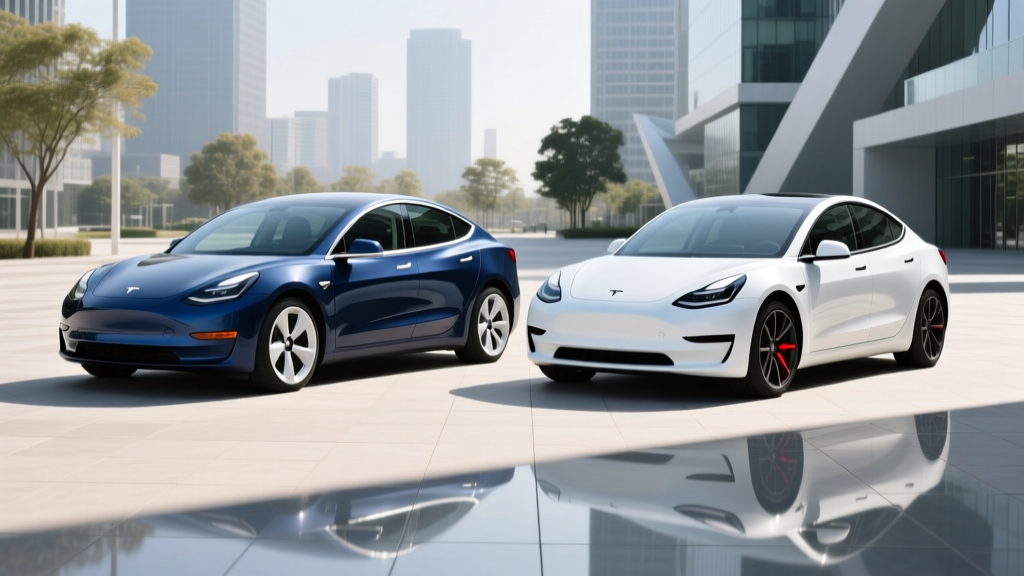
Choosing between a Tesla with rear-wheel drive (RWD) and all-wheel drive (AWD) is one of the most consequential trim decisions a buyer makes — and it's not as simple as "AWD is better." The right answer depends on your climate, commute, charging access, and budget. For the 2026 model year, Tesla offers RWD and AWD (badged as Long Range AWD or Performance AWD) across both the Model 3 and Model Y lineups, with meaningful differences in range, efficiency, acceleration, and price.
This head-to-head breaks down every measurable difference between Tesla's RWD and AWD configurations using current EPA data, real-world driving observations, and IRS §30D tax credit rules — so you can match the drivetrain to your actual needs, not marketing assumptions.
Side-by-Side: 2026 Tesla RWD vs AWD Specifications
Before diving into subjective assessments, here are the hard numbers. All figures reflect 2026 model-year EPA estimates and manufacturer specifications. Battery chemistry varies by drivetrain: RWD models typically use lithium iron phosphate (LFP) cells, while Long Range AWD models use nickel-manganese-cobalt (NMC) chemistry for higher energy density.
| Spec | Model 3 RWD | Model 3 Long Range AWD | Model Y RWD | Model Y Long Range AWD |
|---|---|---|---|---|
| EPA Range | 272 mi | 341 mi | 280 mi | 320 mi |
| Battery (usable, est.) | ~57.5 kWh (LFP) | ~75 kWh (NMC) | ~57.5 kWh (LFP) | ~75 kWh (NMC) |
| Efficiency (MPGe combined) | 132 MPGe | 125 MPGe | 125 MPGe | 117 MPGe |
| Peak DC Fast Charge | 170 kW | 250 kW | 170 kW | 250 kW |
| 10–80% DC Fast Charge | ~25 min | ~22 min | ~25 min | ~22 min |
| Level 2 Charge Rate | 11.5 kW | 11.5 kW | 11.5 kW | 11.5 kW |
| 0–60 mph | 5.8 sec | 4.2 sec | 6.6 sec | 4.8 sec |
| Horsepower | 271 hp | 346 hp | 271 hp | 384 hp |
| Drivetrain | Rear-Wheel Drive | Dual Motor AWD | Rear-Wheel Drive | Dual Motor AWD |
| Cargo Volume | 23 cu ft | 23 cu ft | 72 cu ft (seats folded) | 72 cu ft (seats folded) |
| Base MSRP | $38,990 | $44,990 | $44,990 | $48,990 |
| Battery Warranty | 8 yr / 100,000 mi | 8 yr / 120,000 mi | 8 yr / 100,000 mi | 8 yr / 120,000 mi |
Sources: EPA Fuel Economy, Tesla Specifications. Real-world highway range at 70+ mph typically runs 10–15% below EPA. Cold-weather range loss (below 32°F) can reduce figures by 20–30%.
Range and Efficiency: Where Real-World Miles Diverge From the Sticker
Model 3 RWD: EPA 272 mi → expect ~230–245 mi highway, ~190–210 mi in cold weather
Model 3 LR AWD: EPA 341 mi → expect ~285–305 mi highway, ~240–270 mi in cold weather
Model Y RWD: EPA 280 mi → expect ~235–250 mi highway, ~195–215 mi in cold weather
Model Y LR AWD: EPA 320 mi → expect ~270–290 mi highway, ~225–255 mi in cold weather
The Long Range AWD trims carry a significant range advantage on paper — 69 extra miles in the Model 3 and 40 extra miles in the Model Y. But the efficiency story is more nuanced. The RWD variants actually achieve higher MPGe ratings because they're lighter (no front motor, smaller battery pack) and have fewer drivetrain losses. The RWD Model 3 hits 132 MPGe combined versus 125 MPGe for the Long Range AWD.
What this means in practice: the RWD trims extract more miles per kWh of electricity, but they carry less total energy. If your daily driving is under 80 miles round-trip and you charge at home nightly, the RWD's efficiency advantage translates to lower electricity costs. But if you regularly drive 200+ miles between charges or live in a cold climate where range contracts by a quarter, the Long Range AWD's larger battery provides a critical buffer.
The LFP chemistry in the RWD models also carries a charging-habit difference: Tesla recommends regularly charging LFP batteries to 100%, whereas NMC batteries in Long Range models benefit from daily limits of 80% with occasional full charges. This means your daily usable range on an RWD is closer to the sticker number, while Long Range owners effectively use ~270 daily miles from a 341-mile pack when following best practices for NMC longevity.
Charging Speed and Network Access
This is where the AWD Long Range trims earn a practical edge for road-trippers. The 250 kW peak DC fast-charging capability on Long Range models versus 170 kW on RWD models translates to meaningful time savings on long drives.
| Charging Scenario | RWD (170 kW peak) | Long Range AWD (250 kW peak) |
|---|---|---|
| 10–80% at V3 Supercharger | ~25 minutes | ~22 minutes |
| Miles added in 15 min (peak) | ~130 miles | ~175 miles |
| Level 2 home charge (11.5 kW) | ~6 hours (0–100%) | ~8 hours (0–100%) |
| Level 1 (120V, ~1.4 kW) | ~41 hours | ~54 hours |
The 3-minute gap at a Supercharger sounds modest until you factor in charge-curve taper. Both configurations slow significantly above 80% State of Charge (SoC), but the Long Range AWD's higher peak means it sustains faster charging longer in the 20–60% SoC window. On a 400-mile road trip requiring two stops, that advantage compounds to roughly 10–15 minutes saved total.
All 2026 Teslas use the NACS (North American Charging Standard) connector natively, granting access to the entire Tesla Supercharger network — the most reliable and expansive DC fast-charging network in North America. Neither configuration has an access advantage here; the network is identical for both.
Performance and Drivetrain Dynamics
The performance gap between RWD and AWD is substantial and immediately perceptible. The dual-motor AWD models deliver 346 hp (Model 3) and 384 hp (Model Y) versus 271 hp for both RWD variants. The 0–60 mph times tell the story: 4.2 seconds for the Model 3 LR AWD versus 5.8 seconds for the RWD — a 1.6-second gap that feels dramatic at highway merge ramps.
Beyond straight-line speed, the dual-motor AWD system provides genuine traction benefits in rain, snow, and ice. Tesla's torque-vectoring system can independently manage power to front and rear axles in milliseconds. If you live in a region with regular winter precipitation — the Northeast, Midwest, Mountain West, or Pacific Northwest — the AWD system's traction advantage is not a luxury; it's a safety feature.
That said, the RWD Model 3 and Model Y remain composed in dry conditions. The low center of gravity from the floor-mounted battery pack gives both configurations excellent handling dynamics. The single-motor RWD is also ~150 lbs lighter, which contributes to its efficiency edge and slightly more agile feel in tight urban driving.
Price, Tax Credits, and True Cost of Purchase
The price gap between RWD and AWD Long Range trims is significant — and the federal tax credit can shift the value equation depending on your income, the vehicle's MSRP, and battery-sourcing compliance.
| Trim | Base MSRP | §30D Credit (est.)* | Effective Price | Price Delta vs RWD |
|---|---|---|---|---|
| Model 3 RWD | $38,990 | Up to $7,500 | ~$31,490 | — |
| Model 3 Long Range AWD | $44,990 | Up to $7,500 | ~$37,490 | +$6,000 |
| Model Y RWD | $44,990 | Up to $7,500 | ~$37,490 | — |
| Model Y Long Range AWD | $48,990 | Up to $7,500 | ~$41,490 | +$4,000 |
*Federal §30D tax credit eligibility depends on buyer income caps ($150K single / $300K joint AGI), MSRP limits ($55K sedans / $80K SUVs), and battery critical-mineral and component sourcing requirements per IRS guidelines. Credit may be applied at point of sale. Verify current-year eligibility with a tax professional — rules change and sourcing compliance varies by production batch.
All four trims fall under the MSRP caps ($55,000 for sedans, $80,000 for SUVs), and Tesla has worked to qualify for the full $7,500 credit across its lineup. The key takeaway: the credit applies equally to RWD and AWD trims, so it doesn't narrow the price gap between them. The Model 3 RWD-to-LR AWD gap remains $6,000, and the Model Y gap is $4,000 — meaningful sums that must be justified by the range, performance, and traction benefits.
Ownership Costs: Efficiency, Insurance, and Long-Term Value
Beyond the purchase price, RWD and AWD trims diverge in ongoing ownership costs across several categories:
Electricity costs: The RWD's higher MPGe rating means lower per-mile electricity costs. At the U.S. average residential rate of $0.17/kWh, the Model 3 RWD costs approximately $0.041/mile to fuel versus $0.044/mile for the LR AWD. Over 15,000 annual miles, that's a ~$45/year savings — modest but real over a decade of ownership.
Insurance: AWD models typically carry 5–10% higher insurance premiums due to their higher replacement cost, greater horsepower, and more complex drivetrain. For a typical Tesla owner paying $2,000–$2,800/year for full coverage, that translates to $100–$280 more annually for the AWD variant.
Tire wear: The AWD's additional weight and power delivery to four wheels tends to accelerate tire wear by roughly 10–15% compared to RWD, particularly on the rear tires. Expect tire replacement every 25,000–35,000 miles on AWD versus 30,000–40,000 miles on RWD.
Maintenance: The dual-motor AWD system adds a front motor and associated components, but Tesla's electric drivetrains require minimal scheduled maintenance regardless of configuration. Neither has transmission fluid, and brake wear is minimal thanks to regenerative braking. The cost difference here is negligible.
Battery degradation and warranty: The LFP batteries in RWD models generally exhibit slower degradation than NMC — studies show LFP packs retaining ~90% capacity after 200,000 miles versus ~85% for NMC. However, the RWD's battery warranty covers 100,000 miles while the Long Range AWD covers 120,000 miles. Both warranties guarantee a minimum of 70% capacity retention. The LFP chemistry also tolerates frequent 100% charging without accelerated degradation, which simplifies daily charging habits.
Category Winners: Where Each Drivetrain Excels
341 mi (Model 3) / 320 mi (Model Y) EPA vs. 272/280 mi for RWD. The larger NMC battery delivers 40–69 more miles per charge — critical for road trips and cold climates.
132 MPGe (Model 3 RWD) vs. 125 MPGe (LR AWD). More miles per kWh means lower electricity costs and a smaller carbon footprint per mile driven.
250 kW peak vs. 170 kW. Faster 10–80% times and more miles added per charging stop on road trips.
4.2s 0–60 (Model 3 LR AWD) vs. 5.8s (RWD). Dual-motor traction also dominates in wet and snowy conditions.
$6,000 less (Model 3) or $4,000 less (Model Y) for a vehicle that excels at daily commuting with lower insurance and tire costs.
LFP chemistry degrades more slowly and tolerates 100% daily charging, simplifying ownership habits and extending usable pack life.
Decision Framework: Which Tesla Drivetrain Fits Your Life?
Choose RWD If:
- Your daily round-trip commute is under 100 miles and you charge at home
- You live in a mild climate with infrequent snow or ice
- You prioritize the lowest purchase price and operating cost
- You rarely take road trips exceeding 200 miles one-way
- You prefer simpler charging habits (charge to 100% daily without concern)
- 0–60 in 5.8–6.6 seconds is plenty quick for your needs
Choose AWD Long Range If:
- You regularly drive 200+ miles between charges or take frequent road trips
- You live in a region with harsh winters, heavy rain, or mountain passes
- You want the fastest DC charging for minimal stop time on long drives
- Performance matters — you want sub-5-second 0–60 acceleration
- You need maximum range buffer for cold-weather driving (20–30% range loss in winter)
- You plan to keep the car 8+ years and value the 120,000-mile battery warranty
Final Recommendation: Match the Drivetrain to Your Priorities
There is no universally superior choice between Tesla's RWD and AWD configurations — only the right choice for your specific driving patterns, climate, and budget. The RWD models are the rational pick for cost-conscious commuters in mild climates who charge at home and rarely push past 150 miles in a day. They deliver exceptional efficiency, lower purchase and operating costs, and the practical advantage of LFP chemistry's longevity and charging simplicity.
The AWD Long Range models justify their $4,000–$6,000 premium for buyers who need range confidence on road trips, traction security in adverse weather, or the performance thrill of dual-motor acceleration. If any of those factors describe your regular driving reality, the premium pays dividends in capability and peace of mind.
One practical note: test-drive both configurations if possible. The AWD's additional traction and power delivery feel noticeably different from the RWD, and personal preference for driving dynamics often settles the decision more effectively than any spec sheet.
Frequently Asked Questions
Is the Tesla RWD good in snow?
The RWD Tesla is manageable in light snow thanks to its low center of gravity, traction control, and winter tire compatibility — but it cannot match the dual-motor AWD's grip in sustained snow or ice. If you experience more than a few snow days per year, winter tires on an RWD help significantly, but AWD remains the safer choice for regular winter driving.
Does AWD reduce Tesla range significantly?
The AWD system adds weight and a second motor, which reduces efficiency (MPGe) by about 5–8%. However, the Long Range AWD compensates with a larger battery, so total EPA range is actually higher than the RWD. You're spending more electricity per mile but carrying more energy overall.
Can I switch from RWD to AWD after purchase?
No. Tesla's drivetrain configuration is fixed at the factory. The RWD has a single rear motor, and there is no retrofit path to add a front motor. The drivetrain decision must be made at purchase.
Which Tesla holds its resale value better — RWD or AWD?
AWD Long Range models generally hold resale value slightly better, particularly in northern states where buyers prioritize all-weather capability. However, the RWD's lower initial purchase price means its absolute depreciation in dollars is often comparable. Market demand varies regionally.
Do both RWD and AWD Teslas qualify for the $7,500 tax credit?
Both configurations can qualify for the full §30D federal tax credit, provided the buyer meets income limits ($150K single / $300K joint), the vehicle MSRP is within caps ($55K sedans / $80K SUVs), and battery sourcing requirements are met. Always verify current-year eligibility on IRS.gov and consult a tax professional, as sourcing rules and credit amounts are subject to change.
Is the LFP battery in the RWD less capable than NMC?
LFP has lower energy density than NMC, which is why RWD models have smaller batteries and less total range. But LFP excels in cycle life, thermal stability, and tolerance for 100% daily charging. For daily commuting, LFP is arguably the more practical chemistry. NMC's advantage is packing more energy into the same physical space — essential for the Long Range trims.