The Short Answer on Temu Electric Boats
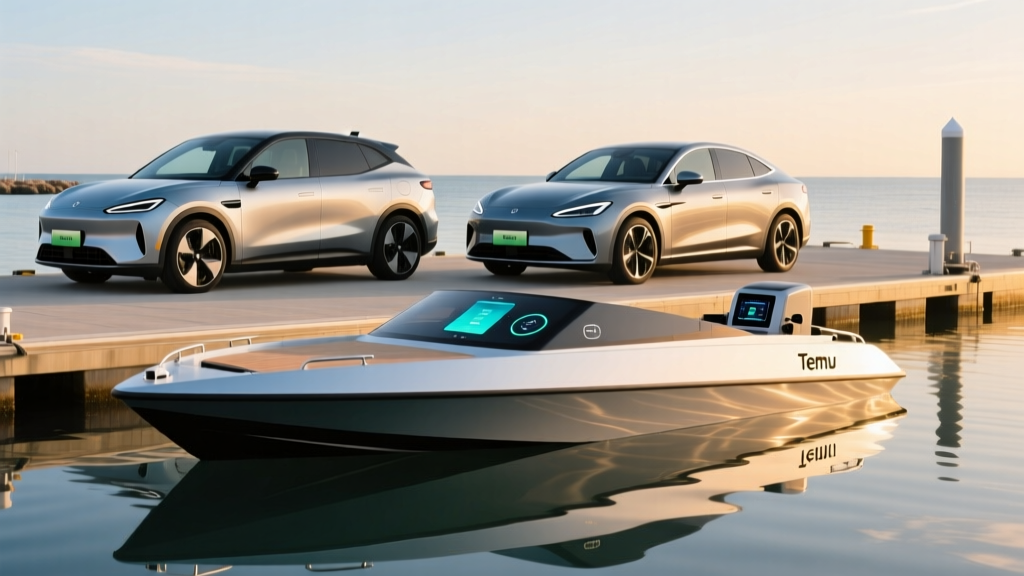
Temu sells small, low-power electric watercraft — typically inflatable dinghies or mini pontoons with 200W–1,500W motors — not highway-legal electric vehicles. These products are not EVs, not eligible for the federal §30D tax credit, and not comparable to electric cars, trucks, or even electric outboards from established marine brands like Torqeedo or ePropulsion. If you're searching "Temu electric boat" because you're curious about affordable EVs, this guide redirects you to real electrified vehicle options that actually deliver daily transportation savings, with full cost breakdowns and 2026 specs.
What Temu "Electric Boats" Actually Are
The Temu marketplace lists dozens of "electric boat" products, but almost all fall into a narrow category: small inflatable or folding watercraft with integrated or attachable electric motors rated between 200 watts and 1,500 watts. At these power levels, expect top speeds of 3–6 mph and a range of roughly 5–15 miles per charge, depending on battery capacity (usually 200Wh–1,000Wh lithium-ion packs). Prices range from $80 to $600.
These are recreational toys — think calm-lake fishing or a novelty river float. They are not Coast Guard-certified vessels for open water, they carry no marine warranty comparable to a Torqeedo or Mercury outboard, and replacement parts or batteries are largely unavailable after purchase. For context, a legitimate electric outboard from Torqeedo starts around $2,000 for a 1.5 kW Travel model and goes up to $15,000+ for serious cruising power.
If your interest in "electric boat" stems from a broader curiosity about electric propulsion and whether going electric saves money, the far more impactful decision is an electric car or plug-in hybrid. Let's compare the real numbers.
Real EV Ownership: 2026 Cost Breakdown
Unlike a Temu watercraft, a modern EV replaces your daily transportation and delivers measurable savings. Here's what the numbers look like for a mainstream 2026 EV — the Hyundai Ioniq 5 (Standard Range RWD) — compared to a comparable gasoline compact SUV (Toyota RAV4 AWD).
| Category | Ioniq 5 EV | RAV4 Gas | Notes |
|---|---|---|---|
| Base MSRP | $42,600 | $32,350 | Per manufacturer 2026 pricing |
| Federal Tax Credit (§30D) | Up to $7,500* | $0 | *Subject to income, MSRP cap, battery sourcing rules — see IRS §30D guidelines |
| Effective Purchase Price | ~$35,100 | $32,350 | After max credit |
| 5-Yr Fuel/Energy (15k mi/yr) | $3,750 | $8,625 | EV: $0.14/kWh avg; Gas: $3.45/gal, 28 MPG combined |
| 5-Yr Maintenance | ~$1,800 | ~$3,600 | No oil changes, fewer brake replacements on EV |
| 5-Yr Insurance (avg) | ~$9,500 | ~$7,800 | EV premiums run 15-25% higher on average |
| Estimated Depreciation | ~$16,000 | ~$13,500 | EV depreciation has normalized but remains slightly steeper |
| 5-Year Total Cost | ~$66,150 | ~$65,875 | Near parity — EV wins if credit is secured |
The takeaway: at near-parity in total cost of ownership, the EV delivers a smoother, quieter, quicker daily driver with zero tailpipe emissions — provided you qualify for the tax credit and have reliable charging access.
EV vs. Gas vs. PHEV: Which Fits Your Situation?
Not every buyer should jump straight to a battery electric vehicle. The right choice depends on your driving patterns, home setup, and climate. Here's a data-driven comparison across all three powertrains:
| Metric | BEV (Ioniq 5) | PHEV (Toyota RAV4 Prime) | Gas (RAV4 AWD) |
|---|---|---|---|
| EPA Range / Electric Range | 290 mi (EPA) | 42 mi electric + 530 mi total | 448 mi (14.5 gal tank) |
| Efficiency | 117 MPGe / 29 kWh/100mi | 94 MPGe (EV mode) / 38 MPG (gas) | 30 MPG combined |
| Battery / Tank | 63 kWh usable (NMC) | 18.1 kWh (NMC) + 14.5 gal | 14.5 gal |
| 0-60 mph | 7.4 sec | 5.7 sec | 8.0 sec |
| Home Charging (Level 2) | ~7 hrs (10.9 kW onboard) | ~2.5 hrs (6.6 kW onboard) | N/A |
| DC Fast Charge (10-80%) | ~18 min (peak 175 kW) | N/A (no DC fast charge) | N/A |
| Starting MSRP | $42,600 | $44,990 | $32,350 |
| §30D Tax Credit Eligibility | Up to $7,500* | Up to $7,500* | $0 |
Real-world range caveat: The Ioniq 5's 290-mile EPA rating assumes moderate temperatures and mixed driving. Expect ~240–260 miles in sustained 75 mph highway driving, and ~200–220 miles in sub-freezing winter conditions due to battery resistance and cabin heating load. The RAV4 Prime's 42-mile electric range similarly drops to ~32–35 miles in cold weather.
Common Misconceptions — Facts vs. Myths
| Myth | Fact |
|---|---|
| "EV batteries need replacing every few years and cost $20,000." | Modern NMC and LFP batteries are warrantied for 8 years/100,000 miles (10 years/150,000 in CARB states). Data from fueleconomy.gov and fleet studies show most packs retain 85-90% capacity after 150,000 miles. Full replacement, if ever needed, runs $8,000–$15,000 depending on chemistry and vehicle. |
| "You can't road-trip an EV." | The U.S. now has over 5,000 DC fast-charging stations with 350 kW-capable chargers along major interstate corridors. A 10-80% charge on the Ioniq 5 takes ~18 minutes at a 175+ kW station. Plan 2-3 stops on a 600-mile trip — comparable to gas-car rest breaks. |
| "EVs are worse in cold weather." | Range drops 20-35% in freezing temps — real, but manageable. Modern EVs with heat pumps (standard on Ioniq 5, RAV4 Prime) recover significant efficiency. Preconditioning while plugged in eliminates most morning range loss. |
| "Charging at home is too expensive to install." | A basic Level 2 home charger (240V, 32A–48A) costs $300–$700 for hardware plus $500–$2,000 for electrician installation, depending on panel proximity. Many utilities offer $300–$1,000 rebates. Total first-year payback vs. gas is common. |
| "Temu electric boats are a good intro to EVs." | These are low-power recreational toys (200W–1,500W) with no safety certification, no warranty infrastructure, and no connection to the EV ecosystem. They don't qualify for any tax incentive and offer no transportation utility. |
First-Time EV Buyer Checklist
Before purchasing any EV, work through these practical questions. Your answers determine whether a BEV, PHEV, or gas vehicle is your best move:
- Can I charge at home? If you have a garage or driveway with access to a 240V outlet (or can install one), a BEV is practical. If you're apartment-dwelling with no charging access, a PHEV (which can run on gas when needed) or sticking with a hybrid is wiser until public infrastructure improves near you.
- What's my daily drive? If your round-trip commute is under 80 miles, even a modest-range EV covers a full week on one charge. If you regularly drive 200+ miles one-way, prioritize a 300+ mile EPA-rated BEV or a PHEV.
- Do I qualify for the §30D credit? For 2026, the credit requires: modified adjusted gross income below $150,000 (single) or $300,000 (joint); vehicle MSRP under $55,000 (sedans) or $80,000 (SUVs/trucks/vans); and compliant battery mineral sourcing. The credit can be transferred to the dealer at point of sale for an immediate price reduction. Always verify current rules on IRS.gov before purchasing.
- What's my climate? Sub-freezing winters mean 20-35% range loss. If you live in Minnesota or Maine, buy 30% more EPA range than you think you need — or choose a PHEV for winter flexibility.
- How long do I keep cars? If you trade every 3 years, higher EV depreciation may cost you. If you keep vehicles 7-10 years, the maintenance and fuel savings compound dramatically in the EV's favor.
Decision Framework: Which Electrified Vehicle Is Right for You?
If X, Then Y
- If you have home charging + a commute under 80 miles + qualify for §30D: Buy a BEV (e.g., Ioniq 5, Tesla Model Y, Chevy Equinox EV). You'll save $1,000–$1,500/year on fuel and nearly eliminate maintenance costs.
- If you have home charging but frequently road-trip 300+ miles: Buy a 300+ mi BEV with 150+ kW DC fast charging (Ioniq 5, Model Y, Kia EV6) — or a PHEV if you want zero range anxiety.
- If you can't charge at home (apartment, street parking): Buy a PHEV (RAV4 Prime, Hyundai Tucson PHEV) or a conventional hybrid. Public-only charging is inconvenient and often more expensive than home rates.
- If you live in extreme cold (regular sub-20°F winters): Prioritize a BEV with a heat pump and 300+ EPA miles, or choose a PHEV. Preconditioning while plugged in is essential.
- If your budget is under $30,000: Consider a used EV (eligible for up to $4,000 under the §25E used clean vehicle credit) or a conventional hybrid. Temu electric watercraft and similar novelty products do not provide transportation value.
The Bottom Line
Temu's electric boat listings are low-power recreational items — fun for a calm afternoon on a pond, but irrelevant to the EV ownership conversation. If your search brought you here because you're exploring what "going electric" actually costs and saves, the data is clear: a mainstream 2026 EV or PHEV, paired with home Level 2 charging and the §30D tax credit, delivers near-parity total ownership cost with gas vehicles while offering a superior daily driving experience. The key is matching the powertrain to your specific charging access, commute, climate, and budget — not chasing novelty products that don't move you anywhere meaningful.
Are Temu electric boats safe?
Temu electric watercraft generally lack U.S. Coast Guard certification, NMMA safety standards, or any established marine warranty. They are best treated as recreational toys for calm, shallow water only — not as legitimate boats for open water, fishing in currents, or carrying passengers beyond the stated capacity.
Can I use a Temu electric boat as a fishing dinghy?
Possibly, in very calm conditions. However, the motors (200W–1,500W) provide minimal thrust, and battery life is typically 1–3 hours at low speed. A legitimate electric outboard from Torqeedo or ePropulsion (1 kW–3 kW range, $2,000–$5,000) offers far better reliability, warranty support, and replacement parts availability.
Do Temu electric boats qualify for any tax credit?
No. The federal §30D clean vehicle credit applies only to highway-capable four-wheeled vehicles meeting specific battery sourcing, MSRP, and buyer income requirements. Electric boats, regardless of source, are not eligible.
What's the cheapest legitimate EV I can buy in 2026?
The 2026 Nissan Leaf S starts around $29,000 before incentives. With the §30D credit (if eligible), the effective price drops to ~$21,500 — making it one of the most affordable new vehicles of any powertrain on the market. Range is a modest 149 miles EPA, suitable for city commuting with home charging.
How do I check if I qualify for the EV tax credit?
Review the current-year rules on IRS.gov's clean vehicle credit page. Key 2026 requirements include income caps ($150K single / $300K joint), vehicle MSRP caps ($55K sedans / $80K SUVs and trucks), and compliant critical mineral and battery component sourcing. Consult a tax professional for your specific situation, as rules are subject to legislative change.