The Smallest EV Trucks You Can Buy in 2026
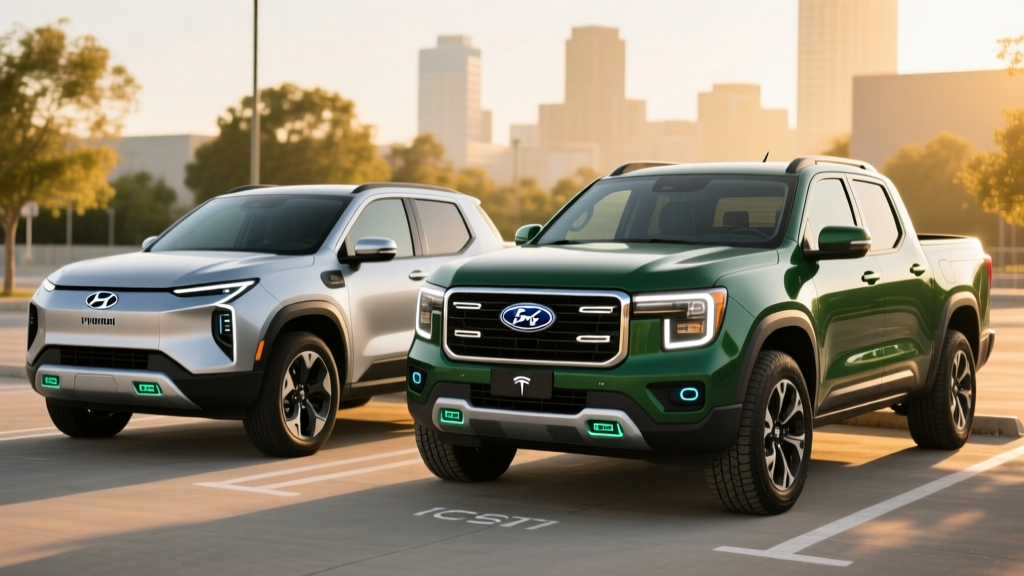
If you need a compact electric pickup, the two production options are the 2026 Hyundai Santa Cruz EV and the 2026 Ford Maverick EV. Both ride on unibody platforms, offer beds under 5 feet, and target urban/suburban buyers who want truck utility without full-size bulk. The Santa Cruz EV starts around $38,000 with up to 290 miles of EPA range, while the Maverick EV begins near $36,500 with roughly 270 miles of range. Neither qualifies for the full $7,500 federal tax credit due to battery-sourcing rules, though point-of-sale lease incentives may apply.
Specs at a Glance: Santa Cruz EV vs Maverick EV
| Spec | 2026 Hyundai Santa Cruz EV | 2026 Ford Maverick EV |
|---|---|---|
| EPA Range | 290 mi (est.) | 270 mi (est.) |
| Battery (usable) | 77.4 kWh, NMC | 72 kWh, NMC |
| Peak DC Charge Rate | 240 kW | 150 kW |
| 10–80% DCFC Time | ~18 min | ~28 min |
| Level 2 Rate | 10.9 kW | 10.5 kW |
| Horsepower | 320 hp (AWD) | 290 hp (AWD) |
| 0–60 mph | ~5.5 sec | ~6.2 sec |
| Bed Length | 4.3 ft (52 in) | 4.5 ft (54 in) |
| Payload Capacity | ~1,300 lb | ~1,400 lb |
| Towing (max) | 3,500 lb | 3,500 lb |
| Base MSRP | $38,000 | $36,500 |
| Federal Tax Credit | $3,750 partial | $3,750 partial |
| Warranty | 10 yr / 100,000 mi battery | 8 yr / 100,000 mi battery |
Source: Manufacturer preliminary spec sheets; verify at hyundainews.com and ford.com.
Real-World Range: What the EPA Sticker Doesn't Tell You
EPA estimates assume mixed driving at moderate temperatures. In real-world use, expect:
- Highway-only at 75 mph: subtract 15–20% — the Santa Cruz EV drops to ~235 mi, the Maverick EV to ~220 mi.
- Cold weather (below 32°F): subtract 20–30% due to battery heating demands and cabin HVAC. The Santa Cruz EV may deliver ~200–220 mi; the Maverick EV ~190–210 mi.
- Towing near max capacity: range can halve. Plan for 130–150 mi between charges if hauling a 3,000-lb trailer.
Both trucks use NMC chemistry, which offers higher energy density but is more sensitive to extreme cold than LFP. Preconditioning the battery before DC fast charging is essential — skip it, and your peak charge rate may drop below 100 kW.
Charging Speed and Home Setup
The Santa Cruz EV's 240 kW peak charge rate is a clear advantage on road trips, adding ~150 miles in 10 minutes at a compatible 350 kW Electrify America station. The Maverick EV's 150 kW peak is adequate but slower, adding ~100 miles in the same window.
At home on Level 2 (240V), both trucks fully recharge overnight in 7–8 hours. Installation costs vary:
| Item | Cost Range |
|---|---|
| Level 2 charger (hardware) | $400–$800 |
| Electrician labor (50-amp circuit) | $600–$1,500 |
| Permit / inspection | $50–$200 |
| Panel upgrade (if needed) | $1,500–$3,000 |
| Total typical install | $1,050–$2,500 |
If your home has a 100-amp panel and you already run central AC and an electric dryer, a panel upgrade to 200 amps may be required. Get a quote from a licensed electrician before purchasing the truck.
Cost of Ownership: EV Truck vs Gas Compact Truck
Let's compare the 5-year cost of owning the Maverick EV versus the gas Maverick Hybrid (40 MPG combined), assuming 12,000 miles/year, $0.14/kWh home electricity, and $3.50/gallon gas:
| Cost Category | Maverick EV (5 yr) | Maverick Hybrid (5 yr) |
|---|---|---|
| Purchase (after credit) | $32,750 | $28,000 |
| Fuel / electricity | $2,520 | $5,250 |
| Maintenance | $1,200 | $2,800 |
| Insurance (avg) | $7,500 | $6,000 |
| Total 5-yr | $43,970 | $42,050 |
The EV saves on fuel and maintenance but carries higher upfront and insurance costs. Break-even occurs around year 6–7 if you keep the truck long-term. If you drive more than 15,000 miles/year, the EV's fuel savings widen significantly.
Federal Tax Credit: What Actually Applies
Under IRS §30D rules, the full $7,500 credit requires meeting critical-mineral and battery-component sourcing thresholds. As of 2026, both Hyundai and Ford source some battery materials from non-compliant suppliers, reducing the credit to $3,750 for purchases. However, leasing may unlock the full $7,500 as a pass-through incentive from the dealer. Income caps also apply: $150,000 single / $300,000 joint modified AGI. Verify current rules at irs.gov.
Decision Framework: Which Smallest EV Truck Fits You?
Choose the Hyundai Santa Cruz EV if:
- You road-trip often and value faster DC charging (240 kW).
- You prefer a longer warranty (10-year battery).
- You prioritize acceleration (320 hp, ~5.5 sec 0–60).
Choose the Ford Maverick EV if:
- You want the lowest entry price ($36,500).
- You need slightly more bed length (54 in vs 52 in).
- You value Ford's dealer network for service.
Stick with a gas/hybrid compact truck if:
- You lack home charging access and rely on street parking.
- You regularly tow over 2,500 lb in cold climates.
- You plan to keep the truck under 4 years (EV depreciation is steeper).
Common Misconceptions About Small EV Trucks
| Myth | Fact |
|---|---|
| "EV trucks can't tow." | Both tow 3,500 lb — enough for a small boat or utility trailer. Range drops sharply, but capability is real. |
| "The battery will need replacement in 5 years." | NMC batteries degrade ~10–15% over 100,000 miles. Warranties guarantee 70% capacity at 8–10 years. |
| "Charging takes hours on road trips." | At a 240 kW station, the Santa Cruz EV adds 150 miles in 10 minutes. Plan stops around meals or rest breaks. |
| "I need a 400-amp panel for home charging." | A 50-amp circuit (240V) is sufficient for overnight Level 2 charging. Most 200-amp panels handle this. |
Frequently Asked Questions
Are there smaller EV trucks than the Santa Cruz or Maverick?
No production models are smaller as of 2026. The discontinued Chevrolet Montana EV (Brazil-only) was slightly shorter, but it's not sold in the U.S. Concepts like the Tesla "compact truck" remain unannounced.
Can I charge at Tesla Superchargers?
Both Hyundai and Ford have adopted the NACS connector for 2026 models, granting access to Tesla's Supercharger network with an adapter (included) or native NACS port.
What's the insurance cost difference?
EV trucks typically cost 15–25% more to insure than gas equivalents due to higher repair costs and battery replacement risk. Get quotes from GEICO, Progressive, and State Farm before buying.
Do these trucks have one-pedal driving?
Yes, both offer adjustable regenerative braking with a true one-pedal mode that brings the truck to a full stop without using the friction brakes.