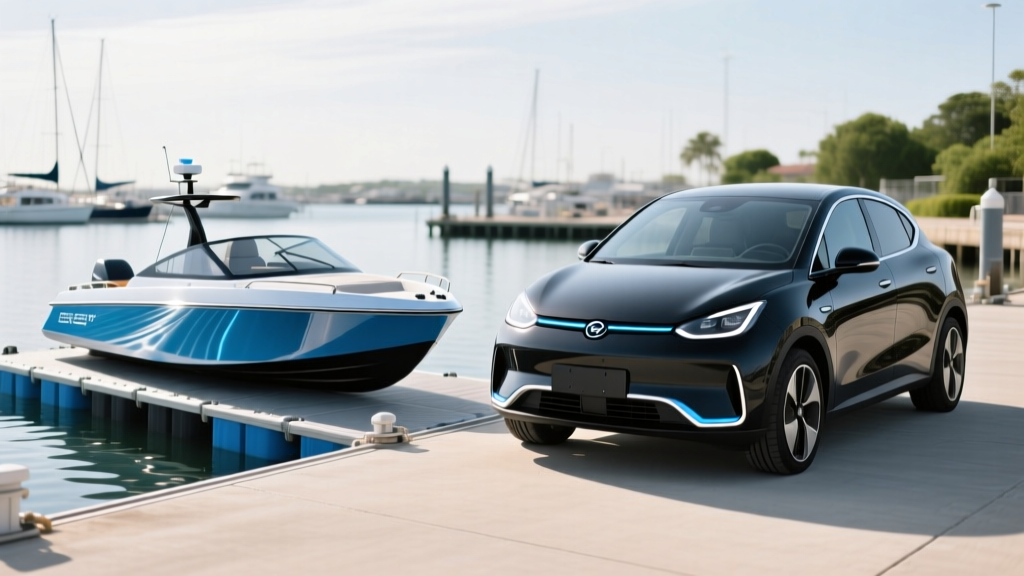
If you're researching small electric boats as an EV owner or shopper, here's the practical reality: the marine electric market in 2026 remains a niche category with limited models, high entry prices, and charging infrastructure that lags far behind the automotive EV world. Unlike electric cars — where you can choose from dozens of models with 250+ miles of EPA range, 150+ kW DC fast charging, and a growing Supercharger/NACS network — small electric boats typically offer 20–60 miles of range on calm water, 10–40 kWh battery packs, and rely almost entirely on shore-power Level 2 charging at marinas or your own dock. The technology overlap is real (lithium-ion packs, regenerative systems, electric motors), but the buying experience, costs, and ownership logistics are fundamentally different. This guide breaks down what an EV-minded buyer needs to know before stepping into the electric marine space.
Why Small Electric Boats Interest EV Owners
Many EV owners are drawn to electric boating for the same reasons they chose an electric car: instant torque, quiet operation, zero tailpipe (or exhaust) emissions, and lower running costs. The core technology is similar — a lithium-ion battery pack feeding an electric motor — but the execution diverges sharply.
In 2026, the small electric boat market is dominated by a handful of players:
- Candela C-8 — A hydrofoiling electric day cruiser with a ~69 kWh battery, roughly 50 nautical miles of range at 22 knots, and a starting price near $330,000.
- X Shore Eelex 8000 — A 26-foot electric cruiser with a 125 kWh battery pack, approximately 100 nautical miles at lower speeds, priced around $350,000.
- Navier N30 — A 30-foot foiling electric boat with ~90 kWh of battery and a focus on efficiency, with pricing starting near $300,000.
- Smaller pontoon and fishing options — Companies like AquaWatt and various pontoon builders offer 5–15 kWh setups on smaller hulls, typically $15,000–$50,000, with 10–25 miles of range at low speeds.
For context, a mainstream electric car like the 2026 Hyundai Ioniq 6 SE Long Range offers a 77.4 kWh battery, 361 miles of EPA range, 240 kW peak DC fast charging, and starts around $42,000 before any federal tax credit. The value proposition diverges dramatically.
Electric Boat vs. Electric Car: The Numbers Side by Side
The table below compares a representative small electric boat (a mid-range 25-foot electric cruiser with a 40 kWh pack) against a typical 2026 electric crossover to illustrate the differences in specs, cost, and infrastructure.
| Attribute | Small Electric Boat (25-ft Cruiser, ~40 kWh) | 2026 Electric Crossover (e.g., Tesla Model Y LR) |
|---|---|---|
| Battery Capacity | 40 kWh (NMC lithium-ion) | 75 kWh (NMC/NCA lithium-ion) |
| Range | 25–40 miles (calm water, 5–8 knots) | 320 miles EPA |
| Motor Power | 20–40 kW continuous | ~255 kW (342 hp) |
| Top Speed | 15–25 knots (17–29 mph) | 135 mph |
| Charging (Level 2) | 3.3–7.2 kW AC (8–14 hours for full charge) | 11.5 kW AC (~8 hours for full charge) |
| DC Fast Charging | Rarely available; some models support 22 kW DC | 250 kW peak (10–80% in ~15–20 min) |
| Base Price | $80,000–$150,000+ | $44,990 |
| Federal Tax Credit (§30D) | Not eligible — boats are excluded | Up to $7,500 (subject to income, MSRP caps, and sourcing rules per IRS §30D) |
| Charging Infrastructure | Limited marina shore power; dock-based | 50,000+ public chargers nationwide (per AFDC) |
Real Costs of Owning a Small Electric Boat
Understanding the total cost of ownership is where electric boats and electric cars diverge most sharply. Here's a realistic breakdown for a mid-range electric day boat used recreationally (approximately 50 outings per year).
| Cost Category | Small Electric Boat (Annual) | Comparable Gas Boat (Annual) | Electric Car (Annual) |
|---|---|---|---|
| Purchase Price | $80,000–$150,000 | $40,000–$80,000 | $40,000–$55,000 |
| Fuel / Electricity | $150–$400 (at $0.15/kWh avg) | $1,500–$3,000 (marine gas) | $500–$800 (at $0.15/kWh avg) |
| Maintenance | $500–$1,500 (hull, motor service) | $1,500–$3,500 (engine, winterization) | $300–$600 |
| Insurance | $800–$2,000 | $500–$1,500 | $1,200–$2,500 |
| Dock / Storage | $2,000–$6,000 | $2,000–$6,000 | N/A (home garage) |
| Depreciation (Year 1) | 15–25% (niche market, uncertain resale) | 10–20% | 15–25% |
The electricity savings are real — a 40 kWh battery charged at residential rates of $0.15/kWh costs about $6 per full charge, compared to $40–$80 filling a gas boat's tank. But dock fees, storage, and the high purchase price mean the overall cost of boat ownership dwarfs that of an electric car.
Charging Infrastructure: The Marina Reality
This is where the EV owner's expectations need a hard reset. In the electric car world, you have access to Tesla Superchargers, Electrify America, EVgo, and a growing NACS-compatible network delivering 150–350 kW DC fast charging. On the water, the reality is starkly different.
What exists today:
- Most marinas offer 30-amp or 50-amp shore power outlets (120V or 240V AC), delivering 3.6 kW to 12 kW — equivalent to Level 1 or Level 2 home charging for cars.
- DC fast charging for boats is virtually nonexistent in 2026. A handful of pilot programs in Scandinavia and a few US coastal marinas have tested 22–50 kW marine DC chargers, but there is no standardized network.
- No equivalent to NACS or CCS exists for marine use — connectors vary by manufacturer and region.
What this means practically: If you buy a small electric boat, you will almost certainly charge it overnight at your dock or slip using Level 2 shore power. A 40 kWh pack charging at 7.2 kW takes roughly 5.5–6 hours from empty. There is no "quick stop" on a long lake crossing. This makes trip planning critical and limits the boat to day-use patterns for most owners.
Battery Chemistry and Degradation: What Carries Over from EVs
If you're familiar with EV battery tech, much of the marine battery conversation will sound familiar — with important differences:
- NMC (Nickel Manganese Cobalt) dominates marine applications because energy density matters more on a boat where weight directly affects range, stability, and hull performance. Most small electric boats in 2026 use NMC packs.
- LFP (Lithium Iron Phosphate) is growing in larger commercial vessels where weight is less critical and cycle life (3,000–5,000+ cycles) matters more. Some smaller pontoon boats use LFP for its safety and longevity, accepting the weight penalty.
- Degradation follows similar patterns to EVs — expect 10–15% capacity loss over 8–10 years under normal use. However, marine environments introduce saltwater corrosion risk, vibration, and thermal stress that can accelerate wear if the battery management system (BMS) isn't marine-grade.
- Warranty coverage for marine battery packs typically runs 3–5 years, significantly shorter than the 8-year/100,000-mile warranties standard on electric cars. Battery replacement costs range from $15,000 to $40,000+ depending on pack size.
One advantage electric boats share with EVs: regenerative systems. Some electric boats use propeller regeneration when sailing or decelerating, recovering a small amount of energy — typically 2–5% of total consumption, not enough to extend range meaningfully but a useful supplement.
Decision Framework: Should You Buy a Small Electric Boat?
Choose a small electric boat if:
- You have dock or slip access with shore power (30-amp minimum, 50-amp preferred) and can charge overnight.
- Your typical outings are under 30 miles round-trip on calm or protected water (lakes, bays, rivers).
- You value silent, emission-free operation — especially important for fishing, wildlife observation, or lakes with noise restrictions.
- You understand the purchase price will be 2–4x an equivalent gas boat and accept the niche resale market.
- You already own an EV and are comfortable with battery management, range planning, and charging logistics.
Stick with a gas boat (or wait) if:
- You need 50+ miles of range for open-water crossings, offshore fishing, or multi-lake trips.
- Your marina lacks shore power or you trailer your boat to different launch sites.
- Budget is a primary concern — the price gap between electric and gas boats remains enormous.
- You want DC fast charging or any form of rapid top-up away from your dock.
- You need the flexibility of a refueling network comparable to what gas stations (or even EV chargers) provide on land.
Common Misconceptions About Small Electric Boats
| Myth | Fact |
|---|---|
| "Electric boats qualify for the $7,500 federal EV tax credit." | They do not. The IRS §30D credit applies only to qualified on-road motor vehicles. Boats, off-road vehicles, and marine craft are excluded. Always verify eligibility at irs.gov. |
| "An electric boat charges as fast as my EV." | No. Without DC fast charging infrastructure, most electric boats charge at 3.3–7.2 kW — a full charge takes 5–14 hours depending on pack size. |
| "Electric boats have the same range as gas boats." | A typical gas boat with a 50-gallon tank can run 100–200+ miles. A 40 kWh electric boat manages 25–40 miles at cruising speed. Range parity does not exist. |
| "Electric boats need no maintenance." | The electric motor requires less maintenance than a marine gas engine, but hull upkeep, anti-fouling, corrosion prevention, battery health monitoring, and BMS service remain ongoing costs. |
| "I can charge my electric boat at any marina." | Not all marinas have shore power at every slip. You must confirm 30A/50A availability and connector compatibility before committing to a boat purchase. |
What a First-Time Electric Boat Buyer Should Know
If you're coming from the EV car world into electric boating, keep these realities front of mind:
- Range is not a sticker number. Just as an EV's EPA range drops at highway speed or in cold weather, a boat's range drops dramatically at higher speeds. A boat rated for 40 miles at 5 knots may only manage 15–20 miles at 15 knots due to hydrodynamic drag, which increases with the square of speed.
- Weather and current are your "cold weather range loss." Headwinds, choppy water, and strong currents can cut range by 30–50% — the marine equivalent of an EV losing range in sub-freezing temperatures.
- Plan every trip around your battery. There is no roadside assistance equivalent on most waterways. Running out of charge on open water is a safety issue, not an inconvenience.
- Survey the dock before you buy. Confirm shore power amperage, outlet type, and whether your marina allows boat charging. Some marinas charge additional electricity fees or prohibit high-draw charging.
- Budget for the full picture. Purchase price + dock fees + insurance + potential battery replacement in 8–12 years. The fuel savings are real but won't offset the premium over gas in most ownership timelines.
Frequently Asked Questions
Are small electric boats practical for everyday use?
For calm-water day trips under 30 miles with overnight dock charging, yes. For open water, long distances, or situations where you trailer to different ramps, the limited range and lack of fast-charging infrastructure make them impractical for most buyers in 2026.
How long does it take to charge a small electric boat?
At a 50-amp/240V shore power connection (roughly 7.2 kW), a 40 kWh battery pack charges from empty in about 5.5–6 hours. At a standard 30-amp/120V outlet (3.6 kW), the same pack takes 11–12 hours. DC fast charging is not widely available for marine use.
Do electric boats cost less to operate than gas boats?
On a per-hour basis, yes. Electricity at $0.15/kWh for a 40 kWh pack costs $6 per full charge, delivering roughly 4–6 hours of cruising. A comparable gas boat burns $30–$60 in fuel over the same period. Annual fuel savings of $1,000–$2,500 are typical for recreational use. However, these savings do not close the large purchase-price gap.
What is the battery lifespan of a small electric boat?
Expect 8–12 years or 1,500–3,000 charge cycles before significant degradation (below 80% capacity), depending on chemistry (NMC vs. LFP), usage patterns, and thermal management quality. Marine-grade BMS systems and proper winterization extend lifespan.
Can I get a federal tax credit for buying an electric boat?
No. The federal §30D Clean Vehicle Credit applies exclusively to qualified on-road motor vehicles — cars, trucks, SUVs, and vans that meet MSRP, income, and battery-sourcing requirements. Electric boats, off-road vehicles, and marine craft are not eligible. Check current rules at irs.gov and consult a tax professional for your specific situation.