The Short Answer
Small electric boats are not electric vehicles (EVs) in the automotive sense — they are electric watercraft powered by lithium-ion battery packs (typically 10–60 kWh) and charged via standard AC outlets or marine-grade Level 2 chargers. They share battery chemistry and charging concepts with EVs, but differ fundamentally in range (usually 20–60 miles on water), speed (5–25 mph), regulation, and infrastructure. This guide explains what a small electric boat actually is, how its ownership economics compare to gas-powered boats and electric cars, and whether one makes sense for your use case.
What Is a Small Electric Boat?
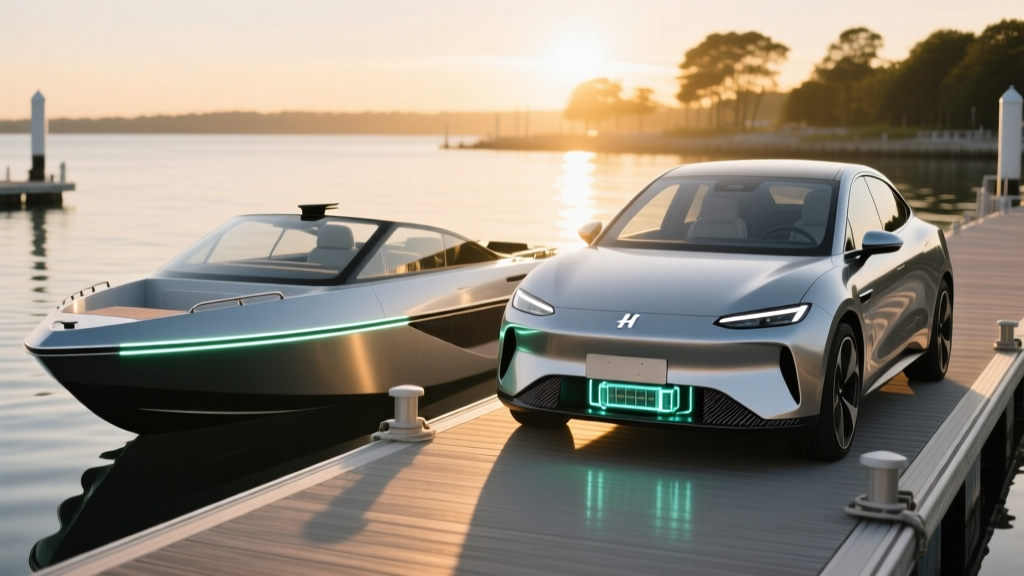
A small electric boat is a watercraft — typically a pontoon, dinghy, fishing skiff, or daysailer — propelled by an electric motor drawing energy from an onboard battery bank. In 2026, leading models include the Arc One (40 kWh battery, ~45-mile range at cruising speed), the Candela C-8 (hydrofoil, 69 kWh, ~57 nautical miles at 22 knots), and more affordable options like the Navier ST30 (30 kWh, ~30-mile range) or electric outboard conversions using Torqeedo or ePropulsion motors paired with portable lithium packs.
Unlike electric cars regulated by NHTSA and tested by the EPA for MPGe and range, electric boats fall under U.S. Coast Guard safety standards and lack a universal "EPA range" sticker. Range depends heavily on hull design, speed, water conditions, and payload — making real-world estimates more variable than even cold-weather EV driving.
How Does a Small Electric Boat Compare to Gas Boats and EVs?
| Metric | Small Electric Boat (2026) | Small Gas Boat (150 HP outboard) | Electric Car (e.g., Chevy Equinox EV) |
|---|---|---|---|
| Energy capacity | 30–69 kWh (battery bank) | ~40 kWh equivalent in 12 gal gasoline | 85 kWh (usable) |
| Range | 20–60 miles (water) | 150–300 miles (water) | 315 miles (EPA, road) |
| Top speed | 20–30 mph (most models) | 40–55 mph | 100+ mph |
| "Fuel" cost per hour | $2–$6 (electricity at $0.15/kWh) | $25–$50 (gas at $3.50/gal, 5–10 GPH) | $0.04–$0.06/mile |
| Maintenance (annual) | $100–$300 (minimal) | $500–$1,500 (oil, impeller, fuel system) | $300–$600 |
| Purchase price | $15,000–$150,000+ | $15,000–$50,000 | $33,000–$45,000 |
| Federal tax credit | Not eligible (§30D is for highway vehicles) | None | Up to $7,500 (§30D, income/MSRP/sourcing rules apply) |
The key takeaway: electric boats win on operating cost and maintenance, but lose decisively on range and refueling flexibility. A gas boat can refill in 5 minutes at any marina; an electric boat needs hours on a dock-side charger or must return to its home slip.
Real Costs and Savings: Electric Boat Ownership Breakdown
| Cost Category | Electric Boat (5-Year) | Gas Boat (5-Year) |
|---|---|---|
| Purchase price | $45,000 | $30,000 |
| Fuel / electricity | $1,500 | $12,500 |
| Maintenance | $1,000 | $5,000 |
| Insurance | $4,500 | $4,000 |
| Winterization / storage | $2,500 | $3,000 |
| Total 5-year cost | $54,500 | $54,500 |
Based on 100 hours/year on the water, electricity at $0.15/kWh, and gas at $3.50/gallon with a 150 HP outboard burning ~8 GPH. The electric boat's higher purchase price is offset within ~5 years by fuel and maintenance savings. However, there is no federal EV tax credit for boats — IRS §30D applies only to on-road motor vehicles with four wheels. Some states offer marine electrification incentives, but these vary widely and must be checked locally.
Battery replacement is the wildcard: marine-grade lithium packs (NMC or LFP chemistry) cost $8,000–$20,000 to replace after 10–15 years or 2,000–5,000 charge cycles, depending on chemistry and depth-of-discharge habits. LFP (lithium iron phosphate) batteries, increasingly common in marine applications, degrade more slowly and tolerate deeper cycling than NMC, but weigh more for the same kWh — a critical trade-off on water.
Charging a Small Electric Boat: What's Involved
Charging infrastructure for electric boats is far less developed than for EVs. Here's what most owners encounter in 2026:
- Level 1 (120V AC, 1.5–2 kW): Standard dock outlet. Adds ~3–5 miles of range per hour. A full 40 kWh charge takes 20–27 hours. Fine for overnight top-ups if you use the boat briefly each day.
- Level 2 (240V AC, 6–19 kW): Requires a dedicated marine-rated charger at your slip or home dock. Adds 10–30 miles per hour. Full charge in 3–7 hours. Installation costs $2,000–$6,000 including marine electrician, GFCI protection, and corrosion-resistant hardware.
- DC fast charging: Virtually nonexistent for small boats in 2026. A few marinas in California and Florida are piloting 50 kW marine DC chargers, but there is no standardized connector (unlike NACS or CCS for cars). This is the single biggest infrastructure gap.
If you don't have a private dock or slip with power access, owning a small electric boat is impractical for anything beyond short, infrequent outings. Public marina charging is rare and unreliable — the marine equivalent of a "charging desert."
Common Misconceptions — Myth vs. Fact
| Myth | Fact |
|---|---|
| "Electric boats qualify for the $7,500 EV tax credit." | No. IRS §30D applies to on-road vehicles only. No federal purchase incentive exists for boats. |
| "You can charge at any marina." | Most marinas offer only 120V outlets (if anything). Dedicated 240V marine charging requires prior arrangement and often slip-owner investment. |
| "Electric boats have zero maintenance." | Low maintenance, not zero. You still need hull cleaning, anode replacement, bilge pump service, and battery management system (BMS) monitoring. |
| "Range is the same as the sticker says." | Marine range varies enormously with speed, current, wind, and payload. Expect 30–50% less range at top speed vs. cruising speed — similar to highway vs. city EV driving, but more extreme. |
| "LFP and NMC batteries are interchangeable in boats." | LFP is heavier but safer and longer-lasting; NMC is lighter (critical for planing hulls and foiling boats) but degrades faster if routinely charged to 100%. Choose based on hull type and usage pattern. |
Decision Framework: Should You Buy a Small Electric Boat?
Choose an electric boat if:
- You have a private dock or slip with 240V power access
- Your typical outings are under 30 miles round-trip
- You value silence, zero local emissions, and minimal maintenance
- You boat on lakes or calm coastal waters with no strong currents
- You're willing to pay a 30–80% purchase premium and wait 5+ years to break even on operating savings
Choose a gas boat if:
- You need 100+ mile range or offshore capability
- You trailer your boat to different launches (no fixed charging)
- You need high speed for watersports or fishing runs
- Upfront budget is under $25,000
Consider an electric car instead if:
- Your goal is reducing transportation emissions — a $35,000 EV with a $7,500 tax credit delivers far more daily utility and infrastructure access than a $45,000 electric boat with no credit and limited charging
Frequently Asked Questions
Can I tow a small electric boat with an EV?
Yes, if your EV's towing capacity exceeds the boat and trailer weight. A small electric pontoon (~2,500 lbs) plus trailer (~800 lbs) totals ~3,300 lbs — within the capacity of a Ford F-150 Lightning (up to 7,700 lbs) or Rivian R1T (up to 11,000 lbs). Expect 20–35% range reduction while towing, consistent with gas vehicle towing penalties.
How long do electric boat batteries last?
Marine lithium packs (LFP or NMC) typically last 2,000–5,000 full charge cycles before degrading to 80% capacity. At 100 outings/year with one full cycle each, that's 20–50 years of use — though calendar aging (10–15 years) usually determines end-of-life first. Warranty terms vary: Arc offers 5 years, while Torqeedo offers 2 years on batteries.
Are electric boats safe in saltwater?
Yes, but corrosion management is critical. Marine-grade systems use sealed battery enclosures, sacrificial anodes, and galvanic isolation. Saltwater exposure demands more rigorous maintenance than freshwater use. Most manufacturers rate their systems for both, but warranty terms may differ.
Do electric boats need to be winterized?
Battery storage replaces engine winterization. You must store lithium packs at ~50% state of charge in a temperature-controlled environment (32–77°F). Leaving a fully charged or fully depleted battery in freezing temperatures can cause permanent capacity loss. Hull winterization (draining water systems, anti-fouling) remains necessary.
What's the cheapest way to get into electric boating?
An electric outboard conversion: an ePropulsion Spirit 1.0 Evo (~$2,300, 1 kW motor, integrated 1 kWh battery) mounted on an existing dinghy or canoe. Range is limited (~8–12 miles at 3–4 mph), but it's a practical entry point under $3,000 total.