Quick Answer: Small Electric Boats & the EV Buyer
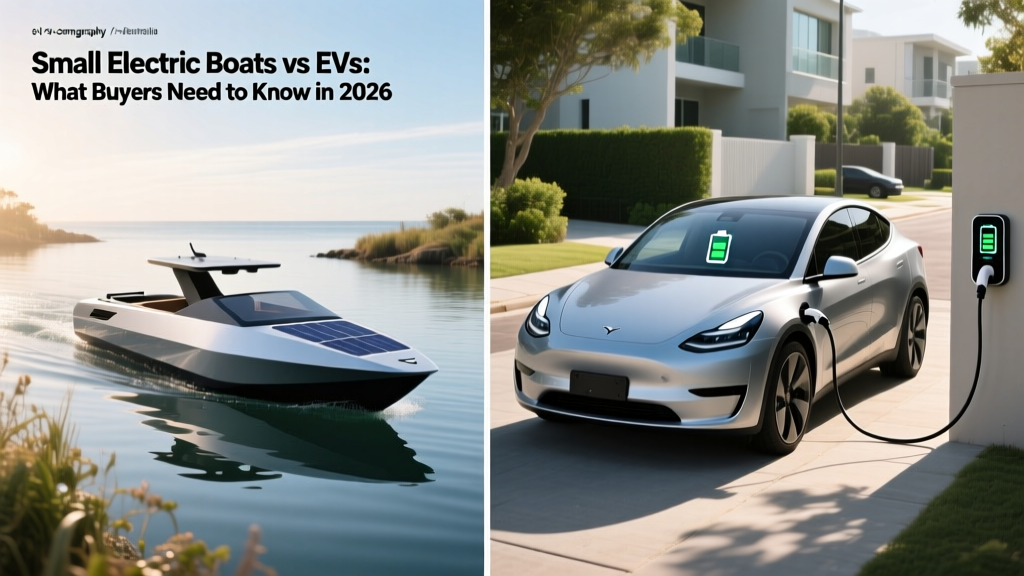
Small electric boats (typically 10–20 feet, powered by lithium battery packs and electric outboard motors) are a growing niche in marine recreation — but they sit outside the scope of federal EV tax credits (§30D), which apply only to highway-capable four-wheeled vehicles. If you're an EV owner or shopper considering a small electric boat, expect to pay $8,000–$45,000 depending on size and battery capacity, charge from standard 120V or 240V outlets (much like home EV charging), and cruise for 2–6 hours on a single charge depending on speed and conditions. The ownership experience overlaps significantly with EVs — same charging concepts, same battery care principles — but the economics, range, and regulatory landscape differ sharply.
What Is a Small Electric Boat?
A small electric boat replaces the traditional gasoline outboard motor with a battery-electric propulsion system. The most common form factors in 2026 include:
- Electric pontoons and deck boats (16–20 ft): 20–40 kWh battery packs, 5–15 kW motors, designed for calm lakes and rivers.
- Electric dinghies and tenders (8–12 ft): 2–5 kWh batteries, 1–3 kW motors, used for short harbor hops or yacht tenders.
- Electric bass/fishing boats (14–18 ft): 10–20 kWh packs with trolling-optimized motors.
- Electric kayaks and canoes: Integrated 0.5–1 kWh lithium packs with small hub motors.
Leading brands in the U.S. market include Torqeedo (German-made electric outboards retrofitted to existing hulls), Flux Marine (electric outboards in the 70–150 HP equivalent range), Arc One (premium electric runabouts), and ElectraCraft (electric pontoons). Pricing varies wildly: a Torqeedo Cruise 10.0 outboard (roughly 20 HP equivalent) runs about $4,500–$5,500 with battery, while a fully integrated Arc One electric runabout starts around $300,000.
For this guide, we're focusing on the accessible segment: electric pontoons, fishing boats, and dinghies under $50,000 — the marine equivalent of the affordable EV segment.
Small Electric Boat vs. Gas Boat: The Numbers
Here's where the comparison to electric cars becomes instructive. Just as EV buyers weigh higher upfront cost against lower fueling and maintenance expenses, electric boat buyers face the same calculus on water.
| Metric | Electric (20 kWh Pack) | Gas (25 HP Outboard) |
|---|---|---|
| Base Purchase Price | $18,000–$28,000 | $12,000–$18,000 |
| Fuel/Energy Cost Per Hour (cruising) | $1.50–$3.00 (electricity) | $8.00–$14.00 (gasoline at $3.50/gal) |
| Annual Fuel/Energy (100 hrs/yr) | $150–$300 | $800–$1,400 |
| Annual Maintenance | $100–$250 (minimal) | $400–$800 (oil, impeller, lower unit) |
| Noise Level at Cruise | ~50 dB (conversation-quiet) | ~75–85 dB |
| Range at Cruise Speed (5 mph) | 15–25 miles / 3–5 hours | 60–100+ miles (with spare fuel) |
| Top Speed | 6–10 mph (typical) | 15–25 mph |
| Refuel/Recharge Time | 4–8 hours (Level 1/2) | 5 minutes (gas can) |
| Emissions on Water | Zero tailpipe | Unburned hydrocarbons in water |
| Winterization | Battery storage management | Fogging, fuel stabilizer, lower-unit drain |
The data reveals the same pattern as EVs: higher upfront cost, dramatically lower operating cost. An electric pontoon owner spending 100 hours per year on the water saves roughly $700–$1,200 annually in fuel and maintenance. At a $6,000–$10,000 price premium over gas, the payback period is 5–10 years — longer than most EVs, because marine use hours are typically lower than driving miles.
Charging a Small Electric Boat: What EV Owners Already Know
If you own an EV, you already understand the fundamentals of electric boat charging. The terminology is identical:
- kWh (kilowatt-hours): The battery's energy capacity — how much "fuel" the tank holds. A 20 kWh boat battery stores the same energy as about 60 miles of EV driving.
- kW (kilowatts): The charge rate — how fast energy flows into the battery.
- Level 1 charging: Standard 120V household outlet, delivering ~1.2 kW. A 20 kWh boat battery takes roughly 16–18 hours from empty.
- Level 2 charging: 240V outlet (like an EV home charger or dryer outlet), delivering 3.3–7.2 kW. The same 20 kWh battery charges in 3–6 hours.
Most small electric boats ship with a Level 1 cord and offer an optional Level 2 onboard charger ($500–$1,200). Unlike EVs, DC fast charging is virtually nonexistent in recreational marine — the infrastructure simply doesn't exist at marinas, and battery packs in small boats aren't designed for high-C-rate charging.
| Charging Method | Power (kW) | Time (0–100%) | Cost Per Full Charge | Cost Per Hour on Water |
|---|---|---|---|---|
| Level 1 (120V household) | 1.2 kW | ~17 hours | $2.60–$3.40 | $0.52–$0.68 |
| Level 2 (240V, 30A) | 7.2 kW | ~3 hours | $2.60–$3.40 | $0.52–$0.68 |
| Solar trickle (200W panel) | 0.2 kW peak | Days (supplement only) | $0.00 | — |
At the U.S. average residential electricity rate of ~$0.13–$0.17/kWh (per EIA data), a full charge costs roughly $2.60–$3.40. That's a fraction of the $15–$25 you'd spend on gasoline for the same time on the water.
Battery Technology: LFP vs. NMC on the Water
The same lithium battery chemistries used in EVs power electric boats, but the marine environment shifts the trade-offs:
| Factor | LFP (Lithium Iron Phosphate) | NMC (Nickel Manganese Cobalt) |
|---|---|---|
| Energy Density | Lower (~140 Wh/kg) — heavier for same kWh | Higher (~220 Wh/kg) — lighter, more compact |
| Cycle Life | 3,000–5,000 cycles to 80% SoH | 1,000–2,000 cycles to 80% SoH |
| Thermal Stability | Excellent — lower fire risk in enclosed bilge | Good — requires active BMS monitoring |
| Cost Per kWh | ~$100–$130/kWh | ~$130–$170/kWh |
| Cold-Weather Performance | Poor below 32°F (reduced capacity, no charging below freezing) | Better in cold (but still degraded) |
| Best For | Warm-climate lake boats, daily-use pontoons | Performance runabouts, weight-sensitive hulls |
For most small electric boat buyers — weekend lake use in moderate climates — LFP is the practical choice. The weight penalty is manageable in a pontoon or deck boat, the cycle life means the battery will likely outlast the boat's hull, and the thermal stability is a genuine safety advantage in marine environments where battery compartments can get hot and humid.
Real-World Range: What the Spec Sheet Doesn't Tell You
Just as EPA range estimates for EVs don't capture highway driving at 75 mph or cold-weather losses, electric boat range specs assume ideal conditions: calm water, moderate speed, no headwind, warm battery.
Real-World Range Expectations (16-ft Electric Pontoon, 20 kWh Battery)
- Spec-sheet range: 20–25 miles at 5 mph cruise
- Calm lake, 5 mph, 70°F: 18–22 miles (close to spec)
- Choppy water, 5 mph, headwind: 12–16 miles (30–40% reduction)
- Pushing to 8 mph (planing attempt): 6–10 miles (energy use roughly doubles with speed squared in water)
- Cold water (45°F), battery not preconditioned: 14–18 miles (15–25% capacity loss)
- With 4 passengers + gear vs. solo: ~10–15% range reduction per 500 lbs added load
The physics are unforgiving: hydrodynamic drag increases with the square of speed, and unlike cars, boats can't use regenerative braking (there's no coasting downhill on water). If you need to cross a large lake at speed, an electric boat in 2026 is not yet the right tool. These vessels excel at slow, quiet cruising — fishing, wildlife watching, sunset pontoon rides — where their range is more than adequate.
Common Misconceptions About Small Electric Boats
| Myth | Fact |
|---|---|
| "Electric boats qualify for the $7,500 federal EV tax credit." | False. IRS §30D applies only to highway-capable four-wheeled vehicles with four wheels. Boats do not qualify. Some states offer marine electrification rebates — check your state's energy office. |
| "You can't sink an electric boat because the battery is sealed." | False. Marine battery packs are IP67-rated (submersible to 1m for 30 min), but hull integrity, not the battery, determines buoyancy. Electric boats can and do sink from hull damage. |
| "Electric outboards have no torque." | False. Electric motors deliver peak torque at 0 RPM — they actually outperform gas outboards in low-end thrust, which is why electric trolling motors have been standard in bass fishing for decades. |
| "The battery will need replacing every 3–5 years." | Mostly false. LFP marine packs rated for 3,000+ cycles at 80% SoH will last 15–20+ years at typical recreational use (50–100 cycles/year). NMC packs may need replacement sooner, at $3,000–$8,000 depending on capacity. |
| "I can charge my boat at any marina." | Mostly false. Most marinas offer 120V shore power (15–30A), which works for overnight Level 1 charging. Dedicated 240V marine charging stations are rare but growing — Dockwa and marina directories are starting to list charging amenities. |
Cost of Ownership: 5-Year Breakdown
| Cost Category | Electric (20 kWh, LFP) | Gas (25 HP 4-Stroke) |
|---|---|---|
| Purchase Price | $24,000 | $15,000 |
| Fuel/Energy (5 years) | $1,100 | $5,500 |
| Maintenance (5 years) | $800 | $3,000 |
| Insurance (5 years) | $3,500 | $3,000 |
| Winterization/Storage (5 years) | $1,500 | $2,000 |
| Battery Replacement | $0 (within cycle life) | N/A |
| Resale Value (estimated) | -$12,000 | -$8,000 |
| Net 5-Year Cost | $18,900 | $20,500 |
The electric boat achieves rough cost parity over five years despite the $9,000 higher purchase price, primarily through fuel and maintenance savings. By year 7–8, the electric boat pulls ahead on total spend — assuming the battery holds up, which LFP chemistry makes highly likely.
Insurance is worth noting: electric boat premiums run 10–20% higher than gas equivalents in 2026, reflecting higher replacement-cost values and insurer unfamiliarity with the technology. This mirrors the EV insurance premium that car buyers encounter.
Decision Framework: Should You Buy a Small Electric Boat?
Choose an Electric Boat If:
- You boat primarily on calm, inland lakes or slow rivers where speeds under 8 mph are the norm.
- You value silence and zero exhaust fumes — critical for fishing, birding, or entertaining.
- You have access to 240V power at your dock, garage, or trailer-storage location for overnight Level 2 charging.
- You already own an EV and understand battery management (State of Charge habits, avoiding prolonged 100% storage, winter care).
- Your typical outing is under 4 hours at cruising speed.
- You live in a state or locality that restricts gas motors on certain water bodies (increasingly common on reservoirs and protected lakes).
Stick With Gas (or Wait) If:
- You need to plane, water-ski, or cover large distances at speed — electric outboards in the affordable segment can't deliver this yet.
- You boat in tidal or open-water environments where currents and wind can strand an underpowered vessel.
- You have no access to charging at your marina or storage location.
- You boat fewer than 30 hours per year — the fuel savings won't justify the price premium within a reasonable timeframe.
- You need a tournament-ready bass boat that can run 50+ mph to reach distant spots.
What EV Buyers Should Know Before Crossing Over to Electric Boats
If you're coming from the EV world, several assumptions don't transfer to marine:
- No public fast-charging network exists for boats. There's no Supercharger equivalent on the water. Plan every outing around your battery capacity and bring a margin — just like early EV road-tripping before DCFC infrastructure matured.
- No federal tax credit applies. The IRS §30D credit is strictly for on-road vehicles. Check IRS clean vehicle credit rules for what qualifies. Some local utilities offer marine electrification rebates — contact your provider.
- Marine battery warranties differ. Unlike the 8-year/100,000-mile battery warranties standard on EVs, marine battery warranties are typically 2–5 years with cycle-count limits. Read the fine print.
- Trailering adds complexity. The combined weight of boat + battery + trailer must stay within your EV's tow rating. A 20 kWh LFP pack adds ~300–400 lbs over a gas equivalent. Verify your EV's towing capacity (many crossovers max out at 1,500–2,500 lbs).
- Stray-current corrosion is real. Unlike a car, a boat sits in a conductive electrolyte (water). Proper marine-grade wiring, galvanic isolation, and sacrificial anodes are essential — not optional. This is where a qualified marine electrician earns their fee.
Frequently Asked Questions
Can I use my home Level 2 EV charger to charge an electric boat?
Often, yes — if the boat's onboard charger accepts standard 240V AC input (most do), you can plug into the same NEMA 14-50 or hardwired circuit you use for your EV. However, you'll need the boat's specific charging cable and connector, which is typically a marine-grade twist-lock (like a Marinco 30A) rather than a J1772 or NACS plug. Never use an EV charging cable directly on a boat — the connectors aren't rated for marine moisture exposure.
How long do electric boat batteries last before replacement?
LFP marine battery packs are typically rated for 3,000–5,000 charge cycles before degrading to 80% State of Health. At 50–100 cycles per year (typical recreational use), that translates to 20–50+ years — effectively the life of the boat. NMC packs, with 1,000–2,000 cycle ratings, may need replacement in 10–20 years at a cost of $3,000–$8,000 depending on capacity.
Are electric boats allowed everywhere?
Most waterways allow electric boats, and some require them. A growing number of lakes and reservoirs — particularly drinking-water supply lakes — ban gas-powered motors entirely to prevent hydrocarbon contamination. Electric-only lakes are a strong tailwind for the segment. Check local regulations before purchasing.
What happens if I run out of charge on the water?
Unlike a gas boat that can accept a fuel delivery from another vessel, a dead electric boat must be towed. This is the marine equivalent of an EV running out of charge far from a charger. Responsible electric boat operators follow the same "20% buffer" rule that EV drivers use: never plan an outing that would drain the battery below 20% SoC under expected conditions, and add margin for wind, current, and passenger load.
Do electric boats work in saltwater?
Yes, but with significantly more maintenance and corrosion-prevention requirements than freshwater use. Saltwater accelerates galvanic corrosion on any metal component, and electric drivetrains add complexity around sealing and isolation. Most manufacturers recommend freshwater use for entry-level models; saltwater-rated electric outboards carry a price premium and require rigorous post-use freshwater rinsing and anode inspection.