Quick Verdict: Two Electric Trucks, Two Very Different Philosophies
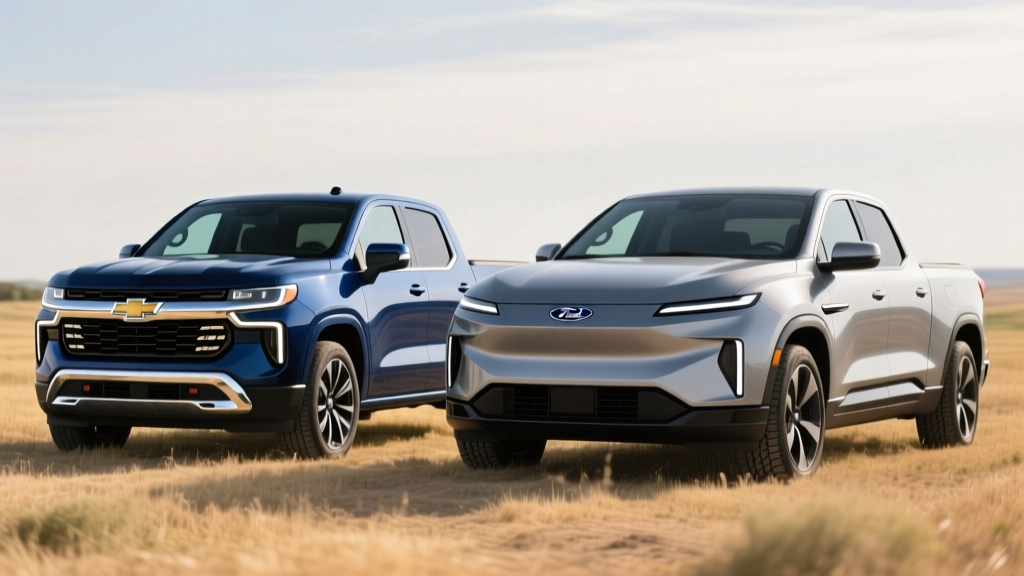
The electric pickup segment has matured enough that the 2025 Chevy Silverado EV vs Ford F-150 Lightning debate now comes down to what you actually need from a truck, not whether an electric truck can work. Ford's Lightning is the proven incumbent — a conventional-looking body-on-frame design adapted for electric propulsion, with real-world miles on the clock and a dealer network that knows how to service it. GM's Silverado EV is the newer challenger built on the dedicated Ultium platform, trading traditional truck styling for a lower, more aerodynamic profile and segment-leading range figures.
Neither truck is universally better. The Lightning wins on familiarity, interior versatility, and immediate availability. The Silverado EV wins on range, DC fast-charging speed, and cargo innovation. Let's break this down category by category with the exact numbers that matter.
Side-by-Side Specifications: Silverado EV vs F-150 Lightning
Before diving into subjective impressions, here's how the 2025 model-year specs stack up. Figures reflect the most comparable trims: the Silverado EV 4WT / 3LT and the F-150 Lightning XLT/Lariat with the extended-range battery, which is where most retail buyers land.
| Specification | 2025 Chevy Silverado EV (4WT / 3LT) | 2025 Ford F-150 Lightning (Extended Range) |
|---|---|---|
| EPA Range | 390 mi (4WT); 440 mi (3LT Max Range) | 320 mi (XLT/Lariat Ext. Range) |
| Battery Capacity (Usable) | ~200 kWh (4WT/3LT); ~215 kWh (Max Range) | ~131 kWh usable |
| Battery Chemistry | Ultium NMC (nickel manganese cobalt) | NMC (nickel manganese cobalt) |
| Peak DC Fast Charge | 350 kW (capable) | 150 kW (peak) |
| 10–80% DC Fast Charge | ~30 min (estimated at 350 kW station) | ~41 min (at 150 kW) |
| Level 2 Home Charging | 11.5 kW (standard); 19.2 kW (available) | 11.3 kW (standard); 19.2 kW (Charge Station Pro) |
| Horsepower | 510 hp (4WT); 664 hp (4WT fully optioned) | 580 hp (Extended Range AWD) |
| 0–60 mph | ~4.5 sec (4WT, est.) | ~3.8 sec (Extended Range AWD) |
| Max Towing | 10,000 lbs (4WT); up to 12,500 lbs (future trims) | 10,000 lbs (Extended Range w/ Max Trailer Tow) |
| Max Payload | ~1,800 lbs (4WT) | ~2,235 lbs (Extended Range) |
| Cargo Bed Length | 5'11" (standard) + eTrunk front trunk | 5'5.5" (standard) + Mega Power Frunk |
| Frunk Volume | ~10.7 cu ft (eTrunk) | 14.1 cu ft (Mega Power Frunk) |
| Efficiency (Combined) | ~50 MPGe (est., 4WT) | 66 MPGe (Lariat Ext. Range, per EPA) |
| Starting MSRP | ~$55,300 (4WT); ~$72,000 (3LT) | ~$55,995 (XLT Std. Range); ~$69,995 (Lariat Ext. Range) |
| Battery/Powertrain Warranty | 8 years / 100,000 miles | 8 years / 100,000 miles |
Key takeaway: The Silverado EV carries a significantly larger battery pack, which translates directly into more range but also more weight, lower efficiency, and a higher price at comparable trims. The Lightning makes better use of a smaller, lighter battery — a reminder that bigger isn't always better in EV design.
Range and Real-World Efficiency
EPA vs. Reality — Silverado EV 4WT: EPA 390 miles. Expect ~320–340 miles in mixed real-world driving, ~270–290 miles at sustained 75 mph highway speeds, and ~250–280 miles in sub-freezing temperatures.
EPA vs. Reality — F-150 Lightning Extended Range: EPA 320 miles. Expect ~260–280 miles in mixed driving, ~220–240 miles at 75 mph highway, and ~200–220 miles in cold weather.
The Silverado EV's Ultium platform gives it a clear range advantage on paper, and that advantage holds in practice. If your priority is minimizing charge stops on long highway runs, the Silverado EV — especially the 440-mile Max Range 3LT — is the stronger choice. But there's a physics cost: that ~200 kWh battery is heavy, and the Silverado EV's efficiency (kWh consumed per mile) trails the Lightning's. You're carrying more energy, but you're also burning more of it per mile driven.
The Lightning's 131 kWh usable pack is lighter, and Ford's thermal management system has proven reliable across multiple model years. Its 66 MPGe combined (Lariat Extended Range, per fueleconomy.gov) is noticeably better than the Silverado EV's estimated ~50 MPGe. If most of your driving is local or regional and you charge at home nightly, the Lightning's range is more than sufficient and its efficiency saves money over time.
Charging Speed and Network Access
This is where the Silverado EV's Ultium architecture flexes. With a 350 kW peak DC fast-charge capability, the Silverado EV can take advantage of the fastest chargers being deployed by Electrify America and EVgo. A 10–80% session in roughly 30 minutes is achievable at a functioning 350 kW stall — though real-world charging curves mean you won't sustain 350 kW for the entire session. Expect peak rates in the 270–320 kW range tapering as the battery fills, which is normal for large NMC packs.
The Lightning tops out at 150 kW DC fast charging. A 10–80% session takes approximately 41 minutes under good conditions. That's competitive with many mainstream EVs but noticeably slower than the Silverado EV. For road trips, that's an extra 10–15 minutes per charge stop — meaningful on a 1,000-mile haul, irrelevant if you rarely DC fast charge.
On the network side, both trucks now use the NACS (North American Charging Standard) connector for 2025, granting access to Tesla's Supercharger network via native port (no adapter needed for newer builds). This is a significant equalizer — both trucks can pull from the same pool of over 20,000 Supercharger stalls in North America. However, Supercharger V3 stalls cap at 250 kW, so the Silverado EV's 350 kW capability is best realized at Electrify America or EVgo 350 kW stations, which are less densely deployed.
| Charging Level | Silverado EV | F-150 Lightning |
|---|---|---|
| Level 1 (120V, 1.4 kW) | ~3–4 mi/hr | ~2–3 mi/hr |
| Level 2 (240V, 11.5 kW) | ~28–32 mi/hr | ~24–28 mi/hr |
| Level 2 (240V, 19.2 kW) | ~45–52 mi/hr | ~40–45 mi/hr |
| DC Fast (peak kW) | 350 kW (~30 min 10–80%) | 150 kW (~41 min 10–80%) |
Performance, Towing, and Payload
The F-150 Lightning Extended Range hits 0–60 mph in approximately 3.8 seconds with 580 hp, making it one of the quickest trucks ever sold. The Silverado EV 4WT, while offering up to 664 hp in fully optioned form, carries substantially more battery weight and clocks in around 4.5 seconds. Both are dramatically quicker than any gas half-ton, but the Lightning feels sportier in daily driving thanks to its lighter overall mass.
For work duty, both trucks are rated at 10,000 lbs max towing in their current configurations. GM has announced a 12,500-lb tow rating for future Silverado EV trims, but that's not yet available for 2025. Payload favors the Lightning at ~2,235 lbs vs. the Silverado EV's ~1,800 lbs — again, the weight penalty of the larger battery shows up here.
When towing at max capacity, expect range to drop 40–55% in either truck. That brings the Lightning down to roughly 145–190 miles and the Silverado EV to roughly 175–235 miles. Towing with any EV remains a planning-heavy exercise — neither truck changes that fundamental reality.
Both trucks offer Pro Power-style onboard power. Ford's Pro Power Onboard delivers up to 9.6 kW of exportable power (240V), which has been widely praised by contractors and tailgaters. GM offers a similar V2L (vehicle-to-load) capability on the Silverado EV, though availability varies by trim.
Pricing, Tax Credits, and Total Cost of Ownership
Pricing and federal incentives significantly reshape the value equation for both trucks. Here's how the numbers break down before and after the IRS §30D federal tax credit.
| Factor | Silverado EV | F-150 Lightning |
|---|---|---|
| Base MSRP (entry retail trim) | ~$55,300 (4WT) | ~$55,995 (XLT Standard Range) |
| Mid-tier MSRP (popular config) | ~$72,000 (3LT) | ~$69,995 (Lariat Extended Range) |
| §30D Federal Credit (max) | Up to $7,500 (eligibility varies) | Up to $7,500 (eligibility varies) |
| MSRP Cap (trucks: $80,000) | Most trims qualify | All current trims qualify |
| Buyer Income Cap (trucks) | $300K joint / $150K single | $300K joint / $150K single |
| Battery Sourcing Requirement | Subject to critical mineral & component rules | Subject to critical mineral & component rules |
| Point-of-Sale Transfer | Available (reduces purchase price at dealer) | Available (reduces purchase price at dealer) |
Critical caveat on the §30D credit: The full $7,500 credit is not guaranteed for every buyer or every trim. Eligibility depends on battery component and critical mineral sourcing requirements that the IRS updates periodically. Both the Lightning (built in Michigan) and the Silverado EV (built in Michigan) have historically qualified, but the exact credit amount can shift based on battery supply chain changes. Always verify current eligibility on irs.gov before purchasing, and consult a tax professional if your situation is complex.
5-Year Ownership Cost Considerations:
| Cost Category | Silverado EV (4WT) | F-150 Lightning (Lariat ER) |
|---|---|---|
| Energy Cost (home charging, $0.14/kWh avg) | ~$3,600 (lower efficiency, more kWh used) | ~$2,800 (higher efficiency) |
| Maintenance | ~$1,200 (tire rotations, cabin filter, fluid top-offs) | ~$1,200 (similar) |
| Insurance (avg.) | Higher (larger battery, higher repair cost) | Moderate (proven platform, more data for actuaries) |
| Tire Replacement (1 set) | ~$1,600–$2,200 (heavy truck eats tires) | ~$1,400–$1,800 |
| Depreciation (est. 5-yr) | Higher risk (new platform, unproven resale) | Moderate (established demand, fleet presence) |
The Lightning's efficiency advantage translates to roughly $800 less in home charging costs over 5 years at average mileage and electricity rates. Insurance premiums for the Silverado EV are expected to be higher, reflecting the cost of its massive battery pack in collision repairs. Depreciation is harder to predict — the Lightning has an established used market, while the Silverado EV's resale value is still being determined.
Tech, Interior, and Daily Usability
The Lightning plays it conventional — and that's a compliment. The interior mirrors the gas F-150 almost exactly, which means intuitive controls, generous cabin space, and the available 12-inch SYNC 4 touchscreen (or 15.5-inch in higher trims with SYNC 4A). The Mega Power Frunk (14.1 cu ft) is a standout feature — lockable, weather-sealed, and equipped with a drain plug and 2.4 kW of onboard power. It's genuinely useful as a mobile workstation or cooler.
The Silverado EV takes a more radical approach. The available 17-inch diagonal infotainment screen is the largest in the segment. The fixed glass roof (no traditional sunshade) creates an airy cabin but can increase solar heat gain in summer. The eTrunk (10.7 cu ft) is smaller than the Lightning's frunk but still practical. The Multi-Flex Midgate is the Silverado EV's killer feature — it allows the bed to extend into the cab area, creating a nearly flat load floor up to ~10 feet long with the tailgate down. For anyone hauling lumber, kayaks, or long gear, this is a genuine functional advantage the Lightning can't match.
On the driver-assistance front, the Lightning offers Ford's BlueCruise (hands-free highway driving on pre-mapped divided highways), which is an SAE Level 2 system — you must remain attentive and ready to take over at all times. GM's Super Cruise is similarly Level 2 and available on higher Silverado EV trims, offering hands-free operation on over 750,000 miles of compatible roads. Both systems are competent, but neither is "self-driving" — that distinction remains critical.
⚠️ ADAS Reality Check: BlueCruise and Super Cruise are SAE Level 2 driver-assist systems. The driver must remain engaged, eyes on the road (or at minimum, responsive to attention prompts). These are not autonomous driving systems. You are legally and practically the driver at all times.
Decision Framework: Which Truck Fits Your Life?
Choose the 2025 Chevy Silverado EV if:
- Range is your top priority — you regularly drive 300+ miles between charges
- You want the fastest possible DC charging for road-trip efficiency
- You haul long items and would use the Multi-Flex Midgate regularly
- You're buying into GM's Ultium platform for the long term
- You value having the latest technology and screen real estate
Choose the 2025 Ford F-150 Lightning if:
- You want a proven electric truck with real-world reliability data
- Efficiency and lower per-mile energy cost matter to you
- You need maximum payload capacity for work use
- The Mega Power Frunk and Pro Power Onboard fit your workflow
- You prefer a familiar F-150 interior with minimal learning curve
- Quicker acceleration (3.8 sec 0–60) matters to you
- You want more predictable depreciation and insurance costs
Final Recommendation
There is no universal winner in the 2025 Chevy Silverado EV vs Ford F-150 Lightning matchup — and that's a sign of a healthy segment. The Lightning is the pragmatic, proven choice: it's efficient, quick, well-packaged, and backed by years of real-world ownership data. The Silverado EV is the technology-forward choice: it offers range and charging speeds the Lightning can't match, plus the Midgate's cargo flexibility.
If I were spending my own money for a daily-driver truck that occasionally road-trips and does light work duty, I'd lean toward the F-150 Lightning Lariat Extended Range — its efficiency, frunk, and proven platform make it the lower-risk, lower-cost-to-own pick. If I were regularly covering 350+ mile routes or needed the Midgate for gear, the Silverado EV 3LT Max Range is the truck I'd want, accepting the higher purchase price and lower efficiency as the cost of that range.
Test-drive both. The right answer depends on your miles, your cargo, and your budget — not on which truck "wins" in the abstract.
Frequently Asked Questions
Does the F-150 Lightning or Silverado EV qualify for the $7,500 federal tax credit?
Both trucks have historically qualified for up to $7,500 under IRS §30D, but eligibility depends on current-year battery sourcing rules, buyer income caps ($300K joint / $150K single for trucks), and the $80,000 MSRP cap for trucks/vans/SUVs. The credit can be transferred to the dealer at point of sale as a purchase-price reduction. Always verify on irs.gov before purchasing, as sourcing requirements are updated periodically.
Which truck charges faster at public DC stations?
The Silverado EV, decisively. Its 350 kW peak DC charge rate is more than double the Lightning's 150 kW. In practice, a 10–80% session takes roughly 30 minutes in the Silverado EV vs. ~41 minutes in the Lightning — assuming you're at a charger that can deliver the peak rate.
Can either truck tow a camper long-distance?
Both are rated for 10,000 lbs, but towing at max capacity cuts range by 40–55%. Plan for 150–235 miles between charges when towing heavy. DC fast charging while towing is feasible but adds significant trip time. For frequent heavy towing, neither electric truck yet matches the range convenience of a diesel.
What's the real-world range difference between the two?
In mixed driving, expect ~320–340 miles from the Silverado EV 4WT (EPA 390) and ~260–280 miles from the Lightning Extended Range (EPA 320). At highway speeds with cold weather, the gap narrows but the Silverado EV still holds a ~50-mile advantage. The Max Range Silverado EV (EPA 440) extends this lead further.
Do both trucks use the same charging connector?
For 2025, both use the NACS (Tesla-style) connector natively, eliminating the need for adapters at Superchargers. Both also support CCS1 charging at Electrify America, EVgo, and other networks via the same port or adapter depending on station type.
Which truck is better for a contractor or work fleet?
The Lightning edges ahead for work duty: higher payload (~2,235 vs. ~1,800 lbs), the larger Mega Power Frunk for tools, and 9.6 kW Pro Power Onboard for running job-site equipment. The Silverado EV's Midgate is better for long materials, but the Lightning's overall work package is more mature and fleet-tested.