Rivian and Tesla occupy two very different corners of the EV market, yet buyers routinely cross-shop them. Tesla brings scale, efficiency, and the largest proprietary fast-charging network in North America. Rivian counters with adventure-oriented utility, more conventional vehicle dynamics, and a rapidly expanding charging footprint via the Rivian Adventure Network and NACS Supercharger access. This guide puts the current 2026 lineup side by side so you can match the right platform to your actual driving life.
Current 2026 Lineup: Which Models Actually Compete?
Tesla's volume player is the Model Y (compact crossover, refreshed Juniper generation), supplemented by the larger Model X and the polarizing Cybertruck. Rivian fields the R1S three-row SUV and R1T pickup, both on the updated Gen 2 platform with NMC and the newer LFP Standard battery options. The R2 and R3 remain announced for later production and are not included here.
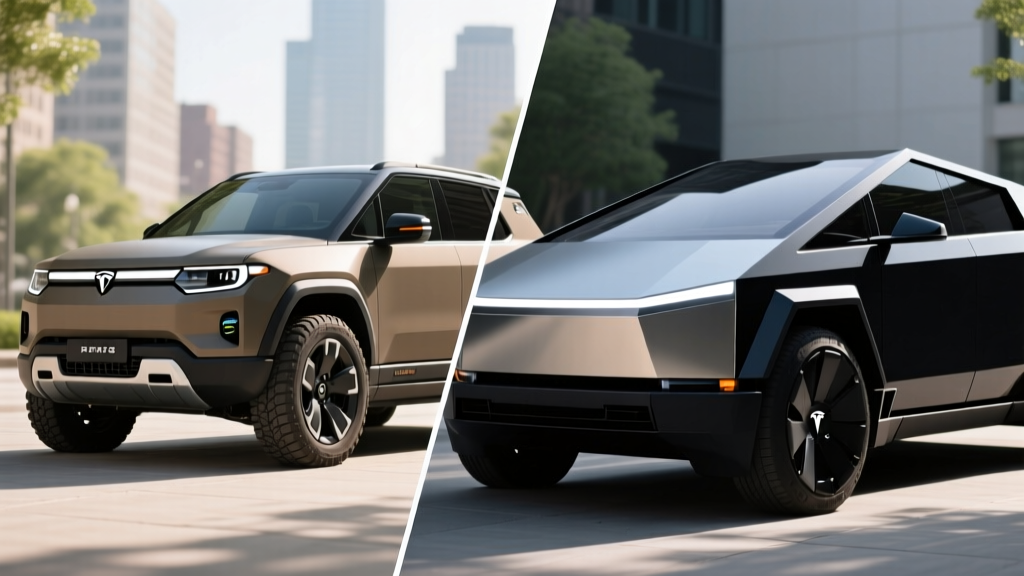
Most cross-shopping happens in two lanes: the R1S vs Model X for family SUV buyers, and the R1T vs Cybertruck for truck shoppers. The Model Y sits a segment below the R1S in size and price but overlaps in many household budgets.
Side-by-Side Spec Table: 2026 Models at a Glance
| Spec | Rivian R1S Dual Max | Tesla Model X Long Range | Rivian R1T Dual Max | Tesla Cybertruck AWD | Tesla Model Y Long Range |
|---|---|---|---|---|---|
| EPA Range | ~380 mi | 348 mi | ~380 mi | 340 mi | 320 mi |
| Battery (usable kWh) | ~149 (NMC Max) | ~100 (NMC) | ~149 (NMC Max) | ~123 (NMC) | ~75 (NMC) |
| Peak DC Charge kW | 220 | 250 | 220 | 250 (800V) | 250 |
| 10–80% DCFC Time | ~38 min | ~30 min | ~38 min | ~15 min | ~27 min |
| Level 2 kW | 11.5 | 11.5 | 11.5 | 11.5 | 11.5 |
| 0–60 mph | 4.5 s | 3.8 s | 4.5 s | 4.1 s | 4.8 s |
| Horsepower | 665 | 670 | 665 | 600 | 384 |
| EPA Efficiency (MPGe) | ~72 | ~102 | ~70 | ~68 | ~122 |
| Cargo (cu ft, seats folded) | 104 | 88 | 54 bed + 11 frunk | 67 bed + 7 frunk | 72 |
| Towing Capacity | 7,700 lb | 5,000 lb | 11,000 lb | 11,000 lb | 3,500 lb |
| Base MSRP | ~$94,000 | ~$81,630 | ~$90,000 | ~$81,630 | ~$48,630 |
| Battery Warranty | 8 yr / 175k mi | 8 yr / 150k mi | 8 yr / 175k mi | 8 yr / 120k mi | 8 yr / 120k mi |
Source: manufacturer spec sheets and fueleconomy.gov (EPA). Figures reflect 2026 model-year data and may vary by trim and wheel option.
Range and Efficiency: Sticker vs. Real World
EPA numbers tell only part of the story. The R1S and R1T Max packs carry enormous energy (roughly 149 kWh usable), which translates to big EPA range but also heavy curb weight and low MPGe. Tesla's Model X and Model Y benefit from years of powertrain and thermal-management refinement, yielding class-leading efficiency per mile.
Real-world expectation: On a 75°F highway trip at 70 mph, expect the R1S Dual Max to deliver roughly 310–330 miles and the Model X LR around 290–310 miles. In 20°F winter conditions with cabin heat, subtract 20–30% from those figures. The Model Y Long Range is the efficiency standout, routinely returning 260–280 real-world highway miles from its smaller pack, and is the cheapest to fuel per mile.
Cybertruck's stainless exoskeleton creates aerodynamic drag that hammers highway efficiency; independent tests have shown 60–65 MPGe at sustained 75 mph, well below the EPA combined figure. If most of your driving is highway, Rivian's quad-motor torque and Tesla's slicker shapes both beat Cybertruck's brick-wall aero.
Charging Speed and Network Access
Tesla owns the Supercharger network, which remains the most reliable and geographically complete DC fast-charging system in North America, with most stalls delivering 150–250 kW. Rivian now uses the NACS connector natively on Gen 2 vehicles, granting direct access to Superchargers without an adapter. Rivian's own Adventure Network focuses on outdoor destinations (national parks, trailheads, ski areas) at 200–420 kW stalls, a meaningful differentiator for the overlanding crowd.
| Level | Rivian R1 (Gen 2) | Tesla Model X/Y | Cybertruck |
|---|---|---|---|
| Level 1 (120V, 1.4 kW) | ~3 mi/hr | ~3 mi/hr | ~3 mi/hr |
| Level 2 (240V, 11.5 kW) | ~25 mi/hr | ~30 mi/hr | ~28 mi/hr |
| DC Fast (peak) | 220 kW / ~140 mi in 15 min | 250 kW / ~200 mi in 15 min | 250 kW (800V) / ~120 mi in 10 min |
The Cybertruck's 800V architecture gives it the fastest 10–80% time in this group (~15 minutes at a V4 Supercharger), but that peak only sustains briefly — the charge curve tapers sharply above 60% SoC. Rivian's larger Max pack takes longer in absolute minutes but sustains a more linear curve deeper into the session, which matters on multi-stop road trips where you charge to 90%.
Category Winners: Where Each Brand Excels
Range & Pack Capacity: Rivian
The Max pack's ~149 kWh usable (NMC) gives R1S and R1T the longest EPA figures here, ideal for remote touring where chargers are sparse.
Efficiency (MPGe): Tesla
Model Y Long Range and Model X sip electrons far more frugally — lower charging costs per mile, especially on expensive public DCFC networks.
DC Fast Charging Speed: Tesla (Cybertruck)
800V architecture and aggressive peak kW deliver the shortest 10–80% session at V4 stalls.
Charging Network Reach: Tesla
Supercharger coverage and uptime still outclass every other network; Rivian's NACS access now lets owners tap it directly.
Utility & Towing: Rivian R1T
11,000-lb rating, gear tunnel, and integrated bed power make the R1T the more practical work/adventure truck versus Cybertruck.
Performance (0–60): Tesla Model X Plaid
At 2.5 seconds (Plaid trim), Model X is the quickest SUV here by a wide margin.
Driver-Assist Tech: Tesla (with caveats)
Autopilot and FSD (Supervised) have the largest real-world data set, but both remain SAE Level 2 — driver supervision is mandatory at all times.
Value (entry price): Tesla Model Y
Starts around $48,630 before incentives, thousands below any Rivian and the cheapest path to a long-range EV in this group.
Pricing and Federal Tax Credit Eligibility
Under current IRS §30D rules, the clean-vehicle credit of up to $7,500 is subject to MSRP caps, buyer income limits, and battery critical-mineral and component sourcing requirements. As of 2026, SUVs (including pickups classified as light trucks) face a higher $80,000 MSRP cap than sedans — but several Rivian and Tesla trims still exceed it.
| Model | Base MSRP | §30D Eligible (2026) | Effective Price After Credit |
|---|---|---|---|
| Tesla Model Y LR AWD | ~$48,630 | Yes (sourcing dependent) | ~$41,130 |
| Tesla Model X LR | ~$81,630 | Yes (SUV cap $80k — borderline by trim) | Varies by trim |
| Tesla Cybertruck AWD | ~$81,630 | Yes (truck cap $80k) | Varies |
| Rivian R1S Dual Max | ~$94,000 | Typically NO — exceeds MSRP cap | Full MSRP |
| Rivian R1T Dual Max | ~$90,000 | Often NO — verify per VIN at purchase | Full MSRP |
| Rivian R1S/R1T Standard (LFP) | ~$70,000–$75,000 | Yes (under cap, sourcing TBD) | ~$62,500–$67,500 |
Eligibility hinges on battery sourcing and buyer MAGI ($300k joint / $150k single). The credit can now be transferred to the dealer at point of sale as a price reduction. Always verify per VIN on fueleconomy.gov before purchase.
This is the single biggest value flip in the comparison: a buyer choosing a Model Y or an R1 Standard pack can knock $7,500 off the purchase, while an R1 Max buyer pays full MSRP. For budget-sensitive shoppers, that gap can decide the purchase.
Ownership Costs: Insurance, Maintenance, and Long-Term
Both brands benefit from EV fundamentals — no oil changes, minimal brake wear thanks to regen, and fewer moving parts. Differences emerge elsewhere:
- Insurance: Tesla premiums have historically run 15–30% higher than Rivian's for comparable coverage, driven by repair-cost data on aluminum unibodies and ADAS calibration. Cybertruck's stainless panels and structural battery carry particularly high collision premiums. Always quote your own ZIP before deciding.
- Maintenance: Rivian includes more scheduled service visits (cabin filters, gear-reduction fluid checks). Tesla's approach is mostly on-demand, but out-of-warranty drive-unit and HVAC repairs can be costly.
- Tires: Heavy EVs wear tires quickly. The R1S Max (~7,200 lb curb weight) and Cybertruck will eat through rubber faster than a Model Y.
- Charging cost per mile: At $0.16/kWh national average (home) and $0.48/kWh (public DCFC), the Model Y costs roughly $0.04/mi at home and $0.12/mi public. The R1S, with ~72 MPGe, runs closer to $0.06/mi home and $0.18/mi public. Over 15,000 miles/year, that's a $300–$900 annual gap depending on charging mix.
Decision Framework: Which One Should You Actually Buy?
Choose Rivian (R1S or R1T) if:
- You regularly tow over 5,000 lb or haul adventure gear in a bed/gear tunnel.
- You need three usable rows (R1S) with real adult space in the third row.
- You value a more traditional, truck-like driving feel and body-on-frame capability (R1T).
- Your road trips target remote destinations where Rivian's Adventure Network is planted.
- Budget is flexible above $90k or you're willing to step down to the Standard LFP pack for tax-credit eligibility.
Choose Tesla (Model Y, Model X, or Cybertruck) if:
- Efficiency and per-mile charging cost are top priorities (Model Y dominates).
- You rely on the Supercharger network for frequent long-distance travel.
- You want the quickest DCFC sessions, especially in the Cybertruck's 800V platform.
- You prioritize the lowest entry price in the segment (Model Y under $50k before credit).
- You're comfortable with Tesla's minimalist interior and screen-centric controls.
Rivian vs Tesla FAQ
Can Rivians use Tesla Superchargers in 2026?
Yes. Gen 2 Rivians ship with a native NACS port, so they plug directly into Superchargers without an adapter. Gen 1 owners can use a Tesla-approved adapter, with software-integrated billing via the Rivian app.
Which brand holds resale value better?
Tesla's depreciation has been steeper than Rivian's on a percentage basis over the last 24 months, largely due to aggressive price cuts on new vehicles. Rivian's lower production volume and strong demand for used R1T trucks have supported residuals, though both brands remain sensitive to broader EV market swings.
Is Tesla FSD actually self-driving?
No. FSD (Supervised) is an SAE Level 2 driver-assist system. The driver must remain fully engaged, eyes on the road, hands available. True driverless operation (Level 4) in consumer vehicles is not yet commercially available from either brand.
Which battery chemistry should I pick?
Rivian's Standard pack uses LFP chemistry — heavier and slightly less energy-dense, but with longer cycle life, lower degradation, and the ability to charge routinely to 100% without penalty. Max packs use NMC for maximum range. Tesla's Long Range trims use NMC; Standard Range variants often use LFP. Choose LFP if you mostly charge at home and want simpler SoC habits.
Do either qualify for the full $7,500 federal tax credit?
The Model Y Long Range and Rivian R1 Standard packs typically qualify, subject to buyer income caps and battery sourcing. Higher-trim R1S/R1T Max and Model X configurations often exceed the MSRP cap and become ineligible. Always verify your exact VIN on fueleconomy.gov and consult a tax professional before relying on the credit.
Which is better for cold climates?
Both use heat pumps for cabin and battery thermal management, reducing winter range loss versus older resistive-heater EVs. Tesla's preconditioning and integrated navigation-to-charger warmup are slightly more refined, but Rivian's larger Max pack gives more absolute buffer. Expect 20–30% range loss below freezing for either brand.
Final Recommendation
There is no universal winner. The Model Y is the rational efficiency and value pick for most households. The R1T and R1S are the clear choices for buyers who need serious towing, three-row space, or adventure utility and can absorb the higher price and lower MPGe. The Model X sits awkwardly in between — quick and efficient for its size, but aging in interior quality versus Rivian. The Cybertruck is a niche play: fastest-charging and most visually distinctive, but compromised on efficiency and practicality. Match the vehicle to your actual driving mix, quote your insurance, verify your tax-credit eligibility by VIN, and the right choice usually becomes obvious.