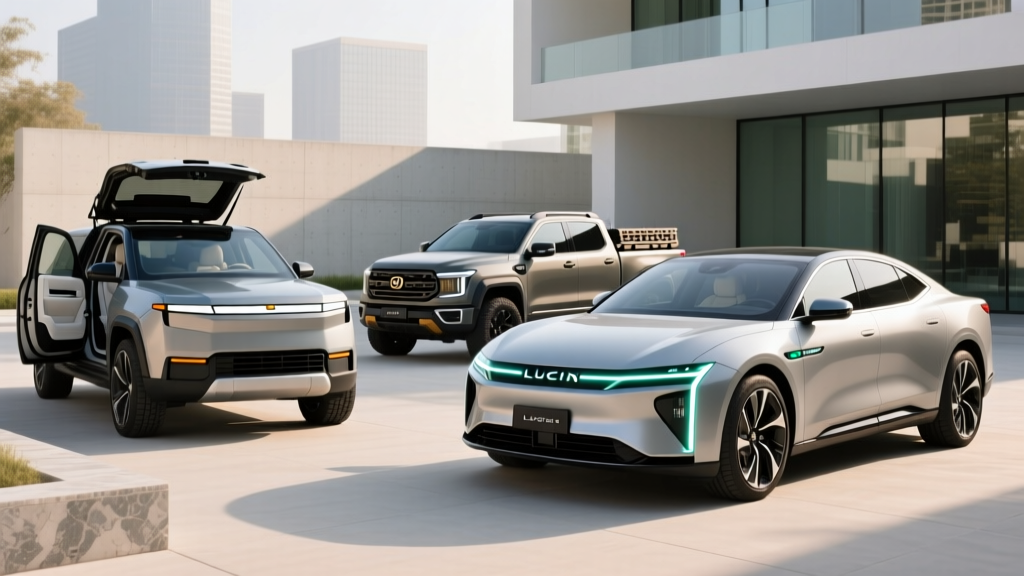
Rivian and Lucid occupy two very different corners of the premium EV market. Rivian builds adventure-ready SUVs and trucks (the R1S and R1T) on a rugged, body-on-frame-inspired skateboard. Lucid engineers the Air sedan around efficiency and luxury, chasing maximum miles per kilowatt-hour. Comparing Rivian vs Lucid isn't about picking an objective winner — it's about matching the vehicle to your garage, your commute, and your weekend.
This guide pits the most cross-shopped configurations against each other using 2026 model-year EPA data, manufacturer specs, and real-world charging observations. If you're weighing a three-row family hauler against a long-range executive sedan, the numbers below should settle the debate.
Side-by-Side Specs: Rivian R1S/R1T vs Lucid Air (2026)
The table below uses the Dual-Motor Standard battery R1S (the volume seller) and the Lucid Air Pure RWD as baseline trims, with the tri-motor variants noted where relevant. All figures reflect the latest EPA and manufacturer data available for 2026 model-year vehicles.
| Spec | Rivian R1S Dual-Motor Standard | Rivian R1T Tri-Motor Max | Lucid Air Pure RWD | Lucid Air Grand Touring |
|---|---|---|---|---|
| EPA Range | 270 mi | 420 mi (est.) | 419 mi | 516 mi |
| Battery (usable) | ~95 kWh (LFP) | ~149 kWh (NMC) | ~88 kWh (NMC) | ~112 kWh (NMC) |
| Peak DC Fast Charge | 200 kW | 220 kW | 200 kW | 300 kW |
| 10–80% DC Time | ~27 min | ~36 min | ~25 min | ~22 min |
| Level 2 Rate | 11.5 kW | 11.5 kW | 19.2 kW | 19.2 kW |
| 0–60 mph | 4.5 sec | 2.9 sec | 5.0 sec | 3.0 sec |
| Horsepower | 533 hp | 850 hp | 430 hp | 819 hp |
| EPA Efficiency | 2.0 kWh/mi (100 MPGe) | 2.1 kWh/mi (96 MPGe) | 4.6 mi/kWh (146 MPGe) | 4.2 mi/kWh (132 MPGe) |
| Cargo Volume | 104.7 cu ft (seats folded) | 54 cu ft bed + 11 cu ft frunk | 32 cu ft trunk + frunk | 32 cu ft trunk + frunk |
| Towing Capacity | 7,700 lb | 11,000 lb | N/A | N/A |
| Base MSRP | $75,900 | $99,900 | $69,900 | $125,000 |
| Federal Tax Credit (§30D) | Up to $7,500 (R1S qualifies as SUV) | Up to $7,500 (R1T qualifies as truck) | Not eligible (sedan MSRP cap rule) | Not eligible (sedan + price cap) |
| Battery/Powertrain Warranty | 8 yr / 175,000 mi | 8 yr / 175,000 mi | 8 yr / 100,000 mi | 8 yr / 100,000 mi |
Sources: fueleconomy.gov, Rivian specs, Lucid Air specs.
Range and Efficiency: Lucid's Physics Advantage
Lucid Air Grand Touring: EPA 516 mi. Expect ~430–460 mi on a mixed highway trip at 70 mph; ~360–390 mi in sub-30°F weather.
Rivian R1S Dual-Motor Standard: EPA 270 mi. Expect ~225–240 mi highway; ~180–200 mi in cold weather with cabin heat. Aerodynamic drag and 6,000+ lb curb weight punish highway efficiency.
Lucid wins range and efficiency decisively. The Air's 0.20 drag coefficient and 900V-class architecture squeeze more miles from fewer kilowatt-hours. The Air Pure RWD achieves 4.6 mi/kWh — among the best of any production EV — while the R1S sips energy at roughly 2.0 mi/kWh. That's a 2.3× efficiency gap, and it shows up at every charging stop and every electric bill.
If your priority is maximum distance between charges — especially for long-haul commuting or cross-country road trips — the Lucid Air is in a class Rivian cannot match with a box-on-wheels form factor. But if you need three rows of seats, a flat load floor, or a tow hitch, the R1S's range trade-off is the cost of capability.
Charging Speed and Network Access
Both brands support CCS1 connectors natively in 2026, and Rivian has adopted NACS (Tesla's connector) on new vehicles beginning with the 2025 refresh, giving R1S/R1T owners direct access to Tesla Superchargers with no adapter. Lucid offers a NACS adapter for Air owners, but the native port remains CCS1.
| Level | Rivian R1S (Standard) | Lucid Air Grand Touring |
|---|---|---|
| Level 1 (120V, 1.4 kW) | ~3 mi/hr | ~3 mi/hr |
| Level 2 (240V, 11.5–19.2 kW) | ~25 mi/hr | ~52 mi/hr (at 19.2 kW) |
| DC Fast (peak) | 200 kW / ~170 mi in 20 min | 300 kW / ~200 mi in 15 min |
Lucid's 900V architecture allows the Grand Touring to sustain higher charging power deeper into the session. Where the R1S tapers sharply above 80% SoC, the Air Grand Touring holds closer to peak rate through 70% before stepping down. On a road trip, this means the Lucid adds range faster per minute plugged in — a meaningful advantage when you're making multiple stops on a 600-mile drive.
However, Rivian's NACS access to the Supercharger network is a practical reliability win. Tesla's network consistently outperforms Electrify America and other CCS networks on uptime and plug-and-charge ease, according to J.D. Power EV charging satisfaction studies. If public charging reliability is a top concern, Rivian's network advantage is real.
Performance and Driving Character
Rivian's Tri-Motor R1T hits 60 mph in 2.9 seconds with 850 hp — supercar territory in a pickup. Lucid Air Grand Touring matches at 3.0 seconds with 819 hp but delivers it in a sedan that weighs 1,200 lb less. The Air handles like a sports sedan; the R1T handles like a very fast truck.
Lower center of gravity, adaptive air suspension standard on Grand Touring, and a cabin tuned for quiet highway cruising. The R1S is comfortable but taller, with more body roll and wind noise at speed.
Neither vehicle disappoints on acceleration. The difference is character: Lucid rewards drivers who enjoy a planted, responsive sedan. Rivian rewards those who want to ford a stream on Saturday and hit a trailhead on Sunday. If your definition of performance includes ground clearance (R1S: 14.9 in max) and wading depth (R1T: 3+ ft), Rivian plays a different sport entirely.
Price, Tax Credits, and Total Cost of Ownership
The IRS §30D credit imposes an MSRP cap: $80,000 for SUVs/pickups/vans, $55,000 for sedans. This is where the Rivian vs Lucid comparison shifts dramatically:
- Rivian R1S Dual-Motor Standard ($75,900 MSRP): Qualifies as an SUV under the $80K cap. Eligible for up to $7,500 if battery sourcing and buyer income requirements are met.
- Rivian R1T (all trims): Qualifies as a pickup under the $80K cap. Dual-Motor and Tri-Motor trims under $80K are credit-eligible.
- Lucid Air Pure ($69,900 MSRP): Classified as a sedan — subject to the $55,000 MSRP cap. Does NOT qualify for the federal credit at current pricing.
- Lucid Air Grand Touring ($125,000): Exceeds both caps. No federal credit.
Buyer income caps also apply: $300K joint / $225K head of household / $150K individual MAGI. Always verify current eligibility at IRS.gov §30D or with a tax professional. Point-of-sale transfer is available for eligible buyers.
| Cost Factor | Rivian R1S Dual-Motor Std | Lucid Air Pure RWD |
|---|---|---|
| Base MSRP | $75,900 | $69,900 |
| Federal Tax Credit | –$7,500 (est.) | $0 |
| Effective Purchase Price | $68,400 | $69,900 |
| 5-Yr Electricity (home L2, $0.14/kWh) | $10,500 | $4,550 |
| 5-Yr Insurance (avg.) | $12,500 | $10,000 |
| Estimated 5-Yr Depreciation | ~45% | ~50% |
| 5-Yr Total Cost (purchase + energy + insurance) | ~$91,400 | ~$84,450 |
The Lucid Air Pure costs less to buy outright and significantly less to fuel thanks to its efficiency advantage — roughly $6,000 less in electricity over five years at national-average residential rates. But the R1S's tax credit eligibility narrows the effective purchase gap to $1,500. Insurance premiums run higher on Rivians due to repair costs and higher claim severity in the adventure-vehicle segment.
Depreciation is the wildcard. Rivian's R1S has held value better than most luxury EVs thanks to strong demand and limited supply in the three-row electric SUV segment. Lucid's lower production volume and brand-new status make long-term residuals harder to predict.
Tech, Interior, and Daily Usability
Three rows, 104.7 cu ft max cargo, roof rack rails, tow hitch, and a gear tunnel (R1T). The R1S fits seven passengers and a week of camping gear. Lucid's sedan trunk can't compete on utility.
34-inch curved glass cockpit display, available Nappa leather, massaging seats, and a 21-speaker Surreal Sound system. The Air Grand Touring's cabin rivals a Mercedes EQS. Rivian's interior is durable and well-designed but reads more "outdoor premium" than "executive lounge."
On driver-assistance tech, both offer Level 2 systems (SAE classification — driver must remain engaged at all times). Rivian's Driver+ and Lucid's DreamDrive Pro both provide adaptive cruise with lane centering. Neither system is "self-driving" — both require hands-on or eyes-on supervision. For hands-free highway driving, neither currently matches GM's Super Cruise or Ford's BlueCruise in mapped coverage.
Decision Framework: Which Should You Choose?
- You need three rows of seating or a truck bed
- You tow a trailer, boat, or camper (up to 11,000 lb on Tri-Motor R1T)
- You want direct NACS access to Tesla Superchargers
- Your weekends involve dirt roads, snow, or off-pavement driving
- You want the $7,500 federal tax credit on a vehicle under $80K MSRP
- Range per charge is your top priority (516 mi EPA on Grand Touring)
- You prioritize efficiency — 4.6 mi/kWh cuts your electricity bill in half vs Rivian
- You prefer a sedan's driving dynamics and lower cabin noise
- Most of your charging is at home (where Lucid's 19.2 kW Level 2 refills faster)
- You value a luxury executive cabin over cargo utility
Pros and Cons at a Glance
- Class-leading utility: 3 rows, tow rating, off-road capability
- Federal tax credit eligible (SUV/truck MSRP cap)
- NACS Supercharger access (2025+ models)
- Strong resale value in the electric SUV/truck segment
- 8 yr / 175,000 mi battery warranty
- Lower efficiency (2.0 mi/kWh) = higher charging cost
- Shorter real-world range on Standard battery (~225 mi highway)
- Higher insurance premiums
- More wind noise at highway speed
- Best-in-class EPA range (516 mi Grand Touring)
- Outstanding efficiency (4.6 mi/kWh Pure RWD)
- Fast Level 2 charging (19.2 kW onboard)
- Refined luxury cabin with curved glass cockpit
- 300 kW DC fast charging (Grand Touring)
- No federal tax credit (sedan MSRP cap)
- Limited cargo space (sedan trunk)
- Smaller service center network
- CCS1 native (NACS requires adapter)
- Unproven long-term depreciation
Frequently Asked Questions
Does the Lucid Air qualify for the $7,500 federal EV tax credit?
No. Under current IRS §30D rules, sedans must have an MSRP at or below $55,000 to qualify. The Lucid Air Pure starts at $69,900, which exceeds that cap. Rivian's R1S qualifies under the higher $80,000 SUV cap, and the R1T qualifies under the truck cap. Always confirm eligibility with a tax professional and check the latest rules at IRS.gov.
Which is cheaper to charge at home — Rivian or Lucid?
Lucid, by a wide margin. The Air Pure's 4.6 mi/kWh efficiency means you'll use roughly 3,260 kWh per year to drive 15,000 miles. The R1S at 2.0 mi/kWh needs about 7,500 kWh for the same distance. At $0.14/kWh, that's $456/year for Lucid vs $1,050/year for Rivian — a $594 annual savings.
Can the Rivian R1S really tow 7,700 pounds without destroying its range?
It can tow 7,700 lb, but expect range to drop by 40–60% depending on trailer aerodynamics and weight. In real-world towing tests, the R1S delivers roughly 120–150 miles of range with a loaded travel trailer. Plan charging stops accordingly and use Rivian's built-in trip planner with tow mode enabled.
Is Lucid's smaller service network a problem?
It depends on your location. Lucid has expanded its service footprint with mobile service vans and a growing number of physical centers, but coverage is thinner than Rivian's or Tesla's in rural areas. If you live in a major metro (LA, SF, NYC, Miami), service access is adequate. If you're in the Mountain West or rural Midwest, check Lucid's service map before committing.
Which holds its value better?
Early data favors Rivian. The R1S has shown stronger-than-average EV residual values due to high demand in the three-row electric SUV segment, where competition remains limited. Lucid Air depreciation is harder to project given lower production volume and fewer used-market data points. Lease both and let the lessor absorb depreciation risk if you're uncertain.