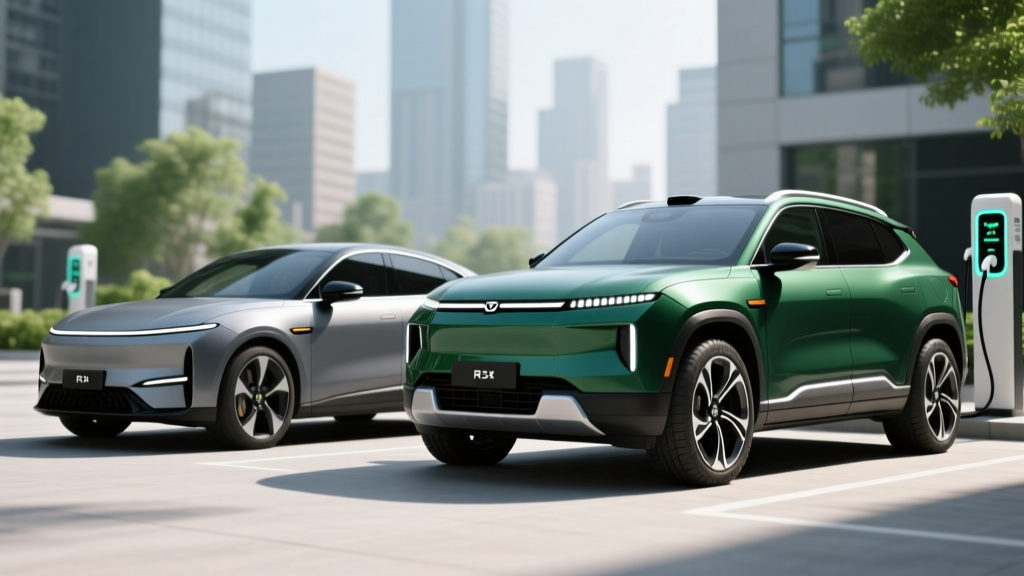
Rivian's compact EV platform finally hits dealer lots in 2026 with two distinct flavors: the efficiency-focused R3 and the dual-motor, adventure-oriented R3X. Both ride on the same shortened version of Rivian's skateboard architecture, but they target very different buyers. The R3 prioritizes range and affordability in a subcompact crossover package, while the R3X adds all-wheel-drive performance, air suspension, and off-road capability. This comparison breaks down every spec that matters — from real-world highway range to DC fast-charge taper — so you can match the right trim to your actual driving life.
Side-by-Side Specs: Rivian R3 vs R3X
| Spec | Rivian R3 (Standard Range AWD) | Rivian R3X (Max Pack) |
|---|---|---|
| EPA Range (est.) | 270 mi | 310 mi |
| Battery (usable) | ~72 kWh (LFP) | ~95 kWh (NMC) |
| Drivetrain | Dual-motor AWD | Tri-motor AWD |
| Horsepower | ~400 hp | ~600 hp |
| 0-60 mph | ~4.5 sec | ~2.9 sec |
| Peak DC Charge Rate | ~175 kW | ~200 kW |
| 10-80% DC Charge | ~25 min | ~28 min |
| Level 2 (240V) | 11.5 kW (~37 mi/hr) | 11.5 kW (~37 mi/hr) |
| Efficiency (est. MPGe) | ~120 MPGe | ~105 MPGe |
| Cargo Volume | ~26 cu ft (rear seats up) | ~26 cu ft (rear seats up) |
| Ground Clearance | 6.5 in | 6.5–10.5 in (air suspension) |
| Starting MSRP (est.) | ~$45,000 | ~$58,000 |
| Battery Warranty | 8 yr / 175,000 mi | 8 yr / 175,000 mi |
These figures are based on Rivian's announced specifications and preliminary data. Final EPA certification, published on fueleconomy.gov, may differ slightly at launch.
Real-World Range: What the EPA Sticker Doesn't Tell You
R3 (EPA est. 270 mi): Expect ~230–245 mi on sustained highway driving at 70+ mph. In freezing temperatures (below 32°F), plan for 185–210 mi due to battery heating demands and cabin HVAC load. LFP chemistry maintains more consistent voltage at low SoC, so range drops feel linear rather than sudden.
R3X (EPA est. 310 mi): Highway driving yields ~265–280 mi in mild weather. Cold weather drops this to ~210–235 mi. The tri-motor powertrain and heavier curb weight (~4,800 lb est.) consume more energy at speed, partially offsetting the larger 95 kWh NMC pack. The heat pump (standard on both) mitigates some cold-weather loss.
The R3X's 40-mile EPA advantage narrows considerably in real-world highway and cold-weather scenarios. On a 300-mile road trip in 40°F weather, the R3X will likely need one DC fast-charge stop while the R3 may need one longer stop or two shorter ones — the gap is roughly 10–15 minutes of total charging time, not a dealbreaker for either.
Charging Speed and Network Access
Both vehicles use the NACS (North American Charging Standard) connector natively, giving them direct access to Tesla's Supercharger network — now the largest and most reliable DC fast-charging network in the U.S. with over 25,000 stalls. Neither requires an adapter.
Understanding the charge curve: Peak kW is the maximum rate the vehicle can accept, but it's only sustained for a portion of the session. Lithium-ion batteries taper charge speed significantly above 80% State of Charge (SoC) to protect cell health. Here's what that looks like in practice:
- R3 (~175 kW peak): The LFP pack can sustain ~150 kW from 10–50% SoC before tapering to ~80 kW through 80%. A 10–80% session takes approximately 25 minutes on a 250 kW Supercharger or Electrify America stall.
- R3X (~200 kW peak): The NMC Max Pack sustains ~175 kW from 10–45% SoC, then tapers progressively. Despite a higher peak rate, the larger battery capacity means a 10–80% session takes roughly 28 minutes — slightly longer in absolute time, but adding more total miles.
Miles-per-minute comparison: In a 15-minute highway stop, the R3 adds approximately 110 miles while the R3X adds approximately 120 miles. The R3X recovers range slightly faster in absolute terms, but the R3's smaller battery means it needs fewer total miles added to reach the next stop.
For Level 2 home charging, both accept 11.5 kW on a 48-amp circuit (hardwired, 60-amp breaker), replenishing the R3's 72 kWh pack in roughly 7 hours and the R3X's 95 kWh pack in about 9 hours. Plan your overnight window accordingly — the R3X may need a dedicated off-peak schedule if your utility offers time-of-use rates.
Category-by-Category Verdicts
310 mi EPA vs 270 mi. The Max Pack's extra 23 kWh of NMC cells provides a meaningful buffer for road trips. However, the R3's superior efficiency (~120 vs ~105 MPGe) means it uses less electricity per mile in daily commuting.
Higher peak kW and more miles added per minute of charging. But the R3's smaller battery charges to 80% in fewer absolute minutes — a wash for most road-trip planning.
Tri-motor, ~600 hp, 2.9-second 0–60. The R3X is a legitimate sports-car killer in a compact crossover body. The R3's 4.5-second 0–60 is quick by any normal standard, but the R3X is in another league.
~120 MPGe combined vs ~105 MPGe. Lower curb weight and dual-motor simplicity mean lower electricity bills. At $0.15/kWh national average, the R3 costs roughly $0.042/mile to fuel vs the R3X at $0.048/mile.
~$13,000 lower starting price. After tax credits (see below), the effective gap can widen to $15,500+. The R3 delivers 87% of the R3X's range at 60% of the price premium.
Air suspension (6.5–10.5 in ground clearance), tri-motor torque vectoring, and Rivian's adventure-focused drive modes. The R3 is a capable light-trail vehicle; the R3X is a genuine overlanding platform.
Both share Rivian's latest software stack, 15.6-inch center display, and the same sensor suite supporting Rivian's Level 2 driver-assistance system. Neither is self-driving — full driver attention is required at all times (SAE Level 2).
Lighter, more efficient, easier to park, and $13K cheaper. If 90% of your driving is under 50 miles round-trip with home charging, the R3's 270-mile range is more than adequate and you'll never touch the Max Pack's extra capacity.
Pricing and Federal Tax Credit Eligibility
| Trim | Est. MSRP | §30D Credit (est.) | Effective Price |
|---|---|---|---|
| R3 Standard Range | ~$45,000 | Up to $7,500 | ~$37,500 |
| R3X Max Pack | ~$58,000 | Up to $7,500 | ~$50,500 |
- MSRP cap: SUVs/crossovers must be ≤$80,000 — both R3 and R3X qualify.
- Buyer income cap: AGI ≤$150,000 (single) / ≤$300,000 (joint) — verify against your tax return.
- Battery sourcing: Critical minerals and battery components must meet phased-in percentage thresholds for 2026. Rivian's supply chain compliance is confirmed for R1S/R1T; R3/R3X sourcing details will be finalized closer to production.
- Point-of-sale transfer: Eligible buyers can apply the credit as an immediate price reduction at the dealer, not just a tax-time refund.
- Assembly: Must be assembled in North America — Rivian's Normal, Illinois plant qualifies.
Ownership Costs: 5-Year Projection
| Category | R3 | R3X |
|---|---|---|
| Purchase (after credit) | ~$37,500 | ~$50,500 |
| Electricity (75k mi) | ~$3,150 | ~$3,600 |
| Insurance (est. avg/yr) | ~$1,800 | ~$2,200 |
| Maintenance (5 yr) | ~$1,200 | ~$1,500 |
| Est. Depreciation | ~$14,000 | ~$18,000 |
| Total 5-Year Cost | ~$57,650 | ~$75,800 |
The R3X costs approximately $18,150 more to own over five years, driven primarily by its higher purchase price. The R3X's tri-motor drivetrain and air suspension may also carry higher long-term maintenance costs beyond the warranty period — more moving components means more potential failure points. Both vehicles share Rivian's 8-year/175,000-mile battery and powertrain warranty, which covers capacity retention below 70% of original capacity.
Battery Chemistry: LFP vs NMC — What It Means for You
The R3's LFP (lithium iron phosphate) battery and the R3X's NMC (nickel manganese cobalt) battery represent a fundamental trade-off:
| Factor | LFP (R3) | NMC (R3X) |
|---|---|---|
| Energy Density | Lower (heavier per kWh) | Higher (lighter per kWh) |
| Cycle Life | 3,000+ cycles | 1,500–2,000 cycles |
| Daily Charging to 100% | Recommended (BMS calibration) | Avoid (80% daily limit advised) |
| Cold-Weather Performance | More range loss in freezing temps | Better cold-weather retention |
| Degradation (10-yr est.) | ~8–12% | ~12–18% |
| Cost per kWh | Lower | Higher |
Practical takeaway: If you charge at home nightly and want to set your charge limit to 100% without worrying about long-term degradation, LFP (R3) is the more forgiving chemistry. If you regularly drive in sub-freezing climates and need every mile of range, NMC (R3X) holds up better in the cold. Both chemistries will comfortably outlast the 8-year warranty period under normal use.
Decision Framework: Which One Matches Your Life?
Choose the Rivian R3 if:
- Your daily commute is under 60 miles round-trip and you have reliable home Level 2 charging.
- Budget is a primary factor — the ~$13,000 price gap is substantial and compounds in insurance and depreciation.
- You prefer LFP chemistry for its longer cycle life and 100% daily charging tolerance.
- You rarely take road trips over 250 miles without an overnight stop.
- You want a nimble, efficient urban/suburban EV that's easy to park and cheap to fuel.
Choose the Rivian R3X if:
- You regularly take road trips of 300+ miles and value the 40-mile EPA range buffer.
- You need genuine off-road capability — air suspension, 10.5 inches of ground clearance, and tri-motor torque vectoring.
- Performance matters: 2.9-second 0–60 and ~600 hp in a compact crossover is exotic-car territory.
- You live in a cold climate where NMC chemistry retains range better than LFP.
- You plan to tow (the R3X is expected to offer higher tow capacity — final rating TBD at launch).
Frequently Asked Questions
Is the Rivian R3 or R3X eligible for the full $7,500 federal tax credit?
Both vehicles are expected to qualify based on MSRP (under the $80,000 SUV cap), North American assembly (Normal, Illinois), and projected battery-sourcing compliance. However, your personal eligibility depends on AGI limits ($150K single / $300K joint) and final critical-mineral sourcing certifications. The credit can be applied at point-of-sale as a price reduction. Verify current-year rules at IRS.gov and consult a tax professional.
How does the R3's LFP battery handle fast charging compared to the R3X's NMC?
LFP batteries tolerate frequent DC fast charging slightly better over the long term due to their more stable chemistry, but both packs are warrantied for 8 years / 175,000 miles at 70% capacity retention. The R3 peaks at ~175 kW vs the R3X at ~200 kW, but real-world charging sessions differ by only ~3 minutes for a 10–80% charge. Neither chemistry should be a deciding factor on charging alone.
Can the R3 handle light off-roading, or do I need the R3X?
The R3's 6.5 inches of ground clearance and dual-motor AWD are sufficient for gravel roads, snow-covered driveways, and maintained forest service roads. The R3X's air suspension (up to 10.5 in), tri-motor torque vectoring, and dedicated off-road drive modes are necessary for rock crawling, deep sand, or technical trails. For weekend camping on unpaved roads, the R3 is adequate. For serious overlanding, the R3X is the clear choice.
Will both models get Rivian's latest ADAS features?
Yes. Both the R3 and R3X ship with Rivian's current driver-assistance suite, which operates at SAE Level 2. This means the system can manage steering, acceleration, and braking on highways, but the driver must remain fully engaged and attentive at all times. It is not self-driving. Expect features like adaptive cruise control, lane-centering, and automated lane changes — comparable to Tesla Autopilot or Ford BlueCruise in capability level.
What's the expected insurance cost difference?
Based on comparable Rivian R1S/R1T insurance data and segment averages, the R3X will cost approximately $300–$500 more per year to insure than the R3, driven by its higher replacement value, tri-motor complexity, and air suspension. Get quotes from your insurer before committing — EV insurance premiums vary significantly by carrier and zip code.
When can I actually buy one?
Rivian has announced production start for the R3 platform in 2026 at its Normal, Illinois facility, with the R3X following shortly after. Reservation holders will receive build invitations first. Check Rivian.com for the latest production timeline and reservation availability. Final pricing and EPA certification will be published closer to delivery.