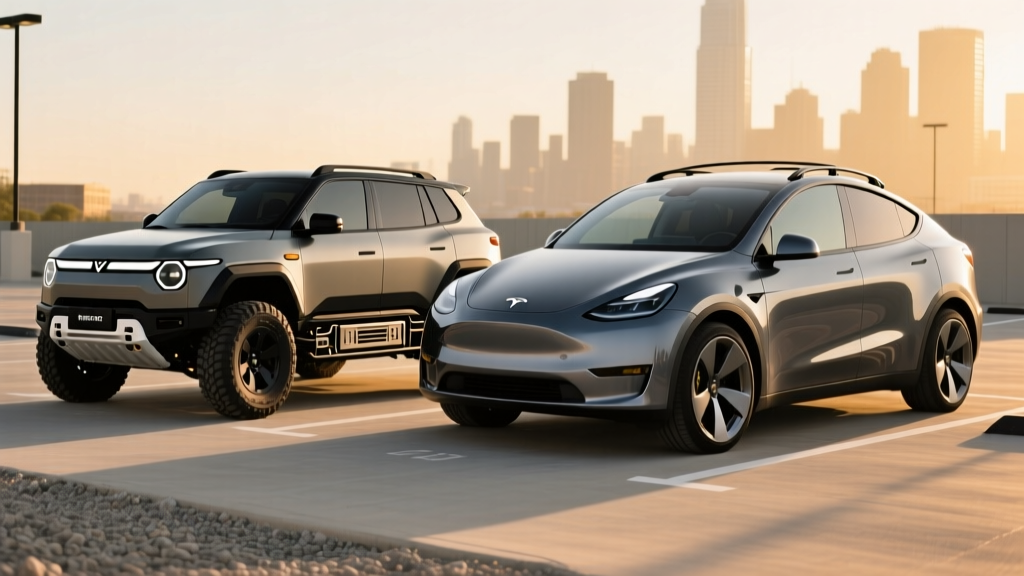
The compact electric SUV segment just got a new contender. Rivian's long-awaited R2 begins deliveries in mid-2026, landing squarely in the crosshairs of the best-selling EV in America: the Tesla Model Y. Both seat five, both target the $45,000–$55,000 bracket, and both promise over 300 miles of range. But beneath the surface, they take radically different approaches to electric transportation.
This comparison breaks down every number that matters — EPA range, battery chemistry, real-world charging curves, federal tax credit eligibility under current IRS §30D rules, insurance expectations, and five-year ownership costs. No hype, no fluff, just the data you need to decide.
Specs at a Glance: Rivian R2 vs Tesla Model Y
Before diving into category verdicts, here is the side-by-side spec sheet. Rivian R2 figures reflect the latest announced specs for the Dual-Motor launch edition; Tesla Model Y figures reflect the 2026 Long Range AWD refresh.
| Specification | 2026 Rivian R2 Dual-Motor | 2026 Tesla Model Y Long Range AWD |
|---|---|---|
| EPA Range (est.) | 330 miles | 320 miles |
| Battery Capacity (usable) | ~85 kWh (NMC) | ~78 kWh (NMC) |
| Peak DC Fast Charge Rate | ~220 kW | ~250 kW |
| 10–80% DC Charge Time | ~24 minutes (est.) | ~22 minutes |
| Level 2 Charge Rate | 11.5 kW | 11.5 kW |
| 0–60 mph | ~4.5 sec | 4.8 sec |
| Horsepower | ~450 hp | ~384 hp |
| EPA Efficiency (MPGe) | ~110 MPGe (est.) | 122 MPGe |
| Cargo Volume (behind 2nd row) | ~33 cu ft | 30.2 cu ft |
| Front Trunk (Frunk) | Yes (~7 cu ft est.) | 4.1 cu ft |
| Starting MSRP | $52,500 (Dual-Motor) | $46,630 (Long Range AWD) |
| Battery Warranty | 8 yr / 175,000 mi | 8 yr / 120,000 mi |
| Basic Warranty | 5 yr / 60,000 mi | 4 yr / 50,000 mi |
| Driver Assist | Rivian Driver+ (SAE L2) | Autopilot / FSD Supervised (SAE L2) |
Real-World Range Reality Check: The R2's 330-mile EPA estimate and the Model Y's 320-mile figure assume moderate temperatures, mixed driving, and speeds under 70 mph. Expect roughly 270–290 miles from the R2 and 260–280 miles from the Model Y in sustained 75 mph highway driving. In freezing temperatures (below 32°F), plan on a 20–30% reduction from either vehicle — meaning a cold-weather road trip could yield as little as 200–230 miles before needing a charger.
Range and Efficiency: Miles Per Kilowatt-Hour
On paper, the R2 edges ahead with an estimated 330 miles versus 320 for the Model Y. But range alone tells only part of the story. Efficiency — measured in MPGe or watt-hours per mile — determines how much electricity you actually buy and how often you stop on road trips.
The Model Y Long Range AWD achieves 122 MPGe combined per fueleconomy.gov, translating to roughly 28 kWh/100mi. The R2, being heavier (estimated ~5,200 lbs vs. ~4,400 lbs for the Model Y) and less aerodynamically optimized, is expected to land around 110 MPGe, or approximately 31 kWh/100mi. That means the R2 needs a larger battery to deliver similar range, and it will cost slightly more per mile to charge.
Over 15,000 annual miles at a national average of $0.16/kWh, the Model Y costs roughly $672/year to charge at home, while the R2 comes in around $744/year — a $72 annual gap that compounds modestly over time.
Range Winner: Rivian R2
330 vs. 320 EPA miles. The R2's larger battery offsets its lower efficiency to deliver a slight range edge.
Efficiency Winner: Tesla Model Y
122 MPGe vs. ~110 MPGe. The Model Y extracts more miles from every kilowatt-hour, keeping charging costs lower.
Charging Speed and Network Access
Charging speed isn't just about peak kW — it's about the charge curve, the network, and what you actually experience at a plug. Both vehicles use NACS connectors natively, but the infrastructure reality differs significantly.
| Charging Level | Rivian R2 | Tesla Model Y |
|---|---|---|
| Level 1 (120V / 12A) | ~1.4 kW (~4 mi/hr) | ~1.4 kW (~4 mi/hr) |
| Level 2 (240V / 48A) | 11.5 kW (~33 mi/hr) | 11.5 kW (~36 mi/hr) |
| DC Fast Charge (Peak) | ~220 kW | ~250 kW |
| 10–80% DC Time | ~24 min (est.) | ~22 min |
| 80–100% Taper | Significant above 80% | Significant above 80% |
The Model Y's peak 250 kW charge rate on V3 Superchargers is well-documented, with the vehicle sustaining roughly 200+ kW through the 10–50% range before tapering. The R2's estimated 220 kW peak, if it follows Rivian's R1S/R1T charge-curve behavior, will likely sustain 180–200 kW in the mid-SoC range. Both vehicles will slow considerably above 80% SoC — a universal lithium-ion characteristic driven by cell-protection protocols.
Network advantage: Tesla. The Supercharger network now exceeds 6,000 U.S. stations with industry-leading uptime (consistently above 95%). Rivian owners can access Superchargers via the built-in NACS port, but Rivian's proprietary Adventure Network remains limited to roughly 100 stations as of early 2026, concentrated near outdoor-recreation corridors. For road-trippers who frequent national parks, Rivian's network is a perk. For everyone else, Tesla's network density is unmatched.
Charging Speed Winner: Tesla Model Y
250 kW peak and 22-minute 10–80% times edge out the R2's estimated 220 kW / 24 minutes.
Network Winner: Tesla Model Y
6,000+ Supercharger stations with 95%+ uptime vs. Rivian's ~100-station Adventure Network (though R2 can also use Superchargers).
Pricing, Tax Credits, and the Real Cost to Buy
This is where the comparison gets complicated — and where the wrong assumption can cost you thousands. Let's break down MSRP, the §30D federal tax credit, and the realistic out-of-pocket cost.
| Cost Factor | Rivian R2 Dual-Motor | Tesla Model Y Long Range AWD |
|---|---|---|
| Base MSRP | $52,500 | $46,630 |
| MSRP Cap (§30D SUV limit: $80,000) | Passes ✓ | Passes ✓ |
| §30D Federal Credit (max) | Up to $7,500 | Up to $7,500 |
| Critical Mineral / Battery Sourcing | TBD — verify at purchase | Currently qualifies (partial) |
| Income Cap (Joint: $300k / Single: $150k) | Buyer must qualify | Buyer must qualify |
| Point-of-Sale Transfer Available | Yes (if eligible) | Yes (if eligible) |
| Est. Price After Max Credit | ~$45,000 | ~$39,130 |
The $5,870 MSRP gap between these vehicles is substantial, and even with identical maximum credits, the Model Y remains the cheaper purchase. However, the §30D credit is not guaranteed for either vehicle. Battery sourcing and critical-mineral requirements under current IRS rules can reduce the credit to $3,750 or eliminate it entirely depending on supply-chain changes. Always verify eligibility on the IRS Clean Vehicle Provisions page and at the point of sale before signing.
Rivian has stated the R2 will use battery cells sourced to maximize §30D eligibility, but final qualification depends on the specific build month and supply-chain status at time of delivery. Tesla's Model Y has seen its credit amount fluctuate between $3,750 and $7,500 throughout 2025–2026 due to shifting battery-component sourcing.
Value Winner: Tesla Model Y
~$5,870 cheaper before credits, and the gap holds after incentives. Lower MSRP means lower sales tax, lower financing costs, and lower insurance premiums.
Performance, Cargo, and Daily Usability
For a family SUV, outright speed matters less than practicality — but it's still fun to measure. The R2's estimated 450 hp and 4.5-second 0–60 time give it a meaningful edge over the Model Y's 384 hp and 4.8 seconds. Both are quick by any standard; the Rivian simply has more punch from its dual-motor setup.
Where the R2 really differentiates is cargo. With an estimated 33 cubic feet behind the second row and a ~7-cubic-foot frunk, it offers roughly 40 cubic feet total enclosed storage — about 6 cubic feet more than the Model Y's 30.2 cu ft rear + 4.1 cu ft frunk. The R2 also features a flat load floor and a more upright tailgate, making it easier to load bulky items like bikes or camping gear.
Inside, the Model Y's minimalist cabin centers on a 15.4-inch touchscreen with virtually no physical buttons. The R2 takes a slightly warmer approach with more material variety, physical HVAC controls, and a digital cluster behind the wheel. Both offer over-the-air updates, phone-as-key, and app-based preconditioning.
Performance Winner: Rivian R2
~450 hp and 4.5-sec 0–60 beat the Model Y's 384 hp / 4.8 sec.
Cargo Winner: Rivian R2
~40 cu ft total enclosed space vs. ~34 cu ft for the Model Y, plus a more usable load floor.
Tech/Software Winner: Tesla Model Y
More mature OTA ecosystem, larger Supercharger integration, and broader third-party app support.
Driver Assistance: Autopilot vs. Rivian Driver+
SAE Automation Level: Both Tesla Autopilot/FSD (Supervised) and Rivian Driver+ are classified as SAE Level 2 — partial driving automation. The driver must remain fully attentive, hands on or near the wheel, and ready to intervene at all times. Neither system is "self-driving." Level 4 driverless operation (like Waymo) requires no human oversight and is only available in limited robotaxi zones.
Tesla's Autopilot is standard and includes adaptive cruise, lane centering, and automatic emergency braking. Full Self-Driving (Supervised) is a $8,000 add-on (or $99/month) that adds traffic-light recognition, city-street navigation, and more assertive lane changes — but still requires constant driver supervision. FSD's real-world performance varies widely by geography and road conditions.
Rivian Driver+ is standard on the R2 and includes highway lane centering, adaptive cruise, and automatic lane changes on divided highways. It does not currently offer city-street navigation. Rivian's approach is more conservative — fewer features, but consistently reliable within its operational domain. Neither system has earned a definitive safety advantage in NHTSA data; both require the same level of driver vigilance.
What These Systems Do NOT Do: Neither Autopilot/FSD nor Driver+ will navigate construction zones reliably, handle unmapped roads, drive in severe weather autonomously, or replace an attentive driver. Treat them as fatigue-reducing cruise control, not autonomous driving.
Five-Year Ownership Cost Breakdown
Purchase price is only the beginning. Here's a realistic five-year / 75,000-mile ownership comparison, assuming home charging at $0.16/kWh, 85% home / 15% public charging mix, and current insurance averages.
| Cost Category (5 yr / 75k mi) | Rivian R2 Dual-Motor | Tesla Model Y LR AWD |
|---|---|---|
| Purchase Price (after est. $7,500 credit) | $45,000 | $39,130 |
| Estimated Depreciation (5 yr) | ~$20,250 (45%) | ~$17,600 (45%) |
| Electricity (75,000 mi) | ~$3,720 | ~$3,360 |
| Insurance (5-yr avg.) | ~$11,500 | ~$9,800 |
| Maintenance (tires, cabin filter, fluid top-offs) | ~$2,200 | ~$1,800 |
| Estimated 5-Yr Total Cost of Ownership | ~$82,670 | ~$71,690 |
| Cost Per Mile | ~$1.10/mi | ~$0.96/mi |
The Model Y holds a clear ~$11,000 five-year cost advantage, driven primarily by lower purchase price, lower insurance premiums (Teslas benefit from a larger actuarial dataset), and slightly better efficiency. The R2's higher insurance cost reflects Rivian's smaller fleet size and limited claims history, which insurers price conservatively.
Note: depreciation estimates are speculative for the R2 since it has no resale history. Tesla's depreciation may be more predictable but has been volatile in recent years due to price cuts. Consult Kelley Blue Book or Edmunds for updated projected values closer to your purchase date.
Pros and Cons
Rivian R2 — Pros
- 330-mile estimated EPA range
- More cargo space and a usable frunk
- Stronger performance (450 hp, 4.5 sec 0–60)
- Longer battery warranty (175,000 mi vs. 120,000 mi)
- Adventure Network near national parks
- Physical controls and warmer interior design
Rivian R2 — Cons
- Higher MSRP ($52,500 vs. $46,630)
- Lower efficiency (~110 vs. 122 MPGe)
- Limited public charging network (though Supercharger access helps)
- Higher estimated insurance costs
- Unproven long-term reliability (new model)
- §30D credit qualification TBD at launch
Tesla Model Y — Pros
- Lower MSRP and lower total cost of ownership
- Best-in-class efficiency (122 MPGe)
- 6,000+ Supercharger stations with excellent uptime
- Mature software, OTA updates, and FSD ecosystem
- Strong resale value history (though volatile)
- Proven manufacturing at scale
Tesla Model Y — Cons
- Less cargo space (34 cu ft total)
- Minimalist interior polarizes buyers
- Shorter battery warranty mileage (120,000 mi)
- FSD costs extra ($8,000) and remains Level 2
- §30D credit amount fluctuates with sourcing changes
- Slower 0–60 than R2 (4.8 sec vs. 4.5 sec)
Decision Framework: Which Should You Buy?
Choose the Rivian R2 if:
- You regularly haul bulky cargo (bikes, kayaks, camping gear) and need maximum enclosed space
- You want stronger acceleration and a more engaging drive
- You plan to keep the vehicle past 120,000 miles and value the longer battery warranty
- You vacation near Rivian Adventure Network locations (national parks, outdoor corridors)
- You prefer physical controls and a less austere interior
- You can absorb a ~$11,000 higher five-year cost for the above benefits
Choose the Tesla Model Y if:
- Lowest total cost of ownership is your top priority
- You road-trip frequently and want the most reliable, densest fast-charging network
- You value a proven vehicle with years of real-world reliability data
- You want the best efficiency (lowest cost per mile to charge)
- You're interested in FSD's expanding feature set (even at Level 2)
- You want a lower purchase price and lower monthly payment
Frequently Asked Questions
Does the Rivian R2 qualify for the $7,500 federal tax credit?
Rivian has designed the R2 to maximize §30D eligibility, but the final credit amount depends on battery sourcing and critical-mineral requirements at the time of delivery. The MSRP ($52,500) is well under the $80,000 SUV cap, and buyer income limits apply ($300,000 joint / $150,000 single). Verify eligibility on the IRS Clean Vehicle page before committing. The credit can be transferred to the dealer at point of sale as a price reduction if you qualify.
Can I charge the Rivian R2 at Tesla Superchargers?
Yes. The R2 is built with a native NACS charge port, meaning it can plug directly into any V3 or V4 Tesla Supercharger without an adapter. You'll use the Rivian app or Tesla's non-Tesla EV charging flow to initiate a session. This dramatically expands the R2's road-trip charging options beyond Rivian's own Adventure Network.
Which vehicle charges faster on a road trip?
The Tesla Model Y, marginally. Its 250 kW peak rate and well-characterized charge curve deliver a 10–80% charge in roughly 22 minutes on a V3 Supercharger. The R2's estimated 220 kW peak should yield ~24 minutes — a difference of about 2 minutes per stop. Over a 600-mile road trip with two charging stops, that's roughly 4 minutes total. In practice, the difference is negligible; network availability and station proximity matter far more than peak kW.
Is the Model Y or R2 safer?
As of early 2026, the refreshed Model Y holds a 5-Star Overall rating from NHTSA and a Top Safety Pick+ from IIHS. The R2 has not yet been crash-tested by either agency, as deliveries have not begun. Rivian's R1S and R1T earned strong safety marks, which suggests the R2's architecture should perform well, but official data is not yet available.
What is the real-world range difference between these two?
In 70°F mixed driving at moderate speeds, expect ~310 miles from the R2 and ~300 from the Model Y. At sustained 75 mph highway speeds, drop to ~270–290 for the R2 and ~260–280 for the Model Y. In sub-freezing weather, both lose 20–30%, yielding roughly 200–230 miles. The R2's larger battery gives it a small but real buffer in all conditions.
Which has lower insurance costs?
The Tesla Model Y, by roughly $1,700 over five years. Tesla benefits from a massive fleet dataset that helps insurers price risk accurately. Rivian's smaller fleet means insurers apply a risk premium until more claims data accumulates. Get quotes from your own insurer before deciding — individual rates vary widely by ZIP code, driving record, and coverage level.
When can I actually buy the Rivian R2?
Rivian has targeted mid-2026 for initial R2 deliveries, starting with the Dual-Motor launch configuration. A lower-priced Single-Motor variant (estimated ~$45,000 MSRP) is expected later in 2026 or early 2027. Reservations are open now with a refundable deposit. Production ramps at Rivian's new facility in Stanton, Georgia, alongside the existing Normal, Illinois plant.
Final Recommendation
There is no universal winner here — only the right vehicle for your priorities. The Tesla Model Y remains the rational economic choice: lower price, lower operating costs, unmatched charging infrastructure, and a proven track record. If you want the most efficient, most affordable-to-own compact electric SUV, it's still the benchmark.
The Rivian R2 is the enthusiast's alternative: more power, more space, longer warranty, and a design ethos built around adventure. If you're willing to pay a ~$6,000 premium at purchase (and ~$11,000 over five years) for those qualities, the R2 delivers a compelling package that the Model Y simply doesn't match on capability.
Test-drive both before deciding. Spec sheets inform, but seat time decides.