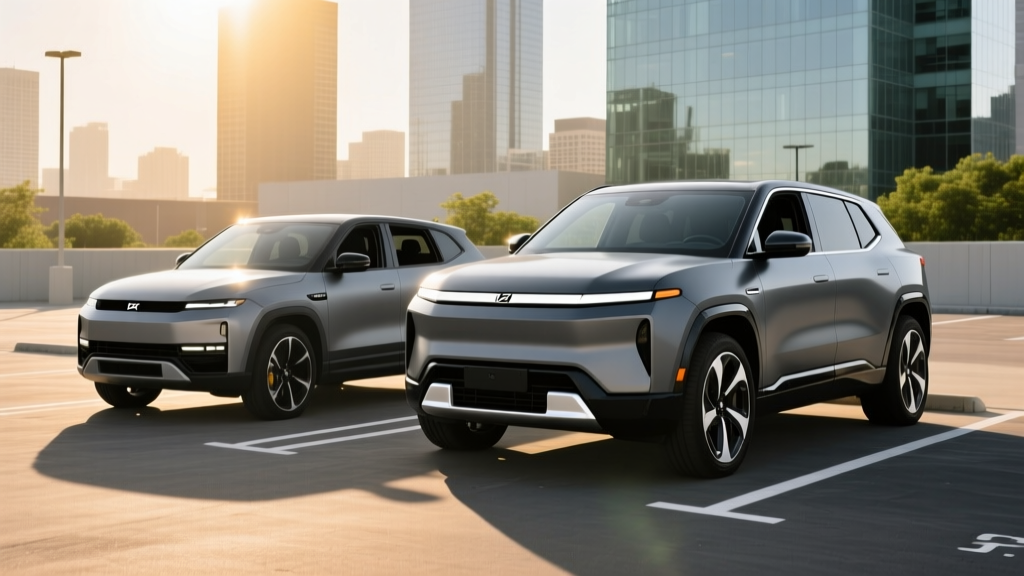
Rivian's lineup now spans two very different SUVs. The R1S is the brand's established three-row flagship, built on a skateboard platform that prioritizes off-road capability and long-distance touring. The R2 is the compact newcomer, engineered for affordability and urban efficiency while retaining Rivian's adventure DNA. Both wear the Rivian badge, but they target entirely different buyers — and the gap between them goes far beyond size.
This comparison uses 2026 model-year specifications, current MSRP figures, and the latest IRS §30D federal tax credit rules. Where Rivian has published preliminary R2 data (production begins mid-2026), those figures are labeled as such. Here's how they stack up across every metric that matters.
Side-by-Side: Rivian R2 vs R1S at a Glance
Before diving into category breakdowns, here are the headline numbers. The R2 specs below reflect Rivian's most recent pre-production disclosures; the R1S figures are from the current 2026 Dual-Motor and Max configurations.
| Specification | Rivian R2 (Standard Range) | Rivian R2 (Extended Range) | Rivian R1S (Dual-Motor Max) |
|---|---|---|---|
| EPA Range (est.) | ~300 mi | ~330+ mi | 410 mi |
| Usable Battery (kWh) | ~85 kWh (est.) | ~105 kWh (est.) | 149 kWh |
| Battery Chemistry | NMC (2170 cells) | NMC (2170 cells) | NMC (2170 cylindrical) |
| Peak DC Fast Charge | ~175 kW (est.) | ~190 kW (est.) | 220 kW |
| 10–80% DC Charge Time | ~30 min (est.) | ~28 min (est.) | ~27 min |
| Level 2 Charge Rate | 11.5 kW | 11.5 kW | 11.5 kW |
| Horsepower | ~350 hp (est., single motor) | ~500 hp (est., dual motor) | 665 hp |
| 0–60 mph | ~6.0 sec (est.) | ~4.5 sec (est.) | 3.4 sec |
| Towing Capacity | 3,300 lb | 3,300 lb | 7,700 lb |
| Cargo Volume (rear seats folded) | ~65 cu ft (est.) | ~65 cu ft (est.) | 104.7 cu ft |
| Seating | 5 passengers | 5 passengers | 7 passengers (3 rows) |
| Base MSRP | $45,000 | ~$52,000 (est.) | $89,800 |
| Efficiency (MPGe, est.) | ~110 MPGe | ~105 MPGe | 77 MPGe (combined) |
| Warranty (Bumper/Powertrain) | 5 yr/60k mi / 8 yr/175k mi | 5 yr/60k mi / 8 yr/175k mi | 5 yr/60k mi / 8 yr/175k mi |
Sources: Rivian R1S Specifications, fueleconomy.gov (EPA). R2 figures marked (est.) are based on Rivian pre-production disclosures and are subject to change at launch.
Range and Efficiency: The Physics of Size
The R1S Max Pack's 410-mile EPA rating is among the highest of any three-row electric SUV. That 149 kWh battery is enormous — roughly 50% more capacity than many mid-size EVs — and it's the primary reason the R1S can sustain long highway legs without frequent stops.
R1S Max: EPA 410 mi. Expect ~320–350 mi at sustained 75 mph highway speeds; ~280–310 mi in sub-30°F winter conditions with cabin heat. The heat pump helps, but a battery this large still loses meaningful capacity to cold.
R2 Extended: EPA ~330 mi (est.). Expect ~265–290 mi highway; ~220–250 mi in freezing weather. Smaller battery means faster cabin preconditioning but less absolute buffer.
R2 Standard: EPA ~300 mi (est.). Expect ~240–265 mi highway; ~200–225 mi in freezing weather. Adequate for daily commuting and weekend trips with planned charging.
Efficiency tells the other half of the story. The R2 is lighter and more aerodynamic, translating to roughly 105–110 MPGe combined versus the R1S Max's 77 MPGe. That 30+ MPGe gap means the R2 costs significantly less per mile to operate — a factor that compounds over years of ownership.
Absolute range: R1S Max (410 mi EPA).
Efficiency per mile: R2 (est. 105–110 MPGe vs. 77 MPGe).
The R1S wins on raw distance; the R2 wins on energy cost per mile.
Charging Speed and Network Access
The R1S Max Pack peaks at 220 kW on a DC fast charger, reaching 10–80% in approximately 27 minutes under ideal thermal conditions. The charge curve is relatively flat through 50% SoC before tapering sharply above 85% — typical behavior for high-capacity NMC packs with active thermal management.
The R2's estimated 175–190 kW peak is lower, but its smaller battery means it can still reach 10–80% in roughly 28–30 minutes. The practical difference at a rest stop is negligible: both vehicles will add 150–200 miles of range in about 20 minutes.
Both vehicles come equipped with the NACS (North American Charging Standard) connector natively, granting full access to Tesla's Supercharger network — over 25,000 stalls in North America — without an adapter. This is a significant advantage over CCS-only vehicles still reliant on Electrify America or EVgo for DC fast charging on road trips.
Peak speed: R1S (220 kW vs. ~190 kW).
Practical trip charging: Tie — both achieve 10–80% in ~27–30 min.
Network access: Tie — both use NACS natively for Supercharger access.
Performance, Capability, and the Towing Question
The R1S Dual-Motor Max produces 665 hp and hits 60 mph in 3.4 seconds — sports-car acceleration in a 6,900-pound three-row SUV. It's genuinely startling the first time you experience it. The Quad-Motor variant (not compared here) pushes past 1,000 hp, but the Dual-Motor is the volume configuration.
The R2 targets a more measured performance envelope. The base single-motor variant will deliver adequate daily acceleration (~350 hp, ~6.0 sec 0–60), while the dual-motor Extended Range should approach 500 hp and a ~4.5-second sprint. Neither figure is slow, but the R2 isn't trying to win drag races.
Where the gap becomes a dealbreaker is towing. The R1S is rated for 7,700 pounds — enough for a 24-foot travel trailer, a pair of snowmobiles, or a large boat. The R2 tops out at 3,300 pounds, limiting it to small utility trailers, a pop-up camper, or a couple of dirt bikes. If you tow anything substantial, the R1S is the only option in this lineup.
Off-road, both vehicles share Rivian's approach to electric trail driving — instant torque vectoring, no transfer case to shift, and software-managed traction control. The R1S has greater ground clearance (up to 14.9 inches with air suspension) and deeper water fording capability. The R2 will be competent on fire roads and light trails but isn't engineered for the Rubicon.
Acceleration: R1S (3.4 sec 0–60).
Towing: R1S (7,700 lb vs. 3,300 lb).
Off-road: R1S (greater clearance and fording depth).
Daily drivability: R2 (lighter, tighter turning radius, easier to park).
Interior, Cargo, and the Third-Row Factor
The R1S seats seven across three rows. The third row is genuinely usable for adults on short trips and comfortable for children on longer drives. Behind the third row, you get 20.2 cu ft of cargo — enough for groceries or a few duffel bags. Fold the third row and you unlock 57.1 cu ft; fold both rear rows and the R1S offers 104.7 cu ft, rivaling full-size gas SUVs.
The R2 is a strict five-seater. Rivian hasn't published final cargo figures, but based on its compact footprint (roughly 185 inches long vs. the R1S at 201 inches), expect approximately 25–30 cu ft behind the second row and around 65 cu ft with seats folded. It also includes a front trunk (frunk), as does the R1S, useful for charging cables and gear you want to keep separate from the cabin.
Material quality is similar across both — Rivian uses a vegan interior with durable, easy-clean surfaces designed for active lifestyles. The R1S has more premium trim options available at higher price points, but the fundamental design language, infotainment system, and driver interface are shared.
Passenger capacity: R1S (7 seats vs. 5).
Maximum cargo: R1S (104.7 cu ft vs. ~65 cu ft).
Urban practicality: R2 (smaller footprint, easier parking).
Pricing, Tax Credits, and the Real Cost to Buy
This is where the R2 fundamentally changes the calculus. The R2 starts at $45,000 for the Standard Range model — roughly half the R1S Max's $89,800 base price. Even stepping up to the R2 Extended Range (estimated ~$52,000) keeps you nearly $38,000 below the R1S Max.
But the sticker price is only part of the equation. The IRS §30D federal tax credit can reduce your effective cost by up to $7,500 — and eligibility rules differ significantly between these two vehicles.
| §30D Requirement | Rivian R2 | Rivian R1S (Max) |
|---|---|---|
| MSRP Cap (SUVs: ≤$80,000) | ✅ Qualifies ($45,000–$52,000) | ❌ Exceeds cap ($89,800 base) |
| Buyer Income Cap (Joint: ≤$300k) | Must meet income limits | Must meet income limits |
| Battery Sourcing (Critical Minerals) | Expected compliant at launch | Eligible (current compliance) |
| Point-of-Sale Transfer | ✅ Available | ✅ Available |
| Maximum Credit | $7,500 | $0 (MSRP exceeds cap) |
The R1S Max's base MSRP of $89,800 exceeds the §30D cap of $80,000 for SUVs. That means no federal tax credit, regardless of your income or the vehicle's battery sourcing. (Note: the lower-priced R1S Dual-Motor Standard, if still offered at an MSRP under $80,000, may qualify — check current trim pricing on Rivian's configurator.)
The R2, priced well under the cap, is positioned to capture the full $7,500 credit at the point of sale — effectively bringing the Standard Range model down to $37,500 before state incentives, and the Extended Range to roughly $44,500. That's a transformative price point for an AWD electric SUV with 300+ miles of range.
Effective price after credit: R2 ($37,500–$44,500) vs. R1S Max ($89,800).
Credit eligibility: R2 qualifies for full $7,500 §30D credit; R1S Max does not.
State and utility incentives may apply to both — check AFDC's state incentive database for local programs.
Ownership Costs: What You'll Actually Spend
Beyond the purchase price, the R2 and R1S diverge in ongoing costs — primarily through energy consumption, insurance, and tire wear.
| Cost Category | R2 Extended Range | R1S Dual-Motor Max |
|---|---|---|
| Energy (15,000 mi/yr, $0.15/kWh home avg) | ~$3,600 | ~$5,200 |
| Insurance (national avg, clean record) | ~$9,500 (5 yr) | ~$12,500 (5 yr) |
| Maintenance (no oil/fluid changes; cabin filter, wipers, brakes) | ~$1,200 | ~$1,500 |
| Tire Replacement (1 set over 5 yr) | ~$1,200 | ~$1,800 |
| Estimated 5-Year Total Operating Cost | ~$15,500 | ~$21,000 |
| Total Cost (Purchase + 5-Year Operating) | ~$57,500 (after credit) | ~$110,800 |
The R2's ~30% efficiency advantage translates to roughly $1,600 less in electricity costs over five years at average residential rates. Insurance premiums for the R1S run higher due to its replacement value, repair complexity, and performance tier. The heavier R1S also wears through tires faster — expect to pay more for replacement rubber on 275/50R22 all-seasons versus the R2's smaller, lighter-duty fitment.
Both vehicles benefit from Rivian's 8-year/175,000-mile battery and powertrain warranty, which guarantees the battery will retain at least 70% of its original capacity during that period. Neither vehicle requires transmission fluid changes, oil changes, or spark plug replacements — standard EV ownership advantages.
Energy: R2 (lower kWh/mi consumption).
Insurance: R2 (lower vehicle value = lower premiums).
5-year total cost: R2 wins decisively (~$15,500 vs. ~$21,000 operating).
Tech, Safety, and Driver Assistance
Both vehicles run Rivian's latest software stack on a shared electrical architecture. The infotainment interface, over-the-air update capability, navigation with integrated route planning (including automatic charge-stop scheduling), and the Rivian app experience are identical across the lineup.
Rivian's driver-assistance suite — branded as Driver+ — includes adaptive cruise control, lane centering, automatic emergency braking, and hands-on-wheel highway assist. This is an SAE Level 2 system, meaning the driver must remain attentive and keep hands on the steering wheel at all times. It is not autonomous driving. Both the R2 and R1S will ship with the same hardware sensor suite (cameras, radar) and the same software capabilities.
Safety ratings from NHTSA and IIHS for the R2 are not yet available (pre-production). The R1S has earned strong marks, and Rivian's structural engineering — including a low center of gravity from the under-floor battery pack — provides inherent rollover protection advantages common to all skateboard-platform EVs.
Infotainment & software: Tie (shared platform).
Driver assistance: Tie (same Driver+ Level 2 suite).
Confirmed safety ratings: R1S (tested); R2 pending.
Decision Framework: Which Rivian SUV Is Right for You?
Choose the Rivian R2 if:
- Your budget is under $55,000 (before incentives) and you want the full $7,500 federal tax credit
- You need seating for five, not seven — no regular third-row passengers
- You commute daily and want maximum efficiency (105+ MPGe) to minimize charging costs
- You live in an urban or suburban area where a smaller SUV is easier to park and maneuver
- You don't tow more than 3,300 pounds
- You want a 300+ mile range EV at a price that competes with gas compact SUVs
Choose the Rivian R1S if:
- You need three rows of seating for 6–7 passengers regularly
- You tow trailers, boats, or campers above 3,300 pounds (R1S max: 7,700 lb)
- You want maximum range (410 mi EPA) for long road trips with fewer stops
- Off-road capability is a priority — serious trail driving, overlanding, deep snow
- Performance matters: 665 hp, 3.4-second 0–60, and 104.7 cu ft of cargo space
- Budget is flexible ($90k+) and the §30D credit is not a deciding factor
Final Verdict: Different Vehicles, Different Missions
There is no universal winner between the R2 and R1S because they solve different problems. The R2 is Rivian's play for mainstream adoption — a well-equipped, efficient, NACS-equipped electric SUV that undercuts $40,000 after the federal credit. It's the vehicle that will bring Rivian to volume, and it's the right choice for the majority of EV shoppers who don't need three rows or 7,700-pound towing.
The R1S remains the best electric adventure SUV on the market for families who need space, capability, and range without compromise. If you regularly fill all seven seats, tow a camper to the trailhead, or need 400+ miles between charges on remote road trips, no compact SUV — electric or otherwise — replaces what the R1S does.
The real question isn't which Rivian is "better." It's which Rivian fits your life. Use the decision framework above, configure both on Rivian's website with your preferred options, and run the numbers against your actual driving patterns. The right answer usually reveals itself quickly.
Frequently Asked Questions
Does the Rivian R2 qualify for the $7,500 federal tax credit?
Based on its MSRP ($45,000–$52,000, well under the $80,000 SUV cap) and expected battery sourcing compliance, the R2 is positioned to qualify for the full $7,500 §30D credit at the point of sale. Buyer income limits still apply: modified adjusted gross income must not exceed $300,000 (joint filers), $225,000 (head of household), or $150,000 (single). Always verify current eligibility on IRS.gov before purchasing.
Why doesn't the R1S Max qualify for the EV tax credit?
The §30D credit caps eligible SUVs at an $80,000 MSRP. The R1S Max Pack starts at $89,800, exceeding that threshold. Lower-trim R1S configurations may fall under the cap — check the current configurator for trim-level pricing.
Can the R2 tow a camper trailer?
The R2's 3,300-pound towing capacity handles small pop-up campers, teardrop trailers, and light utility trailers. For hard-sided travel trailers or anything above 3,300 pounds, you'll need the R1S (7,700 lb capacity) or a dedicated tow vehicle.
Will the R2 use Tesla Superchargers?
Yes. Both the R2 and R1S are equipped with the NACS connector natively, providing direct access to Tesla's Supercharger network without an adapter. This is the most reliable DC fast-charging network in North America.
When will the Rivian R2 be available to buy?
Rivian has targeted mid-2026 for the start of R2 production at its Normal, Illinois facility, with deliveries following shortly after. Reservations are open now with a refundable deposit. Final EPA range and pricing will be confirmed closer to launch.
Which is cheaper to charge at home — R2 or R1S?
The R2, by a meaningful margin. Its higher efficiency (~105–110 MPGe vs. 77 MPGe) means fewer kWh consumed per mile. At a national average residential rate of $0.15/kWh, the R2 costs roughly $0.04–0.05 per mile to fuel at home versus $0.06–0.07 per mile for the R1S Max. Over 15,000 annual miles, that's roughly $300–$400 in annual savings.