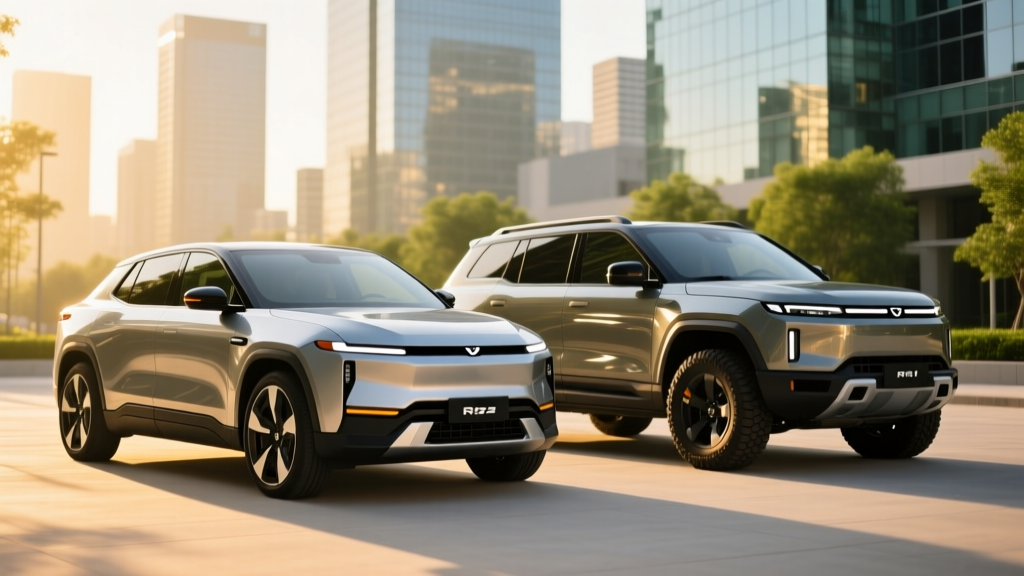
The Rivian R1S has been a benchmark three-row electric SUV since its launch, but the arrival of the smaller, more affordable Rivian R2 changes the calculus for buyers cross-shopping the brand. If you are weighing the R2 vs R1S, you are really deciding between a midsize two-row built for efficiency and value versus a full-size, body-on-frame family hauler built for space and off-road capability. Both share Rivian's latest software stack, driver-assist features, and access to the Rivian Adventure Network — but their pricing, battery options, and real-world usability diverge sharply.
This head-to-head uses current 2026 model-year specifications, EPA data where available, and Rivian's published preliminary figures for the R2 (which enters production in mid-2026). Where R2 numbers are estimates, we label them clearly.
Side-by-Side Specs: Rivian R2 vs R1S at a Glance
| Specification | Rivian R2 (Dual-Motor Standard) | Rivian R1S (Dual-Motor Standard) |
|---|---|---|
| EPA Range (est. R2) | ~330 miles (preliminary) | 352 miles (EPA est.) |
| Battery Capacity | ~92 kWh usable (NMC) (preliminary) | 106 kWh usable (NMC) |
| Max DC Fast Charge | ~200 kW (est.) | 220 kW (peak) |
| 10–80% DCFC Time | ~28 minutes (est.) | ~21 minutes |
| Level 2 Charge Rate | 11.5 kW | 11.5 kW |
| Horsepower | ~550 hp (est.) | 665 hp |
| 0–60 mph | ~4.5 seconds (est.) | 4.5 seconds |
| Efficiency | ~2.8 mi/kWh (est.) | 2.5 mi/kWh (EPA 86 MPGe combined) |
| Cargo Volume (rear seats up) | ~32 cu ft (est.) | 46.7 cu ft |
| Seating | 5 passengers (2-row) | 7 passengers (3-row) |
| Towing Capacity | ~4,500 lbs (est.) | 7,700 lbs |
| Base MSRP | ~$45,000 (est.) | $75,900 |
| Battery Warranty | 8 years / 120,000 miles (est.) | 8 years / 120,000 miles |
| Vehicle Warranty | 5 years / 60,000 miles (est.) | 5 years / 60,000 miles |
Note: R2 specifications are preliminary as of early 2026 and based on Rivian announcements and industry analysis. Final EPA certification and pricing may differ. R1S figures reflect the 2026 Dual-Motor Standard Pack as listed on fueleconomy.gov and Rivian's official configurator.
Range and Efficiency: Real-World Expectations
On paper, the R1S Dual-Motor Standard Pack delivers an EPA-estimated 352 miles of range. The R2 is expected to target roughly 330 miles despite its smaller battery, thanks to a lighter curb weight and more aerodynamic profile. But EPA stickers don't tell the whole story.
R1S: Expect roughly 280–310 miles in mixed highway driving at 70 mph. Cold-weather highway runs (below 30°F) can drop usable range to 230–260 miles even with the heat pump engaged. The R1S's boxy shape and ~6,000-lb curb weight penalize it at sustained highway speeds.
R2: Projected 270–300 miles highway, with cold-weather highway range around 220–250 miles. The R2's smaller frontal area and lighter weight should give it an efficiency edge, meaning fewer kWh burned per mile on your daily commute.
If you primarily drive in urban and suburban settings with frequent regenerative braking opportunities, both vehicles will comfortably approach their EPA numbers. The R2's efficiency advantage will be most noticeable in stop-and-go traffic where its lower mass requires less energy to accelerate and decelerate.
Charging Speed and Network Access
Both vehicles will charge on Rivian's Adventure Network and, via adapter or native NACS port, on the Tesla Supercharger network — a significant advantage for road-trippers. The R1S peaks at 220 kW on DC fast chargers and can add roughly 140 miles of range in 15 minutes under ideal conditions. The R2 is expected to peak around 200 kW, which sounds slower but matters less than the charge curve.
Here's what the charge curve actually looks like in practice:
- R1S: Sustains near-peak power from 10–40% SoC, then tapers progressively. The 10–80% time of ~21 minutes is excellent, but 80–100% can add another 25+ minutes. Always plan to leave chargers at 80% on road trips.
- R2: With a smaller battery, the R2 may sustain its peak rate over a slightly wider SoC window. The estimated 10–80% time of ~28 minutes is competitive, and the smaller pack means each percentage point represents fewer kWh — so charging sessions may feel shorter in wall-clock time for the range gained.
For home charging, both use an 11.5 kW Level 2 onboard charger. On a 48-amp Level 2 wall connector, the R1S will take roughly 9.5 hours from 10–100%, while the R2's smaller battery should refill in about 8 hours. This is a meaningful overnight difference if you have off-peak electricity rates that run on a tight window.
Performance, Capability, and Practicality
The R1S is a body-on-frame, full-size SUV with genuine off-road chops: over 14 inches of ground clearance (adjustable via air suspension), water fording to ~3 feet, and a quad-motor option that produces over 1,000 hp. The Dual-Motor version puts out 665 hp and hits 60 mph in 4.5 seconds — remarkable for a three-row vehicle weighing over three tons.
The R2 uses a unibody architecture and is expected to be significantly lighter. While it will likely offer a dual-motor AWD configuration and respectable ground clearance for light trail use, it won't match the R1S's hardcore off-road ability or its 7,700-lb towing rating. If you tow a boat, camper, or horse trailer, the R1S is the only choice here.
For daily practicality, the R2 wins on maneuverability. Its shorter wheelbase and tighter turning radius make it far easier to park in urban environments. The R1S is 200+ inches long — a challenge in tight parking structures and narrow city streets.
Pricing, Tax Credits, and Total Value
This is where the R2 vs R1S debate gets decisive for most buyers. The R1S starts at $75,900 for the Dual-Motor Standard Pack and climbs past $100,000 with the Max Pack or Quad-Motor configurations.
The R2 is expected to start around $45,000, positioning it against the Tesla Model Y, Hyundai Ioniq 5, and Ford Mustang Mach-E rather than luxury full-size SUVs.
| Factor | Rivian R2 | Rivian R1S |
|---|---|---|
| Base MSRP | ~$45,000 | $75,900 |
| MSRP Cap (§30D SUV limit: $80,000) | ✅ Under cap | ✅ Under cap (base trim) |
| Federal Tax Credit (§30D) | Up to $7,500 (if sourcing requirements met) | Up to $7,500 (if sourcing requirements met) |
| Point-of-Sale Transfer | Yes — reduces purchase price at dealer | Yes — reduces purchase price at dealer |
| Buyer Income Cap (SUV: $300k MFJ) | Applies | Applies |
| Effective Base Price (with full credit) | ~$37,500 | ~$68,400 |
| Typical Well-Equipped Price | ~$50,000–$55,000 | $85,000–$95,000 |
Tax credit caveats: Under current IRS §30D rules, the full $7,500 credit requires meeting both critical-mineral and battery-component sourcing thresholds that tighten annually. Both vehicles are classified as SUVs for the $80,000 MSRP cap, but higher-trim R1S configurations can exceed this cap and lose eligibility entirely. Buyer income limits ($300,000 married filing jointly, $225,000 head of household, $150,000 single) apply to both. Always confirm eligibility with a tax professional before purchasing.
Interior, Tech, and Driver Assistance
Both vehicles will run Rivian's latest software platform with over-the-air updates, native navigation with route-based battery preconditioning, and the company's Driver+ ADAS suite. Driver+ is a SAE Level 2 system — it provides adaptive cruise control and lane-centering on highways but requires continuous driver attention. This is not autonomous driving; you must keep your eyes on the road and hands available to take over at any time.
The R1S offers three rows of seating (7 passengers), a spacious cargo area with 46.7 cu ft behind the third row (expandable to over 100 cu ft with seats folded), and a front trunk (frunk). The R2 will seat five and offer less total cargo volume, but its lower load floor and more car-like ingress will appeal to buyers who don't need three rows.
Both vehicles feature Rivian's signature gear tunnel (on the R1S; expected in a smaller form on the R2), integrated camp kitchen options, and the brand's adventure-oriented software features like trail maps and range planning for off-pavement routes.
Ownership Costs: Efficiency, Insurance, and Maintenance
Over a five-year ownership period, the R2 should cost meaningfully less to operate:
| Cost Category | Rivian R2 (est.) | Rivian R1S |
|---|---|---|
| Energy (home charging, 15k mi/yr) | ~$3,800 | ~$4,600 |
| Insurance (national avg.) | ~$9,500 | ~$12,000 |
| Maintenance (tires, cabin filter, fluid top-offs) | ~$2,200 | ~$2,800 |
| Depreciation (est. 5yr) | ~$18,000 | ~$32,000 |
| Total (excl. purchase price) | ~$33,500 | ~$51,400 |
The R1S's heavier weight means faster tire wear (expect 25,000–30,000 miles on a set of OEM tires vs. 35,000+ on the R2). Insurance premiums for the R1S are higher due to its replacement cost, repair complexity, and higher MSRP. Depreciation in dollar terms will be larger on the R1S simply because the starting price is so much higher, though both should benefit from Rivian's growing brand loyalty and OTA update cadence.
Neither vehicle requires oil changes, transmission fluid, or spark plugs. Brake pad life is extended significantly by regenerative braking — many Rivian owners report 80,000+ miles on original pads.
Decision Framework: Which Should You Choose?
Choose the Rivian R2 if:
- You want an EV SUV under $50,000 (after incentives) with 300+ miles of range.
- You don't need three rows or serious towing capacity.
- You live in an urban or suburban area where a smaller vehicle is more practical.
- You prioritize efficiency and lower operating costs.
- You want Rivian's software, design, and adventure ethos at a mainstream price point.
Choose the Rivian R1S if:
- You need three-row seating for a larger family or frequent carpooling.
- You tow a trailer, boat, or camper regularly (up to 7,700 lbs).
- You want serious off-road capability with adjustable air suspension.
- You have the budget for a premium full-size SUV and want maximum cargo space.
- You want proven, in-production specs rather than preliminary estimates for a new model.
Final Verdict: R2 vs R1S
There is no universal winner between the Rivian R2 and R1S because they serve fundamentally different buyer profiles. The R1S is a proven, capable, spacious electric SUV that justifies its premium price with genuine three-row utility, best-in-class off-road hardware, and strong charging performance. If you need that space and capability, nothing else in Rivian's lineup — or arguably in the broader EV market — matches it.
The R2 is the volume play: a smaller, more efficient, dramatically cheaper EV SUV that delivers the core Rivian experience (software, design, adventure-readiness, Supercharger access) to a much wider audience. For two-row buyers who don't tow and don't rock-crawl, the R2 is the smarter financial choice by a wide margin.
Your priorities — seating, towing, budget, and timeline — should drive this decision. If you can wait for R2 production to ramp and your needs fit a two-row SUV, it's the better value. If you need a three-row EV today with proven specs and full capability, the R1S remains the answer.
Frequently Asked Questions
Is the Rivian R2 smaller than the R1S?
Yes. The R2 is a midsize, two-row SUV roughly comparable in footprint to the Tesla Model Y. The R1S is a full-size, three-row SUV closer in size to a BMW X7 or Mercedes GLS. Expect roughly 15–18 inches less overall length and significantly less cargo volume in the R2.
Can the R2 use Tesla Superchargers?
Yes. Rivian has adopted the NACS (North American Charging Standard) connector for the R2, meaning it should natively access Tesla Superchargers without an adapter. Current R1S vehicles may require a Rivian-provided NACS adapter; newer R1S production has transitioned to native NACS.
Does the Rivian R1S qualify for the $7,500 federal tax credit?
The base R1S Dual-Motor Standard Pack at $75,900 is under the $80,000 SUV MSRP cap and may qualify for up to $7,500 under IRS §30D if battery sourcing requirements are met and buyer income limits are not exceeded. Higher-trim R1S models (Max Pack, Quad-Motor) often exceed the MSRP cap and lose eligibility. Always verify current rules before purchasing.
Which is more efficient: the R2 or the R1S?
The R2 is expected to be significantly more efficient. The R1S achieves roughly 2.5 miles per kWh (86 MPGe combined per the EPA). The R2's lighter weight and smaller frontal area should yield closer to 2.8–3.0 mi/kWh, translating to lower electricity costs per mile and more range from a smaller battery.
When can I buy the Rivian R2?
Rivian has targeted mid-2026 for the start of R2 production at its Normal, Illinois facility. Reservations are open, but delivery timelines will depend on configuration and demand. Early reservation holders should expect delivery in late 2026 or early 2027.
Is the R1S worth the price premium over the R2?
If you need three rows, 7,700-lb towing, or serious off-road capability, the R1S is worth it — no other Rivian offers these features. If you don't need those capabilities, the R2 delivers a very similar software and driving experience for $30,000 less, making the R1S hard to justify on value alone.