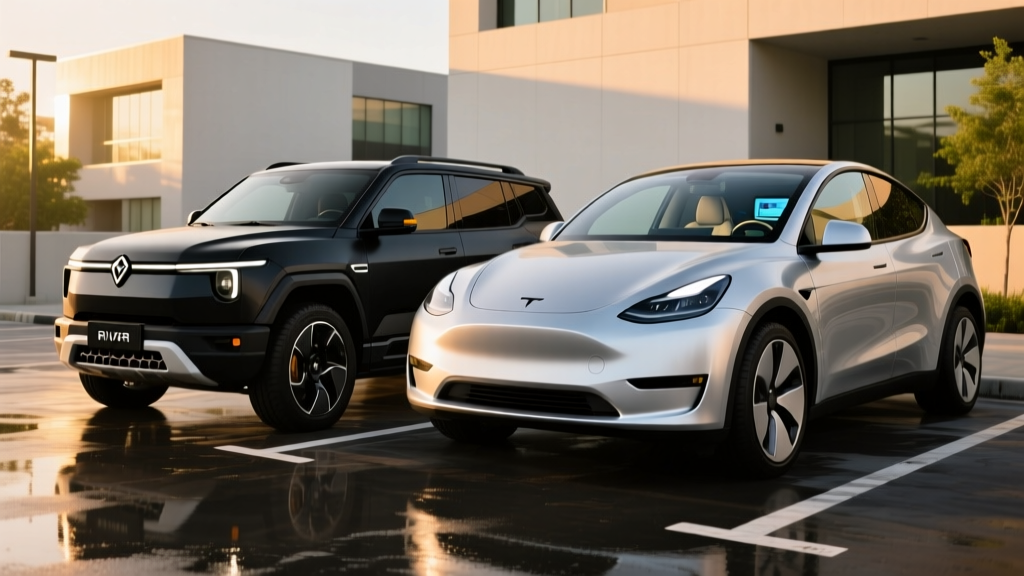
The compact electric SUV segment is the most competitive space in the EV market right now, and two nameplates dominate buyer search bars: the Tesla Model Y and the newly arriving Rivian R2. If you've been searching for a breakdown of the Rivian R2 vs Model Y size, footprint, and overall capability, you're not alone — these two vehicles target the same buyer but take very different approaches to getting there.
The 2026 Tesla Model Y (refreshed for the Juniper generation) is the established benchmark: efficient, tech-forward, and backed by the largest proprietary charging network in North America. The 2026 Rivian R2 is the challenger: slightly smaller on paper but designed with adventure utility, a NACS-native charge port, and a starting price that undercuts Tesla's entry point. Below, we break down every dimension, spec, and ownership variable that matters.
Side-by-Side Specs: Rivian R2 vs Tesla Model Y (2026)
Before diving into analysis, here are the hard numbers. Note that the Rivian R2 is newly entering production in 2026; figures below reflect Rivian's published preliminary specifications and may shift slightly as EPA certification finalizes. The Model Y numbers reflect the refreshed Juniper-generation vehicle currently on sale.
| Specification | Rivian R2 (Standard) | Tesla Model Y Long Range AWD |
|---|---|---|
| EPA Range (est.) | ~300 mi (preliminary) | 320 mi |
| Battery Capacity (usable) | ~75 kWh (est., NMC) | ~78 kWh (NMC) |
| Peak DC Fast Charge Rate | ~175 kW (est.) | 250 kW |
| 10–80% DC Fast Charge Time | ~30 min (est.) | ~25 min |
| Level 2 Charge Rate | 11.5 kW | 11.5 kW |
| 0–60 mph | ~5.0 sec (est., dual-motor) | 4.8 sec |
| Horsepower | ~400 hp (est., dual-motor) | 384 hp |
| Drivetrain | Dual-motor AWD | Dual-motor AWD |
| Efficiency (MPGe est.) | ~110 MPGe combined | 111 MPGe combined |
| Overall Length | ~179 in | 187.0 in |
| Wheelbase | ~110 in | 113.8 in |
| Cargo Volume (rear seats up) | ~25 cu ft (est.) | 30.2 cu ft |
| Cargo Volume (rear seats folded) | ~60 cu ft (est.) | 72.0 cu ft |
| Front Trunk (Frunk) | Yes (~5 cu ft est.) | Yes (~4.1 cu ft) |
| Ground Clearance | ~8.5 in (est.) | 6.6 in |
| Towing Capacity | ~3,300 lbs (est.) | 3,500 lbs |
| Base MSRP | ~$45,000 (est.) | $47,990 (Long Range AWD) |
| Battery Warranty | 8 yr / 175,000 mi (est.) | 8 yr / 120,000 mi |
| Basic Vehicle Warranty | 5 yr / 60,000 mi (est.) | 4 yr / 50,000 mi |
Size and Dimensions: How Do They Actually Compare?
This is where the keyword question gets answered directly. The Rivian R2 vs Model Y size difference is meaningful: the R2 is roughly 8 inches shorter in overall length and rides on a wheelbase about 3.8 inches shorter than the Model Y. In practice, this means:
- Parking and city driving: The R2's shorter footprint makes it noticeably easier to maneuver in tight urban environments and parallel park. Its higher ground clearance, however, gives it a taller seating position.
- Interior passenger space: The Model Y's longer wheelbase translates to more rear legroom. The R2 is expected to offer adequate but tighter rear accommodations — closer to a Mazda CX-5 than a mid-size SUV.
- Cargo capacity: The Model Y wins on paper with roughly 30 cu ft behind the rear seats vs. the R2's estimated 25 cu ft. Fold the seats, and the gap widens: 72 cu ft (Model Y) vs. an estimated 60 cu ft (R2).
- Off-road and adventure utility: The R2's estimated 8.5 inches of ground clearance significantly outpaces the Model Y's 6.6 inches. If unpaved roads, snow, or light trail use are part of your routine, the R2 has a clear dimensional advantage.
The Model Y is the bigger vehicle by every exterior measurement, and that translates directly to interior and cargo volume. The R2 sacrifices some of that space for a smaller, more maneuverable footprint with genuine off-road capability.
Range, Charging, and Efficiency
Range: Model Y Holds the Edge
The Model Y Long Range AWD delivers an EPA-estimated 320 miles — a strong figure for the segment. The Rivian R2 targets approximately 300 miles, which is competitive but trails by about 20 miles on paper. In real-world mixed driving, both vehicles will deliver roughly 10–15% less than their EPA figures, with the R2's less aerodynamic shape potentially widening the gap at sustained highway speeds above 70 mph.
Charging Speed: Tesla's Advantage Is Clear
The Model Y's 250 kW peak DC fast-charging rate on the Tesla Supercharger network remains a segment benchmark. In testing, the Model Y sustains strong charge rates through the 10–50% state of charge (SoC) window before tapering above 80%, completing a 10–80% session in roughly 25 minutes.
The R2's estimated 175 kW peak rate means 10–80% charging will take closer to 30 minutes — not dramatically slower, but a noticeable difference on road trips where every stop adds up. The R2 will ship with a native NACS charge port, meaning it can use Tesla Superchargers directly without an adapter, which significantly expands its usable charging network from day one.
Efficiency: Nearly a Wash
The Model Y achieves an EPA-rated 111 MPGe combined. The R2 is expected to land near 110 MPGe, though its boxier shape and higher ride height may result in slightly worse highway efficiency. In terms of cost per mile, both vehicles will cost roughly $0.04–$0.06 per mile to charge at home (depending on your local electricity rate), far below the $0.12–$0.15 per mile a comparable gas SUV would cost.
Performance and Driving Dynamics
Both vehicles offer dual-motor all-wheel-drive configurations with strong acceleration. The Model Y Long Range AWD posts a 4.8-second 0–60 mph time with 384 hp — brisk, composed, and well-suited to highway merging. The R2's estimated 400 hp and ~5.0-second 0–60 time put it in the same ballpark, though Rivian typically tunes for low-end torque delivery that feels punchy around town.
Where they diverge is character. The Model Y prioritizes on-road refinement, low drag, and efficiency. The R2 is being developed with adventure DNA — higher ground clearance, available all-terrain tires, and Rivian's quad-motor torque-vectoring technology (on higher trims) that can genuinely handle off-pavement use. If your driving includes gravel roads, snow, or camping trips, the R2's capability envelope is meaningfully broader.
Pricing, Tax Credits, and Total Cost of Ownership
Base Price and Tax Credit Eligibility
| Factor | Rivian R2 | Tesla Model Y LR AWD |
|---|---|---|
| Base MSRP | ~$45,000 (est.) | $47,990 |
| Federal §30D Tax Credit (max) | Up to $7,500 (if sourcing requirements met) | Up to $7,500 (if sourcing requirements met) |
| MSRP Cap (§30D SUV limit) | $80,000 — passes | $80,000 — passes |
| Buyer Income Cap (AGI) | $150K single / $300K joint | $150K single / $300K joint |
| Point-of-Sale Transfer | Expected (dealer-registered) | Available (Tesla registered dealer) |
| Est. Price After Max Credit | ~$37,500 | ~$40,490 |
Both vehicles are priced below the IRS §30D MSRP cap of $80,000 for SUVs, and both are expected to qualify for the full $7,500 federal tax credit — provided the buyer meets income thresholds and the vehicle satisfies critical-mineral and battery-component sourcing requirements. These sourcing rules tighten annually; check the latest guidance at IRS.gov's clean vehicle credit page before purchasing. The point-of-sale transfer option allows you to apply the credit as a down-payment reduction at purchase rather than waiting for a tax refund.
At the estimated starting prices, the R2 could undercut the Model Y by roughly $3,000 before incentives and maintain that gap after credits. However, the R2's pricing is preliminary and may shift as Rivian finalizes trim configurations.
Five-Year Ownership Cost Considerations
- Insurance: Tesla vehicles carry higher-than-average insurance premiums due to repair costs. The Model Y typically costs $1,800–$2,400/year to insure depending on your profile. The R2, as a new model, will likely carry similar or slightly lower premiums initially, but Rivian's repair network is smaller, which could affect rates long-term.
- Maintenance: Both EVs require minimal scheduled maintenance — no oil changes, no spark plugs. Expect brake fluid checks, cabin air filter replacement, and tire rotation. Budget roughly $300–$500/year for both vehicles.
- Tires: The R2's available all-terrain tires may wear faster and cost more to replace than the Model Y's all-season rubber. Factor in $200–$400 more per set if you opt for aggressive tread.
- Depreciation: The Model Y has an established resale market. The R2's depreciation curve is unknown; Rivian's brand cachet is strong, but early-production vehicles historically depreciate faster until reliability data matures.
Tech, Interior, and Driver Assistance
Tesla Model Y: Screen-Centric Minimalism
The refreshed Model Y continues Tesla's minimalist interior philosophy: a single 15.4-inch center touchscreen handles navigation, media, climate, and vehicle settings. Build quality on the Juniper generation has improved meaningfully — panel gaps are tighter, and the cabin uses softer materials. Tesla's Autopilot (standard) and Full Self-Driving Supervised ($8,000 option) provide SAE Level 2 driver assistance — meaning the driver must remain fully engaged and hands-on at all times. This is not autonomous driving.
Rivian R2: Adventure-First Utility
Rivian's interior design prioritizes durability and outdoor utility. Expect a large central touchscreen (estimated 13–15 inches), a digital driver display, and materials chosen for easy cleaning after muddy or sandy excursions. Rivian's driver-assistance suite (Highway Assist and Lane Keep) also operates at SAE Level 2, requiring constant driver supervision. Rivian's software receives regular over-the-air updates, though its feature set is narrower than Tesla's FSD offering.
Category-by-Category Verdict
320 miles EPA vs. the R2's estimated 300 miles. The Model Y's superior aerodynamics also help it hold range better at highway speeds.
250 kW peak with a proven 10–80% time of ~25 minutes. The R2's estimated 175 kW and ~30-minute session trails by about 5 minutes per stop.
8.5 inches of ground clearance, available all-terrain tires, and Rivian's adventure-focused engineering. The Model Y isn't built for trails.
30.2 cu ft behind the rear seats and 72 cu ft folded. The R2's smaller footprint sacrifices roughly 5–12 cu ft depending on configuration.
A lower estimated starting MSRP (~$45,000 vs. $47,990) with similar tax-credit eligibility gives the R2 a ~$3,000 price advantage — if Rivian holds the line on pricing.
The R2's native NACS port grants Supercharger access, but Tesla owners enjoy seamless plug-and-charge integration and the broadest network by station count.
8 inches shorter overall with a tighter turning radius. Easier to park and navigate in dense urban environments.
More mature software ecosystem, broader FSD feature set, and a longer track record of OTA improvements. Rivian's stack is capable but younger.
Decision Framework: Which One Fits Your Life?
Choose the Tesla Model Y if:
- Maximum cargo space and rear-seat room are non-negotiable (family hauling, large gear)
- You road-trip frequently and want the fastest DC charging with the most reliable network
- You value the longest proven EPA range in the segment
- You want a mature software ecosystem and established resale-value data
- Your driving is predominantly on paved roads and highways
Choose the Rivian R2 if:
- You want a smaller, more maneuverable EV for urban and suburban driving
- Off-pavement capability matters — gravel roads, snow, camping, light trails
- You want a lower starting price and are willing to accept early-production risk
- You value a more rugged, adventure-oriented design language and interior
- Higher ground clearance is a priority for your climate or terrain
Frequently Asked Questions
Is the Rivian R2 smaller than the Model Y?
Yes. The R2 is approximately 8 inches shorter in overall length and sits on a wheelbase nearly 4 inches shorter than the Model Y. Interior passenger space and cargo volume are reduced accordingly, though the R2 compensates with higher ground clearance and a frunk.
Will the Rivian R2 qualify for the $7,500 federal tax credit?
It is expected to, provided the buyer's adjusted gross income falls below IRS thresholds ($150,000 single / $300,000 joint) and the vehicle meets evolving critical-mineral and battery-component sourcing requirements under §30D. Always verify current eligibility at IRS.gov before purchasing, as rules update annually.
Can the Rivian R2 use Tesla Superchargers?
Yes. The R2 ships with a native NACS (North American Charging Standard) port, meaning it can plug directly into Tesla Supercharger stalls without an adapter. This gives the R2 access to over 20,000 Supercharger locations across North America.
Which has more cargo space?
The Tesla Model Y offers approximately 30.2 cu ft behind the rear seats and 72 cu ft with seats folded. The Rivian R2 is estimated at roughly 25 cu ft and 60 cu ft, respectively. For maximum hauling, the Model Y is the clear choice.
Is either vehicle actually self-driving?
No. Both the Tesla Model Y (Autopilot/FSD Supervised) and the Rivian R2 (Highway Assist) operate at SAE Level 2 automation. The driver must remain fully engaged, with hands on the wheel and eyes on the road, at all times. No consumer vehicle currently sold in the US is self-driving.
When can I buy the Rivian R2?
Rivian has targeted R2 production to begin in 2026, with deliveries following initial manufacturing ramp-up. Reservation holders will receive priority. Check Rivian's official R2 page for the latest availability timeline.