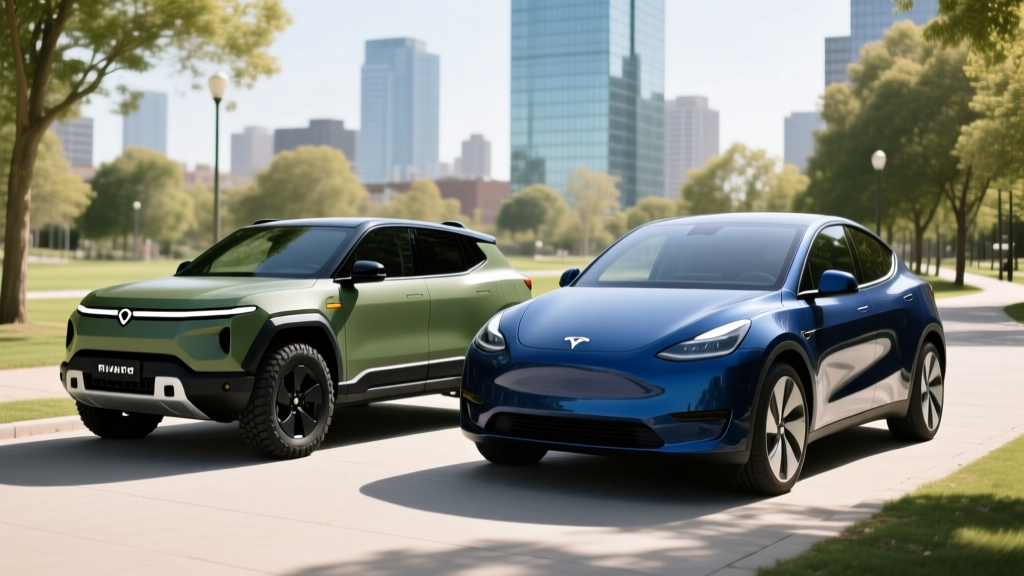
Two compact electric SUVs dominate 2026 buyer shortlists for very different reasons. The Tesla Model Y is the proven veteran with a mature Supercharger network, segment-leading efficiency, and iterative 2026 "Juniper" updates. The Rivian R2 is the ambitious newcomer, leveraging the R1 platform's adventure DNA in a smaller, more affordable package aimed at outdoor-oriented families. Choosing between them is less about which is objectively "better" and more about which ecosystem, capability set, and ownership profile fits your life.
Rivian R2 vs Model Y: Side-by-Side Spec Table
The table below uses EPA-published and manufacturer-confirmed figures for the 2026 model year. Rivian R2 specs reflect announced dual-motor and single-motor trims as production ramps; final EPA certification numbers may shift slightly.
| Specification | 2026 Rivian R2 (Dual-Motor AWD) | 2026 Tesla Model Y Long Range AWD |
|---|---|---|
| EPA Range | ~330 mi (announced) | 320 mi |
| Usable Battery | ~90 kWh (NMC) | ~78 kWh (NMC) |
| Peak DC Fast Charge | ~200 kW | ~250 kW |
| 10–80% DCFC Time | ~30 min | ~25 min |
| Level 2 AC Rate | 11.5 kW | 11.5 kW |
| 0–60 mph | ~4.5 sec | 4.8 sec |
| Horsepower | ~450 hp | 384 hp |
| EPA Efficiency (MPGe) | ~110 MPGe (est.) | 117 MPGe |
| Cargo Volume (rear seats up) | ~28 cu ft | 30 cu ft |
| Cargo Volume (seats folded) | ~65 cu ft | 72 cu ft |
| Base MSRP | ~$45,000 | $44,990 |
| Basic / Powertrain Warranty | 5 yr / 60k mi & 8 yr / 175k mi | 4 yr / 50k mi & 8 yr / 120k mi |
Range and Efficiency: Real-World Expectations
On paper, the R2's ~330-mile EPA estimate and the Model Y's 320-mile rating look nearly identical. In practice, efficiency diverges.
- Tesla Model Y LR AWD: EPA 320 mi. Expect ~270–290 mi at sustained 70 mph highway speeds; ~220–240 mi in sub-freezing weather with cabin heat. Per fueleconomy.gov, the Juniper Long Range rates at 117 MPGe combined.
- Rivian R2 DM AWD: EPA ~330 mi (announced). The taller, boxier profile and heavier curb weight mean highway efficiency typically trails EPA by 8–12%. Expect ~270–285 mi highway, ~215–235 mi in cold conditions.
Tesla's heat pump and best-in-class thermal management give it a measurable edge in winter. Rivian's larger battery partially offsets its less aerodynamic shape, but physics favors the lower, sleeker Model Y on long highway runs.
Charging Speed and Network Access
This is where the ecosystems differ most sharply — and where buyer priorities should drive the decision.
| Charging Level | Rivian R2 | Tesla Model Y |
|---|---|---|
| Level 1 (120V, 1.4 kW) | ~4 mi/hr | ~4 mi/hr |
| Level 2 (240V, 11.5 kW) | ~30 mi/hr | ~34 mi/hr |
| DC Fast Charge (peak) | ~200 kW, NACS port | 250 kW, NACS port |
| 10–80% DCFC (real-world) | ~30 min | ~25 min |
Both vehicles ship with the North American Charging Standard (NACS) port in 2026, ending the adapter era. The Model Y still charges faster at V3 and V4 Superchargers thanks to a more aggressive charge curve that sustains peak rate longer before tapering above 60% SoC.
Network advantage: Tesla owners get native, plug-and-charge access to 20,000+ Superchargers with industry-leading uptime. Rivian owners now access the Supercharger network via NACS, but also rely on the Rivian Adventure Network — a growing but still sparse set of chargers near national parks and trailheads. For rural and adventure charging, Rivian is investing where Tesla rarely does; for daily reliability and road-trip coverage, Tesla's network remains unmatched.
Performance, Ride, and Capability
Both SUVs deliver effortless electric torque, but they're tuned for different missions.
~450 hp and a ~4.5-second 0–60 time edge out the Model Y's 384 hp / 4.8 seconds. The R2's dual-motor torque vectoring and adaptive air suspension (available on higher trims) give it more composure on gravel and light off-road terrain. Ground clearance of ~8.5 inches vs. the Model Y's 6.6 inches matters if your weekend involves fire roads.
The Juniper refresh brought revised dampers and improved NVH, making the 2026 Model Y noticeably quieter and more compliant than pre-2025 versions. On pavement, the lower center of gravity and lighter weight translate to sharper turn-in and less body roll. It's the better daily driver for commuting and canyon carving.
Neither vehicle is a serious off-roader, but the R2's approach angle, wading depth, and available all-terrain tires make it genuinely capable for backcountry camping. The Model Y is strictly a pavement-and-packed-dirt vehicle.
Tech, Interior, and Driver Assistance
Tesla's minimalist interior and Rivian's adventure-practical cabin reflect their brand philosophies.
Infotainment: Tesla's 15.4-inch center screen runs a polished, fast UI with native navigation, streaming, and Sentry Mode. Rivian uses a similar large-screen layout but adds a dedicated driver display and more physical controls for climate — a welcome difference for gloved hands on the trail.
ADAS — critical clarification:
Tesla's FSD (Supervised) offers more ambitious city-street navigation but remains controversial and requires a $8,000 add-on or $99/month subscription. Rivian's Driver+ is more conservative — reliable highway lane-keeping and adaptive cruise, with less urban automation. For buyers who want set-and-forget highway cruising without paying extra, Rivian's bundled approach is simpler.
Price, Tax Credits, and Ownership Costs
Sticker prices are nearly identical at ~$45,000 base, but federal incentives and long-term costs tell a more nuanced story.
- MSRP cap: SUVs must be ≤$80,000 — both qualify
- Buyer income cap: $150k single / $300k joint AGI
- Battery sourcing: critical minerals and components must meet phased-in domestic-content thresholds (tighter in 2026 than 2024)
- Point-of-sale transfer available — apply credit at purchase, not at tax filing
- Final assembly in North America required
As of early 2026, the Model Y qualifies for the full $7,500 credit thanks to U.S. assembly at Giga Texas and compliant battery sourcing. The R2, assembled at Rivian's Normal, Illinois plant, is expected to qualify, but buyers should verify critical-mineral compliance on the specific build — Rivian's supply chain is newer and some early-build batches may fall short of the $3,750 critical-minerals prong. Always confirm on the IRS qualified-vehicle list before signing.
| 5-Year Cost Factor | Rivian R2 DM | Tesla Model Y LR |
|---|---|---|
| Purchase (after $7,500 credit) | ~$37,500 | ~$37,490 |
| Electricity (15k mi/yr, $0.16/kWh) | ~$5,800 | ~$5,400 |
| Insurance (national avg) | ~$10,500 | ~$9,200 |
| Maintenance (tires, cabin filter, fluid) | ~$1,800 | ~$1,500 |
| Estimated Depreciation | ~$16,000 | ~$14,500 |
| Approx. 5-Year Total | ~$71,600 | ~$68,090 |
The Model Y wins on efficiency (lower kWh/mi), insurance (larger claims-history dataset, more repair centers), and depreciation (stronger used demand). Rivian's longer powertrain warranty (8 yr / 175,000 mi vs. Tesla's 8 yr / 120,000 mi) provides better long-term battery peace of mind for high-mileage owners.
Decision Framework: Which Should You Buy?
- You regularly drive on unpaved roads, forest service roads, or to trailheads
- You need higher ground clearance and available all-terrain tires
- You value a longer powertrain warranty (175k mi)
- You prefer physical climate controls and a dedicated driver display
- You want to support a newer automaker investing in adventure-focused charging infrastructure
- Pavement efficiency and maximum real-world highway range are top priorities
- You rely on the Supercharger network for frequent road trips
- You want the lowest insurance and depreciation costs in the segment
- You prefer the most mature over-the-air update ecosystem
- You want proven long-term reliability data from millions of vehicles on the road
Pros and Cons at a Glance
Pros:
- More power and faster 0–60
- Higher ground clearance, genuine light-off-road capability
- Longer 8 yr / 175k mi powertrain warranty
- Adventure Network targets underserved outdoor destinations
- Physical controls complement touchscreen
Cons:
- Lower efficiency = higher charging cost per mile
- Higher insurance premiums (limited claims history)
- Newer platform — long-term reliability unproven
- Slower peak DC charging vs. Model Y
- Early production may face build-quality variability
Pros:
- Best-in-class efficiency (117 MPGe)
- Fastest DC charging in segment (~25 min 10–80%)
- Largest, most reliable public charging network
- Lower insurance and stronger resale value
- Juniper refresh fixed prior NVH complaints
Cons:
- Minimalist interior not for everyone
- FSD (Supervised) costs extra and remains Level 2
- Lower ground clearance — pavement-focused
- Shorter powertrain warranty (120k mi)
- Ubiquity — less distinctive on the road
Final Recommendation
There is no universal winner in the Rivian R2 vs Model Y comparison — only the right answer for your priorities. If your weekly routine includes gravel roads, ski trips, or camping, and you value warranty length and adventure-oriented design, the R2 earns its premium in capability. If your life is highway commutes, cross-country road trips on Superchargers, and minimizing cost-per-mile, the Model Y remains the segment benchmark for good reason. Test-drive both, confirm §30D eligibility on your specific build, and let your actual driving life — not spec-sheet bragging rights — decide.
Frequently Asked Questions
Is the Rivian R2 bigger than the Model Y?
They're close in exterior footprint, but the Model Y offers slightly more cargo volume (72 vs. ~65 cu ft with seats folded). The R2 is taller and boxier, which helps headroom and gear-stacking but hurts aerodynamic efficiency.
Can the Rivian R2 use Tesla Superchargers?
Yes. The 2026 R2 ships with a native NACS port, granting direct access to Tesla's Supercharger network without an adapter — the same as the Model Y.
Which has better long-term battery reliability?
Tesla has a decade of real-world degradation data showing ~10–12% capacity loss at 150,000 miles. Rivian's R1 fleet shows promising early results, but the R2 is new and uses a different cell supplier. Rivian's longer 175,000-mile powertrain warranty provides a stronger safety net.
Do both qualify for the $7,500 federal tax credit in 2026?
The Model Y currently qualifies for the full credit. The R2 is expected to qualify, but critical-mineral sourcing rules tighten in 2026. Verify your specific VIN on the IRS qualified vehicles list before purchase.
Which is cheaper to insure?
The Model Y typically costs 10–15% less to insure due to Tesla's larger repair network and extensive claims data. Get quotes from your provider for both before deciding — individual profiles vary significantly.