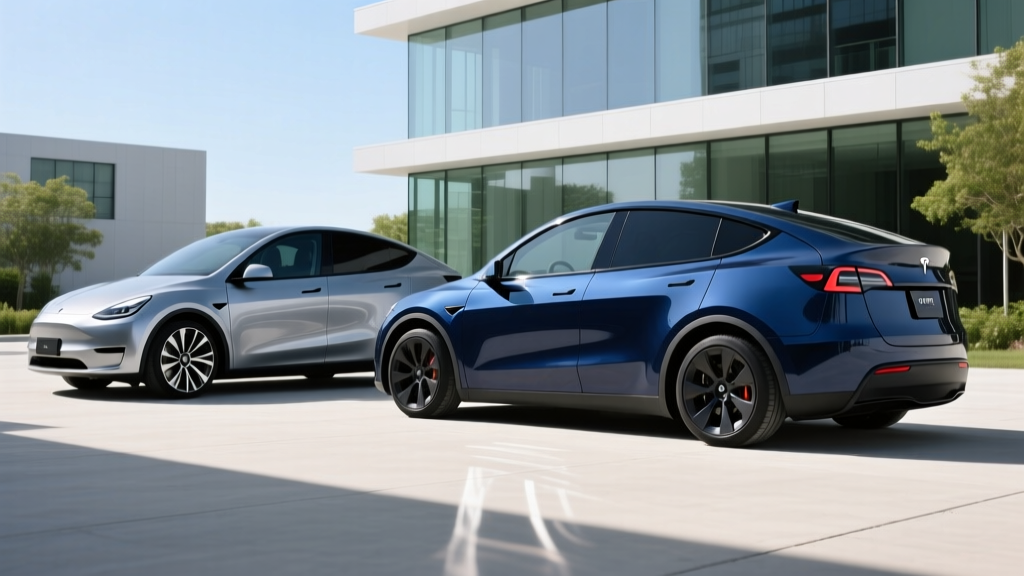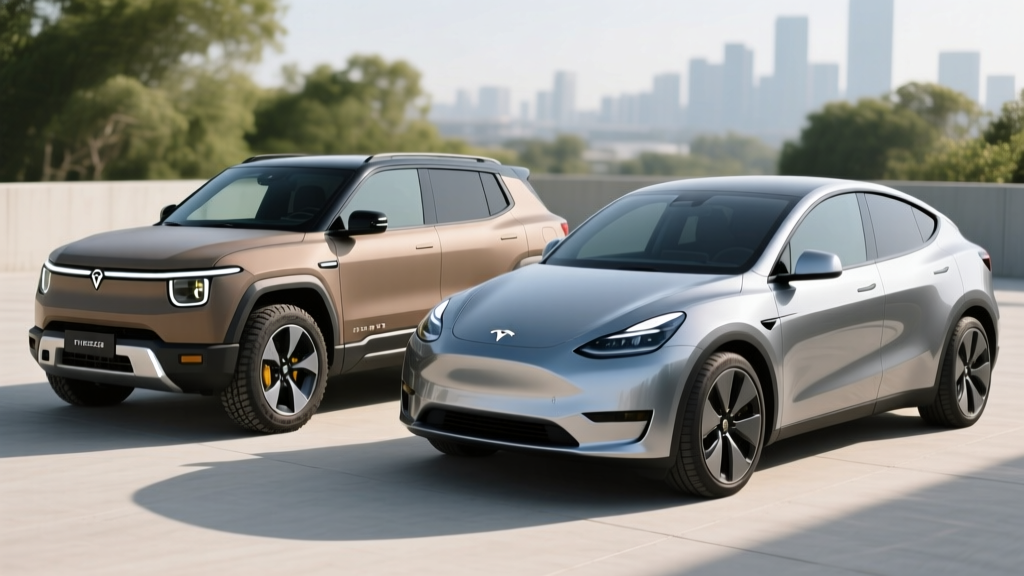
The compact electric SUV segment is the most competitive space in the EV market, and two nameplates dominate buyer shortlists: the Tesla Model Y and the all-new Rivian R2. With the R2 entering production for the 2026 model year, shoppers are running a very specific search — rivian r2 size vs model y — to figure out which of these two electric crossovers actually fits their garage, their family, and their budget.
This comparison breaks down every dimension, powertrain spec, charging metric, and ownership cost that matters, using announced Rivian data and current Tesla specifications. Both vehicles target the same buyer, but they approach the formula very differently.
Exterior Dimensions: How the R2 and Model Y Actually Compare
The Rivian R2 is positioned as a midsize-to-compact crossover — slightly smaller than the R1S but designed to slot directly against the Model Y. Tesla's refreshed Model Y (the "Juniper" update that launched for 2025) grew slightly in length and wheelbase over the prior generation. Here is how the tape measures stack up.
| Spec | 2026 Rivian R2 (Announced) | 2026 Tesla Model Y Long Range |
|---|---|---|
| Length | ~183.0 in (est.) | 188.2 in |
| Width (excl. mirrors) | ~76.0 in (est.) | 75.6 in |
| Height | ~66.0 in (est.) | 63.9 in |
| Wheelbase | ~115.0 in (est.) | 113.8 in |
| Curb Weight (est.) | ~4,800 lbs | 4,363 lbs |
| Battery (usable, est.) | ~85 kWh (NMC) | 75 kWh (NMC) |
| EPA Range | 330 mi (target, prel.) | 320 mi |
| Efficiency | ~26 kWh/100mi (est.) | 25 kWh/100mi (131 MPGe) |
| Peak DC Charge Rate | ~200 kW (est.) | 250 kW |
| 10–80% DC Fast Charge | ~28 min (est.) | ~25 min |
| Level 2 AC Rate | 11.5 kW | 11.5 kW |
| 0–60 mph | ~5.0 sec (Dual AWD est.) | 4.8 sec (LR AWD) |
| Horsepower | ~400 hp (Dual est.) | 384 hp |
| Cargo (rear seats up) | ~28 cu ft (est.) | 30.2 cu ft |
| Cargo (rear seats folded) | ~65 cu ft (est.) | 72.0 cu ft |
| Frunk | Yes (~7 cu ft est.) | 4.1 cu ft |
| Base MSRP | ~$45,000 (announced) | $44,990 |
| Battery Warranty | 8 yr / 100,000 mi (est.) | 8 yr / 120,000 mi |
The Model Y Long Range AWD carries a 320-mile EPA rating. In sustained highway driving at 75 mph, expect roughly 270–285 miles. In sub-freezing temperatures, that can drop to 230–250 miles without preconditioning.
The R2's 330-mile target is preliminary and based on Rivian's announced larger battery pack. Real-world highway and cold-weather expectations should mirror the Model Y — plan for 270–290 miles highway, and 240–260 miles in cold weather, pending final EPA certification.
The critical takeaway on rivian r2 size vs model y: the R2 is expected to be shorter overall but taller and slightly wider, with a longer wheelbase. That translates to a more upright seating position and potentially better headroom, while the Model Y retains an advantage in total cargo volume behind the rear seats and with seats folded. The R2's frunk is expected to be significantly larger — a practical win for stowing charging cables and groceries.
Range and Efficiency: Which Goes Further on a Charge?
Range is the single most searched EV spec, and both vehicles target the 300+ mile bracket that effectively eliminates range anxiety for most daily driving and road trips.
The Model Y Long Range AWD achieves its 320-mile EPA rating with a 75 kWh usable battery and an efficiency figure of roughly 25 kWh per 100 miles (131 MPGe combined). Tesla's thermal management system and heat pump give it an edge in cold-weather efficiency — it remains one of the most efficient AWD electric crossovers on the market.
Rivian has announced a 330-mile target for the R2's largest battery option. Based on the vehicle's estimated weight (~4,800 lbs) and boxier profile, achieving that number likely requires an ~85 kWh usable battery and roughly 26 kWh/100mi efficiency. Rivian's R1T and R1S have historically run slightly less efficient than their EPA stickers in real-world highway testing, so plan conservatively until independent testing confirms final numbers.
The Model Y's proven 320-mile EPA rating and class-leading efficiency give it the edge today. The R2 targets a slightly higher number, but until the EPA certifies it, Tesla holds the confirmed advantage — especially in cold weather where the heat pump matters.
Charging Speed and Network Access
Charging speed is where kW (power — the rate of energy delivery) matters most. Both vehicles support DC fast charging, but the ecosystems differ significantly.
The Model Y peaks at 250 kW on Tesla's Supercharger network, achieving a 10–80% charge in approximately 25 minutes. The Supercharger network remains the gold standard for reliability — over 6,000 stations and 65,000+ connectors in North America, with uptime consistently above 95%. The Model Y uses the native NACS connector.
The R2 is expected to charge at approximately 200 kW peak (based on Rivian's current architecture trajectory). A 10–80% charge should take roughly 28 minutes. Rivian has confirmed the R2 will ship with a native NACS charge port, giving it direct access to Tesla Superchargers without an adapter — a major shift from the CCS-equipped R1T/R1S that required adapters for Supercharger access.
On Level 2 home charging, both vehicles accept 11.5 kW AC, meaning a full charge from empty takes roughly 7–8 hours on a 48-amp home charger — standard overnight replenishment.
Peak charge rate favors Tesla at 250 kW vs the R2's estimated 200 kW. But with native NACS on both vehicles, network access is effectively equalized for 2026. Tesla's slight speed advantage matters most on road trips where every 10–80% stop counts.
Performance and Driving Dynamics
Neither vehicle is a sports car, but both deliver the instant torque that defines the EV driving experience.
The Model Y Long Range AWD produces 384 hp and hits 0–60 mph in 4.8 seconds. The ride quality improved substantially with the Juniper refresh — softer damping, improved sound insulation, and a ventilated front seat upgrade. It remains firm by crossover standards but no longer punishes rough pavement.
Rivian has not published final powertrain output for all R2 trims, but the dual-motor AWD variant is expected to produce approximately 400 hp with a 0–60 time near 5.0 seconds. Rivian's R1 platform has been praised for composed handling relative to its weight, and the R2 — sitting on a dedicated midsize platform — should carry that DNA into a lighter, more agile package.
Where the R2 may differentiate is off-road capability. Rivian has hinted at light off-road modes and higher ground clearance than the Model Y, appealing to buyers who occasionally tackle dirt roads or snow-covered passes.
The Model Y is slightly quicker to 60. The R2 is expected to offer more ground clearance and off-road versatility. Choose based on whether your "performance" need is pavement acceleration or trail capability.
Pricing, Tax Credits, and Total Cost of Ownership
Sticker price tells only part of the story. Federal incentives under IRS §30D can shift the value equation dramatically, and eligibility depends on MSRP caps, buyer income limits, battery component sourcing, and critical mineral requirements.
| Factor | Rivian R2 | Tesla Model Y LR AWD |
|---|---|---|
| Base MSRP | ~$45,000 (announced) | $44,990 |
| SUV MSRP Cap (§30D) | $80,000 ✓ | $80,000 ✓ |
| Federal Credit Eligibility | Up to $7,500 (sourcing-dependent) | Up to $7,500 (sourcing-dependent) |
| Point-of-Sale Transfer | Available (dealer-direct model) | Available (Tesla direct) |
| Effective Price (with max credit) | ~$37,500 | ~$37,490 |
| Est. Insurance (annual avg.) | ~$2,100–$2,400 | ~$1,900–$2,200 |
| Est. 5-Year Maintenance | ~$1,200 | ~$1,000 |
| Est. 5-Year Charging (15k mi/yr) | ~$4,200 | ~$3,900 |
Critical tax credit caveat: The §30D credit has multiple requirements that change annually. Both vehicles are classified as SUVs (subject to the $80,000 MSRP cap), but credit eligibility depends on where battery components and critical minerals are sourced. As of 2026, the foreign entity of concern (FEOC) restrictions on battery components are fully in effect, and critical mineral requirements have tightened further. Always verify current eligibility on IRS.gov and consult a tax professional before purchasing.
On ownership costs, the Model Y holds a slight edge in efficiency (fewer kWh per mile means lower charging costs), and Tesla's insurance partnerships have brought premiums down in many states. Rivian's insurance costs for the R1 platform have historically run higher, though the R2's lower price and repair-friendly design may narrow that gap.
At near-identical MSRPs, the Model Y's confirmed efficiency, slightly lower insurance costs, and proven Supercharger reliability give it a narrow total-cost advantage. The R2 could match or beat it if Rivian secures full §30D eligibility at launch and achieves competitive insurance rates.
Interior, Cargo, and Daily Practicality
This is where the rivian r2 size vs model y debate gets personal. The Model Y's sloping roofline yields 30.2 cu ft behind the rear seats and 72.0 cu ft with them folded — excellent for the segment. The 4.1 cu ft frunk is modest but useful for cables.
The R2 is expected to offer roughly 28 cu ft behind the rear seats but compensate with a significantly larger frunk (~7 cu ft), a gear tunnel option (borrowed from the R1 platform), and a more upright cargo area that accommodates taller items more easily. The taller roofline also means easier loading and better rear headroom for adults.
Inside, the Model Y's Juniper refresh brought a ventilated-seat upgrade, ambient lighting, rear-seat touchscreen, and improved materials. Rivian's R1 interior has been widely praised for thoughtful storage, durable materials, and a more traditional (less screen-dependent) control layout. Expect the R2 to carry forward Rivian's camp-mode features, integrated lighting, and adventure-oriented design cues.
Tech, ADAS, and Software
Both Tesla Autopilot/FSD (Supervised) and Rivian's Driver+ are SAE Level 2 driver-assistance systems. The driver must remain fully engaged, hands on or near the wheel, eyes on the road at all times. Neither system is "self-driving." Only Level 4 services like Waymo operate without a human driver in defined areas.
Tesla's Autopilot comes standard; FSD (Supervised) is a $8,000 option or $99/month subscription. It offers automated lane changes, navigation-guided on/off-ramp handling, and city-street assist. The system's capability is broad but the supervision requirement is absolute — NHTSA continues to scrutinize Tesla's Autosteer and FSD engagement data.
Rivian's Driver+ offers highway lane-keeping, adaptive cruise, and automatic lane changes on mapped roads. It is less aggressive in its feature set than FSD but has drawn praise for smooth, predictable behavior. The R2 is expected to ship with an upgraded sensor suite, potentially including higher-resolution cameras for future feature expansion.
- Neither eliminates the need for active driver attention
- Neither is certified for hands-off or eyes-off driving
- Both can fail to detect stopped vehicles, construction zones, and emergency responders
- Performance degrades in heavy rain, snow, and direct low-sun glare
Tesla's software ecosystem, Supercharger integration, OTA update cadence, and FSD feature breadth remain unmatched. Rivian's tech is solid and improving, but Tesla's vertical integration gives it the edge for tech-forward buyers.
Decision Framework: Which Should You Choose?
- You need maximum confirmed cargo volume (72 cu ft seats-down)
- Efficiency and lowest per-mile charging cost are top priorities
- You want the most mature Supercharger network with the fastest 10–80% times
- You value FSD (Supervised) for highway commuting
- You prefer a proven platform with years of real-world ownership data
- You want a taller, more upright seating position and better rear headroom
- A larger frunk and gear-tunnel storage matter for adventure gear
- You need light off-road capability or higher ground clearance
- You prefer Rivian's design language and adventure-oriented feature set
- You want to support a newer brand and don't mind being an early adopter on the R2 platform
Frequently Asked Questions
Is the Rivian R2 bigger or smaller than the Model Y?
The R2 is expected to be shorter in overall length (~183 in vs 188.2 in) but taller and slightly wider, with a longer wheelbase. Total cargo volume favors the Model Y, but the R2 should offer more usable vertical space and a substantially larger frunk.
Will the Rivian R2 work at Tesla Superchargers?
Yes. Rivian has confirmed the R2 will ship with a native NACS charge port, meaning direct plug-in access to Tesla Superchargers without an adapter.
Which is cheaper to own over 5 years?
The Model Y holds a narrow advantage due to lower energy consumption (fewer kWh per mile), slightly lower insurance premiums in most states, and a longer track record of depreciation data. However, if the R2 qualifies for the full §30D credit at launch and insurance rates are competitive, the gap could close to negligible.
Does the R2 qualify for the $7,500 federal tax credit?
Eligibility depends on battery component and critical mineral sourcing at the time of purchase. The R2's MSRP is well under the $80,000 SUV cap. Buyers must also meet income thresholds ($150K single / $300K joint). Always verify current eligibility at IRS.gov before committing to a purchase.
When can I actually buy the Rivian R2?
Rivian has targeted production start in early 2026 at its Normal, Illinois facility, with deliveries expected to begin mid-2026. Reservation holders get priority. As of this writing, final EPA certification and trim-level pricing have not been published — treat all R2 specs in this comparison as preliminary until Rivian confirms production figures.
Which has better real-world range in winter?
The Model Y's heat pump and proven thermal management system give it a documented advantage in cold-weather range retention. Expect 20–30% range loss in sub-freezing conditions for both vehicles, but Tesla's system has more real-world cold-weather data behind it. The R2's cold-weather performance will need independent validation once production vehicles are available.