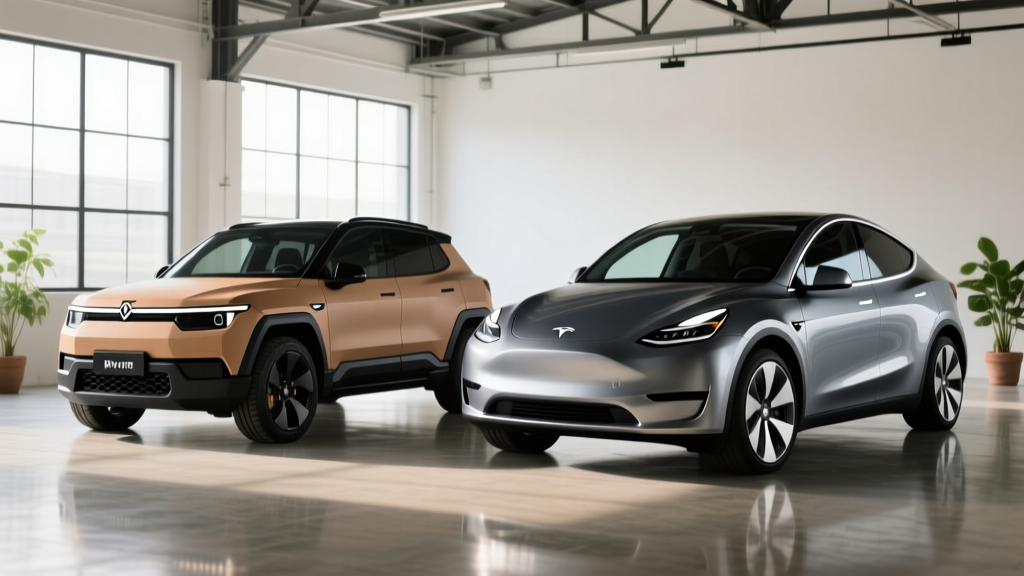
The compact electric SUV segment is where most American EV buyers are landing in 2026, and two nameplates dominate the conversation: the Tesla Model Y and the newly arrived Rivian R2. While range and price dominate the headlines, the real purchase-decision often comes down to physical footprint — how much cabin and cargo space you get relative to the vehicle's exterior dimensions, and how that size translates into daily usability. This Rivian R2 size comparison against the segment benchmark answers that question with hard numbers, not marketing gloss.
Both vehicles target the same buyer: a household that needs a practical five-seat SUV with around 300 miles of range, DC fast charging under 30 minutes, and enough cargo volume for weekend gear. But their approaches to packaging, powertrain, and pricing diverge in ways that matter once you get past the brochure.
Exterior Footprint and Interior Volume: The Numbers
Rivian designed the R2 on a new midsize platform that slots below the R1S. The result is an SUV that is visibly smaller on the outside but, thanks to a flat floor and short overhangs, surprisingly competitive on the inside. The Model Y, refreshed for 2025 and carried into 2026, remains the segment's space-efficiency benchmark, but the gap is narrower than most shoppers expect.
| Dimension | Rivian R2 | Tesla Model Y (Long Range) |
|---|---|---|
| Length | ~181 in | 188.0 in |
| Width (excl. mirrors) | ~76 in | 75.6 in |
| Height | ~66 in | 63.9 in |
| Wheelbase | ~113 in | 113.8 in |
| Curb weight (est.) | ~5,000 lb | ~4,400 lb |
| Cargo (behind 2nd row) | ~30 cu ft | 30.2 cu ft |
| Cargo (max, seats folded) | ~65 cu ft | 72.1 cu ft |
| Front trunk (frunk) | Yes (sealed, drainable) | Yes (~4.1 cu ft) |
| Seating | 5 | 5 (optional 7) |
The R2 is roughly seven inches shorter nose-to-tail than the Model Y, which translates into noticeably easier urban parking and tighter garage fitment. That length advantage, however, shows up at the cargo area when the second row is folded: the Model Y swallows about seven more cubic feet, enough for a pair of large suitcases the R2 will not take with seats down. With the second row upright, the two are functionally tied at ~30 cubic feet, and the R2's boxier roofline actually makes loading tall items (dog crates, coolers) easier than the Model Y's fastback taper.
Both vehicles offer a frunk. Rivian's is drainable — a carryover from the R1T/R1S playbook — which makes it practical for wet gear, ice, or muddy boots. Tesla's frunk is slightly larger in raw volume but lacks a drain.
Side-by-Side Spec Table: Range, Battery, Charging, Performance, Price
Size is only one axis. Below is the full spec comparison buyers actually need, using preliminary Rivian figures and EPA-published Tesla data as of early 2026.
| Spec | Rivian R2 (Standard) | Tesla Model Y Long Range AWD |
|---|---|---|
| EPA range | ~330 mi (prelim.) | 320 mi |
| Battery usable capacity | ~85 kWh (NMC) | ~78 kWh (NMC) |
| Peak DC charge rate | ~220 kW (est.) | 250 kW |
| 10–80% DC time | ~25 min (est.) | ~27 min |
| Level 2 rate (onboard) | 11.5 kW | 11.5 kW |
| 0–60 mph | ~4.5 sec (Dual-Motor est.) | 4.8 sec |
| Horsepower | ~450 hp (Dual est.) | 384 hp |
| EPA efficiency | ~3.5 mi/kWh (est.) | 3.8 mi/kWh (127 MPGe) |
| Starting MSRP | ~$45,000 | $48,990 |
| Battery warranty | 8 yr / 120,000 mi | 8 yr / 120,000 mi |
Two observations stand out. First, the R2's larger battery gives it a modest range edge on paper, but the Model Y's lighter weight and more aerodynamic shape let it stretch each kilowatt-hour further — that efficiency gap compounds on long road trips where the R2 will consume slightly more energy per mile at sustained highway speeds. Second, the R2's preliminary DC charge rate is lower than Tesla's proven 250 kW peak, though both vehicles will typically taper sharply above 80% state of charge, making the 10–80% window the figure that matters.
Charging Network Access: Tesla's Moat vs Rivian's NACS Pivot
Charging hardware specs only matter if you can actually use them. This is where the 2026 landscape has shifted decisively in Rivian's favor compared to even two years ago.
Tesla owners continue to access the Supercharger network natively — over 17,000 V2/V3 stalls in the U.S. as of early 2026, with V4 stalls rolling out at increasing power levels. Plug-and-charge reliability on Superchargers remains the segment benchmark, and the integrated Tesla navigation preconditions the battery automatically for the fastest charge curve.
Rivian ships the R2 with a native NACS charge port, the same physical connector Tesla uses. That means R2 owners can plug directly into Tesla Supercharger stalls without an adapter, accessing the same network that has historically been a Tesla-only advantage. Rivian also supports third-party networks (Electrify America, EVgo, ChargePoint) via the same NACS connector with appropriate CCS adapters where needed.
| Network | Rivian R2 (NACS native) | Tesla Model Y (NACS native) |
|---|---|---|
| Tesla Supercharger | Direct plug-in | Direct plug-in |
| Electrify America | Via NACS-to-CCS adapter | Via NACS-to-CCS adapter |
| EVgo | Via NACS-to-CCS adapter | Via NACS-to-CCS adapter |
| ChargePoint | Via adapter or J1772 L2 | Via adapter or J1772 L2 |
The practical gap has nearly closed. Where Tesla still holds an edge is in the seamlessness of its app-to-charger handshake and the density of Supercharger corridors in rural stretches of the Mountain West and Great Plains. Rivian's in-app charger routing has improved substantially, but first-time R2 buyers should expect a short learning curve identifying which stalls are NACS-native versus those requiring an adapter.
Price, Tax Credits, and Total Cost of Ownership
Sticker price tells only part of the story. The federal EV tax credit under IRS §30D can shift the effective cost by up to $7,500, but eligibility depends on MSRP caps, buyer income limits, and battery-component/critical-mineral sourcing rules that change periodically. Always confirm current-year rules on irs.gov or with a tax professional.
| Factor | Rivian R2 | Tesla Model Y LR AWD |
|---|---|---|
| Base MSRP | ~$45,000 | $48,990 |
| Under $55,000 SUV MSRP cap? | Yes (base) | Yes (LR AWD) |
| Federal §30D eligibility (est.) | Up to $7,500 (sourcing-dependent) | Up to $7,500 (sourcing-dependent) |
| Point-of-sale transfer available? | Yes, via participating dealer | Yes, via Tesla |
| Effective base price (with max credit) | ~$37,500 | ~$41,490 |
| Est. 5-yr electricity cost (15k mi/yr) | ~$3,900 | ~$3,600 |
| Est. 5-yr insurance (national avg) | ~$11,500 | ~$12,200 |
| Est. 5-yr maintenance | ~$1,800 | ~$1,600 |
The R2's lower starting MSRP gives it a meaningful advantage in effective price once the federal credit is applied, assuming both vehicles qualify for the full $7,500 — which depends on the buyer's adjusted gross income (single filers ≤ $150,000; joint ≤ $300,000) and the vehicle's battery-sourcing compliance in the purchase year. Rivian's U.S. assembly in Normal, Illinois, satisfies the domestic-assembly requirement. Tesla's Fremont and Austin production likewise qualifies.
On the operating-cost side, the Model Y's superior efficiency (roughly 8–10% better miles per kWh) saves a few hundred dollars over five years in electricity. Insurance is modestly higher on the Tesla, reflecting its higher repair-cost profile in collision claims data. Maintenance on both is minimal — no oil, no spark plugs, no transmission fluid — with tire rotation, cabin-air-filter replacement, and brake-fluid checks as the primary recurring items.
Category-by-Category Verdicts
~330 preliminary EPA miles vs 320, though real-world highway efficiency favors the Model Y per kWh.
250 kW peak vs ~220 kW estimated, plus a more mature charge-curve profile and native Supercharger integration.
3.8 mi/kWh (127 MPGe) beats the R2's ~3.5 mi/kWh, driven by lower weight and a drag coefficient near 0.23 vs the R2's boxier profile.
Both deliver ~30 cubic feet behind the second row.
72.1 cu ft max vs ~65 cu ft — meaningful for large-item hauling.
~7 inches shorter overall length and a tighter turning circle make it easier in garages and city streets.
Higher ground clearance, available air suspension, and Rivian's adventure-oriented software modes.
Lower base MSRP, comparable federal-credit eligibility, and strong standard equipment.
More mature Autopilot/FSD (Supervised) ecosystem, though both are SAE Level 2 driver-assist — not self-driving.
Performance and Driving Character
The R2's dual-motor setup produces an estimated 450 horsepower, which would make it quicker to 60 mph than the Model Y Long Range's 384 hp and 4.8-second run. Rivian's torque-vectoring and low center of gravity (battery pack underfloor) give it the planted, confidence-inspiring feel familiar from the R1S, but in a smaller, more tossable package. The R2's available air suspension adds adjustable ride height — useful for trailheads, snow, or simply easing entry and exit.
The Model Y Long Range is no slouch at 4.8 seconds, and Tesla's single-speed reduction gearing delivers seamless acceleration. Where the Model Y shows its age is in ride quality: even after the 2025 refresh, the suspension is firm over sharp impacts, and road noise is more pronounced than in the R2 at highway speeds. The R2's taller sidewall options and longer suspension travel give it a compliance advantage on rough pavement.
Towing is a differentiator. The R2 is expected to tow up to 4,500 pounds (pending final certification), while the Model Y is rated at 3,500 pounds. For boat, small camper, or utility trailer duty, the R2's advantage is substantial.
Decision Framework: Which Compact EV SUV Should You Buy?
- You prioritize a shorter exterior footprint for city parking and compact garages
- You want genuine off-road capability and higher ground clearance for trails or snow
- You need to tow more than 3,500 lb
- You prefer a drainable frunk for outdoor/adventure use
- Lower base MSRP and effective post-credit price matter to your budget
- Maximum cargo volume with seats folded is a priority (72 cu ft)
- You want the fastest, most seamless DC fast-charging experience on the Supercharger network
- Energy efficiency (more miles per kWh) is important for high-mileage driving
- You want the most mature ADAS feature set (Autopilot/FSD Supervised) available today
- You may need optional third-row seating for occasional 7-passenger use
There is no universal winner here. The R2 is the better adventure-oriented, city-friendly, value-priced compact SUV. The Model Y remains the efficiency, cargo, and charging-infrastructure benchmark. Your driving patterns — urban commuting vs highway road trips, weekend trail access vs suburban hauling — should dictate the pick.
Frequently Asked Questions
Is the Rivian R2 smaller than the Model Y?
Yes, in overall length. The R2 is approximately 181 inches long versus the Model Y's 188 inches — about 7 inches shorter. However, interior passenger volume is very close, and cargo space behind the second row is nearly identical at ~30 cubic feet. The R2's shorter length makes it noticeably easier to park in tight urban spaces.
Does the Rivian R2 qualify for the $7,500 federal EV tax credit?
The R2 is assembled in the U.S. and its base MSRP is under the $55,000 SUV cap, which are two key requirements under IRS §30D. Full eligibility depends on battery-component and critical-mineral sourcing rules in effect at the time of purchase, plus buyer income limits ($150K single / $300K joint). The credit may be transferred at point of sale. Verify current-year rules before purchasing.
Can the Rivian R2 charge at Tesla Superchargers?
Yes. The R2 ships with a native NACS charge port, the same connector used by Tesla Superchargers. R2 owners can plug in directly without an adapter at NACS-equipped stalls. For CCS-equipped third-party chargers, a NACS-to-CCS adapter is required.
Which has more cargo space: R2 or Model Y?
With the second row upright, both offer approximately 30 cubic feet — essentially a tie. With seats folded, the Model Y provides 72.1 cubic feet to the R2's estimated 65 cubic feet. If you regularly haul large items with seats down, the Model Y has the edge. For daily use with seats up, they are functionally equivalent.
Is the R2 better off-road than the Model Y?
Significantly so. The R2 offers higher ground clearance, available air suspension with adjustable ride height, and Rivian's off-road driving modes. The Model Y is a road-oriented crossover with limited ground clearance and no dedicated off-road capability. For dirt roads, trailheads, or snowy conditions, the R2 is the clear choice.
What is the real-world highway range of each vehicle?
Expect 260–280 highway miles from the Model Y and 265–285 from the R2 in moderate temperatures at 75 mph. In cold weather (below 30°F), both vehicles lose roughly 15–25% of range, bringing usable highway range down to approximately 220–240 miles. Plan charging stops accordingly — this is the single most important real-world adjustment new EV owners make.