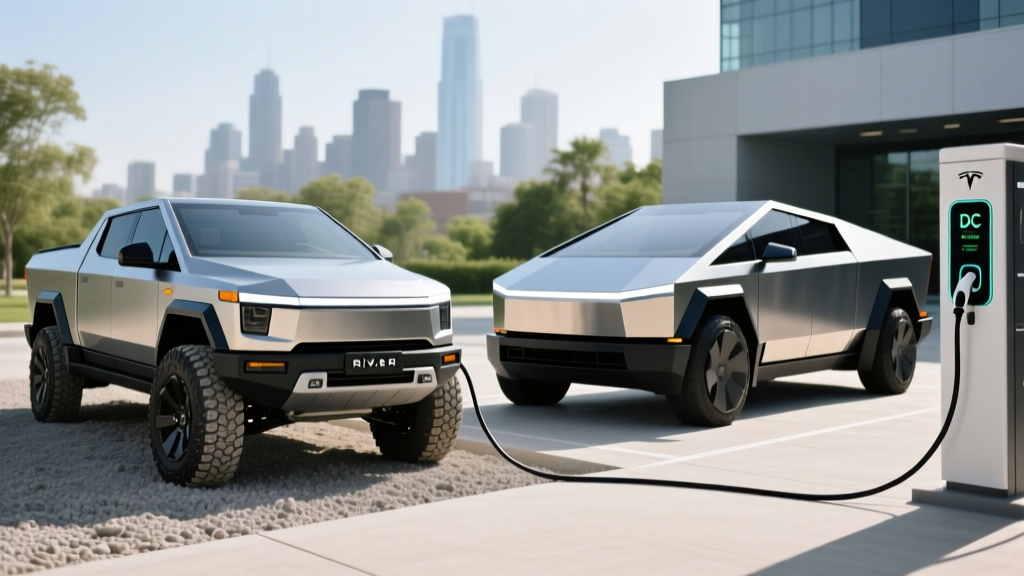
Two electric trucks dominate the premium pickup conversation in 2026, but they approach the segment from radically different philosophies. The Rivian R1T is a refined, adventure-focused platform with proven overlanding chops and a mature charging strategy. The Tesla Cybertruck is a polarizing, stainless-steel wedge packed with Tesla's powertrain and software ecosystem. Neither is universally "better" — the right choice depends on your daily driving, towing needs, charging access, and whether you prioritize trail capability or highway efficiency.
This comparison uses current 2026 model-year specifications, real-world testing data, and IRS §30D tax-credit rules to help you decide. We compare the most popular dual-motor configurations: the R1T Dual-Motor (Standard battery) and the Cybertruck Long Range AWD.
Side-by-Side: Rivian R1T vs Cybertruck Specs at a Glance
| Specification | Rivian R1T Dual-Motor (Standard) | Tesla Cybertruck Long Range AWD |
|---|---|---|
| EPA Range | 270 mi | 340 mi |
| Real-World Highway (est.) | ~230–245 mi | ~285–305 mi |
| Battery (usable / chemistry) | 95 kWh / NMC | ~123 kWh / NMC (structural pack) |
| Peak DC Fast Charge | ~200 kW | ~250 kW |
| 10–80% DC Charge Time | ~30 min | ~28 min |
| Level 2 Charge Rate | 11.5 kW (48A) | 11.5 kW (48A) |
| Charge Port / Adapter | NACS (native, 2025+) | NACS (native) |
| 0–60 mph | 4.5 sec | 3.9 sec |
| Horsepower | 533 hp | 600 hp |
| Towing Capacity | 11,000 lb | 11,000 lb |
| Payload Capacity | 1,760 lb | 2,500 lb |
| Bed Length | 54 in (4.5 ft) | 72 in (6 ft) |
| Cargo Volume (bed + frunk) | ~38 cu ft combined | ~74 cu ft combined (incl. vault) |
| Efficiency (MPGe / kWh/100mi) | 73 MPGe / 46 kWh/100mi | 79 MPGe / 42 kWh/100mi |
| Base MSRP | $69,900 | $79,990 |
| Battery / Powertrain Warranty | 8 yr / 175,000 mi | 8 yr / 120,000 mi |
Sources: EPA fueleconomy.gov (R1T), EPA fueleconomy.gov (Cybertruck), Rivian and Tesla manufacturer specification sheets.
Range and Efficiency: Highway Reality vs EPA Stickers
Rivian R1T: EPA 270 mi — expect ~230–245 mi at 70 mph highway; ~190–210 mi in sub-30°F weather.
Cybertruck Long Range: EPA 340 mi — expect ~285–305 mi at 70 mph highway; ~240–265 mi in sub-30°F weather.
The Cybertruck's 70-mile EPA advantage is significant, and it holds up in real-world highway driving. Tesla's structural battery pack and the truck's aerodynamic profile (despite its angular appearance, it has a lower drag coefficient than the R1T) contribute to roughly 42 kWh/100mi on the highway versus the R1T's 46 kWh/100mi.
However, efficiency only tells part of the story. The R1T's shorter bed and lower curb weight (~6,700 lb vs the Cybertruck's ~6,800 lb) mean it's more nimble on trails and easier to park in urban environments. If most of your driving is under 150 miles round-trip with occasional longer hauls, the R1T's range is adequate. If you regularly drive 250+ miles between charging stops on road trips, the Cybertruck's larger pack provides meaningful buffer.
Cold weather impacts both trucks similarly — expect 15–25% range loss below freezing. Neither truck currently offers an optional range-extender battery (the Cybertruck's announced range-extender pack has been repeatedly delayed and is not available as of 2026).
Charging Speed and Network Access
| Level | Rivian R1T | Tesla Cybertruck |
|---|---|---|
| Level 1 (120V / 12A) | ~1.4 kW — 3 mi/hr | ~1.4 kW — 3 mi/hr |
| Level 2 (240V / 48A) | 11.5 kW — 25 mi/hr | 11.5 kW — 27 mi/hr |
| DC Fast Charge (peak) | ~200 kW — 130 mi/30 min | ~250 kW — 170 mi/30 min |
Both trucks now use the NACS connector natively, which is a major convergence point. Rivian transitioned to NACS starting with 2025 model-year vehicles, meaning 2026 R1Ts plug directly into Tesla Superchargers without an adapter. This was previously the Cybertruck's biggest infrastructure advantage, and it's now neutralized.
Charging-curve reality: Neither truck sustains its peak charge rate for the full session. The Cybertruck peaks near 250 kW at low state-of-charge (SoC) but tapers significantly above 60%, averaging closer to 150–170 kW across a 10–80% session. The R1T peaks around 200 kW with a flatter curve, averaging roughly 140–160 kW. In practice, the Cybertruck's 10–80% advantage is only about 2 minutes — both complete the session in roughly 28–30 minutes under optimal conditions (preconditioned battery, warm weather, V3/V4 Supercharger or equivalent 350 kW station).
At home on Level 2, both accept 11.5 kW, fully recharging the R1T in about 8.5 hours and the Cybertruck in about 11 hours from near-empty. Most owners charge overnight and rarely deplete below 20%, making home charging the practical equalizer.
Performance, Capability, and Daily Usability
Both trucks are genuinely quick. The Cybertruck Long Range AWD hits 60 mph in 3.9 seconds with 600 hp, while the R1T Dual-Motor does it in 4.5 seconds with 533 hp. In real-world driving, both feel effortlessly fast — the difference is academic unless you're drag-racing at stoplights.
Where they diverge sharply is utility and off-road capability:
- Bed size: The Cybertruck's 6-foot bed (plus the front trunk and rear "vault" under the bed floor) gives it substantially more cargo volume. The R1T's 4.5-foot bed is compact, though its unique Gear Tunnel (optional) adds lockable cross-body storage.
- Off-road: The R1T has a clear advantage. Its available air suspension provides up to 14.9 inches of ground clearance, a wading depth of over 3 feet, and approach/departure angles purpose-built for trails. The Cybertruck's adaptive air suspension offers up to 17.4 inches of ground clearance in Extract mode but has a longer wheelbase and less wheel articulation, making it less capable on technical terrain.
- Towing: Both rate at 11,000 lb. However, towing cuts EV range by 40–55% in real-world testing for both trucks. Plan for ~120–140 miles of range while towing heavy loads.
- Payload: Cybertruck wins here at 2,500 lb vs the R1T's 1,760 lb — important if you regularly haul heavy materials.
Pricing, Tax Credits, and Ownership Costs
- MSRP Cap: Trucks/vans/SUVs must be under $80,000 MSRP. Both trucks' base trims qualify; fully loaded trims may exceed the cap.
- Buyer Income Cap: AGI ≤ $150,000 (single) / $300,000 (joint). Check IRS §30D rules for current thresholds.
- Battery Sourcing: Critical minerals and battery component requirements tighten annually. As of 2026, both vehicles face partial or full credit reduction depending on supply-chain compliance. Verify current sourcing status on the manufacturer's website before purchasing.
- Point-of-Sale Transfer: Eligible buyers can transfer the credit to the dealer at purchase, reducing the upfront price rather than waiting for a tax refund.
| Cost Factor | Rivian R1T Dual-Motor | Tesla Cybertruck LR AWD |
|---|---|---|
| Base MSRP | $69,900 | $79,990 |
| Est. Federal Credit (§30D)* | $3,750–$7,500 | $3,750–$7,500 |
| Effective Price (after max credit) | ~$62,400 | ~$72,490 |
| 5-Year Electricity (15k mi/yr, $0.14/kWh) | ~$4,830 | ~$4,410 |
| 5-Year Insurance (avg.) | ~$12,500 | ~$14,800 |
| 5-Year Maintenance (est.) | ~$1,200 | ~$900 |
| Estimated 5-Year Depreciation | ~$28,000 | ~$35,000 |
| Approx. 5-Year Total Cost of Ownership | ~$78,930 | ~$92,700 |
*Tax credit amount varies by sourcing compliance and buyer income. Consult a tax professional and verify at irs.gov.
The R1T holds a clear cost advantage. It's $10,090 cheaper at base MSRP, tends to cost less to insure (Rivian's lower repair-cost profile vs Tesla's stainless-steel body panels and structural battery), and has shown stronger residual values in the used-EV market. The Cybertruck's higher insurance premiums — averaging 15–20% more than the R1T — reflect Tesla's collision-repair complexity and the exoskeleton's panel-replacement costs.
On the electricity side, the Cybertruck's slightly better efficiency saves roughly $420 over five years at average mileage and electricity rates, but this doesn't offset its higher purchase price or insurance.
Category Winners: Where Each Truck Excels
340 mi EPA vs 270 mi — a 70-mile gap that matters on road trips.
Both use NACS natively; Cybertruck peaks higher but tapers harder. Sessions are nearly identical.
3.9 sec 0–60 and 600 hp edge out the R1T's 4.5 sec / 533 hp.
Superior articulation, wading depth, and trail geometry.
~$10K cheaper, lower insurance, stronger resale.
6-ft bed, 2,500-lb payload, and the vault under-bed storage.
Tesla's UI, OTA cadence, and Supercharger integration remain industry-leading.
More consistent panel fit, interior materials, and fewer reported delivery defects.
Driver-Assistance and Autonomy: What Each System Actually Does
Neither Tesla Autopilot/FSD (Supervised) nor Rivian's Driver+ is self-driving. Both require continuous driver supervision — hands on or near the wheel, eyes on the road. Only Level 4 robotaxi services (Waymo, Zoox) operate without a human driver.
Tesla's Autopilot and available FSD (Supervised) are more feature-rich: automatic lane changes, traffic-light recognition, and city-street navigation. However, FSD remains a supervised system, and its $8,000–$12,000 cost (depending on current pricing) is a significant add-on that doesn't eliminate driver responsibility.
Rivian's Driver+ offers adaptive cruise, lane centering, and automatic lane changes on highways. It's less ambitious than FSD but has a strong reliability record with fewer disengagement complaints. Rivian includes Driver+ standard on most trims.
Decision Framework: Which Truck Fits Your Life?
- You prioritize off-road capability, camping, and overlanding
- Your budget is closer to $65–75K and you want to maximize value
- You prefer a traditional truck aesthetic and proven build quality
- You drive under 200 miles daily and charge at home
- You want a lower insurance premium and stronger resale value
Choose the Tesla Cybertruck if:
- Maximum range (340 mi EPA) is your top priority for frequent road trips
- You need the 6-foot bed and 2,500-lb payload for work or hauling
- You want Tesla's software ecosystem, OTA updates, and Supercharger UX
- You value straight-line performance and don't mind the polarizing design
- You're comfortable paying a ~$10K premium and higher insurance costs
Final Recommendation
For most buyers shopping in the $65K–$85K electric-truck segment in 2026, the Rivian R1T is the more pragmatic purchase. It's cheaper, more capable off-road, better built, and costs less to insure and own over five years. Its 270-mile range is sufficient for daily driving and moderate road trips when paired with home Level 2 charging and Supercharger access (now native via NACS).
The Cybertruck earns its premium for buyers who need the extra 70 miles of range, the larger bed, or who are deeply invested in the Tesla ecosystem. If you tow frequently, haul heavy payloads, or regularly drive 300+ miles between charges, the Cybertruck's advantages justify the cost. Just budget for higher insurance and accept that its repair costs and depreciation curve are steeper.
Test-drive both. The R1T feels like a premium adventure vehicle that happens to be electric. The Cybertruck feels like a technology statement that happens to be a truck. Your preference between those two identities will tell you which one to buy.
Frequently Asked Questions
Can the Rivian R1T use Tesla Superchargers?
Yes. Starting with 2025 model-year vehicles, Rivian switched to the NACS charge port natively. All 2026 R1Ts plug directly into Tesla Superchargers without an adapter, accessing the same V3 and V4 stalls as the Cybertruck.
Which truck tows better in real-world conditions?
Both are rated at 11,000 lb, but real-world towing range is the limiting factor. Expect 120–140 miles of range when towing near max capacity with either truck. The Cybertruck's larger battery gives it a slight range buffer while towing, but neither truck is ideal for long-distance heavy towing without frequent charge stops.
Does either truck qualify for the full $7,500 federal tax credit in 2026?
It depends on current battery-sourcing compliance and your income. Both trucks fall under the $80,000 MSRP cap for trucks at their base trims, and both meet the vehicle classification requirements. However, critical-mineral and battery-component sourcing rules under §30D tighten each year. Check the IRS clean vehicle credit page and the manufacturer's incentive page at the time of purchase for the exact credit amount. A tax professional can confirm your personal eligibility.
How do insurance costs compare?
The Cybertruck typically costs 15–20% more to insure than the R1T. Tesla's stainless-steel exoskeleton panels are expensive to replace after collisions, and Tesla's structural battery pack complicates repair assessments. Rivian's more conventional body structure and established repair network result in lower premiums. Get quotes from your insurer for both before deciding.
Which truck has better long-term battery warranty coverage?
Rivian offers an 8-year/175,000-mile battery warranty, while Tesla provides 8 years/120,000 miles. Rivian's 55,000-mile advantage is meaningful for high-mileage drivers. Both warranties cover capacity retention below a specified threshold (typically 70% of original capacity). Review the exact warranty terms on each manufacturer's site before purchase.