Rivian R1S vs. Tesla Model X: The Ultimate Family EV SUV Showdown
Choosing the right electric vehicle for a growing family is a monumental decision. When browsing the best electric SUVs on the market, two heavyweights consistently rise to the top of the premium three-row segment: the rugged, adventure-ready Rivian R1S and the sleek, tech-forward Tesla Model X. Both vehicles offer blistering acceleration, expansive interiors, and zero tailpipe emissions, but they approach the concept of a family hauler from entirely different philosophies.
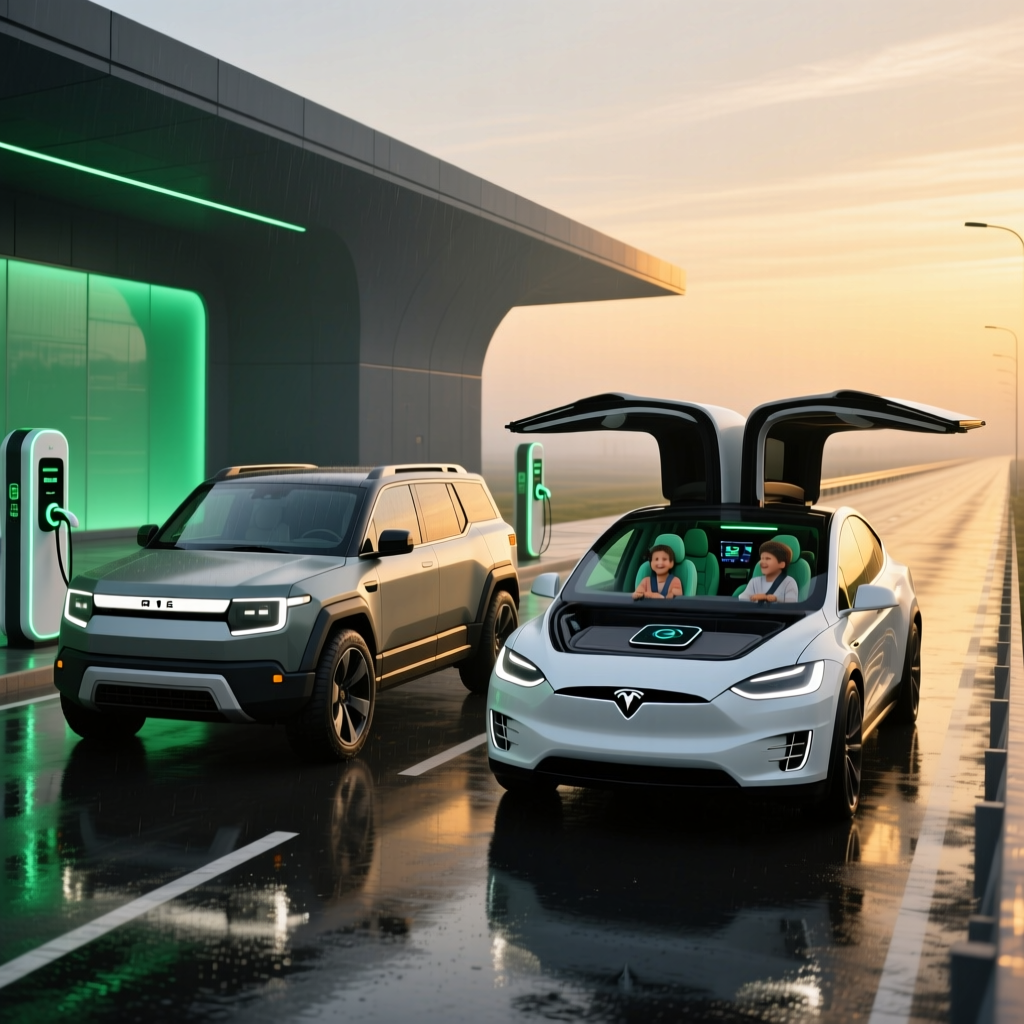
The Rivian R1S is built like a modern luxury expedition vehicle, prioritizing off-road capability, unique storage solutions, and a connection to the outdoors. In contrast, the Tesla Model X is a futuristic people-mover, famous for its dramatic falcon-wing doors, minimalist cabin, and industry-leading Supercharger network. In this comprehensive head-to-head comparison, we will dissect every aspect of these two premium EVs to help you determine which one deserves a spot in your garage.
Side-by-Side Spec Comparison
Before diving into the nuances of daily driving and family road trips, let us look at the core specifications that define these two electric SUVs. Note that specifications reflect the most current dual-motor and long-range configurations available.
| Feature | Rivian R1S (Dual-Motor Large Battery) | Tesla Model X (Long Range) |
|---|---|---|
| Starting MSRP (Approx.) | $79,900 | $77,990 |
| EPA Estimated Range | 352 miles | 335 miles |
| 0-60 MPH | 4.5 seconds | 3.8 seconds |
| Seating Capacity | 7 Passengers | 5, 6, or 7 Passengers |
| Cargo Space (Behind 3rd Row) | 10.4 cu. ft. (46.7 cu. ft. folded) | 15.8 cu. ft. (88.1 cu. ft. folded) |
| Front Trunk (Frunk) | 11.0 cu. ft. | 6.5 cu. ft. |
| Towing Capacity | 7,700 lbs | 5,000 lbs |
| Charging Architecture | NACS / CCS (Adapter dependent) | Native NACS |
Range & Efficiency: Going the Distance
Range anxiety is a primary concern for families planning cross-country road trips. According to EPA estimates, the Rivian R1S equipped with the Large Battery pack achieves an impressive 352 miles of range. For those willing to upgrade to the Max Battery pack, the R1S pushes past the 400-mile mark, making it one of the longest-range EVs on the market. The R1S achieves this despite its boxy, aerodynamically challenged silhouette, thanks to a massive battery capacity and highly efficient silicon-carbide inverters.
The Tesla Model X Long Range counters with an EPA-estimated 335 miles. While slightly lower on paper, Tesla’s real-world highway efficiency is legendary. Independent test data frequently shows the Model X outperforming its EPA ratings at sustained highway speeds, largely due to its teardrop shape and industry-leading thermal management system. For families who frequently drive through extreme climates, the Model X’s heat pump and battery preconditioning algorithms offer a slight edge in preserving range during freezing winter months.
Ultimately, both vehicles offer more than enough range to handle the daily school run, soccer practice, and weekend getaways without requiring a mid-trip charge. However, for ultra-long-haul driving, the Rivian’s Max Battery option provides a comforting buffer that Tesla currently does not match in the Model X lineup.
Pricing & Value Proposition
Pricing in the premium EV segment is notoriously fluid, with both manufacturers occasionally adjusting MSRPs and incentive structures. Generally, the Tesla Model X Long Range starts at a slightly lower base price than the Rivian R1S Dual-Motor Large Battery. However, the true cost of ownership depends heavily on how you configure the vehicle.
Tesla’s pricing model is relatively straightforward. You choose your powertrain, select a paint color, wheel size, and interior trim, and decide whether to add Enhanced Autopilot or Full Self-Driving capability. There are no hidden packages or complex tiers to navigate.
Rivian, on the other hand, operates more like a traditional luxury automaker. While the base R1S is well-equipped, the brand offers a la carte options that can significantly inflate the final price. Add-ons like the Camp Kitchen, premium off-road packages, and upgraded interior materials can push the R1S well into six-figure territory. For a detailed breakdown of trim levels and options, check out our full Rivian R1S review. If value and predictability are your main concerns, Tesla’s streamlined ordering process holds a slight advantage.
Charging Speed & Infrastructure
A family EV is only as good as the charging network that supports it. Historically, the Tesla Model X has held an insurmountable advantage thanks to the proprietary Tesla Supercharger network. Superchargers are renowned for their reliability, plug-and-play simplicity, and widespread availability along major highway corridors. The Model X can peak at charging speeds of up to 250 kW on V3 Superchargers, adding roughly 175 miles of range in just 15 minutes.
Rivian has rapidly closed this gap. With the industry’s widespread adoption of the North American Charging Standard (NACS), newer Rivian vehicles are being built with native NACS ports, while older models are supported via official adapters. This grants R1S owners full access to the Tesla Supercharger network. Additionally, Rivian is building its own exclusive Adventure Network along popular outdoor routes. For a deeper dive into navigating the modern charging landscape, read our comprehensive EV charging guide.
While Rivian now has access to the same hardware, Tesla’s native integration still offers a slightly more seamless software experience. The Model X automatically routes you through Superchargers, preconditions the battery upon approach, and bills your account automatically without ever needing to open an app or use an adapter.
Performance & Driving Dynamics
Do not let their family-friendly dimensions fool you; both of these SUVs offer sports-car levels of acceleration. The Tesla Model X Plaid is a technological marvel, boasting over 1,000 horsepower and a mind-bending 2.5-second 0-60 mph time. Even the standard Long Range model hits 60 mph in a brisk 3.8 seconds. The Model X features an adaptive air suspension that lowers the vehicle at highway speeds for better aerodynamics and provides a remarkably smooth, car-like ride on paved roads.
The Rivian R1S takes a completely different approach to performance. While the Quad-Motor variants can rival the Tesla in a straight line, the R1S is fundamentally an off-road vehicle at heart. It features a sophisticated electro-hydraulic roll control system that eliminates the need for traditional sway bars, allowing for incredible wheel articulation on rocky trails while maintaining a surprisingly flat cornering stance on the pavement. The R1S offers over 14 inches of ground clearance in its highest off-road mode and can wade through nearly three feet of water.
If your family’s idea of performance involves track days and highway passing power, the Model X is the undisputed king. But if your weekends involve towing a boat, navigating snowy mountain passes, or exploring unmapped forest trails, the R1S is in a league of its own. For more on its trail capabilities, visit our Rivian R1S review.
Interior Space & Family Practicality
When it comes to hauling kids, gear, and groceries, interior packaging is paramount. The Tesla Model X is famous for its rear falcon-wing doors. While they look like a gimmick, parents quickly realize they are a game-changer. The doors open upward and outward, requiring minimal side clearance and completely exposing the rear cabin. This allows parents to stand up straight while buckling toddlers into car seats, completely eliminating the dreaded head-bump on the door frame.
However, the Model X’s sloping, aerodynamic roofline compromises third-row headroom and rear cargo space. The third row is best reserved for small children, and with all seats up, cargo space is somewhat limited. The front trunk (frunk) is also surprisingly small for a vehicle of this size.
The Rivian R1S embraces its boxy, traditional SUV proportions. This design yields excellent headroom across all three rows and a much more usable, cavernous cargo area behind the third row. The R1S also boasts a massive 11-cubic-foot frunk, which is perfect for storing muddy boots, wet swimsuits, or charging cables away from the main cabin. Furthermore, the R1S offers unique features like the available Camp Kitchen and a built-in gear tunnel (on the R1T truck, though the R1S features clever rear cargo cubbies) that cater specifically to outdoor enthusiasts. If maximum interior volume and traditional SUV utility are your priorities, the Rivian wins this category easily.
Technology, Infotainment & Safety
Tesla has long been the benchmark for in-car technology. The Model X features a massive 17-inch cinematic touchscreen that controls virtually every function of the vehicle. For families, the standout feature is the dedicated rear touchscreen. Mounted between the second-row seats, it allows rear passengers to control their own climate zones, watch Netflix, or play high-fidelity video games using wireless controllers. Tesla’s over-the-air (OTA) updates continually introduce new features, ensuring the car feels fresh years after purchase. Additionally, Tesla’s Autopilot and available Full Self-Driving software remain some of the most advanced driver-assistance systems available, reducing fatigue on long highway stretches.
Rivian’s tech ecosystem is equally impressive but tailored to a different lifestyle. The R1S features a beautiful 15.6-inch central display and a dedicated 12.3-inch digital instrument cluster. The software includes topographic trail maps, campsite locators, and detailed vehicle telemetry for off-roading. Rivian also offers excellent OTA updates and a highly intuitive smartphone app that allows for precise climate control and vehicle tracking. Both vehicles have earned top marks in IIHS safety ratings and NHTSA crash tests, providing immense peace of mind for safety-conscious parents.
Warranty & Ownership Costs
Protecting your investment is crucial when spending premium dollars on an EV. Tesla offers a standard 4-year/50,000-mile basic vehicle warranty and an 8-year/150,000-mile warranty on the battery and drive unit for the Model X Long Range. Tesla’s service network has expanded significantly, and mobile rangers can often fix minor issues right in your driveway.
Rivian provides a 5-year/60,000-mile bumper-to-bumper warranty and an 8-year/175,000-mile battery warranty, slightly edging out Tesla in mileage coverage on the powertrain. Rivian’s service network is still growing, which can be a point of frustration for owners in rural areas, though their mobile service fleet is highly praised for its convenience and expertise. For a deeper look at long-term reliability, check out our Tesla Model X review.
The Verdict: Which Family EV SUV is Right for You?
Choosing between the Rivian R1S and the Tesla Model X ultimately comes down to your family’s lifestyle and priorities. Both are exceptional vehicles that push the boundaries of what an electric SUV can be.
Choose the Tesla Model X if: You prioritize cutting-edge technology, seamless Supercharger integration, and mind-bending on-road performance. The falcon-wing doors make it an incredibly practical choice for parents with young children in car seats, and the rear entertainment screen is a lifesaver on long road trips. It is the ultimate high-tech, luxury people-mover.
Choose the Rivian R1S if: Your family’s weekends are spent camping, skiing, towing, or exploring the wilderness. The R1S offers superior cargo space, a massive frunk, legitimate off-road capability, and a rugged design that doesn’t mind getting dirty. It is the ultimate adventure companion that happens to be a fantastic daily driver.
Whichever you choose, you are securing one of the best electric SUVs on the market, ensuring your family travels in safety, comfort, and style.
Frequently Asked Questions
Which SUV is easier for loading car seats?
The Tesla Model X is widely considered the superior vehicle for loading car seats, thanks entirely to its falcon-wing doors. Because the doors hinge upward and the roof section opens, parents can stand completely upright next to the second-row seats. This eliminates the need to hunch over or awkwardly twist while securing heavy infant carriers and buckling harnesses. The Rivian R1S uses traditional doors, which are wide and accommodating, but still require parents to lean into the cabin.
Can the Rivian R1S tow more than the Model X?
Yes, the Rivian R1S is the clear winner for towing. When properly equipped, the R1S boasts a maximum towing capacity of 7,700 pounds, making it more than capable of hauling a large boat, a horse trailer, or a heavy camper. The Tesla Model X is rated to tow up to 5,000 pounds. While sufficient for a small utility trailer or a pair of jet skis, it falls short of the Rivian’s heavy-duty capabilities. Keep in mind that towing significantly reduces the electric range on both vehicles.
How do maintenance costs compare between the two?
Both vehicles benefit from the inherently low maintenance requirements of electric drivetrains, eliminating the need for oil changes, spark plugs, and transmission fluid replacements. However, the Tesla Model X may incur higher long-term maintenance costs related to its complex falcon-wing door mechanisms and intricate air suspension system. The Rivian R1S also uses an air suspension system but features a more traditional door setup. Routine maintenance for both primarily consists of tire rotations, cabin air filter replacements, and windshield wiper fluid top-offs.
Do both vehicles qualify for EV tax credits?
EV tax credit eligibility is subject to strict manufacturing, battery sourcing, and MSRP caps dictated by federal and local governments. Because both the Rivian R1S and Tesla Model X frequently exceed the MSRP caps set for SUVs under current federal guidelines, they often do not qualify for the federal point-of-sale tax credit. However, buyers should always consult a tax professional and check local state-level incentives, as many regional rebates are based on income rather than the specific vehicle’s MSRP.