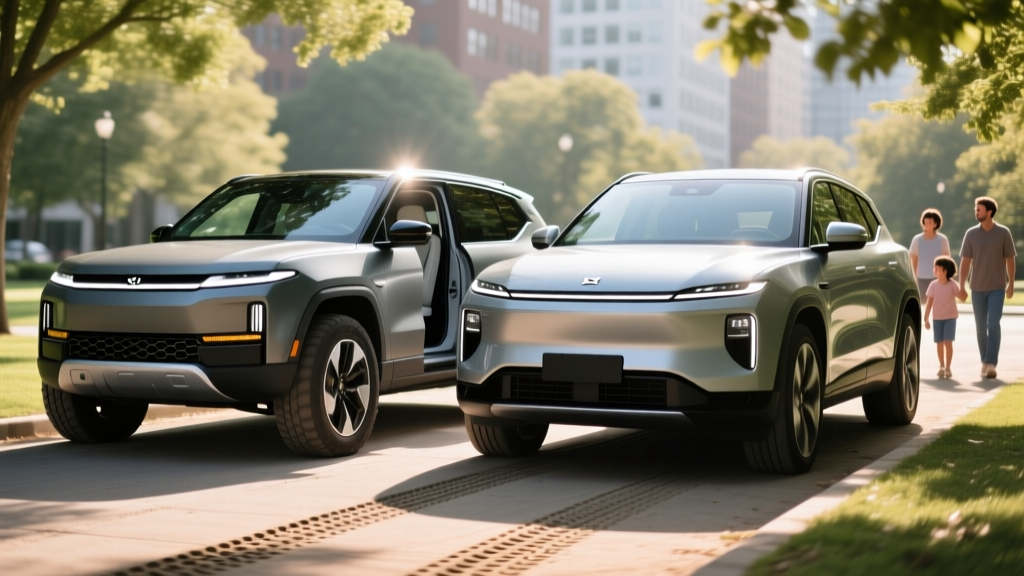
Rivian's two-row R1S has earned its place as one of the most capable electric SUVs on the road — a 3-row adventure rig with serious off-road chops and a premium price tag. The upcoming R2, expected to begin deliveries in early 2026, promises to distill much of that capability into a smaller, more affordable package. But "smaller and cheaper" doesn't automatically mean "better for you." This comparison breaks down every spec that matters — range, charging, performance, cargo, pricing, and tax-credit eligibility — so you can pick the right Rivian SUV for your driveway.
Side-by-Side Spec Table: R1S vs R2 at a Glance
| Spec | 2026 Rivian R1S (Dual Large) | 2026 Rivian R2 (Dual Standard) [Est.] |
|---|---|---|
| EPA Range | 410 mi (confirmed) | ~330 mi (preliminary) |
| Real-World Highway Range | ~310-340 mi | ~250-280 mi (est.) |
| Battery Usable kWh | ~141 kWh (NMC) | ~95 kWh (NMC est.) |
| Peak DC Fast Charge | ~220 kW | ~200 kW (est.) |
| 10-80% DCFC Time | ~30 min | ~25 min (est.) |
| Level 2 Charge Rate | 11.5 kW (~19 kW AC onboard) | 11.5 kW (est.) |
| 0-60 mph | 3.4 sec (Dual) | ~3.6 sec (est.) |
| Horsepower | 665 hp (Dual) | ~450 hp (est.) |
| Efficiency (MPGe) | 73 MPGe combined | ~90 MPGe (est.) |
| Cargo Volume (behind 2nd row) | 57.1 cu ft | ~35 cu ft (est.) |
| Seating | 3 rows / 7 passengers | 2 rows / 5 passengers |
| Towing Capacity | 7,700 lbs | ~4,500 lbs (est.) |
| Base MSRP | $84,900 (Adventure Dual Large) | ~$45,000 (announced) |
| Battery/Powertrain Warranty | 8 yr / 175,000 mi | 8 yr / 175,000 mi (expected) |
Sources: EPA fueleconomy.gov for R1S confirmed figures; Rivian R2 announcement page for preliminary R2 specs.
Range and Efficiency: Big Battery vs. Lean Platform
The R1S carries a massive ~141 kWh usable battery pack (NMC chemistry), giving it an EPA-rated 410 miles on the Dual Large configuration. That's genuinely exceptional for a 3-row SUV. But big batteries come with real-world trade-offs: the R1S weighs over 6,800 lbs, and highway driving at 75+ mph with climate control running will pull that number down to roughly 310-340 miles. In cold weather (below 30°F), expect another 15-20% reduction — so winter road trips may deliver closer to 260-290 miles of practical range.
The R2's smaller platform (~95 kWh estimated) targets around 330 miles EPA. With less mass to move, the R2 should achieve better efficiency — roughly 90 MPGe combined vs. the R1S's 73 MPGe. That means lower per-mile electricity costs and less strain on the battery during daily driving. Real-world highway range for the R2 will likely land around 250-280 miles, which is adequate for most commutes and moderate road trips but noticeably tighter than the R1S for long-haul travel.
Bottom line: If you regularly drive 300+ miles between charging stops, the R1S's larger battery buffer matters. If your typical day is under 100 miles with occasional 200-mile trips, the R2's efficiency advantage saves money without practical sacrifice.
Charging Speed and Network Reality
Both vehicles use the NACS (Tesla-style) connector natively, giving them access to Rivian's growing Adventure Network (300+ stations planned by late 2026) and the full Tesla Supercharger network — currently over 19,000 stalls in North America.
| Charging Level | R1S (Dual Large) | R2 (Est.) |
|---|---|---|
| Level 1 (120V / 12A) | ~1.4 kW / ~3 mi/hr | ~1.4 kW / ~4 mi/hr |
| Level 2 (240V / 48A) | 11.5 kW / ~25 mi/hr | 11.5 kW / ~32 mi/hr |
| DC Fast Charge (peak) | ~220 kW / 10-80% in ~30 min | ~200 kW / 10-80% in ~25 min |
The R2's smaller battery gives it a subtle charging advantage: even with a slightly lower peak charge rate (~200 kW vs. ~220 kW), it fills a smaller energy pool faster. A 10-80% session in roughly 25 minutes means you add about 230 miles of range in the time it takes to grab lunch. The R1S adds roughly 290 miles in 30 minutes — more absolute range, but the larger pack means longer sessions if you need to fill beyond 80%.
Charge curve reality check: Both vehicles will taper significantly above 80% SoC. Rivian's thermal management system (shared architecture) handles preconditioning well, but don't plan road trips around peak kW numbers — sustained average rate matters more. Expect the R1S to average around 150-170 kW over a 10-80% session, and the R2 around 140-160 kW.
Performance, Capability, and What You Actually Feel
The R1S Dual Motor produces 665 hp and hits 0-60 mph in 3.4 seconds. That's sports-car acceleration in a vehicle that can tow 7,700 lbs and ford 3+ feet of water. The quad-motor R1S (not compared here) drops that to under 3.0 seconds. Off-road, the R1S offers adjustable air suspension with up to 14.9 inches of ground clearance, a dedicated off-road mode, and genuine rock-crawling capability.
The R2 is expected to deliver around 450 hp in its dual-motor configuration with a 0-60 time near 3.6 seconds — still seriously quick. However, Rivian has positioned the R2 as more of a lifestyle crossover than a hardcore off-roader. Ground clearance and approach/departure angles will be more modest, and towing capacity drops to an estimated 4,500 lbs. It'll handle gravel roads and light trails fine, but it's not built for Moab.
Price, Tax Credits, and the Value Equation
This is where the comparison shifts dramatically. The R1S starts at $84,900 for the Adventure Dual Large trim. Well-equipped examples with the Max battery or quad-motor configuration push past $100,000.
The R2's announced starting price is ~$45,000, with a dual-motor Standard battery variant expected around $52,000-$55,000. That's nearly a $40,000 gap before incentives.
Federal Tax Credit (§30D) Eligibility — 2026 Rules
- MSRP Cap: SUVs must be under $80,000. The R1S Dual Large at $84,900 base exceeds this cap and does not qualify for the $7,500 federal credit at the Adventure Dual Large trim. Lower trims or the Standard battery (if offered under $80K) may qualify — verify on IRS.gov.
- R2 Eligibility: At ~$45,000-$55,000, the R2 clears the MSRP cap easily.
- Buyer Income Cap: AGI must be ≤$150K (single), ≤$225K (head of household), ≤$300K (joint). Both vehicles are subject to this.
- Battery Sourcing: Critical minerals and battery component requirements phase up annually. Rivian's supply chain has been evolving — check the IRS's qualified vehicle list before purchasing, as eligibility can change mid-year.
- Point-of-Sale Transfer: Both vehicles can apply the credit as a point-of-sale discount if eligibility is confirmed at purchase.
Net effective price (if R2 qualifies for full $7,500): R2 Standard Dual ~$47,500 vs. R1S Dual Large ~$84,900 (no credit). The value gap widens to nearly $45,000.
Ownership Costs: Efficiency, Insurance, and Maintenance
| 5-Year Cost Factor | R1S (Dual Large) | R2 (Dual Standard) [Est.] |
|---|---|---|
| Electricity (15K mi/yr, $0.16/kWh avg) | ~$5,800 | ~$4,200 |
| Insurance (national avg, good driver) | ~$14,000 | ~$9,500 |
| Maintenance (tires, cabin filter, fluid) | ~$2,500 | ~$2,000 |
| Depreciation (est. 5-yr) | ~$38,000 | ~$18,000 |
| Est. 5-Year Total Cost | ~$60,300 | ~$33,700 |
The R1S costs significantly more to insure — premium SUVs with $85K+ price tags carry higher comprehensive and collision premiums. The R2's lower MSRP and smaller battery replacement cost translate to meaningfully cheaper insurance. Electricity costs also favor the R2 thanks to its superior MPGe rating: over 75,000 miles, you'll save roughly $1,600 on charging alone.
Depreciation is the wildcard. Rivian's brand is still maturing, and the R1S has seen steep initial depreciation (common for luxury EVs). The R2, as a more mass-market product, may hold value better proportionally — but we won't know until used-market data accumulates over 2-3 years.
Category Winners: Where Each Rivian Excels
410 mi EPA vs. ~330 mi. For road-trippers and those in charging deserts, the R1S's larger battery provides a crucial buffer.
Smaller battery fills faster — 10-80% in ~25 min vs. ~30 min. More practical for quick pit stops.
~$45K base, qualifies for $7,500 credit, lower insurance and electricity costs. The R1S is nearly double the effective price.
7,700-lb towing, 3-row seating, serious off-road clearance. The R2 is a crossover, not an adventure truck.
~90 MPGe vs. 73 MPGe. Lighter, smaller, less energy per mile — cheaper to feed daily.
57.1 cu ft behind row 2, 7-passenger seating. The R2's ~35 cu ft and 5-seat layout can't compete for big families.
Pros and Cons: The Honest Summary
R1S Pros
- 410-mi EPA range — class-leading for 3-row SUVs
- Genuine off-road capability with air suspension
- 7,700-lb towing capacity
- Premium build quality and materials
- Proven platform with years of real-world data
R1S Cons
- $84,900+ base price, likely ineligible for $7,500 credit
- Heavy — 6,800+ lbs hurts tire wear and efficiency
- Higher insurance premiums
- 30-min 10-80% charge time is average, not class-leading
R2 Pros
- ~$45K starting price, likely qualifies for full $7,500 credit
- Better efficiency (~90 MPGe) means lower daily costs
- Faster 10-80% charging (~25 min)
- NACS native — full Supercharger access from day one
- More manageable size for urban parking
R2 Cons
- Pre-production — final specs not EPA-certified yet
- ~330-mi range is good, not exceptional
- 2-row / 5-seat only — no 3-row option
- Lower towing capacity (~4,500 lbs)
- Unproven platform — early-adopter risk
The Decision Framework: Which Rivian SUV Is Right for You?
Choose the R1S if:
- You need 3 rows of seating for 6-7 passengers regularly
- You tow a boat, trailer, or camper (7,700-lb capacity)
- You take frequent 300+ mile road trips and want maximum range buffer
- Serious off-roading (rock crawling, deep snow, overlanding) is part of your lifestyle
- Budget is not your primary constraint and you value proven capability
Choose the R2 if:
- You're a 1-4 person household that doesn't need a 3rd row
- Daily commuting and weekend trips under 250 miles are your norm
- You want the lowest total cost of ownership with federal tax credit eligibility
- You live in an urban or suburban area where a smaller SUV is more practical
- You're comfortable with early-adopter risk on a new platform in exchange for significant savings
Final Recommendation
These two vehicles serve fundamentally different buyers. The R1S is the no-compromise adventure SUV — it does everything a large family could need, from towing to off-roading to cross-country road trips, with a range buffer that reduces charging stress. Its price reflects that versatility, and the tax-credit ineligibility at the base trim stings.
The R2 is the rational daily driver — it delivers 80% of the Rivian experience at roughly 50% of the cost. For the vast majority of EV shoppers who don't need 3 rows or 7,700-lb towing, the R2 is the smarter financial decision, especially with the $7,500 federal credit bringing effective pricing into the low $40Ks.
If you can wait for R2 deliveries and your needs fit a 2-row crossover, the value proposition is hard to argue with. If you need capability today and budget allows, the R1S remains one of the most complete electric SUVs available.
Frequently Asked Questions
Can I reserve the R2 now, and when will deliveries start?
Rivian opened R2 reservations with a refundable deposit. Production at Rivian's Normal, Illinois facility is targeted for early-to-mid 2026, with initial deliveries to reservation holders. Exact timing depends on your configuration and deposit position. Check rivian.com/r2 for current estimates.
Will the R2 have access to Tesla Superchargers?
Yes. The R2 ships with a native NACS charge port, giving it plug-and-charge access to the Tesla Supercharger network without an adapter — same as the current R1S (2025+ models with NACS).
Does the R1S qualify for any federal tax credit in 2026?
The base R1S Adventure Dual Large at $84,900 exceeds the IRS's $80,000 MSRP cap for SUVs under §30D rules. However, if Rivian offers a Standard battery R1S trim below $80,000, that configuration could qualify. Always verify current eligibility on the IRS qualified vehicle list before purchase, as battery sourcing requirements also apply.
How does R2 cargo space compare to competitors like the Tesla Model Y?
The R2's estimated ~35 cu ft behind the second row is competitive with compact electric SUVs. The Tesla Model Y offers about 30 cu ft behind its second row (76 cu ft with seats folded). Final R2 cargo figures will be confirmed closer to launch.
Which Rivian will hold its value better?
Depreciation data for the R2 doesn't exist yet. The R1S has experienced typical luxury-EV depreciation (roughly 35-45% over 3 years based on current used listings). The R2's lower entry price and broader market appeal could mean better percentage retention, but high production volume could also soften used prices. This is a wait-and-see metric.
Is the R2 built on the same platform as the R1S?
No. The R2 uses Rivian's new mid-size platform, which is lighter, more cost-efficient to manufacture, and designed for higher production volume. The R1S uses the original R1 platform. They share software architecture and design language, but the underlying structures are distinct.