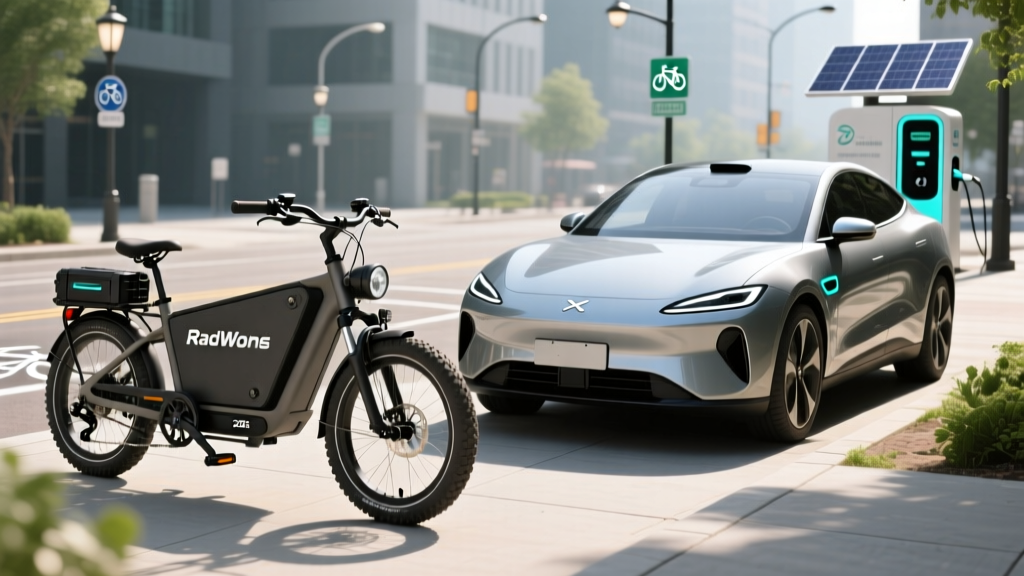
If you're searching for a RadWagon electric cargo bike and wondering whether it can replace a car — or how it stacks up against a compact EV like the Chevy Equinox EV or Nissan Leaf — here is the quick, practical answer. A RadWagon-class e-cargo bike costs roughly $1,800–$2,100 upfront, "refuels" for pennies per charge, and handles 2–4 mile urban errands with kids or groceries in tow. A compact EV starts around $28,000–$38,000 (before incentives), delivers 230–320 miles of EPA range, and handles highway trips, winter weather, and family hauling at scale. They solve fundamentally different problems. The RadWagon is a car-supplement for last-mile cargo runs; the EV is a car-replacement. Most households that thrive with an e-cargo bike already own or lease an electrified car for longer trips. Below, we break down the exact numbers so you can decide which — or whether both — belongs in your 2026 garage.
The 30-Second Verdict
- RadWagon e-cargo bike: Best for urban errands under 5 miles, fair-weather hauling, and buyers who already have a car for highway/rainy-day use. Total 5-year cost: ~$2,500–$3,200.
- Compact EV (e.g., Chevy Equinox EV, Hyundai Kona Electric): Best for all-weather commuting, family transport, road trips, and single-car households. Total 5-year cost: ~$32,000–$42,000 (before incentives).
- Bottom line: They're complementary, not competitive. Buy the EV first if you need a primary vehicle. Add the e-cargo bike if you want to eliminate short car trips.
What the RadWagon Electric Cargo Bike Actually Offers in 2026
The RadWagon line from Rad Power Bikes has evolved through several generations, with the latest models (RadWagon 5 and RadWagon 5 ST) featuring a 750W rear-hub motor, a 672 Wh (48V, 14 Ah) lithium-ion battery, and a claimed range of 25–45 miles per charge depending on pedal-assist level, cargo weight, and terrain. The cargo deck supports up to 350 lbs of payload, making it viable for two small children in approved child seats or a week's worth of groceries.
Key 2026 RadWagon specs to know:
- Motor: 750W (peak) rear hub, Class 2 (throttle up to 20 mph) or Class 3 (pedal-assist up to 28 mph with firmware update in some jurisdictions)
- Battery: 672 Wh, lithium-ion (NMC chemistry), removable for indoor charging
- Range: 25–45 miles (real-world: expect ~30 miles with 100+ lbs of cargo and moderate assist)
- Charge time: ~5–6 hours on a standard 120V outlet (0–100%); no fast-charging option
- Top speed: 20 mph (throttle), 28 mph (pedal-assist, where legal)
- Price: ~$1,899–$2,099 MSRP depending on model and accessories
- Weight: ~76–85 lbs (varies by configuration)
The RadWagon does not qualify for the federal §30D EV tax credit, which applies only to four-wheeled vehicles meeting specific battery-sourcing, MSRP, and buyer-income requirements per IRS guidelines. However, some states and municipalities offer e-bike rebates — Denver, Colorado, for example, has offered up to $300–$1,700 for cargo e-bikes through local programs. Check your local energy office or transportation authority for current availability.
RadWagon vs Compact EV: The Numbers Side by Side
To make a fair comparison, we're pitting the RadWagon against two popular compact EVs in 2026: the Chevrolet Equinox EV (2LT, ~$33,000 MSRP) and the Hyundai Kona Electric (SE, ~$32,975 MSRP). These are the vehicles a RadWagon shopper might cross-shop if they're deciding whether to go car-free or car-lite.
| Spec / Metric | RadWagon 5 (E-Cargo Bike) | Chevy Equinox EV 2LT | Hyundai Kona Electric SE |
|---|---|---|---|
| Base MSRP (2026) | ~$1,899 | ~$33,000 | ~$32,975 |
| Federal Tax Credit (§30D) | Not eligible | Up to $7,500 (eligibility varies) | Up to $7,500 (eligibility varies) |
| Effective Price After Credit | ~$1,899 | ~$25,500–$33,000 | ~$25,475–$32,975 |
| EPA Range | N/A (25–45 mi claimed) | ~319 mi (EPA est.) | ~261 mi (EPA est.) |
| Battery Capacity | 0.672 kWh (672 Wh) | ~85 kWh (usable) | ~64.8 kWh (usable) |
| "Fuel" Cost Per Mile | ~$0.003–$0.005 | ~$0.04–$0.06 (home charging) | ~$0.04–$0.06 (home charging) |
| Charge Time (0–100%) | ~5–6 hrs (120V) | ~9.5 hrs (Level 2, 11.5 kW) | ~6.5 hrs (Level 2, 10.9 kW) |
| DC Fast Charge (10–80%) | N/A | ~30 min (up to 150 kW peak) | ~43 min (up to 100 kW peak) |
| Top Speed | 20–28 mph | ~115 mph (electronically limited) | ~108 mph |
| Annual Insurance (avg.) | ~$0–$200 (optional) | ~$1,800–$2,400 | ~$1,600–$2,200 |
| Annual Maintenance | ~$100–$200 | ~$200–$400 | ~$200–$400 |
| Weather Capability | Fair-weather (limited rain/snow) | All-season, climate-controlled | All-season, climate-controlled |
Sources: fueleconomy.gov, manufacturer spec sheets, Rad Power Bikes. Tax credit eligibility depends on buyer income, vehicle MSRP caps, and battery-sourcing requirements — consult the IRS or a tax professional.
5-Year Cost of Ownership: Where the Math Gets Interesting
The headline price difference is massive, but ownership costs tell a more nuanced story. Below, we model a 5-year horizon assuming 3,000 miles/year on the RadWagon (urban errands, ~12 miles/day, 5 days/week) and 12,000 miles/year on the EV (commuting + road trips).
| Cost Category (5 Years) | RadWagon 5 | Chevy Equinox EV 2LT | Gas Compact (Toyota RAV4, baseline) |
|---|---|---|---|
| Purchase Price | $1,899 | $33,000 | $30,000 |
| Tax Credit Applied | $0 | –$7,500* | $0 |
| Fuel / Electricity | $45 | $2,400 | $6,600 |
| Maintenance | $750 | $1,500 | $3,500 |
| Insurance | $500 (optional) | $10,500 | $8,500 |
| Depreciation (est.) | $1,200 | $12,000 | $13,500 |
| Total 5-Year Cost | ~$3,394 | ~$39,900 | ~$48,600 |
*§30D credit eligibility varies. Assumes $0.13/kWh home charging for EV, $3.30/gal gas for RAV4 at 30 MPG combined, and national-average insurance rates. See fueleconomy.gov for vehicle-specific MPGe data.
The RadWagon's 5-year cost is roughly one-tenth that of the Equinox EV — but they're not doing the same job. The RadWagon replaces short car trips; the EV replaces all car trips. If you already own a vehicle and use the RadWagon to eliminate 3,000 miles of driving per year, the e-cargo bike pays for itself in fuel and wear savings within 18–24 months.
Real-World Ownership: What First-Time E-Cargo Bike Buyers Should Know
E-cargo bikes occupy a unique space between cycling and driving. Here are the practical realities that spec sheets don't capture:
Charging and Storage
The RadWagon's 672 Wh battery charges from any standard 120V outlet — no special electrical work required. A full charge costs roughly $0.09 at the national average electricity rate of $0.16/kWh. However, you need secure, covered storage. At 76–85 lbs, the RadWagon is not something you carry up three flights of stairs nightly. If you lack a garage, carport, or ground-floor storage, theft and weather exposure become serious concerns. Budget $200–$400 for a heavy-duty U-lock and chain, and consider e-bike-specific insurance (typically $150–$300/year through providers like Velosurance or Sundays).
Cold Weather and Range Loss
Lithium-ion batteries lose capacity in cold temperatures. At 32°F, expect the RadWagon's range to drop by 20–35% compared to 70°F conditions — meaning your 35-mile summer range becomes roughly 22–28 miles in winter. This matters less for a cargo bike (most trips are short), but it's a real limitation. Store and charge the battery indoors when possible; charging a cold battery degrades it faster.
Cargo Capacity vs an EV
The RadWagon's 350-lb payload capacity handles two small children (in approved Yepp or Thule seats, ~$100–$200 each) or 3–4 grocery bags. It does not handle highway-speed travel, rain/snow commutes comfortably, or large cargo like furniture. A compact EV offers 25–52 cu ft of cargo space (seats folded), climate control, and crash protection. For a single-car household, the EV is non-negotiable. For a two-car household, the RadWagon can replace the second car for local errands.
Safety and Legal Considerations
Class 2 e-bikes (throttle up to 20 mph) are legal on most roads and bike paths in the U.S., but local regulations vary. Some jurisdictions restrict cargo e-bikes from sidewalks and multi-use paths. Helmets are required in most states for riders under 18, and strongly recommended for all riders — especially when carrying children. Unlike an EV, the RadWagon has no airbags, crumple zones, or NHTSA crash-test ratings. You are the crumple zone.
Common Misconceptions: Myth vs Fact
| Myth | Fact |
|---|---|
| "An e-cargo bike can replace my car entirely." | It can replace short urban trips (under 5 miles). Highway travel, severe weather, and large cargo still require a car. Most successful e-cargo bike owners keep one car. |
| "The RadWagon qualifies for the $7,500 federal EV tax credit." | The §30D credit applies only to four-wheeled motor vehicles. E-bikes are not eligible. Some state/local e-bike rebates exist — check your municipality. |
| "E-bikes don't need maintenance." | Chains stretch, brake pads wear, tires puncture, and batteries degrade. Budget $100–$200/year for tune-ups and consumables. Battery replacement (after 3–5 years or ~500 charge cycles) costs $400–$600. |
| "Charging an e-bike is basically free." | It's very cheap (~$0.09 per full charge), but not free. Over 5 years at 3,000 miles/year, electricity costs roughly $45. That's still 98% less than gas for equivalent car trips. |
| "An EV and an e-cargo bike are the same purchase decision." | They solve different problems at different scales. An EV is a $25,000–$40,000 primary-vehicle decision. An e-cargo bike is a $1,900–$2,100 last-mile supplement. |
Decision Framework: Should You Buy the RadWagon, an EV, or Both?
Choose the RadWagon Electric Cargo Bike If:
- You already own a car (or EV) for longer trips and bad weather
- Most of your errands are within 3–5 miles of home
- You have secure, ground-level storage (garage, shed, or carport)
- You live in a relatively flat area with bike-lane infrastructure
- You want to eliminate short car trips to save on fuel, parking, and wear
- Your budget is under $2,500 and you don't need financing
Choose a Compact EV (Equinox EV, Kona Electric, etc.) If:
- You need a primary vehicle for commuting, road trips, and all-weather driving
- You have access to home Level 2 charging (or can install it for $500–$1,500)
- You transport passengers regularly (children, carpools)
- You drive more than 30 miles per day on average
- You qualify for the §30D tax credit (check income caps and MSRP limits at irs.gov)
- You need crash-tested safety features and climate control
Choose Both If:
- You're a two-adult household replacing a two-car setup with one EV + one e-cargo bike
- You want to maximize household savings: the EV handles commuting and road trips, the RadWagon handles school runs and grocery trips
- You have the storage and charging infrastructure for both
What a First-Time EV Buyer Should Know (If You're Considering the EV Path)
If the comparison above has you leaning toward a compact EV instead of (or alongside) the RadWagon, here are the essentials:
- Home charging is the backbone. A Level 2 home charger (240V, 32–48A, 7.7–11.5 kW) adds 25–40 miles of range per hour and costs $500–$1,500 installed, depending on panel capacity and run length. If your home has a 100A electrical panel, you may need a $1,500–$3,000 panel upgrade to support a 48A charger. A licensed electrician should assess this.
- Real-world range is 15–25% below EPA estimates on the highway. A 319-mile EPA rating translates to roughly 240–270 miles at 70 mph in moderate weather, and 200–230 miles in cold weather (below 30°F). Plan road trips around 200-mile legs to stay comfortable.
- DC fast charging peaks and tapers. A "150 kW peak" charge rate is sustained only between ~10–50% State of Charge. Above 80%, charging slows dramatically to protect the battery. A 10–80% charge in 30 minutes is realistic; 0–100% at a DC fast charger is inefficient and unnecessary.
- The §30D tax credit is not guaranteed. Eligibility depends on your adjusted gross income (caps: $150K single, $300K joint), the vehicle's MSRP (caps: $55K sedans, $80K SUVs/trucks), and battery mineral/component sourcing. Always verify current rules on irs.gov before purchasing.
Frequently Asked Questions
Can I ride the RadWagon in the rain?
The RadWagon has an IP-rated water-resistant battery and display, and can handle light rain. However, it is not waterproof. Heavy downpours, standing water, and snow/ice significantly reduce safety and traction. Most e-cargo bike owners treat it as a fair-weather vehicle and use a car for wet days.
How long does the RadWagon battery last before replacement?
Lithium-ion e-bike batteries typically retain 80% of original capacity after 500–800 full charge cycles. At 3,000 miles/year and 30 miles per charge, that's roughly 100 cycles per year — meaning the battery should last 5–8 years before noticeable degradation. A replacement battery costs $400–$600 from Rad Power Bikes.
Is the RadWagon street-legal without a license or registration?
Yes, in most U.S. states. Class 2 e-bikes (throttle up to 20 mph) are treated as bicycles under federal law (CPSC) and most state laws. No driver's license, registration, or insurance is legally required, though insurance is strongly recommended. Always verify your local and state regulations.
How does the RadWagon compare to gas for cost per mile?
The RadWagon costs roughly $0.003–$0.005 per mile in electricity. A gas car averaging 28 MPG at $3.30/gallon costs ~$0.12 per mile in fuel alone — not including maintenance, insurance, or depreciation. For a 3-mile grocery trip, the RadWagon costs about $0.01; the gas car costs about $0.36 in fuel.
Should I buy the RadWagon or wait for a better e-cargo bike?
The RadWagon is one of the most affordable and well-supported e-cargo bikes on the market, with a strong dealer and service network. Competitors like the Aventon Abound (~$1,399) and Lectric XPress 750 (~$1,499) offer similar capability at lower prices, but Rad Power Bikes has broader accessory compatibility and customer support. If your needs are met by current specs, there's no compelling reason to wait — e-cargo bike technology is mature at this price point.