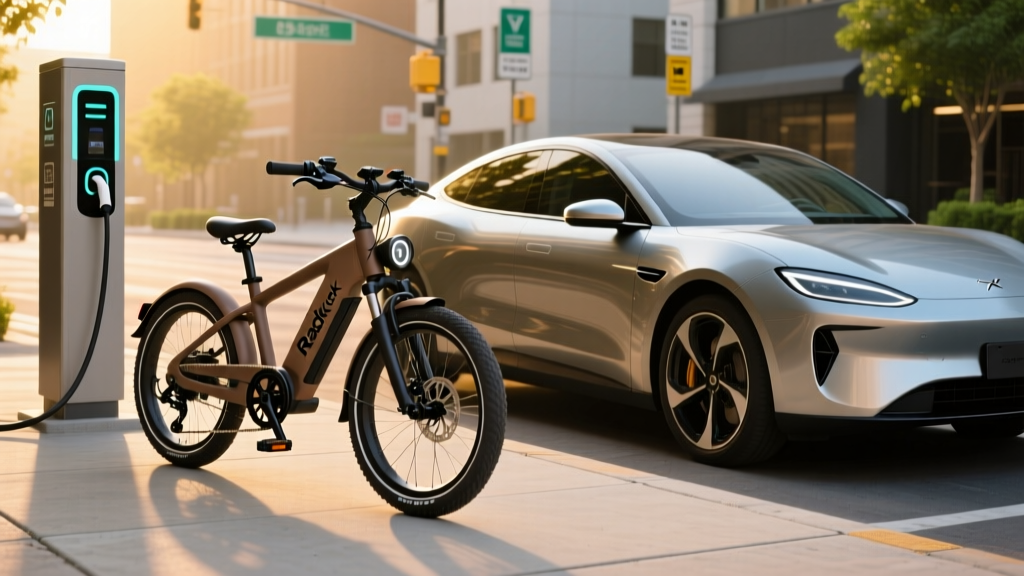
If you're researching the Rad Power RadKick belt drive electric lightweight bike as a commute alternative to a full electric vehicle, here's the practical answer: the RadKick is a compelling last-mile and urban commuter solution at roughly $1,500-$1,800, but it serves a fundamentally different use case than an EV. An e-bike handles 3-15 mile urban commutes at pennies per charge with zero parking hassle, while an EV covers highway travel, weather protection, cargo, and passenger needs. Most smart commuters aren't choosing one or the other—they're using both.
Quick Verdict
Rad Power RadKick (or similar belt-drive e-bike): Best for solo urban commutes under 15 miles, fair-weather riding, and buyers wanting minimal maintenance and sub-$2,000 entry cost.
Budget EV (e.g., Chevy Equinox EV, Nissan Leaf): Best for all-weather commuting, highway travel, family hauling, and buyers with home Level 2 charging access.
Both: The ideal setup for many households—one EV for longer trips and bad weather, one e-bike for daily solo errands and commutes.
What the RadKick Belt Drive E-Bike Actually Is
The Rad Power RadKick (and similar belt-drive lightweight e-bikes in the Rad Power lineup) prioritizes low maintenance and clean operation. A Gates Carbon Drive belt replaces the traditional chain, eliminating the need for lubrication, reducing grease transfer to clothing, and extending drivetrain life to roughly 2-3x that of a chain. The trade-off is a higher initial drivetrain cost and the requirement for a frame with a belt-split design (since belts can't be broken and re-joined like chains).
Typical specs for this category in 2026:
- Motor: 250W-500W rear hub or mid-drive (Class 1 or Class 2, 20 mph max assist)
- Battery: 360Wh-500Wh lithium-ion (removable)
- Range: 20-45 miles per charge (varies heavily by assist level, rider weight, terrain)
- Weight: 35-48 lbs (lightweight for e-bikes, heavy vs. acoustic bikes)
- Charge time: 3-5 hours on standard 120V household outlet (no special equipment needed)
- Price: $1,499-$1,899 MSRP depending on configuration
Unlike electric vehicles, e-bikes are not eligible for the federal §30D tax credit. However, some states and municipalities offer e-bike rebates (typically $300-$1,000) through local sustainability programs. Check your city or utility provider for current incentives—these vary enormously by jurisdiction and change frequently.
E-Bike vs EV: The Real Cost Comparison
The financial case for an e-bike versus an EV comes down to your commute distance, household vehicle needs, and whether you already own a car. Here's a concrete 5-year cost breakdown for a solo commuter traveling 10 miles round-trip, 250 days per year:
| Category | Belt-Drive E-Bike | Budget EV (e.g., Equinox EV) | Gas Car (30 MPG) |
|---|---|---|---|
| Purchase price | $1,699 | $33,600 (after ~$7,500 credit*) | $28,000 |
| Fuel/energy (5 yr) | $125 ($0.05/charge) | $2,250 ($0.15/kWh home) | $7,500 ($3.50/gal) |
| Maintenance (5 yr) | $400 (tires, brake pads, belt inspection) | $1,500 (tires, cabin filter, fluid top-offs) | $3,500 (oil, filters, brakes, belts) |
| Insurance (5 yr) | $0-$600 (optional homeowner's rider) | $6,000-$9,000 | $5,000-$7,500 |
| Parking (urban, 5 yr) | $0 | $0-$6,000 | $0-$6,000 |
| Total 5-year cost | $2,224-$2,824 | $43,350-$48,850 | $44,000-$50,000 |
| Cost per mile | $0.18-$0.23 | $3.47-$3.91 | $3.52-$4.00 |
*Federal §30D credit eligibility depends on MSRP caps ($55,000 for cars), buyer income limits, and battery component/critical mineral sourcing requirements per current IRS rules. Not all buyers qualify. Consult a tax professional.
The e-bike's cost advantage is staggering—but only if it actually replaces car trips. If you still need a vehicle for weekend trips, grocery hauling, bad weather days, or passenger transport, the e-bike becomes an addition to your household fleet, not a replacement. In that scenario, you're paying for both.
Range, Weather, and the Real-World Limitations Nobody Talks About
E-bike manufacturers quote range figures under ideal conditions: flat terrain, moderate assist, 165-lb rider, 70°F, no wind. Real-world range on a RadKick-class e-bike drops significantly under common conditions:
Range Myths vs Reality
| Claim | Reality |
|---|---|
| "45-mile range" | Expect 25-35 miles at moderate assist (Level 3 of 5) with a 180-lb rider on mixed terrain. Full-throttle riding cuts this to 15-20 miles. |
| "All-weather commuting" | E-bikes are ridable in rain, but cold weather (below 40°F) reduces battery capacity by 15-30%. Wet roads increase braking distance and accelerate component wear. Most commuters switch to a car or transit below 35°F or in heavy precipitation. |
| "No maintenance needed" | Belt drives eliminate chain maintenance, but you still need tire replacements ($40-80 each, every 1,500-3,000 miles), brake pad changes ($20-50, every 2,000-4,000 miles), and eventual battery replacement ($400-600, typically at 3-5 years or 500-800 charge cycles). |
| "Charge anywhere" | Charging requires access to a standard 120V outlet for 3-5 hours. If you live in an apartment without outlet access near your bike storage, you'll need to carry the battery indoors—a 7-10 lb inconvenience. |
For context, a budget EV like the 2026 Chevy Equinox EV offers an EPA-estimated 319 miles of range (expect 260-280 highway, less in cold weather), DC fast charging at up to 150 kW (10-80% in approximately 30 minutes), and full climate control. The EV solves every problem the e-bike creates—but at 20-30x the purchase price and with parking, insurance, and registration overhead.
Home Charging and Infrastructure: What Each Option Requires
One of the most overlooked factors in the e-bike vs EV decision is charging infrastructure:
E-Bike Charging
- Requirement: Standard 120V household outlet
- Charge time: 3-5 hours (0-100%)
- Installation cost: $0 (assuming accessible outlet)
- Apartment-friendly: Yes, if you can bring the battery indoors (check building rules on lithium battery storage)
- Public charging: Virtually nonexistent—e-bike charging infrastructure doesn't exist in any meaningful way
EV Home Charging
- Level 1 (120V): 3-5 miles of range per hour of charging. Sufficient only for daily driving under 30 miles with overnight charging.
- Level 2 (240V): 25-40 miles of range per hour. Recommended for most EV owners. Requires a dedicated 40A or 50A circuit.
- Level 2 installation cost: $500-$2,500 depending on panel capacity, circuit run distance, and local permit requirements. Older homes with 100A panels may need a $2,000-$5,000 panel upgrade.
- Apartment/condo: Significantly harder. Requires landlord/HOA approval, dedicated parking with electrical access, and often shared-cost negotiations.
If you lack reliable home or workplace EV charging access, an e-bike (which you can charge at any outlet) may actually be more practical than an EV for daily commuting—even though public DC fast chargers exist for road trips. According to the U.S. Department of Energy, public charging infrastructure continues to expand, but reliability and availability remain inconsistent in many regions.
Decision Framework: Which Should You Choose?
Choose the E-Bike If:
- Your one-way commute is under 12 miles and mostly on bike lanes or low-speed roads
- You live in a mild climate (fewer than 60 days/year below 40°F or with heavy precipitation)
- You have secure bike storage at home and work (theft is the #1 e-bike ownership risk)
- You don't regularly carry passengers or more than 20 lbs of cargo
- You want total commute costs under $500/year
- You already own a car for longer trips and bad weather
Choose the EV If:
- Your commute exceeds 15 miles one-way or includes highway segments
- You live in a region with harsh winters or frequent rain
- You need to carry passengers, children, or significant cargo regularly
- You have home Level 2 charging access (or can install it)
- You want one vehicle to handle all transportation needs
- You qualify for the §30D federal tax credit and/or state incentives, bringing effective purchase price closer to a gas car
Choose Both If:
- You're a two-person household that can share one EV for errands and road trips while using e-bikes for daily solo commutes
- You want to reduce household transportation costs by 40-60% while maintaining flexibility
- You have secure storage for both and access to charging for both
Common Misconceptions Addressed
| Misconception | Fact |
|---|---|
| "E-bikes are toys, not real transportation" | In the Netherlands, e-bikes have replaced cars for 25%+ of commutes under 10 miles. In U.S. cities with bike infrastructure (Portland, Minneapolis, NYC), e-bike commuting is growing 15-25% annually. |
| "An EV is always greener than an e-bike" | An e-bike uses roughly 5-8 Wh/mile versus an EV's 250-350 Wh/mile. Even accounting for grid electricity sources, e-bikes have a dramatically smaller energy and materials footprint per passenger-mile. |
| "I don't need a car if I have an e-bike" | For most Americans outside dense urban cores, an e-bike replaces 40-70% of car trips—not all of them. You'll still need a car (or car-share/rental access) for highway travel, big-box shopping, and bad-weather days. |
| "Belt drives are maintenance-free" | Belt drives are lower maintenance—no lubrication, no stretch, longer life. But they still require periodic tension checks, sprocket inspection, and eventual replacement (typically $150-$250 at 10,000-15,000 miles). |
| "EVs are too expensive for commuters" | After federal and state incentives, a 2026 Chevy Equinox EV or used Tesla Model 3 can cost $25,000-$35,000, with fuel and maintenance savings of $1,500-$2,500/year vs. gas. Over 5 years, total cost of ownership often beats a comparable gas car. |
First-Time Buyer Checklist
Whether you're buying an e-bike or an EV, these are the questions that determine satisfaction:
For the E-Bike Buyer:
- Test ride before buying. Geometry, motor engagement feel, and weight distribution vary enormously. A bike that looks perfect on paper may feel wrong at 18 mph in traffic.
- Verify local e-bike laws. Class 1 and 2 e-bikes (20 mph max) are legal on most bike paths. Class 3 (28 mph) may be restricted. Some cities require helmets for all e-bike riders regardless of age.
- Budget $200-$400 for accessories. You'll need a quality U-lock or chain ($80-$150), front and rear lights ($50-$100), fenders ($40-$80), and a rack or panniers for cargo ($60-$150).
- Check homeowner's/renter's insurance. Many policies cover e-bikes up to $1,500-$2,500 under personal property, but verify. Dedicated e-bike insurance (e.g., Velosurance, Sundays) runs $100-$300/year for theft and liability coverage.
- Plan battery end-of-life. Lithium-ion batteries degrade to 70-80% capacity at 500-800 charge cycles (roughly 3-5 years of daily use). Replacement batteries cost $400-$600. Factor this into your 5-year cost.
For the EV Buyer:
- Get a Level 2 charging quote before purchasing. Call a licensed electrician for a site assessment. If your panel needs upgrading, that's a $2,000-$5,000 surprise you want to know about upfront.
- Verify §30D eligibility. Use the IRS's official guidance to check income caps ($150K single / $300K joint), MSRP limits, and battery sourcing requirements. Rules change—verify for your purchase year.
- Test the real-world range. Take the EV on a highway loop at 70+ mph with climate control on. EPA range is tested under mixed conditions; highway range is typically 15-25% lower.
- Research insurance costs. EV insurance premiums run 10-25% higher than comparable gas cars due to repair costs and battery replacement exposure. Get quotes before committing.
- Plan for road trips. Download PlugShare, EVgo, and Electrify America apps. Map your most common long-distance routes and verify DC fast charger availability and reliability.
Frequently Asked Questions
Can the Rad Power RadKick or similar e-bike replace my car entirely?
For a small percentage of urban dwellers with short commutes, mild climates, and no passenger or cargo needs—yes. For most Americans, an e-bike replaces 40-70% of car trips. You'll still need access to a vehicle (owned, shared, or rental) for highway travel, severe weather, and large purchases.
Is a belt drive worth the premium over a chain?
If you commute in work clothes and value cleanliness and low maintenance, yes. Belt drives don't require lubrication, don't stain clothing, and last 2-3x longer than chains. The trade-off is higher replacement cost ($150-$250 vs. $20-$40 for a chain) and the need for a belt-compatible frame.
How does e-bike range compare to EV range in cold weather?
Both suffer. E-bike lithium-ion batteries lose 15-30% capacity below 40°F. EVs lose 20-40% of EPA range in freezing temperatures due to battery chemistry and cabin heating demands. The difference is that an EV's 300-mile range dropping to 200 miles is still plenty; an e-bike's 35-mile range dropping to 22 miles might strand you.
Do e-bikes qualify for any tax credits?
Not at the federal level—the §30D credit applies only to four-wheeled vehicles. However, states like California, Colorado, and Massachusetts have launched e-bike rebate programs ($300-$1,000) through sustainability or low-income mobility initiatives. Check your state energy office or utility provider for current programs.
What's the theft risk for e-bikes vs. EVs?
Significantly higher for e-bikes. E-bikes are portable, resalable, and often stored in accessible locations. Industry estimates suggest 3-5% of e-bikes are stolen annually in urban areas. Budget $80-$150 for a quality lock, store indoors when possible, and consider dedicated e-bike insurance. EVs have standard vehicle theft rates (roughly 0.3% annually) and are covered under auto insurance.
Should I buy an e-bike or EV first if I can only afford one?
If you currently own a functional gas car, buy the e-bike first—it's the lower-risk, lower-cost experiment that can immediately reduce your fuel and maintenance costs. If you don't own a car and need one for employment or family obligations, buy the EV (or a used EV) first, as it covers all transportation needs while the e-bike covers only a subset.