Quick Answer: Propella Electric Bikes or an EV for Your Commute?
If your daily round-trip commute is under 30 miles, you can charge at home, and you don't regularly carry passengers or cargo, a Propella electric bike (priced around $1,200–$1,700 depending on model) can replace most car trips at a fraction of the cost — roughly $0.01 per mile in electricity versus $0.04–$0.05 per mile in an EV. But if you need highway capability, all-weather comfort, year-round reliability in cold climates, or must carry more than a backpack, an entry-level EV like the Chevrolet Equinox EV or Nissan LEAF remains the practical primary vehicle. The real decision isn't either/or — many households use an EV as the primary car and an e-bike for fair-weather last-mile trips.
Propella has carved out a niche in the lightweight, single-speed electric bike category, appealing to urban commuters who want simplicity and low weight. But autoedgeview.com focuses on four-wheeled electrification — so the question we're answering here is practical: does an e-bike like Propella actually compete with an EV for daily transportation, or is it a supplement? Let's run the numbers.
What Is a Propella Electric Bike? Specs at a Glance
Propella's lineup centers on minimalist e-bikes designed for urban commuting. The flagship Propella V5 (and its step-through variant) features a rear-hub motor, integrated battery, and single-speed drivetrain. Here's what you're working with:
| Specification | Propella V5 (Typical) | Entry-Level EV (e.g., 2026 Nissan LEAF S) |
|---|---|---|
| Price | ~$1,399–$1,699 | ~$28,140 MSRP (before credits) |
| Battery Capacity | ~360 Wh (0.36 kWh) | ~40 kWh usable (NMC) |
| Claimed Range | 32–40 miles (pedal assist) | 149 miles EPA |
| Top Speed | ~18–20 mph (Class 1/2 e-bike) | ~90+ mph |
| Charge Time (0–100%) | ~3–4 hours (standard outlet) | ~8 hours (Level 2, 7.2 kW) |
| Weight | ~35–40 lbs | ~3,500+ lbs |
| Passenger Capacity | 1 rider | 5 passengers |
| Cargo | Backpack / small pannier | 23+ cu ft trunk |
| Weather Protection | None (rider exposed) | Full climate control |
| Federal Tax Credit | Not eligible | Up to $7,500 (§30D, subject to eligibility) |
Propella's e-bikes are not electric vehicles in the automotive sense. They don't qualify for the IRS §30D Clean Vehicle Credit, which applies to four-wheeled vehicles meeting battery-sourcing, MSRP, and buyer-income requirements. Some states and local utilities offer e-bike rebates — check your jurisdiction — but there is no federal purchase incentive equivalent to the EV credit.
Real-World Cost Breakdown: Propella E-Bike vs. EV Commute
The economics of e-bike commuting are compelling on paper. Let's model a realistic scenario: a 15-mile round-trip commute, 240 workdays per year, with electricity at $0.16/kWh (U.S. residential average as of early 2026) and gasoline at $3.40/gallon.
| Cost Factor | Propella E-Bike | 2026 Nissan LEAF S (EV) | 2026 Honda Civic (Gas Baseline) |
|---|---|---|---|
| Purchase Price | $1,499 | $28,140 (est. $20,640 after $7,500 credit if eligible) | $24,950 |
| Energy Cost per Mile | ~$0.008 (0.05 kWh/mi × $0.16) | ~$0.043 (27 kWh/100mi × $0.16) | ~$0.113 (33 MPG × $3.40/gal) |
| Annual Energy Cost (3,600 mi) | ~$29 | ~$155 | ~$407 |
| Annual Maintenance | ~$75 (tires, brake pads, chain) | ~$300 (tire rotation, cabin filter, fluid top-off) | ~$650 (oil, filters, brakes, belts) |
| Insurance (Annual) | $0–$150 (optional, often uninsured) | ~$1,400–$1,800 | ~$1,200–$1,600 |
| Year 1 Total Cost | ~$1,649–$1,724 | ~$22,495–$23,095 (with credit) / ~$29,995 (without) | ~$27,007–$27,407 |
| 5-Year Total Cost | ~$2,124–$2,474 | ~$28,275–$32,095 (with credit) | ~$35,257–$37,257 |
The Propella e-bike is dramatically cheaper to own — but it's solving a different problem. You're not getting highway capability, crash protection, climate control, or the ability to drive in freezing rain. The real comparison is whether the e-bike can replace enough car trips to justify itself alongside your existing vehicle, or whether an EV replaces your gas car entirely.
Range Reality: E-Bike vs. EV in the Real World
Propella advertises up to 40 miles of range on pedal-assist mode. In real-world urban riding — with stops, hills, headwinds, and heavier riders — expect closer to 25–32 miles on a full charge. That's adequate for most urban round-trip commutes but leaves no buffer for detours or forgotten charging.
By comparison, a 2026 Nissan LEAF S carries an EPA-estimated 149 miles of range from its ~40 kWh battery. Real-world highway driving at 70 mph reduces that to roughly 120–130 miles. In cold weather (below 30°F), lithium-ion battery chemistry and cabin heating demands can cut range by 20–30%, bringing effective range to ~100 miles. Larger-battery EVs like the Chevrolet Equinox EV (EPA 319 miles) offer substantially more buffer, though cold-weather losses still apply proportionally.
Range Reality Check:
- Propella e-bike: 25–32 real-world miles (40 mi claimed, pedal assist)
- Nissan LEAF S: ~120–130 real-world highway miles (149 mi EPA)
- Chevy Equinox EV: ~250–280 real-world highway miles (319 mi EPA)
- Cold weather penalty: 15–30% range loss for EVs; 20–40% for e-bikes (smaller battery, no thermal management)
E-bikes like Propella typically lack active thermal management for their batteries. In hot weather, sustained high-assist riding can stress the small battery pack and accelerate degradation. In cold weather, lithium-ion internal resistance rises, and you'll feel the range loss immediately — a 40-mile claimed range can drop to 20–25 miles at 20°F. EVs with liquid-cooled battery packs handle temperature extremes far better, though the energy cost of cabin heating is real.
Charging Practicality: Where and How You Plug In
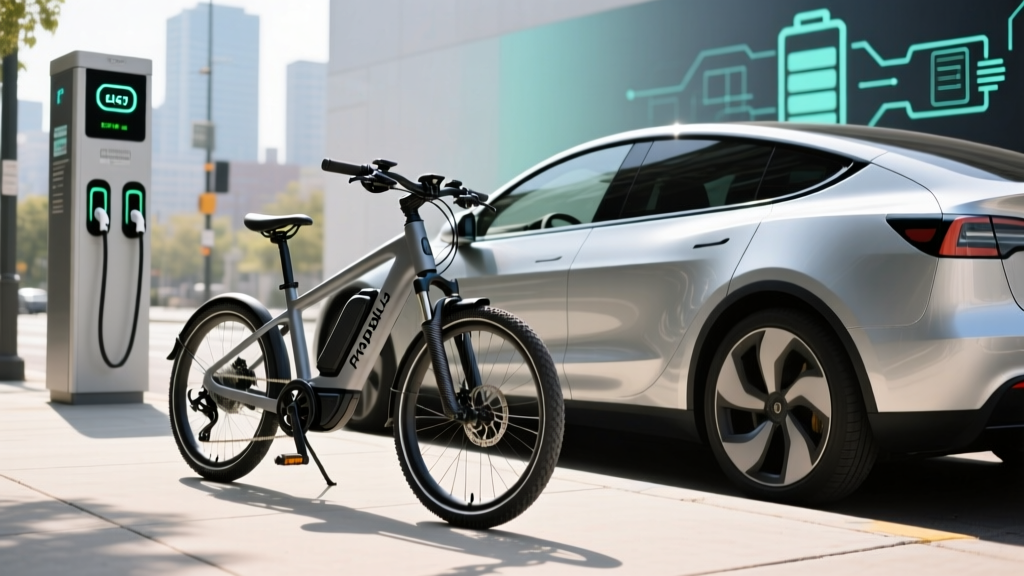
One of Propella's advantages is charging simplicity: the battery is either integrated or removable, and you charge from a standard 120V household outlet. A full charge takes roughly 3–4 hours. There's no need for a Level 2 home charger installation, no electrician visit, no panel upgrade.
EV home charging is more involved. Most EV owners install a Level 2 charger (240V, typically 32–48 amps / 7.7–11.5 kW) for overnight charging. Installation costs vary widely:
| Component | Typical Cost Range |
|---|---|
| Level 2 charger hardware (e.g., ChargePoint Home Flex, Emporia Vue) | $350–$700 |
| Electrician labor (240V outlet or hardwire) | $500–$2,000 |
| Electrical panel upgrade (if needed, 100A → 200A) | $1,500–$4,000 |
| Permit and inspection | $50–$300 |
| Total (no panel upgrade) | $900–$3,000 |
| Total (with panel upgrade) | $2,400–$7,000 |
If you live in an apartment or lack off-street parking, EV home charging may not be feasible. In that scenario, you'd rely on public Level 2 and DC fast charging — which costs more per kWh ($0.30–$0.55 at most DC fast chargers) and adds time inconvenience. An e-bike, by contrast, can be carried inside and charged from any outlet — a significant advantage for apartment dwellers.
For EVs, DC fast charging on road trips is a key capability Propella cannot match. A LEAF with CHAdeMO can add roughly 60–80 miles in 30 minutes at a 50 kW station. Modern CCS or NACS-equipped EVs like the Hyundai Ioniq 5 or Tesla Model 3 can accept 150–250 kW peak, adding 150–200+ miles in 20–25 minutes. An e-bike simply isn't designed for intercity travel.
Common Misconceptions: E-Bikes and EVs
| Myth | Fact |
|---|---|
| "E-bikes are basically free to ride." | Electricity costs are minimal (~$0.008/mi), but tires, chains, brake pads, and eventual battery replacement ($200–$400 for a Propella-class pack) add up to $75–$150/year in maintenance. |
| "An e-bike can fully replace my car." | Only if your trips are short, weather cooperates, and you don't need to carry passengers or cargo. For most households, an e-bike supplements a car rather than replacing it. |
| "EVs cost more to own than gas cars long-term." | Over 5 years, a credit-eligible EV with home charging typically costs $5,000–$10,000 less than a comparable gas car when you factor fuel savings, lower maintenance, and the §30D credit — though insurance premiums can be 10–20% higher. |
| "E-bike batteries last forever." | Lithium-ion e-bike batteries typically last 500–800 full charge cycles before significant degradation (20%+ capacity loss). At daily charging, that's roughly 2–3 years before you notice reduced range. Budget $200–$400 for a replacement pack. |
| "You need a special license or registration for an e-bike." | Class 1 and Class 2 e-bikes (under 20 mph motor-assisted) are legal on most bike paths and don't require licensing in most U.S. states. Class 3 (28 mph) has some restrictions. Check local regulations. |
| "EVs are worse for the environment because of battery production." | Lifecycle analyses from the EPA consistently show EVs produce fewer lifetime emissions than gas cars in every U.S. grid region, even accounting for battery manufacturing. E-bikes have an even smaller manufacturing footprint. |
Decision Framework: Should You Buy a Propella E-Bike, an EV, or Both?
Choose a Propella electric bike if:
- Your daily commute is under 20 miles round-trip on surface streets
- You live in a mild climate with 200+ rideable days per year
- You lack home EV charging access (apartment, no garage) but can charge an e-bike indoors
- You already own a car (gas or EV) for longer trips, bad weather, and cargo
- Your budget for a secondary commuter is under $2,000
- You want near-zero maintenance and no insurance requirement
Choose an EV if:
- You need a primary vehicle for all weather, all distances, and passengers
- Your commute includes highways or exceeds 30 miles round-trip
- You can install a Level 2 home charger (or have reliable workplace charging)
- You want to eliminate gas expenses and reduce lifetime maintenance costs
- You qualify for the federal §30D tax credit (income caps: $150K single / $300K joint; vehicle MSRP caps: $55K sedans / $80K SUVs and trucks; battery sourcing requirements apply — see IRS guidelines)
- You need crash protection, airbags, and NHTSA-rated safety
Choose both if:
- You're a two-vehicle household replacing one gas car with an EV and using an e-bike for short solo commutes
- You want to minimize total household transportation spend — the EV handles family and long trips; the e-bike handles daily solo errands
First-Time Buyer Considerations: What to Know Before You Choose
If you're considering a Propella e-bike: Test-ride before buying. The single-speed drivetrain means no gears for hill climbing — the motor assists, but steep grades still require rider effort. Check whether the battery is removable (for indoor charging in apartments) or frame-integrated (more secure but requires parking near an outlet). Verify local e-bike regulations for bike-path access. Budget for a quality U-lock or folding lock ($60–$120) and consider theft insurance through renters or homeowners policies, as e-bike theft is rampant in urban areas.
If you're considering your first EV: Confirm your home electrical panel can support a Level 2 charger before purchasing — an electrician consultation ($100–$200) can prevent surprises. Check your commute against real-world range, not the EPA sticker: subtract 20% for highway driving and another 15–20% for cold climates. Research your local public charging network — the Alternative Fuels Data Center maps every public charger in the U.S. And verify your tax-credit eligibility before counting on $7,500 in savings; battery critical-mineral and component sourcing requirements disqualify some otherwise eligible vehicles.
Frequently Asked Questions
Is a Propella e-bike a good alternative to buying an electric car?
For short, fair-weather urban commutes under 20 miles, a Propella e-bike can replace many car trips at a fraction of the cost — roughly $1,500 versus $28,000+ for an EV. But it cannot replace a car for highway driving, bad weather, passenger transport, or long trips. Think of it as a complement to a car, not a full replacement, unless your transportation needs are very narrow.
How much does it cost to charge a Propella e-bike versus an EV?
Charging a Propella's ~360 Wh battery from empty costs roughly $0.06 at the U.S. average electricity rate of $0.16/kWh. A full charge of a Nissan LEAF's 40 kWh battery costs about $6.40 at the same rate. Per mile, the e-bike costs about $0.008 and the EV about $0.043 — the EV is roughly 5× more expensive per mile but still far cheaper than gas ($0.11+/mile).
Do Propella e-bikes qualify for any tax credits or incentives?
Propella e-bikes do not qualify for the federal §30D Clean Vehicle Credit, which applies only to four-wheeled motor vehicles. Some states, cities, and utility companies offer e-bike purchase rebates (typically $100–$500). Check your local utility and state energy office for current programs. As of 2026, no federal e-bike incentive has been enacted, though legislation has been proposed.
How long does a Propella e-bike battery last before replacement?
Expect 500–800 full charge cycles before noticeable degradation (roughly 20% capacity loss). At daily charging, that translates to approximately 2–3 years of daily use before range drops meaningfully. A replacement battery pack costs $200–$400 depending on model. Store the battery at 40–60% charge during long periods of non-use, and avoid regularly draining to 0% or charging to 100% in hot weather to maximize lifespan.
Can I ride a Propella e-bike in the rain?
Propella e-bikes have basic water resistance for light rain, but they are not waterproof. Heavy rain, puddle submersion, and pressure washing can damage the motor controller and battery connections. Most e-bike commuters in rainy climates use fenders, waterproof bags, and dedicated rain gear. If your commute is in a consistently rainy climate (Pacific Northwest, for example), an EV provides clear advantages in comfort and reliability.
What's the total 5-year cost of owning an e-bike vs. an EV vs. a gas car?
Over 5 years with a 3,600-mile annual commute: a Propella e-bike costs approximately $2,100–$2,500 total (purchase + energy + maintenance). A credit-eligible EV like the Nissan LEAF costs roughly $28,000–$32,000 total (after $7,500 credit, including energy, maintenance, and insurance). A comparable gas car costs roughly $35,000–$37,000. The e-bike is cheapest by far but provides dramatically less capability. The EV typically beats the gas car by $5,000–$7,000 over 5 years when the tax credit applies and home charging is available.