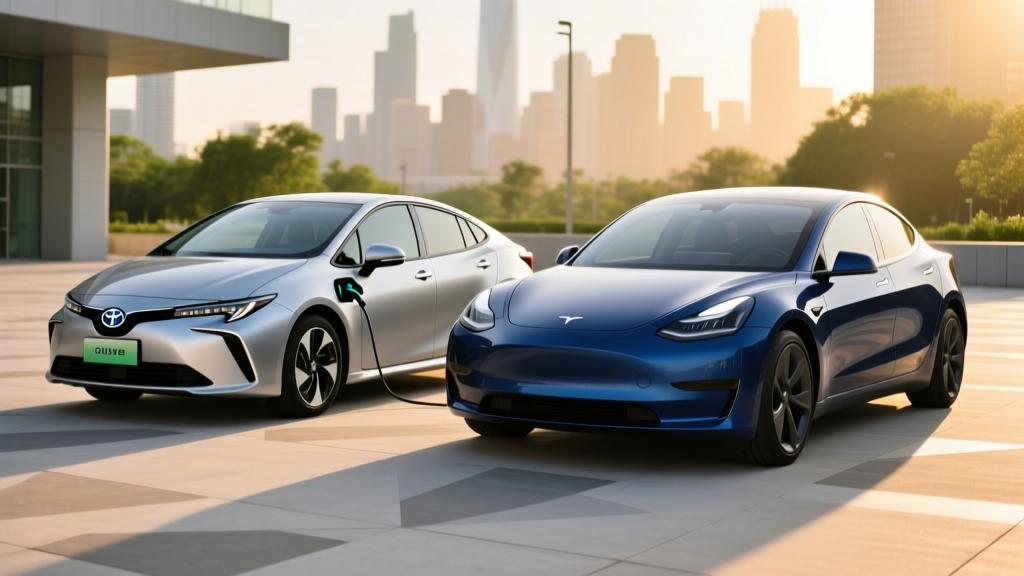
Shoppers cross-shopping a Toyota Prius and a Tesla Model 3 aren't choosing between two cars — they're choosing between two electrification philosophies. The 2026 Prius Prime is a plug-in hybrid (PHEV) that blends a short electric-only commute with unlimited gas range. The 2026 Tesla Model 3 is a pure battery-electric vehicle (BEV) that eliminates the gas station entirely but demands a charging plan. Both are compelling. Neither is universally better.
This guide compares the 2026 Toyota Prius Prime and the 2026 Tesla Model 3 on every metric that matters: real-world range, charging logistics, performance, cargo, tech, tax-credit eligibility, and five-year ownership cost. We'll use EPA data from fueleconomy.gov, manufacturer spec sheets, and current IRS §30D rules to cut through the marketing.
Side-by-Side: 2026 Prius Prime vs Tesla Model 3 Specs
Before the nuance, here are the hard numbers. The Prius Prime tested is the XSE trim (top trim, most common comparison point). The Model 3 is the Long Range AWD, the volume trim most buyers consider.
| Spec | Toyota Prius Prime XSE | Tesla Model 3 LR AWD |
|---|---|---|
| Powertrain | PHEV (2.0L I4 + 2 motors) | BEV (dual motor AWD) |
| Total System HP | 220 hp | ~384 hp |
| 0–60 mph | 6.6 sec | 4.2 sec |
| Battery (usable) | ~10.9 kWh (Li-ion) | ~75 kWh (NMC) |
| EPA electric-only range | 39 mi (EV mode) | N/A (always electric) |
| EPA total range (EV + gas) | ~440 mi combined | 341 mi |
| EPA MPGe (charge-depleting) | 114 MPGe | 132 MPGe |
| EPA MPG (gas-only hybrid) | 48 combined | N/A |
| Max AC charge (Level 2) | ~3.3 kW (~6 hr full) | 11.5 kW (~8 hr full) |
| DC fast charge capable? | No | Yes, peak ~250 kW |
| 10–80% DC time | N/A | ~25 min |
| Charging port | J1772 (AC only) | NACS (native Supercharger) |
| Cargo (behind rear seats) | ~20.3 cu ft | ~23 cu ft (+ frunk ~3 cu ft) |
| Base MSRP (target trim) | ~$37,500 | ~$47,500 |
| Federal §30D credit (max) | Up to $3,750 | Up to $7,500 |
| Powertrain warranty | 5 yr / 60k mi (hybrid 10/150k) | 4 yr / 50k mi (battery 8/120k) |
Two immediate takeaways: the Model 3 dominates on performance, efficiency-while-electric, and DC charging speed. The Prius Prime wins on total range flexibility, upfront MSRP, and zero reliance on charging infrastructure.
Range and Efficiency: Electric Miles vs Unlimited Miles
Prius Prime: EPA rates 39 miles electric-only, but expect ~32–36 mi in mixed driving, and closer to 25–28 mi at sustained 70 mph highway speeds or in cold weather (below 40°F). Once the battery depletes, the hybrid system delivers ~48 MPG indefinitely.
Model 3 LR AWD: EPA rates 341 miles. Real-world highway driving at 70–75 mph typically yields 280–305 mi; in freezing temperatures with cabin heat, plan for 230–260 mi. Tesla's heat pump helps, but physics still wins in winter.
If your daily commute is under 30 miles round-trip and you can charge at home overnight, the Prius Prime lets you drive on electricity 90%+ of the time while still offering a 440-mile total envelope for road trips. The Model 3 offers 280–305 real highway miles before needing a 20–25 minute Supercharger stop — manageable, but requires planning on trips over ~250 miles.
Daily commuting under 35 mi: Prius Prime (cheaper electric miles, no range anxiety).
Single-charge distance without stops: Model 3 (280+ real highway miles vs ~28 electric + gas handoff).
Maximum trip distance without stopping: Prius Prime (~440 mi on a full tank + full battery).
Charging: Home Outlet vs Supercharger Network
This is where the two vehicles diverge most sharply. The Prius Prime has no DC fast-charging capability — it charges exclusively on AC power at up to ~3.3 kW, meaning a full 0–100% recharge takes about 5.5–6 hours on a Level 2 home charger. On a standard 120V household outlet (Level 1), expect roughly 11–12 hours. That's fine for overnight replenishment of 39 miles, but it means public charging infrastructure is essentially irrelevant to Prius Prime owners.
The Model 3 charges at 11.5 kW on Level 2 (adding roughly 40–45 miles per hour of charging) and peaks at ~250 kW on DC fast chargers. On a Tesla V3/V4 Supercharger, a 10–80% session takes about 25 minutes, though sustained speeds taper significantly above 60% State of Charge — a common EV charging-curve reality that marketing materials gloss over. The Model 3's native NACS connector gives it plug-and-pay access to the entire Supercharger network, widely regarded as the most reliable public charging ecosystem in the U.S.
| Level | Prius Prime | Model 3 LR AWD |
|---|---|---|
| Level 1 (120V, ~1.4 kW) | ~4 mi/hr added | ~5 mi/hr added |
| Level 2 (240V, home/public AC) | ~12 mi/hr (at 3.3 kW) | ~42 mi/hr (at 11.5 kW) |
| DC Fast Charge | Not supported | Peak 250 kW, ~170 mi in 15 min |
Home charging install cost matters for both, but differently. A Prius Prime owner can often get by with a simple 120V outlet if daily electric needs are under 35 miles — zero install cost. A Level 2 home charger (recommended for convenience) runs $500–$1,800 installed depending on panel proximity and permit requirements. Model 3 owners strongly benefit from Level 2 at home; daily DC fast-charging degrades the battery faster and costs 2–3× more per mile than home charging.
DC fast-charging capability and Supercharger network access make the Model 3 the clear winner for anyone who can't charge at home or takes regular road trips. However, the Prius Prime wins on simplicity — plug into any household outlet overnight and you're set for commuting.
Performance, Cargo, and Daily Usability
The 2026 Model 3 Long Range AWD produces approximately 384 hp and hits 60 mph in 4.2 seconds. The Prius Prime XSE, with its 220-hp combined system, reaches 60 mph in 6.6 seconds — respectable for a PHEV and dramatically improved from previous generations, but it's not a performance car. On a twisty on-ramp or a passing maneuver, the Model 3's instant electric torque is in a different league.
Cargo space tells a closer story. The Prius Prime offers ~20.3 cu ft behind the rear seats in a practical hatchback layout with a wide opening. The Model 3 provides ~23 cu ft in the trunk plus a ~3 cu ft front trunk (frunk), though its sedan trunk opening is narrower. For bulky items like furniture or large dog crates, the Prius hatch is more usable than the raw number suggests.
Interior tech diverges in philosophy. Tesla's minimalist cabin centers everything on a 15.4-inch touchscreen — no physical stalks (turn signals are on the steering wheel), no instrument cluster. The Prius retains a traditional instrument display, physical climate controls (mostly), wireless Apple CarPlay and Android Auto, and Toyota Safety Sense 3.0 with adaptive cruise and lane centering. Tesla's Autopilot is standard; Full Self-Driving (Supervised) is an expensive add-on — and it is critical to remember this is a SAE Level 2 driver-assist system requiring constant supervision, not autonomous driving.
Price and Federal Tax Credit: The $10,000+ Question
Sticker price alone tells one story. After federal tax credits, the story shifts considerably.
| Prius Prime XSE | Model 3 LR AWD | |
|---|---|---|
| Base MSRP | ~$37,500 | ~$47,500 |
| Max §30D credit | Up to $3,750 | Up to $7,500 |
| Effective price (max credit) | ~$33,750 | ~$40,000 |
| Price gap after credit | Model 3 still ~$6,250 more | |
The Prius Prime qualifies for a partial credit (up to $3,750) because its smaller battery meets only the critical-minerals requirement under current IRS §30D rules, not the full battery-component sourcing requirement. The Model 3 Long Range, assembled in the U.S. with qualifying battery sourcing, can reach the full $7,500 — but eligibility depends on your income (AGI caps: $150k single / $300k joint), the vehicle's MSRP staying under the $55,000 sedan cap, and point-of-sale transfer availability. Always confirm with a tax professional before counting on the credit.
Even after the maximum credit for each, the Model 3 costs roughly $6,250 more upfront. That gap narrows over time through fuel savings (see below), but it's real money at purchase.
Five-Year Ownership Cost: Where the Math Flips
Assuming 15,000 miles/year, $3.50/gallon gas, and $0.14/kWh home electricity:
| Cost Category | Prius Prime XSE | Model 3 LR AWD |
|---|---|---|
| Fuel / energy | ~$3,800 (mix of electric + gas) | ~$2,700 (home charging dominant) |
| Maintenance | ~$2,400 (oil changes, filters, brakes) | ~$1,200 (cabin filter, wipers, tires) |
| Insurance (avg) | ~$7,500 | ~$10,500 |
| Tires (1 replacement set) | ~$700 | ~$1,100 |
| Total operating (5 yr) | ~$14,400 | ~$15,500 |
The Model 3 saves on energy and maintenance but costs significantly more to insure — Tesla insurance premiums average 30–45% higher than the Prius Prime per IIHS industry data. Over five years, the operating-cost difference is surprisingly small: roughly $1,100 in the Prius Prime's favor. Add back the $6,250 purchase-price gap, and the Prius Prime retains a ~$7,350 total-cost advantage over five years for most buyers.
Where the Model 3 wins long-term: if you drive more than 20,000 miles/year, keep the car 8+ years, or have cheap solar-powered electricity, the energy savings compound enough to close the gap. The Prius Prime also carries long-term hybrid-battery replacement risk (~$3,000–$4,000 after the 10-year/150k-mile warranty), though failure rates are low based on Toyota's two-decade hybrid track record.
Decision Framework: Which Should You Choose?
- Your daily commute is under 35 miles and you can charge overnight at home (even on a 120V outlet)
- You regularly take road trips exceeding 300 miles and don't want to plan charging stops
- You live in an apartment or area without reliable public or home Level 2 charging
- You want the lowest total cost of ownership over 5 years
- You prefer physical controls, a traditional instrument cluster, and CarPlay/Android Auto
- You want a hatchback for cargo flexibility
- You can install a Level 2 home charger and want to never visit a gas station
- Performance matters — 4.2-second 0–60 and instant torque change daily driving
- You want access to the Supercharger network for hassle-free road trips
- You drive 20,000+ miles/year and want to maximize per-mile energy savings
- You value over-the-air updates, Sentry Mode, and Tesla's software ecosystem
- You qualify for the full $7,500 tax credit and plan to keep the car 7+ years
Frequently Asked Questions
Can the Prius Prime drive on electricity alone on the highway?
Yes, but its electric-only range drops sharply at highway speeds. Expect roughly 25–28 miles at 70 mph before the gas engine engages. For city and suburban driving under 50 mph, the full 35–39 miles is realistic.
Is Tesla's Autopilot or FSD self-driving?
No. Both are SAE Level 2 driver-assist systems. You must keep your hands on or near the wheel and monitor the road at all times. Tesla's "Full Self-Driving (Supervised)" is a misnomer — it handles more scenarios than basic Autopilot but requires active supervision. Only Level 4 services like Waymo operate without a driver.
Does the Prius Prime qualify for the full $7,500 tax credit?
No. Under current IRS §30D rules, the Prius Prime qualifies for up to $3,750 (meeting the critical-minerals requirement but not the battery-component requirement). The Model 3 LR can qualify for the full $7,500 if your income is under the AGI cap and the vehicle meets all sourcing requirements. Verify current-year rules at IRS.gov before purchasing.
Which is cheaper to insure?
The Prius Prime, by a wide margin. Average annual premiums for the Prius Prime run $1,400–$1,600 depending on state and driving record; Model 3 premiums average $2,000–$2,300. Over five years, that's a $3,000+ insurance gap.
What happens if I can't charge the Prius Prime at home?
The Prius Prime still functions as an excellent conventional hybrid, delivering ~48 MPG combined on gas alone — better than most non-plug-in hybrids. You lose the electric-commute benefit but gain nothing in penalty. This is a key advantage over a BEV if charging access is uncertain.
Which holds resale value better?
Historically, Teslas depreciated faster than Toyotas, but recent market corrections have narrowed this. Expect the Prius Prime to retain ~55–60% of its value at 5 years and the Model 3 to retain ~48–54%, depending on trim, mileage, and market conditions. Toyota's brand reputation for longevity still carries weight in the used market.
Neither vehicle is wrong. The Prius Prime is the pragmatic bridge — electric commuting without range compromise, lower total cost, and no infrastructure dependency. The Model 3 is the full-electric commitment — faster, cheaper per mile, and backed by the best charging network, but requiring home charging and a higher upfront budget. Match the car to your daily miles, charging access, and how much you value performance versus pragmatism.