Quick Answer: Porsche currently offers two EV SUVs in the U.S.: the Macan Electric (starting ~$78,800 MSRP, 288–308 miles EPA range, 270 kW peak DC fast charging) and the Cayenne Electric (announced for late 2025/2026, estimated ~$85,000+ starting, targeting ~300+ miles EPA). Neither qualifies for the federal §30D tax credit due to MSRP caps and battery-sourcing rules. Expect real-world highway range of 230–260 miles for the Macan Electric, with 10–80% DC fast charging in roughly 21 minutes under ideal conditions. Total 5-year ownership can run $15,000–$25,000 higher than a comparable gas Porsche SUV when factoring depreciation, insurance, and the lack of federal incentives — but daily operating costs (charging, maintenance) are meaningfully lower.
The Porsche EV SUV Lineup in 2026: What's Available
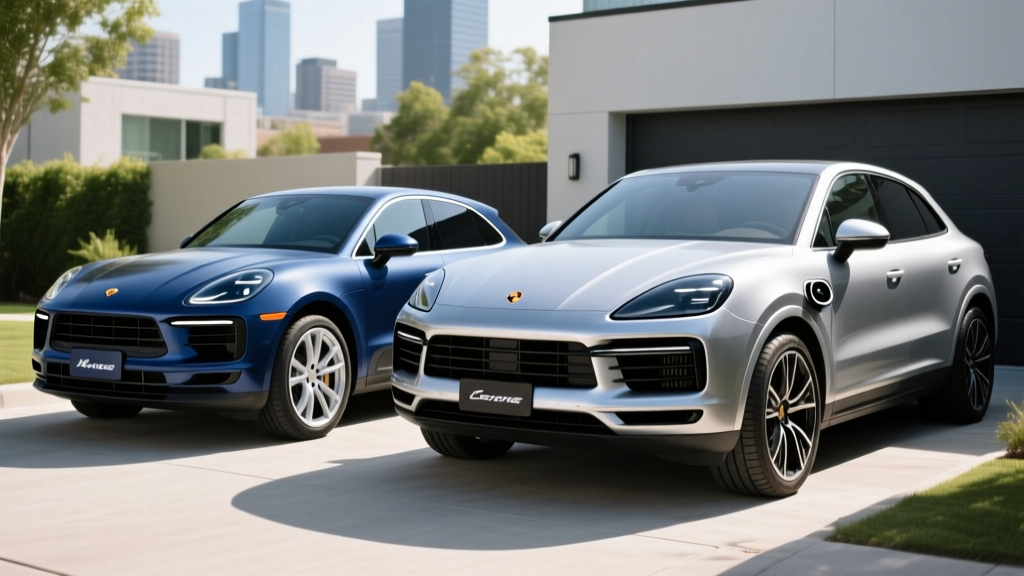
Porsche's electric SUV strategy centers on two nameplates. The Macan Electric, launched for the 2024 model year and carried into 2026, is the brand's volume electric contender — a midsize luxury crossover built on the PPE (Premium Platform Electric) architecture co-developed with Audi. It's available in several trims including the base Macan 4, Macan 4S, and Macan Turbo.
The Cayenne Electric was officially announced by Porsche as an upcoming addition, expected to arrive as a 2026 or 2027 model. It rides on the same PPE platform but in a larger, more powerful configuration. As of this writing, final EPA certification figures for the Cayenne Electric are not published — specs below are Porsche's preliminary estimates and should be treated as such.
| Spec | Macan 4 Electric | Macan Turbo Electric | Cayenne Electric (Announced/Est.) |
|---|---|---|---|
| EPA Range | 308 mi | 288 mi | ~310 mi (est.) |
| Battery (Usable) | 95 kWh (NMC) | 95 kWh (NMC) | ~100 kWh (NMC, est.) |
| Horsepower | 402 hp | 630 hp | ~450–700 hp (trim-dependent) |
| 0–60 mph | 4.9 sec | 3.1 sec | ~3.5–4.5 sec (est.) |
| Peak DC Fast Charge | 270 kW | 270 kW | ~270+ kW (est.) |
| 10–80% DC Charge | ~21 min | ~21 min | ~22 min (est.) |
| Level 2 AC Charge | 11 kW (std) | 11 kW (std) | 11 kW (est.) |
| Base MSRP | $78,800 | $106,900 | ~$85,000+ (est.) |
| Battery Warranty | 8 yr / 100,000 mi | 8 yr / 100,000 mi | 8 yr / 100,000 mi (est.) |
Real-World Range Reality Check: The Macan 4 Electric's EPA sticker says 308 miles, but real-world highway driving at 70–80 mph typically yields 240–265 miles depending on temperature and terrain. In cold weather (below 35°F), expect a further 15–25% reduction — putting winter highway range closer to 190–220 miles. The Turbo trim, with its stickier tires and higher power draw, drops to roughly 225–245 miles highway in mild conditions. These figures are consistent with independent testing by fueleconomy.gov data and third-party range evaluations.
Charging the Porsche EV SUV: Speeds, Connectors, and Reality
The Macan Electric's 800-volt PPE architecture enables its headline 270 kW peak DC fast-charging rate — but as with all EVs, peak is not sustained. Here's how charging actually works across scenarios:
| Charging Level | Power (kW) | Miles Added per Hour | Typical Use Case |
|---|---|---|---|
| Level 1 (120V household) | ~1.4 kW | ~4–5 mi/hr | Emergency / overnight trickle |
| Level 2 (240V home, 48A) | 11 kW | ~35–40 mi/hr | Daily home charging (~9 hr for full) |
| DC Fast Charge (peak) | 270 kW | ~160 mi in 10 min | Road trips (10–80% in ~21 min) |
| DC Fast Charge (sustained avg.) | ~170–190 kW avg | Varies by SoC | Real-world average across session |
Charging curve reality: The Macan Electric hits 270 kW only at a low state of charge (roughly 10–25% SoC) and at a compatible charger (350 kW Electrify America or equivalent). Above 50% SoC, the rate tapers to ~150 kW, and above 80% it drops sharply to under 50 kW. This is normal lithium-ion behavior — the battery management system protects cell longevity by reducing current at higher states of charge. Always precondition the battery via the Porsche Charging Planner (built into the nav system) before arriving at a DC fast charger; this warms the pack to optimal temperature and can shave 3–5 minutes off your session.
Connector: The Macan Electric uses the CCS1 connector standard in North America. Porsche has not yet adopted NACS (Tesla's connector) on current PPE vehicles, though future models may transition. For Tesla Supercharger access, you'll need a CCS-to-NACS adapter — Porsche has indicated compatibility with approved adapters, but verify with your dealer before relying on this for road trips.
Cost Breakdown: Buying, Charging, and Owning a Porsche EV SUV
Let's run the actual numbers. Below is a 5-year total cost of ownership estimate for a Macan 4 Electric versus its closest gas counterpart, the Macan S (starting ~$68,000 MSRP, ~19 MPG combined). Assumptions: 12,000 miles/year, $0.16/kWh home electricity, $3.80/gallon premium fuel, and typical luxury-SUV insurance.
| Category | Macan 4 Electric | Macan S (Gas) |
|---|---|---|
| MSRP (base) | $78,800 | $68,000 |
| Federal Tax Credit (§30D) | $0 (MSRP cap + sourcing) | N/A |
| Purchase price after credit | $78,800 | $68,000 |
| Fuel / Energy (5 yr, 60k mi) | $5,400 | $12,000 |
| Maintenance (5 yr) | $2,500 | $5,800 |
| Insurance (5 yr avg.) | $14,500 | $11,200 |
| Est. Depreciation (5 yr) | $38,000 | $30,000 |
| Total 5-Year Cost | ~$139,200 | ~$127,000 |
| Cost per mile (operating) | $0.09/mi (energy) + maint. | $0.20/mi (fuel) + maint. |
Key takeaways from the numbers:
- Energy savings are real: The Macan Electric consumes roughly 2.2–2.5 kWh/mile (about 88–100 MPGe combined per fueleconomy.gov). At $0.16/kWh, that's ~$0.09/mile vs. $0.20/mile for premium gas. Over 60,000 miles, you save ~$6,600 on energy.
- Maintenance savings add up: No oil changes, no spark plugs, far less brake wear (regen braking extends pad life 2–3x). Porsche's scheduled maintenance for the EV is roughly 55% cheaper over 5 years.
- Insurance costs more: EV luxury SUVs carry 20–30% higher premiums due to repair costs and battery replacement risk. Budget an extra $500–$700/year.
- Depreciation is the wildcard: Porsche EVs have seen steeper initial depreciation than their gas counterparts, partly due to rapid EV market evolution and limited used-EV demand in the luxury segment. The Macan Electric may lose 45–55% of value in 5 years vs. 40–48% for the gas Macan.
- No federal tax credit: The §30D credit has an MSRP cap of $80,000 for SUVs (per IRS guidelines), and the Macan 4 at $78,800 technically clears this — but battery component and critical-mineral sourcing requirements disqualify most Porsche trims for 2026. Verify current eligibility on the IRS clean vehicle credit page before purchasing.
Porsche EV SUV vs. Gas and Hybrid Alternatives
If you're cross-shopping, here's how the Macan Electric stacks up against gas and plug-in hybrid rivals in the luxury SUV space:
| Vehicle | Powertrain | EPA Range / MPG | 0–60 | Base MSRP | Fed. Credit Eligible |
|---|---|---|---|---|---|
| Macan 4 Electric | BEV (95 kWh) | 308 mi | 4.9s | $78,800 | Unlikely (sourcing) |
| Macan S (Gas) | Gas V6 | 19 MPG combined | 4.6s | $68,000 | N/A |
| Cayenne E-Hybrid (PHEV) | PHEV | 46 MPGe / 17 mi EV | 5.2s | $91,700 | Partial (check IRS) |
| BMW iX xDrive50 | BEV (111.5 kWh) | 324 mi | 4.4s | $87,250 | Unlikely (MSRP cap) |
| Genesis GV60 Perf. | BEV (77.4 kWh) | 235 mi | 3.9s | $62,000 | Possible (check IRS) |
The Macan Electric's advantage is its combination of charging speed (270 kW is among the fastest in the luxury SUV segment) and Porsche driving dynamics — torque vectoring, rear-axle steering, and adaptive air suspension give it a handling edge that neither the iX nor GV60 fully matches. Its disadvantage is range-per-dollar: the Genesis GV60 offers similar performance at $16,000 less, and the BMW iX provides more range and interior space, though at a higher MSRP that also kills its tax-credit chances.
The Cayenne E-Hybrid (PHEV) is worth considering if you lack reliable home charging. With 17 miles of electric-only range covering most commutes and a gas engine for road trips, it eliminates range anxiety entirely — though its $91,700 starting price and more complex powertrain mean higher long-term maintenance.
First-Time EV Buyer: What Porsche Won't Tell You
If this is your first EV, several ownership realities deserve honest discussion:
Home charging is nearly essential. Relying solely on public DC fast charging is possible but expensive ($0.35–$0.55/kWh at Electrify America stations, roughly doubling your per-mile cost vs. home charging) and adds wear to the battery from repeated high-rate charging. A Level 2 home charger (240V, 48A circuit) costs $1,200–$2,800 installed, depending on your electrical panel. If your home has a 200-amp panel, you're usually fine; a 100-amp panel may require a $2,000–$4,000 upgrade. Always get a quote from a licensed electrician before purchasing.
Cold weather cuts range hard. The Macan Electric's heat pump (standard on U.S. trims) mitigates cabin-heating energy draw, but battery chemistry itself is less efficient below freezing. Owners in northern climates consistently report 15–25% range loss in winter. If your daily commute is under 60 miles round-trip, this won't matter. If you regularly drive 200+ miles in winter, plan your charging stops accordingly.
Public charging reliability varies. Porsche partners with Electrify America for complimentary charging (typically 3 years of included sessions). EA's network reliability has improved but still lags behind Tesla's Supercharger network in uptime. Download the EA app and PlugShare before road trips to check station status.
| Myth | Fact |
|---|---|
| "The battery will need replacing in 5 years." | Porsche warranties the battery for 8 years/100,000 miles at ≥70% capacity retention. Industry data shows NMC packs losing ~10–15% capacity over 150,000 miles with normal use. A full replacement (if out of warranty) runs $18,000–$25,000, but is rarely needed. |
| "It qualifies for the $7,500 federal tax credit." | As of 2026, the Macan Electric's battery sourcing does not meet §30D critical-mineral and component requirements. The MSRP barely clears the $80K SUV cap, but sourcing rules are the disqualifier. Check IRS.gov for the current eligible-vehicle list. |
| "270 kW charging means I'll always charge that fast." | 270 kW is the peak rate at low SoC on a 350 kW-capable charger. Average session speed (10–80%) is closer to 170–190 kW due to the charge curve taper. Always precondition the battery for best results. |
| "I can use Tesla Superchargers natively." | The Macan Electric uses CCS1. NACS (Tesla) adapter compatibility exists with approved adapters, but Porsche recommends verifying compatibility. Not all Supercharger stalls support CCS-adapter vehicles. |
| "EVs cost nothing to maintain." | Tires wear 15–20% faster due to instant torque and heavier weight. Cabin air filters, brake fluid, coolant, and wiper systems still need service. Budget ~$500/year for scheduled maintenance. |
Decision Framework: Should You Buy a Porsche EV SUV?
Buy the Macan 4 Electric if:
- You have Level 2 home charging (or can install it)
- Your daily driving is under 150 miles and you road-trip 3–5 times per year
- You prioritize driving dynamics and brand prestige over maximum range-per-dollar
- You can absorb the ~$12,000 5-year cost premium over the gas Macan for the EV experience
- You live in a moderate climate or accept winter range trade-offs
Buy the Macan Turbo Electric if:
- Performance is paramount (3.1s 0–60, 630 hp) and the $106,900 MSRP fits your budget
- You understand the Turbo sacrifices ~20 miles of EPA range for its performance hardware
Wait for the Cayenne Electric if:
- You need more cargo space (Macan: ~18 cu ft rear; Cayenne: ~27 cu ft est.)
- You want three-row or larger-family practicality
- You prefer to let the platform mature for a year before committing
Choose the Cayenne E-Hybrid (PHEV) instead if:
- You lack reliable home or workplace charging
- You frequently tow (PHEV retains full gas-engine towing capacity, ~7,700 lbs)
- You want electric commuting without range anxiety on long trips
Consider the BMW iX or Genesis GV60 if:
- Range-per-dollar or interior space matters more than Porsche badge value
- You want a potentially tax-credit-eligible alternative (GV60 — verify on IRS.gov)
Frequently Asked Questions
Does the Porsche Macan Electric qualify for any tax incentives?
As of 2026, the Macan Electric does not qualify for the federal §30D clean vehicle credit ($7,500) due to battery component and critical-mineral sourcing requirements not being met, despite its MSRP falling under the $80,000 SUV cap. Some states offer separate EV rebates (e.g., California, Colorado, New York) — check your state's energy office for current programs. Point-of-sale transfer of the federal credit is irrelevant here since the vehicle doesn't qualify.
How long does it take to charge the Macan Electric at home?
On a Level 2 home charger (240V, 48A, delivering 11 kW to the vehicle), a full charge from 10% to 100% takes approximately 9–10 hours. Most owners charge overnight, plugging in at ~30% SoC and waking to a full battery. On a standard 120V outlet (Level 1), expect ~3–4 days for a full charge — practical only for topping off, not daily use.
What's the real cost per mile to drive the Macan Electric?
At the U.S. average residential electricity rate of ~$0.16/kWh and the Macan 4's efficiency of ~2.3 kWh/mile, your energy cost is approximately $0.09/mile when charging at home. Public DC fast charging at $0.45/kWh raises this to ~$0.25/mile. Compare this to the gas Macan S at ~$0.20/mile on premium fuel.
Will the Porsche EV SUV battery degrade significantly?
All lithium-ion batteries degrade, but Porsche's NMC cells are engineered for longevity. Industry-wide data from similar PPE-platform vehicles (Audi e-tron GT, Q8 e-tron) shows approximately 8–12% capacity loss over 100,000 miles with mixed charging habits. Porsche's warranty guarantees ≥70% capacity retention for 8 years or 100,000 miles. To maximize longevity, avoid routinely charging to 100% on DC fast chargers and try to keep daily SoC between 20–80%.
Can the Macan Electric handle road trips?
Yes, with planning. The 270 kW peak charging capability means you can add ~160 miles of range in 10 minutes at a compatible 350 kW charger. On a 500-mile trip, expect 2 charging stops of ~20–25 minutes each (10–80%). Use the built-in Porsche Charging Planner to route through compatible stations and precondition the battery automatically. The main constraint is charger availability in rural areas — check PlugShare for coverage along your route.
Is the Macan Electric all-wheel drive?
Yes. All Macan Electric trims sold in the U.S. feature dual-motor all-wheel drive. The system can vary torque distribution front-to-rear in milliseconds, and the available rear-axle steering (standard on Turbo, optional on 4S) improves both low-speed maneuverability and high-speed stability.