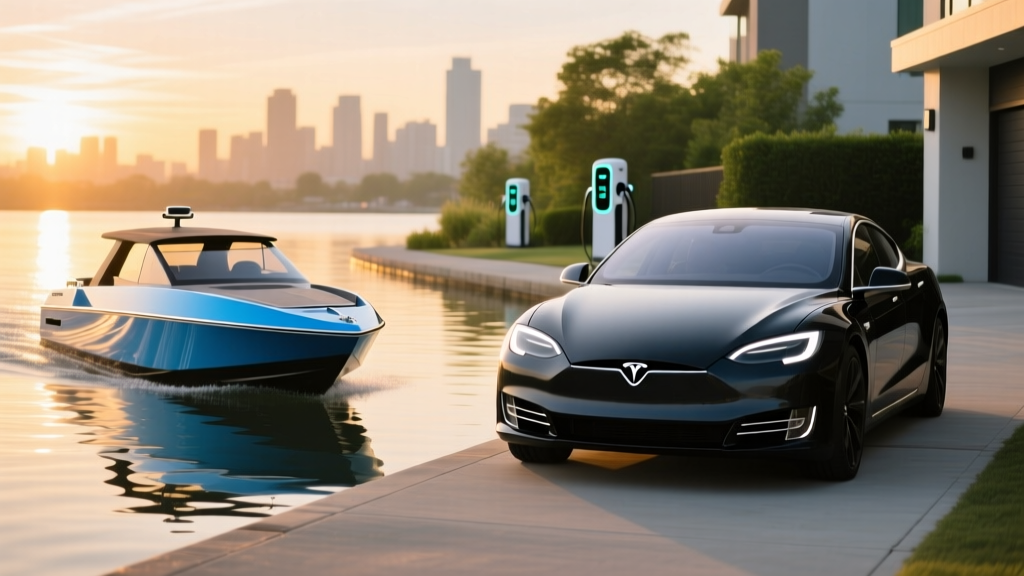
If you've spent years optimizing your electric car's efficiency and charging routine, the idea of a personal electric boat feels like the natural next frontier. But before you start browsing marine listings, here's the direct answer: personal electric boats in 2026 remain a niche, high-cost category with limited range (typically 15–40 miles per charge depending on vessel type and speed), long charging times (4–10+ hours on Level 2 equivalent shore power), and prices starting around $25,000 for small runabouts and climbing past $150,000 for capable day cruisers. Unlike the EV car market, there is no federal §30D-style tax credit for electric boats, and the charging infrastructure at marinas is sparse and inconsistent. This guide breaks down whether a personal electric boat makes sense for you — and how the ownership reality compares to the EV you already drive.
What Exactly Is a Personal Electric Boat in 2026?
The term "personal electric boat" covers a surprisingly wide spectrum — from 10-foot electric dinghies and pontoon boats to 25-foot electric runabouts and even small electric sailboats with auxiliary motors. What unites them is a fully electric drivetrain: a lithium battery bank (typically LFP chemistry for marine safety) powering one or more electric motors connected to a propeller or jet drive.
Key players in 2026 include Candela (hydrofoiling C-8, ~$390,000), X Shore (X Shore 1, ~$329,000), Arc Boats (Arc One, ~$300,000+), and more accessible options like Navier, Flux Marine outboards for repowers, and Chinese-market electric pontoons entering through importers. On the budget end, Sea-Doo and smaller manufacturers offer electric personal watercraft and dinghy motors in the $5,000–$20,000 range.
The critical distinction for EV-minded buyers: unlike cars, where you can compare EPA range and kW charging speeds across a standardized framework, the marine industry lacks a single universal efficiency or range rating. Range depends enormously on hull type, water conditions, passenger load, and especially speed — a planing hull at 25 knots consumes exponentially more energy than a displacement hull at 5 knots. This is the marine equivalent of the EV highway-vs-city range gap, but far more dramatic.
Battery, Range, and Charging: The Numbers That Matter
If you understand kW (power) and kWh (energy capacity) from your EV, the same physics applies on water — but the consumption profile is harsher. Water is roughly 800 times denser than air, so pushing a hull through it demands serious energy, especially once you leave displacement speeds and get on plane.
| Spec | Candela C-8 | X Shore 1 | Arc One | Budget Pontoon (typical) |
|---|---|---|---|---|
| Battery (kWh) | 69 kWh (NMC) | 126 kWh (NMC) | 226 kWh (NMC) | 20–40 kWh (LFP) |
| Range (nautical miles) | ~50 nm (foiling, 22 kn) | ~50 nm (cruise, 20 kn) | ~45 nm (cruise, 25 kn) | 15–25 nm (5–8 kn) |
| Top Speed | 27 kn | 30 kn | 45 kn | 10–12 kn |
| Motor Power | 75 kW | 240 kW | 500 kW | 5–15 kW |
| Charge Time (shore power) | ~3.5 hrs (DC fast) | ~6 hrs (22 kW AC) | ~8 hrs (DC fast capable) | 4–8 hrs (3–7 kW AC) |
| Base Price (USD) | ~$390,000 | ~$329,000 | ~$300,000+ | $25,000–$55,000 |
Charging infrastructure is where the personal electric boat experience diverges sharply from EV ownership. Most marinas offer 120V (15A) or 240V (30A/50A) shore power — the marine equivalent of Level 1 and Level 2 car charging. DC fast charging for boats exists at only a handful of pioneer marinas (Candela has installed dedicated fast chargers at select European and US locations). There is no Electrify America or Tesla Supercharger equivalent for boats. If your home dock or marina doesn't have a 240V circuit rated for marine use with GFCI protection, you're looking at a $2,000–$8,000 electrical upgrade — and not all marinas will permit it.
Electric Boat vs Gas Boat vs Your EV: A Cost Comparison
The economic case for a personal electric boat mirrors the early days of EV cars: higher upfront cost, lower operating cost, and a break-even horizon that depends heavily on your usage patterns.
| Cost Category | Electric Boat | Gas Boat (V8, 350 HP) |
|---|---|---|
| Energy/Fuel | $600–$1,200 (electricity at $0.15/kWh) | $4,000–$7,000 (marine gas at $5–6/gal) |
| Maintenance | $300–$600/yr (no oil, impeller, winterization simplified) | $1,500–$3,000/yr (oil changes, winterization, fuel system, impeller) |
| Slip/Moorage | $3,000–$8,000 (same as gas; some marinas charge premium for shore power) | $3,000–$8,000 |
| Insurance | $1,500–$3,500 (higher due to battery replacement risk) | $1,000–$2,500 |
| Total Annual Operating | $5,400–$13,300 | $9,500–$20,500 |
The operating savings are real — roughly $3,000–$7,000 per year for a moderately used boat — but they don't offset the purchase price gap quickly. A comparable gas runabout might cost $80,000–$120,000; the electric equivalent runs $250,000–$400,000. At $5,000/year in savings, you're looking at a 26-to-56-year break-even on the purchase premium alone. The economics improve dramatically at the small-boat end: a $30,000 electric pontoon vs a $22,000 gas pontoon breaks even in 3–5 years of moderate use.
Notably, the IRS §30D clean vehicle tax credit applies only to highway-capable vehicles — electric boats, personal watercraft, and off-road vehicles do not qualify. Some states offer marine electrification incentives (California's CARB programs, for instance), but these are limited and change frequently. Check your state's environmental agency for current programs.
Real-World Ownership: What EV Drivers Already Know (and What's Different)
If you own an EV, you already think in terms of charge planning, kWh efficiency, and battery health. Several of those skills transfer directly to electric boat ownership — but with important marine-specific wrinkles.
Home charging access is non-negotiable. Just as apartment-dwelling EV buyers face challenges, electric boat owners without a private dock or marina slip with dedicated shore power will struggle. Public "charging docks" are exceedingly rare. If your marina doesn't allow you to install a 240V/50A marine-grade outlet at your slip, you're limited to slow 120V trickle charging — which for a 69 kWh battery means 50+ hours for a full charge.
Cold-water and winter considerations. Lithium batteries lose capacity and charge acceptance in cold temperatures — the same issue that reduces your EV's winter range. In northern climates, electric boats require either heated indoor winter storage or a battery conditioning system, adding $2,000–$5,000 to annual ownership costs. LFP batteries handle cold better than NMC but still lose 10–20% capacity below 40°F.
Battery degradation and replacement. Marine battery packs face harsher conditions than car batteries: constant vibration, salt exposure, and high-humidity environments. Most manufacturers quote 8–10 year battery warranties with 70% capacity retention thresholds (similar to EV warranties). However, marine battery replacement costs are steep: $15,000–$40,000 for a full pack replacement depending on capacity, compared to $5,000–$20,000 for an EV battery swap.
Corrosion and galvanic isolation. This is where marine electrical systems are fundamentally different from automotive. Stray currents in water can cause rapid galvanic corrosion of metal components. Electric boats require isolation transformers, galvanic isolators, and rigorous bonding systems — maintenance items that don't exist in your EV. Budget $500–$1,000/year for marine electrician inspections.
Common Misconceptions About Personal Electric Boats
| Myth | Fact |
|---|---|
| "Electric boats are silent and maintenance-free." | The drivetrain is quiet and low-maintenance, but hull maintenance, bottom paint, bilge pumps, shore power connections, and battery management systems all require regular attention. |
| "You can charge anywhere with a regular outlet." | A 120V/15A outlet delivers ~1.5 kW — charging a 69 kWh battery would take 46+ hours. You need 240V shore power for practical use. |
| "Electric boats qualify for the $7,500 federal tax credit." | The §30D credit applies only to on-road vehicles. Boats are excluded. Some state/local incentives may apply. |
| "Solar panels on the boat can keep it charged." | A typical bimini-top solar array (400–800W) adds maybe 2–4 kWh per day of sunny docking — enough to offset parasitic loads, not to meaningfully recharge a 69–126 kWh battery. |
| "Electric boats can't go fast." | The Arc One hits 45 knots and the Candela C-8 cruises at 22 knots on foils. Speed isn't the issue — sustaining it without draining the battery is. |
Decision Framework: Is a Personal Electric Boat Right for You?
Choose an electric boat if:
- You boat primarily on calm, protected waters (lakes, slow rivers, sheltered bays)
- Your typical outing is under 30 nautical miles round-trip
- You have a private dock or marina slip with 240V/30A+ shore power access
- You value near-silent operation (wildlife viewing, conversation, no exhaust fumes)
- You boat 50+ times per year, making operating savings meaningful
- You're comfortable with a $25,000–$400,000 purchase and understand the premium over gas
Stick with a gas or diesel boat if:
- You boat offshore, in rough water, or need long range (50+ nm without charging)
- Your marina lacks shore power infrastructure or won't allow electrical upgrades
- You need quick refueling for multi-day trips or commercial use
- Your budget is under $25,000 and you need a capable runabout or ski boat
- You boat in cold climates without heated indoor storage options
The honest parallel to draw is 2012-era EV ownership: exciting technology, real environmental benefits, and genuine operating savings — but meaningful compromises in range, infrastructure, and upfront cost that only certain use cases can absorb. If your boating profile fits the electric envelope, the experience is transformative. If it doesn't, forcing the fit will lead to the marine equivalent of range anxiety — but on water, where running out of energy carries more serious safety implications.
What First-Time Electric Boat Buyers Should Know
Before you sign a purchase agreement, verify these five items:
- Shore power audit: Have a licensed marine electrician inspect your slip's electrical service. Confirm amperage, GFCI protection, and whether the marina's transformer can handle your boat's charger draw (some older marinas have limited total capacity shared across all slips).
- Range calculation for YOUR waters: Ask the manufacturer for a range curve (speed vs distance) and apply it to your typical route. Add a 30% safety margin for current, wind, and battery aging.
- Battery warranty specifics: What is the capacity retention guarantee (e.g., 70% at 8 years)? Who handles replacement — the boat builder, the battery supplier, or a third-party marine service? What's the estimated replacement cost in today's dollars?
- Insurance quotes: Get written quotes from at least two marine insurers before purchasing. Some carriers are still cautious about electric marine propulsion and may charge 20–50% higher premiums than equivalent gas boats.
- Resale trajectory: The electric boat market is young and evolving rapidly. Today's $300,000 electric runabout may depreciate steeply as next-generation models with solid-state batteries and faster charging arrive in the late 2020s. Factor in 15–25% annual depreciation for the first three years.
Frequently Asked Questions
How long does it take to charge a personal electric boat?
On 240V/30A shore power (the marine equivalent of Level 2), expect 4–10 hours for a full charge depending on battery size (20–130 kWh). DC fast charging, where available, can deliver a 20–80% charge in 30–60 minutes for larger boats — but DC marine chargers are currently installed at fewer than a dozen marinas in the US.
Can I use my EV home charger for an electric boat?
Not directly. EV chargers use J1772 or NACS connectors; boats use marine-specific shore power connectors (typically NEMA L6-30, L14-50, or Marinco/Hubbell marine plugs). The boat's onboard charger converts AC shore power to DC for the battery. However, the electrical principles are identical: a 240V/50A circuit can deliver up to 12 kW to the boat's charger, similar to a high-power Level 2 EV setup.
Are electric boats safe in saltwater?
Yes, with proper engineering. Modern electric boats use sealed battery enclosures, galvanic isolation, and marine-grade corrosion protection. However, saltwater environments accelerate wear on all electrical components, and you should budget for more frequent inspections and higher maintenance costs than freshwater use.
What happens if I run out of charge on the water?
Unlike an EV that can be towed to a charger, a dead electric boat needs to be towed back to shore power — which means calling Sea Tow or Vessel Assist (typically $300–$800 per incident, or covered by premium marine assistance memberships). Some electric boats offer optional small gasoline range-extender generators ($3,000–$8,000 add-on) as a backup, similar to the BMW i3 REx concept.
Will electric boats get cheaper?
Prices are expected to decline 5–10% annually through 2030 as battery costs continue to fall and production volumes increase. The entry-level segment (electric pontoons, small runabouts under $50,000) is where price parity with gas boats is most likely to arrive first — potentially by 2028–2030 for comparable models.