The Silicon Underneath Your EV's Autonomy Stack
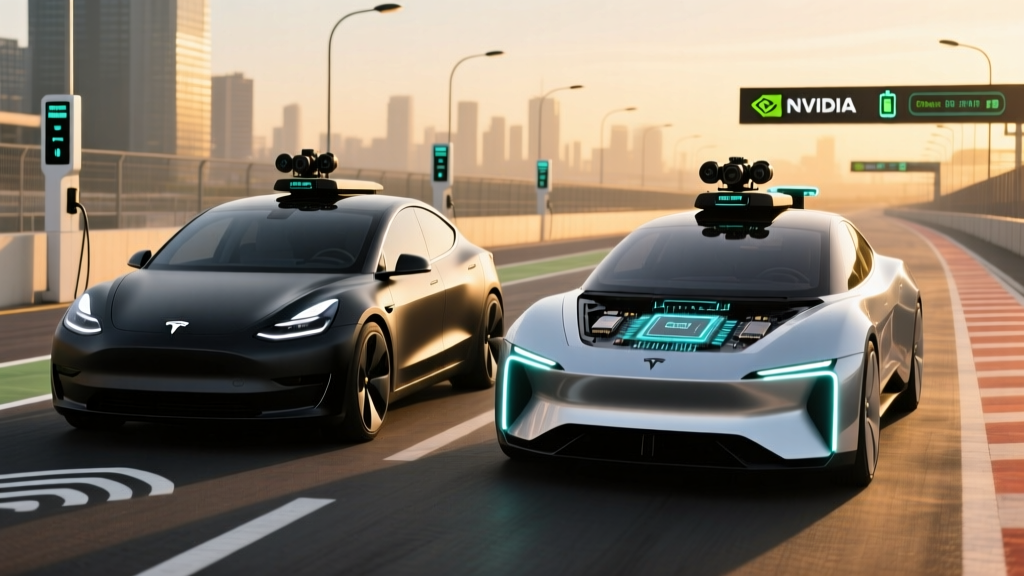
When most EV shoppers compare vehicles, they look at range, charging speed, and price. But the processor running the car's driver-assistance system determines whether your EV can handle a highway merge confidently or fumble at a construction zone. In 2026, two silicon architectures dominate the advanced EV autonomy conversation: Tesla's in-house FSD Computer (Hardware 4 and the emerging Hardware 5) and Nvidia's DRIVE Orin and next-generation DRIVE Thor platform. Understanding the Nvidia vs Tesla AI chips divide is no longer just for engineers — it directly shapes which vehicles you can buy, what they can do, and how much that capability costs.
This comparison isn't a traditional vehicle head-to-head. Instead, we're evaluating the two dominant AI chip ecosystems powering electrified vehicles in 2026, mapped to the real cars you can actually buy. Tesla's silicon runs exclusively in Tesla vehicles. Nvidia's platform powers a growing roster from Mercedes-Benz, Hyundai, Jaguar, Lotus, and several Chinese OEMs. The chip you get depends entirely on the badge on the hood.
Side-by-Side: Nvidia vs Tesla AI Chips — The Spec Sheet
The raw numbers tell one story. How each chip is deployed in a vehicle tells another. Below is a comparison of the platforms as implemented in representative 2026 EVs: the Tesla Model Y (Long Range, HW4) and the Hyundai Ioniq 5 (with Nvidia DRIVE Orin-based Highway Driving Assist 2).
| Spec | Tesla FSD HW4 (Model Y LR) | Nvidia DRIVE Orin (Ioniq 5 HDA2) |
|---|---|---|
| Chip Architecture | Tesla FSD Computer HW4 (dual NPU) | Nvidia DRIVE Orin-X (Arm + GPU + DLA) |
| Peak AI Performance | ~300+ TOPS (estimated) | 254 TOPS (INT8) |
| Camera Inputs Supported | 8 cameras (5MP, HW4 sensors) | Up to 16 cameras + LiDAR/radar fusion |
| Sensor Fusion Approach | Vision-only (no LiDAR/radar) | Multi-sensor (camera + radar + optional LiDAR) |
| Representative EV — EPA Range | 320 mi (Model Y LR) | 303 mi (Ioniq 5 LR RWD) |
| Real-World Highway Range | ~260–280 mi (75 mph, moderate temps) | ~245–265 mi (75 mph, moderate temps) |
| Battery (Usable) | 75 kWh (NMC) | 77.4 kWh (NMC) |
| DC Fast Charge Peak | 250 kW (10–80% ~25 min) | 240 kW (10–80% ~18 min) |
| 0–60 mph | 5.0 sec | 5.1 sec (AWD) / 7.4 sec (RWD) |
| Horsepower | 346 hp (AWD LR) | 320 hp (AWD) |
| Efficiency (MPGe) | 117 MPGe combined | 114 MPGe combined |
| Cargo Volume | 76 cu ft (rear seats folded) | 59.3 cu ft (rear seats folded) |
| ADAS Included or Extra | Basic Autopilot included; FSD = $8,000 add-on or $99/mo | HDA2 standard on SEL/Limited trims |
| Base MSRP (Representative EV) | $44,990 (Model Y LR) | $47,400 (Ioniq 5 SEL AWD) |
| 8 yr / 120,000 mi | 10 yr / 100,000 mi |
Sources: fueleconomy.gov, Tesla and Hyundai manufacturer spec sheets. Real-world range estimates based on 75-mph highway driving in 60–75°F conditions; cold weather (below 32°F) reduces range 20–35% for both platforms.
Chip Architecture Deep Dive: How Each Platform Thinks
Tesla's FSD Computer HW4 is custom-designed silicon, fabricated on a Samsung process node, with dual neural processing units (NPUs) optimized exclusively for Tesla's vision-only neural network stack. Tesla controls the entire pipeline — from the camera hardware on the car to the training clusters (Dojo and Nvidia H100 farms) that build the models. The result is tight vertical integration: the chip does exactly what Tesla's software demands, nothing more. HW4 cameras upgraded to 5-megapixel sensors with improved low-light performance over HW3's 1.2-megapixel units, and the NPU throughput roughly doubled.
Nvidia's DRIVE Orin is a general-purpose automotive AI system-on-chip. It combines Arm Cortex-A78AE CPU cores, an Ampere-architecture GPU, and Deep Learning Accelerators (DLAs). OEMs like Hyundai, Mercedes-Benz, Volvo, and NIO license the platform and build their own software stacks on top — or use Nvidia's DRIVE OS and perception toolkits. This gives automakers flexibility: Hyundai can fuse camera, radar, and LiDAR data for its HDA2 system; Mercedes can pursue certified Level 3 conditional autonomy on highways (Drive Pilot, available in Germany and Nevada). The trade-off is that the Nvidia chip's potential depends heavily on how well each OEM implements their software layer.
The practical difference for buyers: Tesla's chip gives you one company's vision of autonomy, iterated rapidly via OTA updates, with a vision-only approach that occasionally struggles in edge cases (heavy rain, faded lane markings, unusual construction zones). Nvidia-powered EVs give you each OEM's interpretation — some conservative and reliable (Hyundai's HDA2), some ambitious (Mercedes' Level 3 Drive Pilot, limited to 40 mph on approved highways in Nevada and California).
Category-by-Category Verdict
🏆 Autonomy Capability: Tesla
Tesla's FSD (Supervised) handles a wider variety of road scenarios — city streets, unprotected left turns, parking lot navigation — than any Nvidia-powered consumer system in 2026. The vision-only approach is more ambitious and covers more edge cases, though it demands more driver vigilance in adverse weather.
🏆 Sensor Redundancy: Nvidia
Nvidia-powered vehicles typically fuse cameras with radar and, in some cases, LiDAR. This multi-sensor approach provides better performance in rain, fog, and low-visibility conditions where Tesla's vision-only system may degrade or issue warnings to take over.
🏆 Range & Efficiency: Tesla
The Model Y LR achieves 320 mi EPA and 117 MPGe combined — edging the Ioniq 5's 303 mi and 114 MPGe. Tesla's powertrain efficiency remains best-in-class, and the chip's power draw is minimal relative to the traction battery.
🏆 Charging Speed: Nvidia (Ioniq 5)
Hyundai's E-GMP platform delivers a 10–80% DC fast charge in ~18 minutes at 240 kW peak, outpacing the Model Y's ~25-minute 10–80% session at 250 kW peak. The Ioniq 5 sustains its charge curve longer before tapering above 80% SoC.
🏆 Value (Out-of-Pocket): Nvidia
HDA2 comes standard on Ioniq 5 SEL and above. Tesla charges $8,000 for FSD or $99/month — a significant adder that pushes the effective purchase price higher. For buyers who don't need city-street autonomy, Nvidia-platform EVs deliver strong highway ADAS at no extra cost.
🏆 Future-Proofing Potential: Tie
Tesla iterates FSD rapidly via OTA — HW4 vehicles continue receiving capability upgrades. Nvidia's DRIVE Thor (next-gen, 2,000+ TOPS) is beginning to appear in 2026–2027 model-year vehicles, promising a generational leap. Both ecosystems are actively advancing; neither is stagnant.
Price and Tax Credit Comparison
The chip platform itself doesn't appear on the window sticker, but the vehicles that house them do — and IRS §30D tax credit eligibility can dramatically shift the value equation. As of 2026, the federal credit remains up to $7,500 for qualifying new EVs, subject to MSRP caps ($55,000 for SUVs, $55,000 for sedans), buyer income limits ($300,000 MFJ / $150,000 single), and battery critical-mineral and component sourcing requirements that tighten annually.
| Cost Factor | Tesla Model Y LR (HW4) | Hyundai Ioniq 5 SEL AWD (Orin) |
|---|---|---|
| Base MSRP | $44,990 | $47,400 |
| ADAS Cost | +$8,000 (FSD) or $0 (basic Autopilot) | $0 (HDA2 included on SEL+) |
| Effective Price (with FSD) | $52,990 | $47,400 |
| §30D Credit Eligibility (2026) | Eligible (up to $7,500, sourcing-dependent) | Eligible (up to $7,500, sourcing-dependent) |
| Best-Case Net Price | ~$45,490 (with FSD, after $7,500 credit) | ~$39,900 (after $7,500 credit) |
| Point-of-Sale Transfer | Yes — reduces purchase price at delivery | Yes — reduces purchase price at delivery |
| 5-Year Insurance Estimate | ~$9,500–$12,000 (higher for Tesla) | ~$7,500–$9,500 |
Tax credit eligibility depends on battery sourcing requirements that tighten each year under the Inflation Reduction Act. Verify current eligibility at fueleconomy.gov before purchasing. Income caps apply: $300K MFJ / $150K single filer. Point-of-sale transfer available through registered dealers.
Real-World Range and Charging Network Considerations
Chip architecture doesn't directly determine range, but the vehicles these chips ship in do differ meaningfully in real-world usability.
Tesla Model Y (HW4): The 320-mile EPA estimate translates to roughly 260–280 miles at sustained highway speeds (75 mph) in moderate temperatures. In cold weather (below 32°F), expect 200–230 miles due to battery chemistry limitations and cabin heating draw — even with Tesla's heat pump. The Supercharger network remains the most reliable DC fast-charging ecosystem in North America, with 250 kW V3 stalls widely available and NACS (Tesla's connector) now the industry standard that other OEMs are adopting. Tesla's integrated navigation preconditioning routes you through Superchargers and warms the battery before arrival, consistently delivering near-peak charge rates.
Hyundai Ioniq 5 (Nvidia Orin): The 303-mile EPA figure drops to roughly 245–265 miles highway, and 190–220 miles in cold conditions. However, the Ioniq 5's 800V E-GMP architecture charges faster in practice — the 10–80% session in ~18 minutes beats the Model Y's ~25 minutes because Hyundai sustains a flatter charge curve before tapering. The Ioniq 5 uses the CCS1 connector natively but can access Tesla Superchargers via a NACS adapter (provided by Hyundai for 2025+ models). Public charging reliability on Electrify America, EVgo, and ChargePoint networks has improved but still lags Supercharger uptime in many regions.
• Model Y LR: EPA 320 mi → expect ~270 mi highway, ~215 mi in winter
• Ioniq 5 LR AWD: EPA 303 mi → expect ~255 mi highway, ~205 mi in winter
Both figures assume 75-mph average, climate control active, no towing. Mountain driving and aggressive acceleration reduce range further.
Ownership Cost Differences: Beyond the Sticker
The chip ecosystem affects ownership costs in ways that aren't immediately obvious:
Efficiency: Tesla's Model Y achieves 117 MPGe combined (28 kWh/100 mi) versus the Ioniq 5's 114 MPGe (29 kWh/100 mi). At the US average electricity rate of ~$0.17/kWh and 12,000 miles/year, the annual charging cost difference is roughly $40 — negligible on its own, but it compounds over a decade of ownership.
Insurance: Tesla vehicles consistently carry higher insurance premiums due to repair costs, ADAS calibration expenses, and actuarial data from higher incident rates in some demographics. Expect to pay $2,000–$2,400/year for a Model Y versus $1,500–$1,900/year for an Ioniq 5 in comparable markets and driver profiles.
Maintenance: Both EVs eliminate oil changes, spark plugs, and transmission fluid. Brake wear is minimal thanks to regenerative braking. Tesla's cabin air filter and HEPA filter replacements run ~$100–$150 every 2–3 years. Hyundai's scheduled maintenance is similarly light. Neither chip requires owner-side maintenance — the compute hardware is sealed and passively or actively cooled by the vehicle's thermal management system.
Depreciation: Tesla's depreciation curve has steepened since 2023 due to aggressive price cuts on new vehicles compressing used values. The Ioniq 5 has held value somewhat better in percentage terms, though both vehicles depreciate more than comparable Toyota or Honda EVs/hybrids. Expect roughly 45–55% value retention at 5 years for either vehicle.
Decision Framework: Which Chip Ecosystem Matches Your Needs?
Choose Tesla (FSD HW4/HW5) if:
- You want the most capable city-street driver-assist available in a consumer vehicle today and are willing to pay $8,000 for FSD (or subscribe at $99/month)
- Supercharger network access is a priority for road trips — it remains the most reliable, best-integrated fast-charging ecosystem
- You value rapid OTA feature updates and Tesla's vertically integrated approach to autonomy development
- You accept the vision-only sensor philosophy and its limitations in heavy rain, fog, or faded lane markings
- Cargo space matters: the Model Y offers 76 cu ft vs the Ioniq 5's 59.3 cu ft
Choose Nvidia-Powered EVs (Orin / Thor) if:
- You want strong highway driver-assist (lane centering, adaptive cruise, lane changes) included in the vehicle price — no $8,000 add-on required
- Multi-sensor redundancy (camera + radar + LiDAR) gives you more confidence in adverse weather and edge cases
- You prefer choosing from multiple OEMs (Hyundai, Mercedes, Volvo, Jaguar, Lotus) rather than a single brand
- Fastest DC charging sessions matter more to you — the Ioniq 5's ~18-minute 10–80% charge beats Tesla's ~25 minutes
- Lower insurance costs and a lower effective purchase price (after incentives) are priorities
Final Recommendation
There is no universal winner in the Nvidia vs Tesla AI chips debate because these platforms serve fundamentally different buyer profiles. Tesla's custom silicon delivers the broadest autonomy feature set in a consumer vehicle — if you're willing to pay for FSD, supervise actively, and accept the vision-only trade-offs. The Supercharger ecosystem and class-leading efficiency are genuine advantages that extend beyond the chip itself.
Nvidia's platform strategy gives you choice. You can buy an Ioniq 5 with excellent included ADAS, a Mercedes EQS with certified Level 3 capability in specific conditions, or wait for DRIVE Thor-powered vehicles arriving in late 2026 and 2027 with dramatically higher compute. For most buyers who want reliable highway assistance without a five-figure upcharge, the Nvidia ecosystem — as implemented by established OEMs — offers better value today.
The bottom line: If autonomy capability is your top priority and you'll use FSD regularly, Tesla's chip ecosystem justifies its cost. If you want a well-rounded EV with strong included driver-assist, faster charging, and lower total cost of ownership, an Nvidia-powered EV like the Ioniq 5 is the smarter buy. Test-drive both with their ADAS active — the silicon difference becomes obvious within the first 20 minutes behind the wheel.
Frequently Asked Questions
Does the AI chip affect my EV's range or efficiency?
Minimally. Both the Tesla FSD Computer and Nvidia DRIVE Orin draw roughly 30–75 watts under load — a negligible fraction of the 75+ kWh traction battery. The far larger efficiency factors are vehicle aerodynamics, weight, motor type, and thermal management. You won't notice a range difference attributable to the chip.
Can Tesla's FSD chip be upgraded in older vehicles?
Tesla has offered HW3-to-HW4 upgrades in some service scenarios, but there is no guaranteed upgrade path. If you're buying in 2026, purchase a vehicle with HW4 already installed. HW5 (announced for future vehicles) will likely require new hardware that cannot be retrofitted to HW4 cars.
Which Nvidia-powered EVs offer the most advanced autonomy in 2026?
Mercedes-Benz's DRIVE Pilot (Level 3, conditional autonomy at up to 40 mph on approved highways) is the most advanced consumer system on Nvidia silicon, available in Nevada and California on the EQS sedan. Hyundai's HDA2 is the most widely available and practical system, covering highway lane-centering, adaptive cruise, and automated lane changes on most Ioniq 5 SEL and above trims.
Is Nvidia's upcoming DRIVE Thor chip worth waiting for?
DRIVE Thor promises over 2,000 TOPS of AI performance — roughly 8x the Orin-X — and is expected in 2027 model-year vehicles from several OEMs. If you're buying in 2026, current Orin-based systems are mature and capable. Waiting for Thor makes sense only if you don't need a vehicle immediately and want the highest compute headroom for future autonomy features.
Does the AI chip affect my car insurance rate?
Indirectly, yes. Insurers consider the vehicle's ADAS capability, repair costs (ADAS sensor calibration after collisions), and actuarial claim data. Teslas tend to carry higher premiums partly due to higher repair costs and claim frequency in some demographics. The chip itself isn't rated separately, but the system it enables influences your premium.
Can I use FSD on a non-Tesla EV?
No. Tesla's FSD software is proprietary and exclusive to Tesla vehicles. Nvidia's DRIVE platform is licensed to multiple OEMs, meaning you can experience Nvidia-powered autonomy in vehicles from Hyundai, Mercedes, Volvo, and others — but the specific features and capability vary by manufacturer.