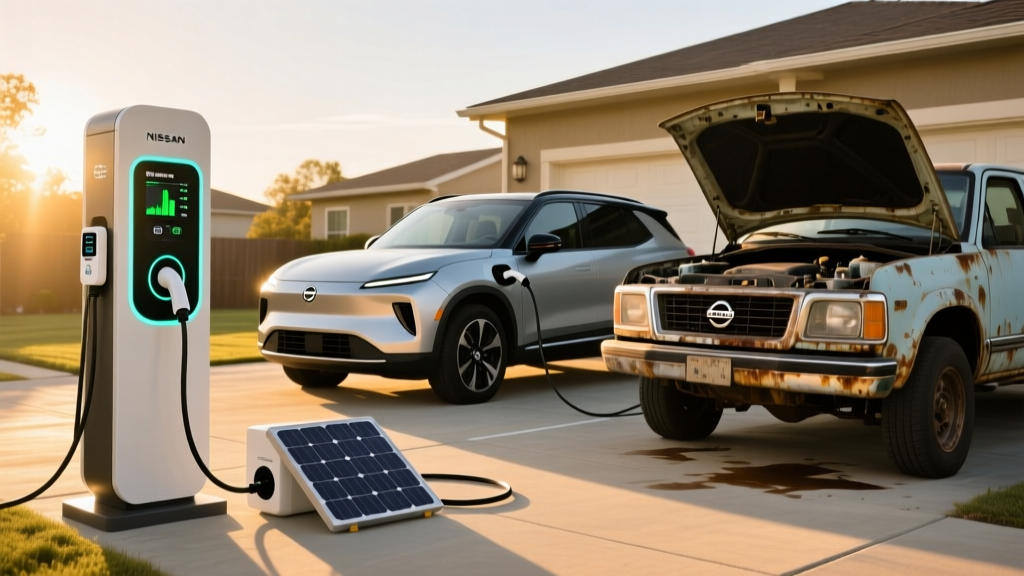
If you're still driving or considering a 2002 Nissan Frontier Supercharged, you already know the appeal: a 3.3L VG33ER V6 pushing 210 horsepower through a roots-type supercharger, paired with a 5-speed manual or 4-speed automatic. It's a cult-classic compact truck. But you also know the pain at the pump. With EPA-rated fuel economy hovering around 15 city / 19 highway / 16 combined MPG (per fueleconomy.gov), that supercharged V6 drinks roughly 6.25 gallons per 100 miles. At $3.50/gallon, you're spending $0.219 per mile on fuel alone.
This guide uses the 2002 Frontier Supercharged as a real-world baseline to show exactly what modern EV charging costs — at home and in public — and what it takes to set up a Level 2 home charger in 2026. Whether you're cross-shopping a used Frontier against a new EV, or you're an EV owner benchmarking your savings, the numbers below are exact, sourced, and honest.
EV Charging Levels Explained: kW, Miles Per Hour, and Real Charge Times
The single most important distinction in EV charging is kW (kilowatts) vs. kWh (kilowatt-hours). kW measures power — how fast energy flows into the battery, like water pressure from a hose. kWh measures energy — the total amount stored, like gallons in a tank. A 60 kWh battery charged at 7.2 kW takes roughly 8.3 hours from empty. Never confuse the two.
| Level | Voltage | Power (kW) | Miles of Range Added Per Hour | Typical Use Case |
|---|---|---|---|---|
| Level 1 | 120V AC | 1.0–1.4 kW | 3–5 mi/hr | Overnight trickle; PHEV topping off |
| Level 2 | 240V AC | 3.3–19.2 kW | 12–75 mi/hr | Home daily charging; workplace; hotels |
| DC Fast Charge | 400–800V DC | 50–350 kW | 150–1,200+ mi/hr (peak) | Road trips; highway corridors |
Real-world charge time examples (10% to 80% SoC):
- 75 kWh battery (e.g., Tesla Model Y Long Range) at 250 kW DCFC: ~22 minutes (peak curve tapers above 50-60% SoC)
- 84 kWh battery (e.g., Hyundai Ioniq 5) at 350 kW DCFC (800V architecture): ~18 minutes
- 60 kWh battery (e.g., Chevy Equinox EV) at 11.5 kW Level 2: ~4.5 hours (0-100%)
- 13 kWh PHEV battery (e.g., Toyota RAV4 Prime) at 3.3 kW Level 2: ~2.5 hours
DC fast charging is never a flat rate. The charge curve peaks early (often between 10-40% SoC) and tapers significantly above 80% to protect battery chemistry. A "250 kW capable" vehicle may only sustain that rate for 5-8 minutes before dropping to 100 kW, then 50 kW above 80%. This is why manufacturers quote 10-80% times — the final 20% can take as long as the first 70%.
Home EV Charger Installation: Electrical Requirements, Permits, and Costs
A Level 2 home charger requires a dedicated 240V circuit, typically 40A to 60A, on a NEMA 14-50 outlet or hardwired connection. Here's what that actually involves and what it costs in 2026.
Electrical requirements:
- Circuit amperage: 40A minimum (for a 32A continuous charger); 50A or 60A recommended for 40-48A chargers
- Wire gauge: 6 AWG copper (for 50A) or 4 AWG (for 60A), run in conduit where exposed
- Outlet type: NEMA 14-50 (plug-in) or hardwired junction box — hardwired is preferred for 48A+ chargers and avoids NEC derating issues with plug-in receptacles in some jurisdictions
- GFCI protection: Required by NEC 2020/2023 for garage receptacles; hardwired units may bypass this requirement (check local code)
- Panel capacity: Your main service panel must have enough spare amperage. A typical 200A panel can usually accommodate a 40-60A EV circuit. A 100A panel often cannot.
| Item | Low Estimate | High Estimate | Notes |
|---|---|---|---|
| Level 2 Charger (Equipment) | $350 | $750 | 32A–48A Wi-Fi-enabled units |
| Electrician Labor (standard install) | $500 | $1,500 | Short run, panel nearby, no drywall work |
| Electrical Permit | $50 | $250 | Varies by municipality |
| Panel Upgrade (100A → 200A) | $1,500 | $4,000 | Required for older homes with insufficient capacity |
| Conduit/Long Wire Run (100+ ft) | $300 | $1,200 | Detached garages, long runs from panel |
| Total (no panel upgrade) | $900 | $2,500 | Typical suburban home with 200A panel |
| Total (with panel upgrade) | $2,400 | $6,500 | Older home needing service upgrade |
Panel upgrade reality check: Homes built before 1990 often have 100A or 125A main panels. Adding a 40-60A EV circuit may exceed the panel's rated capacity, especially if you also run electric heat, a dryer, and an electric range. An electrician will perform a load calculation (NEC Article 220) to determine if your panel can handle the additional draw. If not, a service upgrade to 200A is mandatory — and that's the single biggest variable in your install cost. Budget for it.
The federal Alternative Fuel Vehicle Refueling Property Credit (IRS Form 8911) covers 30% of home charger equipment and installation costs, up to $1,000, for qualifying taxpayers in eligible census tracts. Check irs.gov for current eligibility rules, as census-tract qualifications apply.
Connector Compatibility: NACS, CCS1, and CHAdeMO in 2026
The connector landscape has consolidated significantly. As of 2026, NACS (North American Charging Standard) — originally Tesla's proprietary connector — is the dominant standard. Ford, GM, Rivian, Volvo, Hyundai/Kia, and most major automakers have adopted NACS for new vehicles. CCS1 (Combined Charging System) remains on vehicles sold between 2018-2024, and CHAdeMO is effectively legacy (Nissan Leaf being the primary holdout).
| Connector | Brands / Vehicles | Adapter Needed? |
|---|---|---|
| NACS (native) | Tesla (all), Ford (2025+), GM (2025+), Rivian (2025+), Hyundai/Kia (2026+), Volvo/Polestar | No — charges natively at Tesla Superchargers and NACS public stations |
| CCS1 (native) | VW ID.4 (2021-2024), BMW iX/i4 (2022-2024), older Hyundai Ioniq 5 (2022-2024), Chevy Bolt (2017-2023) | CCS-to-NACS adapter (~$200) needed for Tesla Supercharger access |
| CHAdeMO | Nissan Leaf (all years), Mitsubishi Outlander PHEV (older) | No adapter available to NACS; limited public infrastructure |
For home Level 2 charging: All EVs use a J1772 connector for AC charging, or NACS (which integrates AC pins). If you buy a NACS-equipped home charger, CCS vehicles will need a J1772-to-NACS adapter or vice versa. Most quality Level 2 chargers ship with J1772 connectors; NACS home chargers are increasingly available from Tesla (Wall Connector), Emporia, and ChargePoint.
Cost Per Mile: 2002 Frontier Supercharged vs. EV Charging Scenarios
Here's where the 2002 Nissan Frontier Supercharged becomes a stark comparison point. Let's calculate real fueling costs per mile.
2002 Nissan Frontier Supercharged (SC V6, 2WD, automatic):
- EPA combined: 16 MPG
- Real-world mixed driving (loaded, highway, warm climate): ~14-15 MPG
- At $3.50/gallon (2026 national avg for regular unleaded): $0.219-$0.250 per mile
- The VG33ER supercharger requires regular 87-octane fuel per Nissan's specification, but real-world knock-sensor activity under load can benefit from 89-octane, pushing costs higher
| Vehicle / Scenario | Energy Source | Cost Per Unit | Efficiency | Cost Per Mile |
|---|---|---|---|---|
| 2002 Frontier SC (EPA) | Gasoline (87 oct) | $3.50/gal | 16 MPG combined | $0.219 |
| 2002 Frontier SC (real-world) | Gasoline (87 oct) | $3.50/gal | 14 MPG | $0.250 |
| EV — Home Level 2 (off-peak) | Electricity | $0.13/kWh | 3.5 mi/kWh (avg BEV) | $0.037 |
| EV — Home Level 2 (peak TOU) | Electricity | $0.28/kWh | 3.5 mi/kWh | $0.080 |
| EV — Public Level 2 (ChargePoint, etc.) | Electricity | $0.35/kWh | 3.5 mi/kWh | $0.100 |
| EV — DC Fast Charge (Electrify America) | Electricity | $0.48/kWh | 3.5 mi/kWh | $0.137 |
| EV — Tesla Supercharger (avg 2026) | Electricity | $0.30/kWh | 3.5 mi/kWh | $0.086 |
The verdict: Even the most expensive DC fast-charging scenario ($0.137/mi) costs 45% less per mile than the Frontier Supercharged at EPA ratings, and 64% less than its real-world fuel economy. Home off-peak charging at $0.037/mile is 83% cheaper than the Frontier's real-world $0.219/mile.
Over 15,000 miles per year, the Frontier Supercharged burns roughly $3,285-$3,750 in fuel. An EV charged primarily at home off-peak costs $555-$1,200. That's a $2,000-$3,200 annual fuel savings with an EV — enough to pay off a home charger installation in the first year.
Best Home EV Chargers for 2026: Equipment Picks
Based on power output, reliability, smart features, and connector options, these are the top Level 2 home chargers for 2026.
Emporia Vue EV Charger
Power: 48A (11.5 kW at 240V) | Connector: J1772 (NACS adapter included) | Cable: 24 ft | Smart features: Wi-Fi, scheduling, solar integration, energy monitoring via Emporia Vue panel | Price: ~$399
Best for: Budget-conscious buyers who want 48A output and energy tracking. Requires a 60A dedicated circuit. Hardwired installation recommended.
Tesla Wall Connector (Gen 4)
Power: 48A (11.5 kW) | Connector: NACS native | Cable: 24 ft | Smart features: Wi-Fi, OTA updates, power sharing (link up to 6 units on one circuit), access control | Price: ~$450
Best for: Tesla owners and NACS-native vehicles (Ford, GM, Rivian 2025+). CCS vehicles need a NACS-to-CCS adapter for AC charging, which adds ~$150-200.
ChargePoint Home Flex
Power: Up to 50A (12 kW, adjustable via DIP switches) | Connector: J1772 (25 ft cable) | Cable: 25 ft | Smart features: Wi-Fi, Alexa, scheduling, amperage adjustment without electrician revisit | Price: ~$649
Best for: Homes with variable panel capacity — you can set it to 16A, 24A, 32A, 40A, or 50A to match your circuit. Universal J1772 compatibility works with every EV sold in the US.
Grizzl-E Smart
Power: 40A (9.6 kW) | Connector: J1772 | Cable: 24 ft | Smart features: Wi-Fi, OCPP-compatible, works with utility demand-response programs | Price: ~$499
Best for: Cold-climate durability (rated to -40°F) and utility-program compatibility. Built in Canada. Requires a 50A circuit.
Safety, Code, and Installation Best Practices
EV charging is a high-draw, long-duration electrical load — your charger may pull maximum amperage for 6-10 hours continuously. This is fundamentally different from a dryer or oven that cycles on and off. NEC (National Electrical Code) treats continuous loads (3+ hours) with stricter derating rules.
- Continuous-load rule: A charger rated at 40A continuous requires a circuit rated for 50A (125% of continuous load). Never undersize the circuit.
- GFCI breaker: Required for plug-in receptacles in garages (NEC 2020, Article 210.8). Hardwired chargers may be exempt — confirm with your local inspector.
- Outdoor rating: If your charger mounts outside, ensure the unit carries a NEMA 4 (weatherproof) rating. Most major chargers (Tesla Wall Connector, ChargePoint Home Flex, Grizzl-E) are NEMA 4 rated.
- Cable management: A 24-25 ft cable draped across a garage floor is a trip hazard and degrades the cable jacket over time. Use a wall-mounted cable organizer or retractable reel.
- Surge protection: While not code-required in most jurisdictions, a whole-panel surge protector ($150-$300 installed) protects your charger's electronics and your vehicle's onboard charger from voltage spikes.
- Permit and inspection: Virtually all jurisdictions require a permit for new 240V circuits. The inspection verifies wire gauge, breaker sizing, grounding, and GFCI compliance. Skipping the permit risks insurance denial in the event of an electrical fire.
2002 Frontier Supercharged: What It Would Take to Match EV Running Costs
The 2002 Nissan Frontier Supercharged was a compelling performance truck in its era. The VG33ER's roots-type supercharger delivered 210 HP and 246 lb-ft of torque — impressive for a 3,500-lb compact truck. But the thermodynamic penalty of forced induction on a 3.3L V6 is brutal efficiency.
To put it in EV terms: the Frontier Supercharged achieves the energy equivalent of roughly 55 MPGe (miles per gallon equivalent, using the DOE's conversion of 33.7 kWh = 1 gallon of gasoline). A 2026 Hyundai Ioniq 5 achieves 110-132 MPGe depending on trim. That's more than double the energy efficiency, before even accounting for electricity being cheaper per unit of energy than gasoline.
If you're maintaining a Frontier SC as a weekend vehicle, your annual mileage may be low enough that fuel cost isn't the primary concern — parts availability, supercharger belt maintenance, and the aging SC/SE-specific components (intercooler, bypass valve) become the ownership story. But for daily driving, the math is unambiguous: any EV charged at home will cost 60-83% less per mile to "fuel," and the $900-$2,500 home charger installation pays for itself within 6-14 months of typical driving.
Frequently Asked Questions
How much does it cost to install a home EV charger?
A standard Level 2 home charger installation costs $900 to $2,500 total (equipment, electrician labor, and permit) in a home with an adequate 200A electrical panel. If your home needs a panel upgrade from 100A to 200A, add $1,500-$4,000, bringing the total to $2,400-$6,500. The federal Alternative Fuel Vehicle Refueling Property Credit (IRS Form 8911) may cover 30% of costs up to $1,000, subject to census-tract eligibility.
How fast will each charging level add range?
Level 1 (120V) adds 3-5 miles of range per hour — adequate for PHEVs with small batteries. Level 2 (240V) at 48A adds roughly 35-45 miles per hour for most EVs, fully recharging a 75 kWh battery overnight in 7-8 hours. DC fast charging at 150-350 kW adds 150-1,200+ miles per hour at peak, taking a typical EV from 10-80% in 18-30 minutes depending on battery size and architecture.
Which connector and charger is compatible with my EV?
For 2026 model-year vehicles, most new EVs use NACS (Tesla, Ford, GM, Rivian, Hyundai/Kia, Volvo). Vehicles from 2018-2024 typically use CCS1. The Nissan Leaf uses CHAdeMO. For home Level 2 charging, all EVs accept J1772 or NACS AC charging — adapters are available for cross-compatibility. Check your vehicle's charge port before purchasing a home charger.
How much does EV charging cost per mile compared to gas?
Home off-peak charging averages $0.037-$0.050 per mile. Public DC fast charging averages $0.10-$0.14 per mile. By comparison, the 2002 Nissan Frontier Supercharged at 14-16 MPG costs $0.219-$0.250 per mile at $3.50/gallon gasoline. Even the most expensive public EV charging is roughly 45-50% cheaper per mile than the Frontier's real-world fuel cost.
What electrical upgrades might I need for a home EV charger?
The most common upgrade is a panel capacity increase (100A to 200A service), required in older homes where the existing panel cannot support an additional 40-60A continuous load alongside existing appliances. You may also need a new conduit run if your garage is far from the panel (adding $300-$1,200 for long wire runs), or a sub-panel installation in a detached garage. A licensed electrician will perform a NEC Article 220 load calculation to determine your exact needs — always get this assessment before purchasing equipment.