Two Chinese EV Giants, Two Very Different Playbooks
If you're tracking the global EV market in 2026, the Nio vs BYD question is unavoidable. BYD has scaled into the world's largest plug-in vehicle manufacturer, selling millions of units across dozens of markets with aggressively priced sedans and SUVs. Nio, by contrast, has positioned itself as a premium-lifestyle brand — think leather-lined interiors, battery-swap stations, and a subscription-style ownership model that's closer to a luxury tech company than a traditional automaker.
For buyers outside mainland China — particularly in Europe, the Middle East, and select Southeast Asian markets where both brands now compete — choosing between them isn't just about price. It's about fundamentally different philosophies on battery ownership, charging infrastructure, and what an EV should feel like to live with daily.
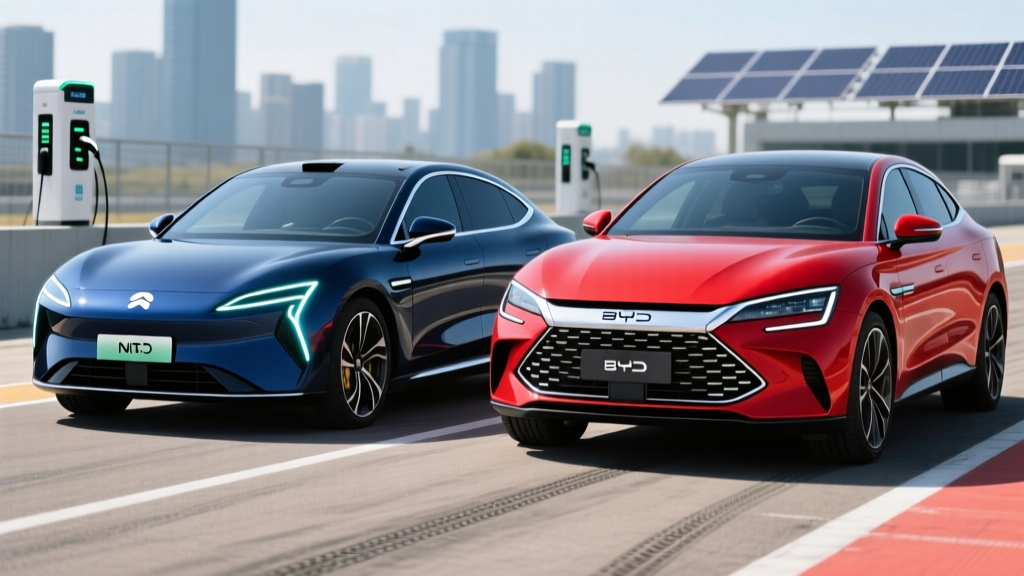
This comparison pits two of their most globally relevant 2026 models against each other: the BYD Seal (a Tesla Model 3–rivaling sport sedan) and the Nio ET5 (a premium compact sedan with battery-swap capability). Both target the same buyer — someone who wants a 300+ mile EV sedan with modern tech — but they get there through very different means.
Side-by-Side Specs: BYD Seal vs Nio ET5 (2026 Model Year)
| Spec | BYD Seal (Design AWD) | Nio ET5 (100 kWh Long Range) |
|---|---|---|
| EPA-est. Range | ~320 mi (est.)* | ~340 mi (WLTP-based est.)* |
| Battery Capacity (usable) | 82.5 kWh (LFP Blade) | 100 kWh (NMC, swappable) |
| Battery Chemistry | LFP (Lithium Iron Phosphate) | NMC (Nickel Manganese Cobalt) |
| Peak DC Fast Charge | 150 kW | 140 kW |
| 10–80% DC Charge Time | ~30 min | ~34 min |
| Level 2 AC Charge Rate | 11 kW | 11 kW (optional 22 kW) |
| 0–60 mph | 3.8 sec | 4.0 sec |
| Horsepower | 523 hp (AWD) | 483 hp (AWD) |
| Efficiency (MPGe est.) | ~110 MPGe combined | ~105 MPGe combined |
| Cargo Volume | 14.1 cu ft (trunk) + frunk | 12.7 cu ft (trunk) + frunk |
| Starting MSRP (Global) | ~$42,000 (€39,990 EU) | ~$48,000 (€44,900 EU, w/o battery lease) |
| Battery/Powertrain Warranty | 8 yr / 100,000 mi | 10 yr / unlimited mi (with BaaS lease) |
*Note: Neither BYD nor Nio has EPA-certified range figures for US sales as of early 2026, as neither brand is officially on sale in the United States. Range figures above are estimates derived from WLTP testing and independent real-world evaluations, converted for US readers. WLTP tends to overstate range by 10–15% compared to EPA methodology. Always verify with local regulatory bodies.
Category-by-Category Verdicts
Range & Efficiency: BYD Seal
Despite a smaller 82.5 kWh battery, the Seal's LFP chemistry and lighter curb weight give it a slight efficiency edge — roughly 3.9 mi/kWh vs the ET5's 3.4 mi/kWh. In real-world highway driving at 70 mph, expect approximately 260–280 miles from the Seal and 270–295 miles from the ET5 before needing a charge. The ET5's larger battery compensates for its heavier platform, but you're carrying more weight to go roughly the same distance. For daily commuting under 50 miles round-trip, both are more than sufficient, and neither requires mid-week charging if you have Level 2 access at home.
Charging Speed: BYD Seal (Narrowly)
The Seal peaks at 150 kW on DC fast charging, reaching 10–80% in approximately 30 minutes. The ET5 peaks at 140 kW with a 10–80% time around 34 minutes. Both taper significantly above 80% SoC — expect the final 20% to add another 20+ minutes on either car. However, Nio's battery-swap network (available in China and expanding in Europe) can deliver a full battery in under 5 minutes at a swap station, which is genuinely transformative if you live near one. Without swap access, the Seal's slightly faster conventional charging gives it the edge for most international buyers.
Performance: BYD Seal
The Seal Design AWD's 523 hp and 3.8-second 0–60 time edge out the ET5's 483 hp and 4.0 seconds. Both are genuinely quick — faster than most buyers will ever need on public roads — but the Seal's lower center of gravity (thanks to the CTB — Cell-to-Body — battery integration) gives it marginally sharper cornering feel. The ET5 is no slouch; its dual-motor AWD system delivers linear, predictable thrust. For track days or aggressive canyon driving, the Seal has the slight advantage. For comfortable daily driving with passing power on tap, both deliver.
Interior & Tech: Nio ET5
Nio's premium positioning shows clearly inside the ET5. The cabin uses higher-grade materials — Nappa leather, real wood trim, and a 12.8-inch AMOLED center display running Nio's Banyan OS. The NOMI AI assistant (a small robotic face on the dash) adds personality. The Seal's interior is well-built but leans more utilitarian: synthetic leather, a 15.6-inch rotating touchscreen, and BYD's DiLink infotainment. It's functional and modern, but the ET5 feels a tier above in perceived quality — which matters at this price point.
Value & Pricing: BYD Seal
At approximately $42,000 (converted from European pricing), the Seal undercuts the ET5 by $6,000+ when the Nio is purchased with its battery outright. Even with Nio's Battery-as-a-Service (BaaS) lease — which drops the ET5's purchase price by ~$14,000 in exchange for a monthly battery rental fee of roughly $140–$170/month — you're paying more over a 5-year ownership period. The Seal simply delivers more car per dollar, especially when you factor in its slightly better efficiency and comparable equipment levels.
Ownership Flexibility: Nio ET5
If you value future-proofing and battery flexibility, Nio wins decisively. The swappable battery means you can upgrade to a larger pack for road trips (Nio offers a 150 kWh semi-solid-state pack for long-distance rental), swap a degraded battery for a fresh one under warranty, or simply never worry about battery degradation since you don't technically own the cell. BaaS also means lower upfront cost and the ability to downgrade to a smaller 75 kWh pack if your needs change. BYD's battery is excellent — LFP chemistry is known for longevity and minimal degradation — but it's fixed. What you buy is what you keep.
Real-World Range & Charging Network Reality
Spec-sheet range numbers rarely tell the full story. Here's what to actually expect from each vehicle in daily use:
BYD Seal — Real-World Range Expectations
WLTP-rated: ~354 mi (570 km) | Estimated EPA-equivalent: ~320 mi | Real-world highway (70 mph, mild weather): ~260–280 mi | Cold weather (below 32°F / 0°C): ~220–245 mi
The Seal's LFP battery handles cold weather slightly worse than NMC chemistry — expect 20–25% range loss in freezing conditions versus 15–20% for the ET5. However, LFP's advantage is that you can charge it to 100% regularly without degradation concerns, which effectively gives you access to the full battery capacity daily. With NMC, manufacturers typically recommend stopping at 80–90% for daily use to maximize longevity.
Nio ET5 — Real-World Range Expectations
WLTP-rated: ~373 mi (600 km, 100 kWh) | Estimated EPA-equivalent: ~340 mi | Real-world highway (70 mph, mild weather): ~270–295 mi | Cold weather (below 32°F / 0°C): ~235–260 mi
The ET5's larger 100 kWh NMC battery provides a bigger buffer, but the car is heavier (roughly 4,700 lbs vs the Seal's 4,400 lbs). Nio's heat pump system helps mitigate cold-weather losses, and preconditioning the battery while navigating to a charger optimizes DC fast-charge speeds. If you have access to Nio's Power Swap stations, range anxiety essentially disappears — you can swap to a full battery in 3–5 minutes, faster than any DC fast charge currently available.
On public charging networks, both vehicles use CCS2 connectors in European and most international markets. The Seal and ET5 will charge on any Electrify America, Ionity, ChargePoint, or EVgo station at their respective peak rates. Neither is limited by proprietary connectors — a significant advantage over some competitors still tied to legacy plugs.
Price, Tax Credits, and Total Cost of Ownership
| Cost Factor | BYD Seal | Nio ET5 |
|---|---|---|
| Base MSRP (est. global) | ~$42,000 | ~$48,000 (battery included) |
| BaaS Option (lower upfront) | Not available | ~$34,000 + ~$155/mo battery lease |
| US Federal §30D Tax Credit | Not eligible (not sold in US) | Not eligible (not sold in US) |
| EU/Local Incentives | Varies by country (e.g., Germany's Umweltbonus discontinued; Norway VAT exemption applies) | Varies by country (same conditions) |
| Est. Electricity Cost (15k mi/yr @ $0.15/kWh) | ~$580/yr (3.9 mi/kWh) | ~$650/yr (3.4 mi/kWh) |
| Est. Insurance (annual avg.) | ~$1,400–$1,800 | ~$1,600–$2,100 |
| Maintenance (annual est.) | ~$200–$350 | ~$200–$400 (Nio Service includes some items) |
| 5-Year Est. Total Running Cost | ~$11,000–$13,500 | ~$12,500–$15,500 (+$9,300 BaaS if leased) |
On tax credits: As of 2026, neither BYD nor Nio sells vehicles in the United States, so the IRS §30D federal EV tax credit does not apply to either vehicle. For European buyers, incentive eligibility varies dramatically by country — Norway offers generous VAT exemptions, while Germany discontinued its purchase bonus in late 2023. Always check your local transport ministry or EEA transport authority for current incentive programs before purchasing.
The BaaS factor: Nio's Battery-as-a-Service model is genuinely unique. By leasing the battery separately, you reduce the purchase price by approximately $14,000 and gain the flexibility to swap, upgrade, or replace without owning a depreciating component. Over 5 years, the battery lease costs roughly $9,300 — which may or may not offset the benefit depending on how long you keep the car and whether you value the swap flexibility. For buyers who plan to own for 8+ years, purchasing the battery outright may make more financial sense.
Key Differences That Matter Daily
- Battery chemistry philosophy: BYD bets on LFP — cheaper, longer-lasting, safer (lower thermal runaway risk), but slightly less energy-dense and more affected by cold. Nio uses NMC — higher energy density, better cold performance, but more expensive raw materials and slightly faster long-term degradation if charged to 100% regularly.
- Charging ecosystem: BYD relies entirely on public and home charging infrastructure. Nio supplements this with its Power Swap and Power Home battery-swap network — a genuine differentiator in markets where it's available (primarily China, expanding to Norway, Germany, and the Netherlands).
- Brand positioning: BYD is volume-driven, value-oriented, and increasingly mainstream. Nio is premium, lifestyle-focused, and invests heavily in owner community (Nio Houses, Nio Day events, concierge services). You're buying into different cultures.
- Software & ADAS: Nio's NOP+ (Navigate on Pilot Plus) is a Level 2 highway driving assist system that competes with Tesla Autopilot in capability. BYD's DiPilot is competent but less ambitious — adaptive cruise, lane-keep, and automated parking without the same level of highway autonomy features. Neither is "self-driving" — both require active driver supervision at all times.
- Resale and depreciation: Limited data exists for either brand in Western markets. BYD's massive global scale suggests stronger parts availability and service networks long-term. Nio's BaaS model could support resale values by removing battery degradation from the equation, but the brand's smaller footprint introduces uncertainty.
Decision Framework: Which Should You Choose?
Choose the BYD Seal if:
- You want the most range and performance per dollar spent
- You prefer to own your battery outright with no monthly subscription
- You charge primarily at home (Level 2) and rarely need ultra-fast public charging
- You value LFP battery longevity — charge to 100% daily without guilt
- You want a proven, high-volume manufacturer with expanding global service
- Your budget tops out around $45,000 and you don't want to stretch
Choose the Nio ET5 if:
- You live near a Nio Power Swap station and want 5-minute "refueling"
- You value premium interior materials and a luxury-brand experience
- You want the flexibility to upgrade or swap your battery as technology evolves
- You prefer NMC chemistry for better cold-weather range retention
- You're comfortable with a battery subscription model (BaaS) to lower upfront cost
- You want NOP+ highway assist features that rival the best Level 2 systems available
- Premium brand cachet and owner-community events matter to you
Frequently Asked Questions
Can I buy a BYD Seal or Nio ET5 in the United States?
As of 2026, neither BYD nor Nio officially sells vehicles in the US market. Both brands are available across Europe, the Middle East, Southeast Asia, and (of course) China. US tariffs on Chinese-manufactured EVs (currently 100% under Section 301) make near-term US entry economically unviable for either company. If you're a US buyer, consider the Tesla Model 3, Hyundai Ioniq 6, or BMW i4 as alternatives with similar specs and full US availability, tax credit eligibility, and service networks.
Is LFP (BYD) or NMC (Nio) battery chemistry better?
Neither is universally better — it depends on your priorities. LFP (lithium iron phosphate) offers longer cycle life (3,000+ cycles vs ~1,500–2,000 for NMC), lower cost, better thermal safety, and the ability to charge to 100% regularly. Its trade-offs are lower energy density (heavier battery for the same range) and worse cold-weather performance. NMC (nickel manganese cobalt) provides higher energy density and better cold-weather range, but costs more, degrades faster if routinely charged to 100%, and relies on cobalt — a material with supply-chain and ethical concerns. For a garage-charged daily driver in a mild climate, LFP is arguably the smarter long-term choice. For cold-climate buyers who need maximum range from a smaller pack, NMC has advantages.
How does Nio's battery swap actually work?
Nio operates automated Power Swap stations where you drive in, the car is lifted, and a robot removes your depleted battery and installs a fully charged one — all in approximately 3–5 minutes without leaving the driver's seat. You then drive away on a full charge. This works because Nio owners on the BaaS plan don't own their specific battery; they own the right to a charged battery of the same capacity tier. Swap stations are dense in China (2,500+ stations) and expanding in Europe (Norway, Germany, Netherlands). If no swap station is near you, the ET5 charges conventionally via CCS2 like any other EV.
Which is cheaper to own over 5 years?
The BYD Seal is cheaper to own over 5 years by approximately $2,500–$4,000, primarily due to its lower purchase price and slightly better efficiency. The Seal's electricity cost over 75,000 miles is roughly $580/year vs $650/year for the ET5. Insurance is typically $200–$300/year less for the BYD. The Nio's BaaS model can narrow this gap if you value the swap flexibility and don't mind the monthly lease, but on pure math, the Seal wins on cost. For 8+ year ownership, the Seal's LFP battery longevity (minimal degradation over 10+ years) further widens the gap.
Do either qualify for EV incentives in Europe?
Incentive eligibility varies by country. In Norway, both vehicles benefit from VAT exemptions on EVs, making them significantly more affordable than in other markets. In Germany, the federal Umweltbonus purchase subsidy was discontinued in December 2023, so neither receives a direct purchase incentive there. France's bonus écologique has income and price caps that may apply. The UK has no purchase grant but offers benefit-in-kind (BiK) tax advantages for company car buyers. Always verify current incentive status with your national transport authority before purchasing, as programs change frequently. According to the IEA policy database, EV incentive structures across Europe remain in flux through 2026.
What about safety ratings?
The BYD Seal achieved a 5-star Euro NCAP rating in 2023 testing with strong scores in adult occupant protection (89%) and safety assist (76%). The Nio ET5 also earned 5 stars from Euro NCAP in 2023 with comparable results. Both vehicles come standard with comprehensive ADAS suites including AEB, lane-keep assist, blind-spot monitoring, and rear cross-traffic alert. For detailed crash-test scores, consult Euro NCAP's official results database.
Final Verdict: It Depends on What You Prioritize
The Nio vs BYD comparison ultimately reveals two legitimate but distinct approaches to building a competitive EV sedan. The BYD Seal is the rational, value-driven choice — it delivers more performance and comparable range for less money, with the long-term reliability benefits of LFP chemistry and no subscription strings attached. If you want a straightforward, high-quality EV sedan that minimizes cost-per-mile, the Seal is the clear pick.
The Nio ET5 is the experience-driven choice — a more premium cabin, a genuinely innovative battery-swap ecosystem (if accessible), and a brand that invests in owner community. If you live in a market with Nio swap stations, value luxury materials, and appreciate the flexibility of not owning a fixed battery, the ET5 justifies its premium. The BaaS model is a legitimate innovation that no other automaker offers at scale.
Neither is a wrong choice. But for the majority of international buyers without access to battery-swap infrastructure, the BYD Seal's combination of price, efficiency, and simplicity makes it the more practical recommendation in 2026.